


This question might have too many answers, as currently six private Chinese aerospace companies are developing reusable rocket technology. Yet it might also have no answer at all, because China’s private space sector follows technological paths and development models fundamentally different from SpaceX’s. Perhaps the better question is: What does a Chinese-style SpaceX look like?
But first, let’s explore who comes closest.
As of October 2025, if we’re measuring purely by reusable rocket maturity, Jianyuan Technology leads the pack. On May 29, the company’s Yuanxingzhe-1 verification rocket completed its first sea-based flight and recovery test at the Oriental Space Port in Shandong Province.
The test successfully completed eight operational phases and achieved a soft landing on the sea surface. The rocket executed the vertical takeoff and landing maneuver that has become SpaceX’s Falcon 9 signature—going straight up and down like a helicopter.
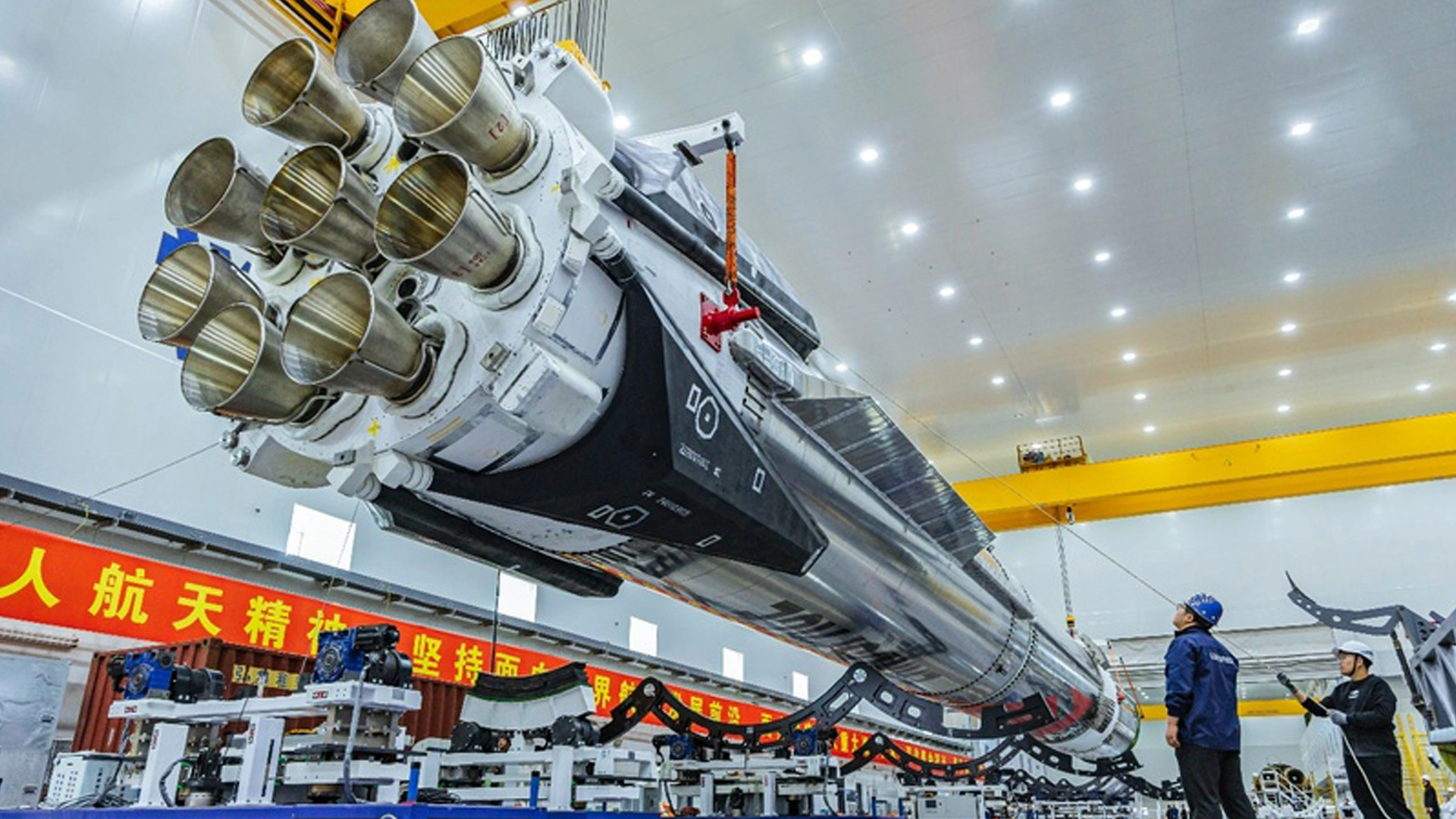
However, there’s a crucial caveat. In payload capacity, the Yuanxingzhe-1 remains a medium-lift rocket, with a significant gap compared to large medium-lift rockets like the Falcon 9. To complete the same satellite constellation deployment, the Yuanxingzhe-1 would require far more launches than the Falcon 9, substantially driving up costs. From a commercial standpoint, another leading contender—LandSpace’s Zhuque-3—presents a more competitive match.
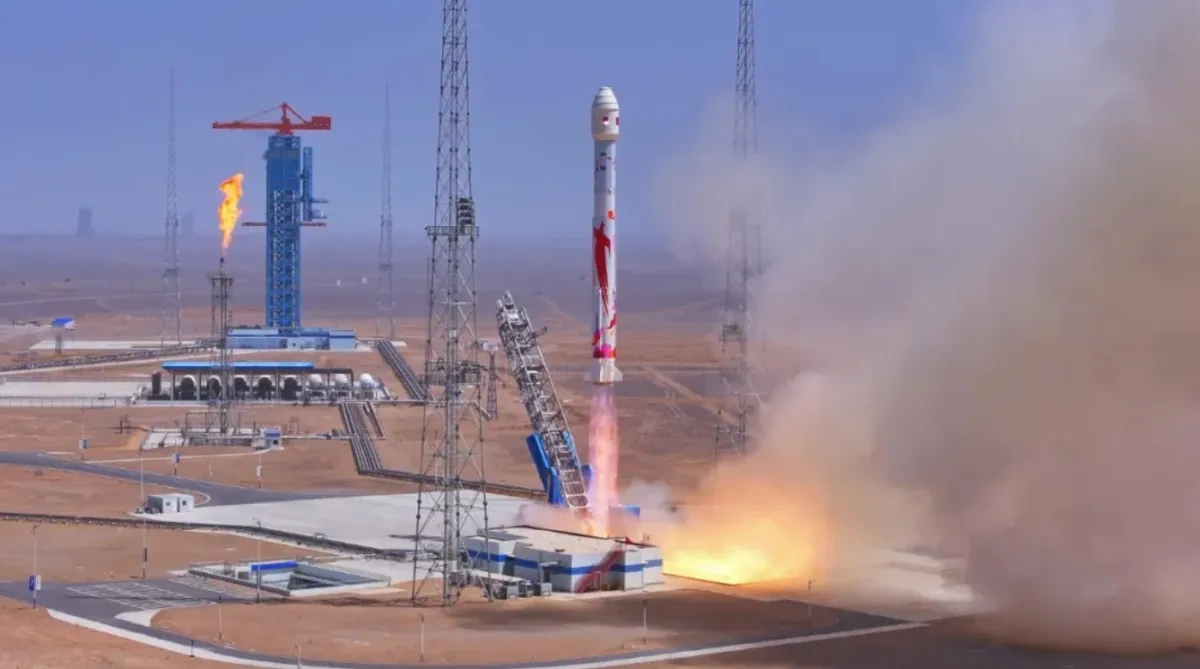
The Falcon 9 can deliver 22.8 tons to Low Earth Orbit (LEO) in expendable mode. According to LandSpace’s official specifications, the Zhuque-3 can carry 21.3 tons in the same configuration. The designs are remarkably similar—both employ nine-engine layouts and share the goal of first-stage reusability. If successfully deployed, the Zhuque-3 stands poised to compete directly with the Falcon 9 on commercial terms.
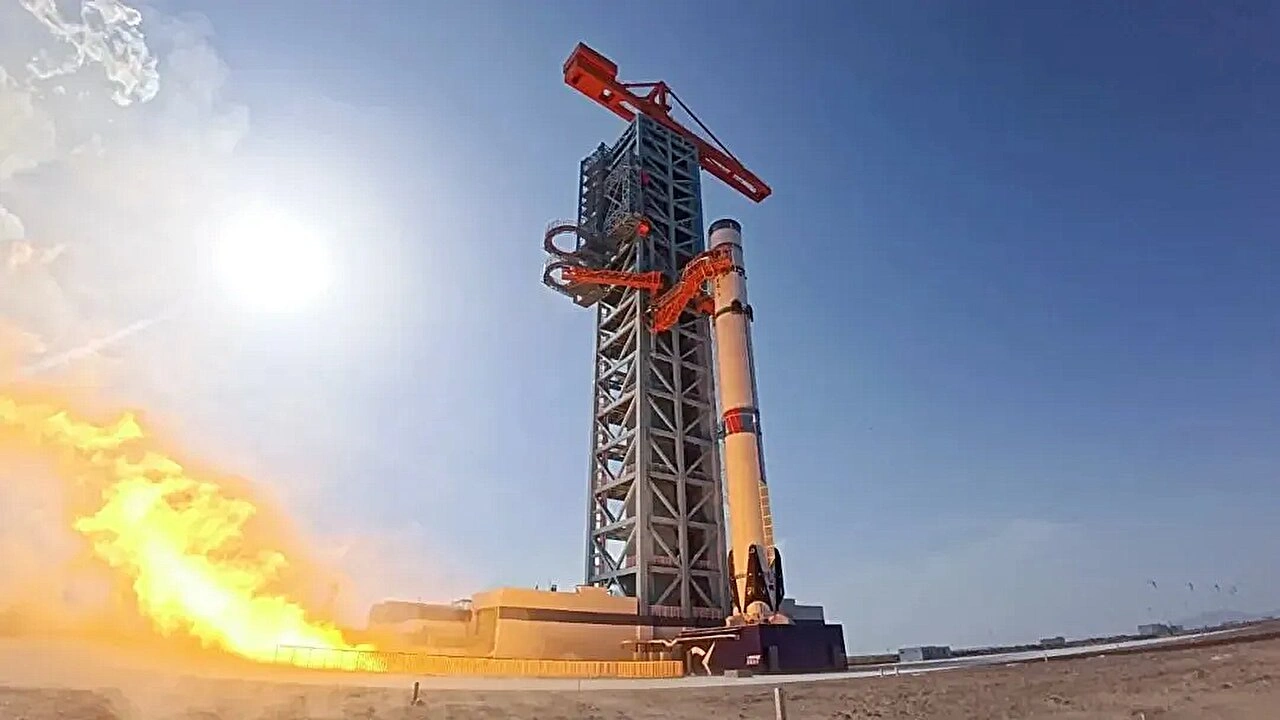
According to a report from China’s official media CCTV, on October 20, the Zhuque-3 successfully completed its fueling rehearsal and static fire test—essentially a dress rehearsal before maiden flight. The inaugural launch is scheduled for sometime in 2025.
Elon Musk’s reaction was telling. Shortly after the Zhuque-3’s static fire test, he posted on X: “If they are lucky, it might outperform Falcon in 5 years, by which time SpaceX will be launching Starship”
The subtext was clear: By the time you catch up to my Falcon 9, I’ll already be flying something better. But if the maiden flight proceeds smoothly this year, the Zhuque-3 may actually achieve a technological leapfrog over SpaceX.
This is because, although the Falcon 9 currently demonstrates mature recovery capabilities, its liquid oxygen/kerosene propulsion faces a critical reusability challenge—coking. RP-1 kerosene produces carbon residue during combustion that adheres to precision components like turbopumps, injectors, and cooling channels, forming coke deposits. After each recovery, SpaceX must thoroughly clean and inspect the engines. This not only increases maintenance costs but lengthens the refurbishment cycle, limiting launch frequency.
Liquid oxygen/methane combustion, by contrast, burns much cleaner, significantly reducing coking and theoretically enabling rapid “land and refly” turnarounds. This is precisely why SpaceX abandoned kerosene for methane when developing its next-generation Starship. LandSpace’s Zhuque-3 chose this technical path—better suited for high-frequency reuse—from the beginning.
Furthermore, as early as July 12, 2023, LandSpace’s Zhuque-2 Yao-2 rocket successfully launched, becoming the world’s first liquid oxygen/methane rocket to deliver a payload to its intended orbit—earlier than Starship’s first successful orbital flight. In the engineering application of methane rockets, LandSpace already leads globally.
So, can we say “LandSpace is China’s SpaceX”? From a business model perspective, the answer is more complicated. Besides reusable rockets, SpaceX has another crucial business: Starlink. The vertical integration of rockets and satellites is core to SpaceX’s business model.
China’s answer to Starlink—the Qianfan Constellation—takes a markedly different approach. It follows a “government-led, market-participating” model spearheaded by Shanghai’s Songjiang District. LandSpace doesn’t own the constellation; instead, it’s positioned as an essential contractor, providing critical launch services.
This raises a fundamental question: Since the Qianfan Constellation has such clear government backing, why not simply use the more mature “national team” Long March series rockets for deployment?
The answer lies in an objective “structural capacity gap” within China’s aerospace sector. This gap doesn’t stem from inability but from a fundamental timing conflict: The Qianfan Constellation’s deployment needs are urgent, but the national team’s pre-existing commitments make it impossible to fully meet Qianfan’s demands in both volume and pace.
To understand this conflict, we need to grasp just how urgent the situation is, and why.
According to the deployment plan, Phase 1 aims to place 648 satellites for regional network coverage, Phase 2 will deploy 1,296 for global coverage, and Phase 3 will expand the constellation to over 15,000 satellites—a global low-orbit communication network rivaling Starlink in scale.
But the reality is, as of March 2025, only 90 Qianfan satellites were in orbit. Even to complete Phase 1, over 500 satellites remain. At least 30 more launch missions must be completed in short order.
There’s an old Chinese saying: haste makes waste. So why the rush this time? Because this is a race against time on the international stage.
For low-orbit communication satellites, orbital capacity and communication frequency bands are precious, finite resources. The International Telecommunication Union (ITU) coordinates satellite communication frequency bands based on a “first-come, first-served” principle – whichever country’s satellite network completes filing, coordination, and actual launch first secures priority rights to those frequencies.
The frequency application process itself is marathon-length. According to information from the 2024 National People’s Congress, even for frequency bands commonly used by Earth observation satellites, over 180 applications from more than 60 institutions within China alone required coordination—a process typically taking one to two years.
In other words, if Qianfan cannot complete its deployment on schedule, the consequence isn’t merely project delay; it could mean losing orbital and frequency resources to other countries. The entire project would face profound uncertainty.
So why can’t the national team simply accelerate?
This is because, China’s national aerospace program is simultaneously advancing multiple strategic projects critical for long-term development. These missions are not only technically complex but carry extremely high political and strategic priority. Their launch schedules are meticulously planned and inflexible. For example:
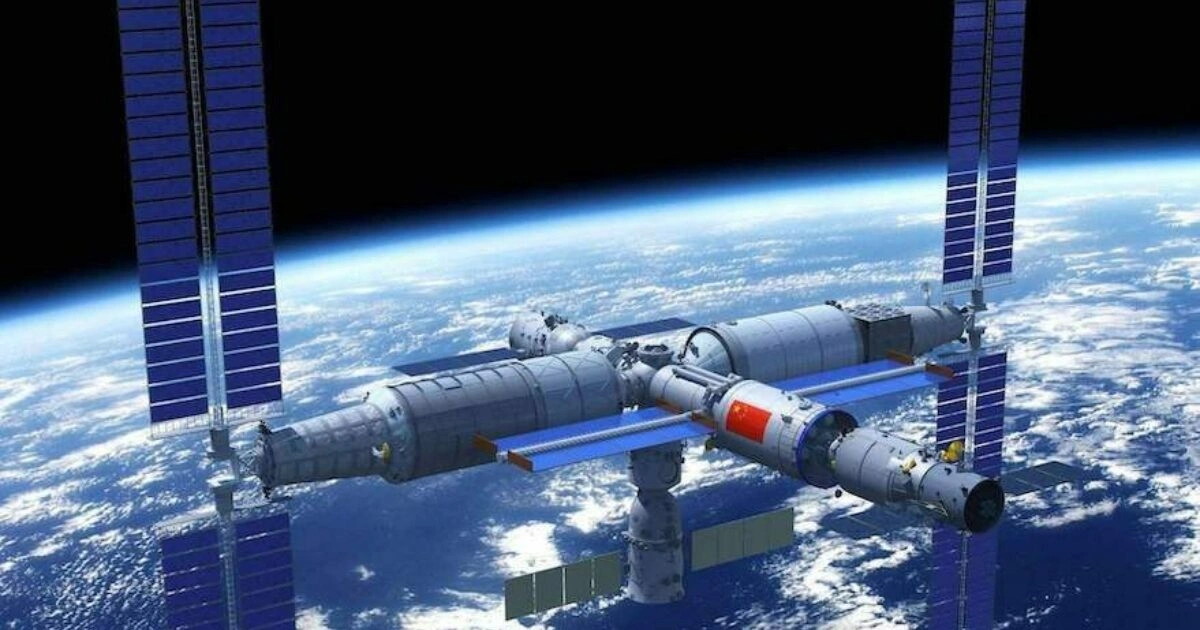
The Tiangong space station requires regular launches of crewed and cargo spacecraft to ensure continuous astronaut presence and scientific experimentation, with potential expansion tasks ahead.
The Lunar Exploration and Planetary Exploration programs are advancing steadily. From Chang’e-6 to the planned lunar research station construction, and onward to the Tianwen series’ Mars and deep space exploration missions, each requires dedicated launch windows for heavy-lift rockets.
Quantum communication satellites, gravity measurement satellites, and orbital supercomputers—missions aimed at securing technological high ground—also require the high reliability that national team rockets guarantee.
Therefore, the issue isn’t that the national team doesn’t want to help. Facing this multi-front landscape of crewed spaceflight, deep space exploration, and cutting-edge scientific experiments running concurrently, the production capacity and launch facilities for the Long March series must prioritize these long-cycle, high-difficulty national projects. Against this backdrop, Qianfan’s high-frequency, batch-launch demands—deploying tens of thousands of satellites in compressed timeframes—naturally struggle to find full accommodation within the national team’s fixed schedule. Arguing about first-come, first-served makes it even less justifiable, as these national projects were planned decades ago.
Even more critical is cost.
The Qianfan Constellation ultimately aims to be a profitable, sustainable commercial project. The Long March rockets, prioritizing the successful orbit insertion of strategic payloads, primarily employ traditional designs emphasizing high reliability and redundancy—pursuing advanced performance and safety rather than economies of reuse. While the national team is developing reusable rockets, their technological maturity and commercial application still require time.
Currently, if all 15,000 satellites of the Qianfan Constellation were deployed using the national team’s expendable rockets, the launch costs would be astronomical. Even if the network were successfully deployed, it would be a successful spectacle rather than a truly commercially viable project.
Therefore, at this moment when mega-constellations like Qianfan urgently need high-frequency, low-cost launches, relying entirely on the national team’s primary rockets cannot fully meet deployment needs in terms of launch windows, frequency, or cost. Against this backdrop, private companies like LandSpace have found their irreplaceable historical mission—they’re not competitors to the national team but an indispensable piece of China’s space strategy puzzle.
Reusable rockets like the Zhuque-3 have payload capacities ideally suited for large-scale satellite deployment. Their liquid oxygen/methane reusable technology theoretically enables rapid “land and refly” turnarounds—crucial for the time-pressed Qianfan Constellation.
Let’s do a simple calculation: The Qianfan Constellation’s Phase 1 requires deploying 648 satellites. In the Zhuque-3’s reusable mode with an 18-ton payload, assuming each Qianfan satellite weighs about 300 kg, it could launch approximately 60 satellites per mission. Theoretically, only 10-11 successful launches would complete Phase 1 deployment.
And if the Zhuque-3 achieves its design target of 10-20 reuses per rocket, as LandSpace projects, then just 1-2 rocket cores could meet all Phase 1 launch requirements. This is the foundation for LandSpace’s commercial viability.
Thus, from a technological standpoint, LandSpace indeed appears the most likely candidate to become “China’s SpaceX.” But according to analysis by Wang Qiang, a retired Senior Colonel of the PLA and specially appointed expert at Fudan University, considering business model, corporate ethos, and historical mission, LandSpace might better be called “Chinese-style SpaceX”—or perhaps not compared to SpaceX at all.
America’s SpaceX leveraged NASA’s mature technology to serve its own Starlink. Its corporate narrative is driven by Elon Musk’s personal ambition to colonize Mars.

China’s LandSpace, and other private aerospace companies, follow a path of complementing and cooperating with the national team, providing launch capacity for national satellite constellations and the commercial market.
Their mission isn’t a Mars expedition but the more pragmatic goal of bringing satellite internet coverage to Earth as quickly as possible, making space services benefit more people. This is a story rooted in present realities, serving practical needs. Their most pressing task is helping complete deployment of another Starlink-scale constellation, ensuring that free competition remains vigorous beyond the Kármán line.
Thus, the fundamental difference between American and Chinese private space models is this: One vertically integrates all space businesses within a single company. The other has the national team safeguarding strategic tasks while private enterprises focus on commercial markets, then advancing key projects through government-enterprise cooperation – it’s an industrial division of labor based on “specialization.”
SpaceX’s vertical integration brings extremely high iteration efficiency but also means putting all eggs in one basket; China’s division of labor model can accommodate more technological paths and allow more teams to contribute, but requires more complex coordination mechanisms.
Which model is superior? Analyses from different nationalities, standpoints, and knowledge frameworks will likely have their own answers. Time will be the ultimate test.
But one thing is certain: When the Zhuque-3 makes its maiden flight, when the Qianfan Constellation gradually takes shape, and when people on the high seas and in remote areas have more choices for getting online, we will find that China’s private space sector has already carved out its own path – not a copy of SpaceX, but an innovative solution adapted to China’s context.
This, perhaps, is the real answer to the question, “What is the Chinese-style SpaceX?”
Editor: Charriot Zhai