


Many may remember that one of Donald Trump’s signature moves after returning to the White House was effectively to “kill” Voice of America (VOA).
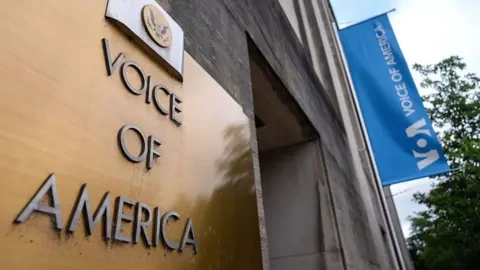
In March 2025, Trump issued an executive order directing the U.S. Agency for Global Media (USAGM), which oversees VOA, to reduce its workforce and operations to the minimum level permitted by law. What followed was a near-total shutdown of VOA. Its programming was suspended, more than 90 percent of its full-time employees were placed on administrative leave, and hundreds of contract journalists were let go. The funding lifelines for other U.S.-backed media outlets, including Radio Free Asia (RFA) and Radio Free Europe/Radio Liberty (RFE/RL), were also cut off.
But the story has recently taken an U-turn. For fiscal year 2026, the White House initially requested just $153 million for USAGM, ostensibly to oversee an orderly shutdown of the agency. Congress, however, ultimately approved $653 million, with VOA receiving the largest share at nearly $200 million. Although that figure represents a significant reduction from the $867 million allocated in FY2025, it hardly suggests that the agency is preparing to close its doors.
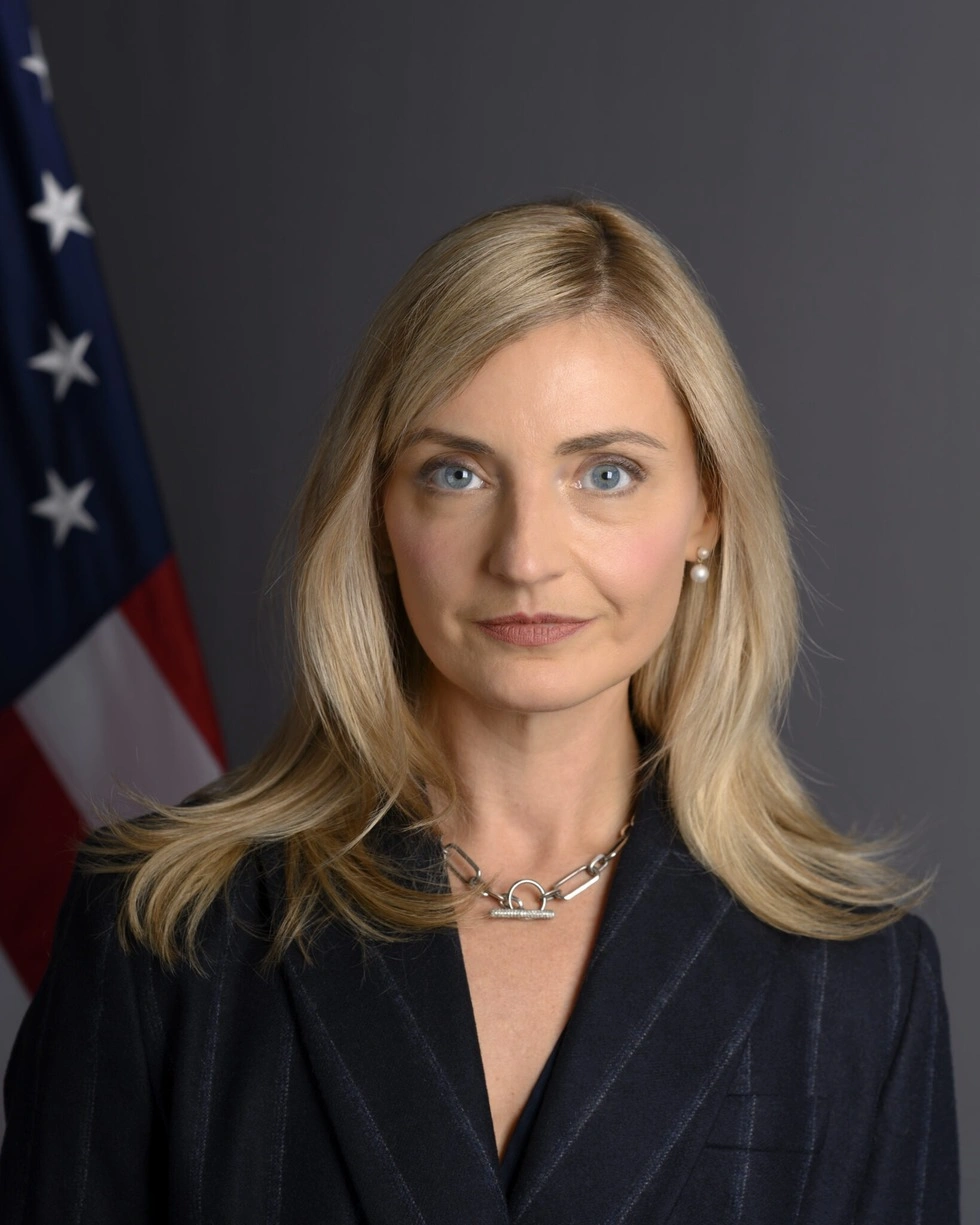
An even more significant signal has come from the administration’s personnel decisions. The White House has nominated Sarah Brooke Rogers to head USAGM. Rogers also serves as the current Deputy Under Secretary of State for Public Diplomacy. She has already appeared before the Senate for her confirmation hearing and is awaiting final approval.
The administration’s intentions become even clearer in its budget documents. For FY2027, the State Department has proposed creating a new account called International Communication Activities (ICA), requesting $238 million in dedicated funding. According to the budget proposal, the money would support “targeted international communications to advance U.S. foreign policy priorities,” with specific funding earmarked for VOA’s Persian- and Mandarin-language services.
At the same time, the White House is seeking authorization to allow the Secretary of State to directly exercise certain powers currently held by USAGM and its CEO, giving the department greater authority to redistribute international broadcasting resources.
All the signs point in the same direction: the U.S. government has no intention of abandoning international propaganda. Instead, it is undertaking a fundamental overhaul of the country’s international media apparatus. In other words, the White House wants to “Make Voice of America Great Again.”
But what would it actually take to make VOA great again?
More funding? More journalists? Longer broadcasts?
Rogers’ answer is quite the opposite: the most effective voice of America may not need to come from a VOA studio at all.
Shortly before she was set to take over USAGM, Singapore’s ISEAS–Yusof Ishak Institute published a particularly revealing report in April 2026: Public Diplomacy in the Digital Sphere: A Comparative Assessment of Chinese and U.S. Influence in Southeast Asia.
Rather than simply asking which country has the more effective propaganda machine, the report examines a much more practical question: After China and the United States invest substantial resources in building overseas social media networks, can they actually turn visibility into meaningful audience engagement?
Researcher Surachanee Sriyai examined 4,987 Facebook posts published by Chinese and U.S. diplomatic missions across Southeast Asia between November 1, 2024, and June 29, 2025. Of these, 2,732 came from Chinese missions and 2,255 from U.S. missions. The researcher cross-referenced the posts with engagement data, including likes, comments, and shares, and supplemented the findings with interviews with regional experts. The report also cautions that social media metrics should not be equated directly with political influence; they are only one way of assessing communication effectiveness.
The findings are intriguing. U.S. embassies generally have more money, more personnel, and substantially larger followings. But a larger audience does not necessarily translate into more effective engagement. ISEAS found that digital public diplomacy is subject to diminishing marginal returns: more funding, a larger audience, and a higher volume of content do not automatically produce a proportional increase in influence. In fact, some smaller accounts with more precisely targeted audiences are better at converting exposure into engagement. For the United States, that is hardly a flattering conclusion.
More awkwardly still, Chinese diplomatic missions in Southeast Asia performed better overall in terms of engagement efficiency and conversion rates. Four of the five diplomatic missions with the highest conversion rates were Chinese. The report therefore concludes that, based on observable returns from digital communication efforts, China currently demonstrates a higher “observed ROI.”
This finding is somewhat counterintuitive. In ISEAS’s assessment, differences in localization should have made the contrast between the two countries’ public diplomacy approaches much more pronounced. China and the United States employ two distinctly different organizational models. The United States establishes a broad strategic framework at the center, while allowing individual embassies considerable freedom to localize their messaging. Chinese diplomacy, by contrast, tends to rely on a unified narrative developed at the center, with overseas missions maintaining a relatively high degree of consistency.
U.S. embassies in Southeast Asia frequently use local languages, feature local personalities, highlight local festivals, and engage with issues specific to their host societies. Although Washington sets the overall strategic boundaries, individual embassies enjoy considerable latitude in deciding how to communicate within them. Chinese embassies, by contrast, display greater narrative consistency. Themes such as friendship, shared development, win-win cooperation, and regional stability recur across their communications in different countries.
The report also found that approximately 20 percent of the Chinese posts in its sample were reposts of content from senior Chinese officials or official diplomatic accounts. The corresponding figure for the United States was only about 5 percent.
If the report had ended there, American diplomats might have begun questioning their entire approach to public diplomacy. Fortunately for them, ISEAS identified another important distinction: the 20 regional experts interviewed generally believed that the United States still enjoys an advantage when it comes to trust. At the same time, China’s economic importance and relatively consistent messaging are making it an increasingly competitive player. The experts emphasized that Southeast Asian audiences care less about the sheer volume of information than about two crucial factors: credibility and local relevance.
This is precisely the weakness Rogers is now trying to address. If America’s biggest problem is no longer getting people to see its messages, but persuading those who see them to believe, engage, share, and even voluntarily defend the American position, then simply expanding the follower counts of official accounts and publishing more posts will deliver increasingly limited returns.
So what is the most effective solution?
Find someone the audience already trusts.
When Americans Learn to Speak Through Other People’s Voices
The U.S. public diplomacy establishment has actually been grappling with this problem for years.
In 2021, the Atlantic Council published a report calling for reforms to U.S. public diplomacy. It explicitly argued that the old model, in which Washington produced content and overseas missions merely translated it, was outdated. U.S. diplomatic missions should produce more locally tailored content and establish more flexible mechanisms for working with local content creators and even social media influencers. The report stressed that materials produced centrally in Washington could never replace content specifically designed for overseas audiences.
In other words, the next generation of America’s international propaganda system is no longer about how to make sure the whole world hears America speak. It is about how to make America’s message sound as though it is not coming from America at all.
By 2026, this approach was beginning to take shape.
In late March, Britain’s The Guardian disclosed a diplomatic cable signed by U.S. Secretary of State Marco Rubio and sent to American diplomatic missions around the world. According to the report, the cable instructed U.S. missions to coordinate efforts against what it described as “anti-American propaganda.”
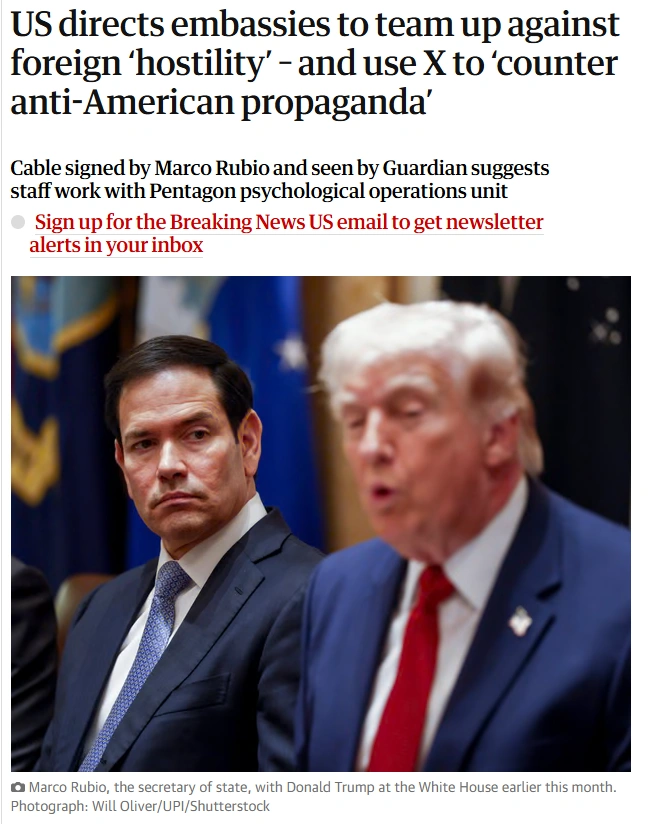
One of the stated objectives was to promote local voices supportive of U.S. interests. Specifically, the cable emphasized recruiting local influencers, academics, and community leaders to participate in communications campaigns and make American messaging more locally grounded.
Rogers has already been pursuing this approach at the State Department. Also in March, while testifying before the House Foreign Affairs Committee, she revealed that the department’s Bureau of Global Public Affairs was using cross-platform digital strategies and data analytics to identify target audiences. Artificial intelligence and advanced analytics were also being deployed to identify emerging issues and measure communication effectiveness.
Rogers has gone further, placing educational exchanges, sports, music, business, cultural programs, and even NFL players within the toolkit of American public diplomacy. She explicitly described the State Department’s exchange programs as a long-term network connecting emerging leaders, influencers, and future decision-makers across different countries.
Traditional American international broadcasting has always suffered from one fundamental problem: its source is too obvious. When the U.S. president makes a statement, the entire world knows it is coming from the U.S. president. When the State Department issues a declaration, everyone knows it represents the position of the U.S. government. When VOA publishes an opinion piece, audiences at least know that its funding comes from the U.S. Congress.
But imagine that the same issue first appears in a video by a financial blogger in Jakarta, is then shared by a university professor in Manila, followed by a discussion hosted by a youth organization in Kuala Lumpur, and eventually makes its way onto a local television program. By the time the message reaches its audience, Washington, sitting at the other end of the communication chain, is far less visible.
That is the real value of so-called “localization.” It is not simply about translating English into Indonesian, Thai, or Vietnamese. It is about translating the source of the message into a familiar local voice.
Instead of directly lecturing audiences about politics, the U.S. government quietly hands a microphone and a budget to the local food blogger they follow every day, the one who usually complains about rising food prices. This is what Rogers means by “localized narratives”: getting local people to use American funding, speak in their own dialects, discuss issues in their own communities, and casually spread American values as naturally as a familiar condiment spread across a piece of bread.
If the preceding examples describe the general principles, developments in Southeast Asia offer a much more concrete picture of how this strategy is being implemented.
In late August this year, The Guardian, citing a project proposal it had obtained, reported that the U.S. State Department was planning a Southeast Asian initiative worth approximately $11 million. The proposal included around $5 million for communications activities, $3 million for training influencers and journalists, and another $3 million to arrange production and exchange visits to Washington and Houston for approximately 180 participants. The project also planned to recruit up to 30 prominent social media influencers across 11 Southeast Asian countries, paying each of them $2,500.
The most revealing aspect of this initiative is not the number of participants, but the criteria for selecting them. According to the project documents cited in the report, the United States is not necessarily looking for people who are already strongly pro-American. Instead, it wants to identify individuals somewhere in the middle of what it calls a “rejection-to-acceptance continuum”: people who are not hostile toward the United States but have not fully embraced the American position either.
Through training, visits, and content production, the project hopes to gradually move these individuals closer to the U.S. position on issues such as trade, technology standards, and the South China Sea.
What Does This Mean for China?
If Rogers continues to push ahead with reforms along these lines, the implications for China will go far beyond the United States simply producing more anti-China reports.
First, the sources of American messaging are being “de-Americanized.” The voice of VOA may not become louder, but the voice of America will become increasingly difficult to recognize.
In the past, China’s response to American media was relatively straightforward: when VOA or CNN published a smear campaign against China, official channels would issue an immediate rebuttal. It was like a boxing match in which both opponents were clearly visible. But in the network of influencers Rogers is seeking to build, the opponent disappears.
Instead of confronting an official account bearing the USAGM logo, China may find itself dealing with a Southeast Asian beauty blogger offering makeup tutorials or an African agricultural influencer sharing farming tips. At the 45-second mark of a video, the creator might casually slip in a sarcastic remark about Chinese investment.
Faced with this kind of fragmented, grassroots-looking micro-narrative, China’s customary reliance on grand, overarching narratives may come across as an overreaction. After all, how can a Foreign Ministry spokesperson reasonably be expected to rebut a comedy blogger with just 10,000 followers?
Second, international messaging is becoming increasingly granular. Washington may discuss “China’s economic influence,” but a blogger in Manila can talk about whether Chinese products threaten local jobs. Young opinion leaders in Bangkok can discuss how Chinese tourists are changing the neighborhood where their family lives. An entrepreneur in Hanoi can analyze what Chinese platforms mean for the local e-commerce industry.
Once a broad geopolitical narrative is broken down into thousands upon thousands of everyday concerns, the traditional centralized model of responding to foreign messaging will become increasingly difficult to sustain.
Third, the competition in international communications may be shifting from a contest between media organizations to one between social networks. Under these circumstances, the most important indicators may no longer be the number of accounts or followers held by VOA and CGTN. Instead, what matters is how many lasting connections a country has established within overseas societies: alumni, academics, journalists, businesspeople, influencers, and community partners.
This brings us right back to the findings of ISEAS: influence is not the same as exposure. Seeing you does not mean believing you. Believing you does not necessarily mean being willing to speak for you. And that final step is precisely what Rogers is trying to win.
Of course, localization cannot resolve the oldest problem facing public diplomacy: the credibility of a country’s messaging ultimately remains constrained by the reality of its policies. If a country’s actual foreign policy clearly contradicts the public diplomacy narratives it promotes, such as “partnership” and “mutual respect,” no amount of sophisticated algorithms or personable influencers can erase the credibility costs created by those policies.
Nevertheless, Rogers appears to have understood at least one thing: international communications in the 20th century was a battle for frequencies; in the early 21st century, it became a battle for platforms. Today, the scarcest resource is increasingly trust.
That is why making VOA great again may have less to do with buying more splash-screen advertisements on people’s phones and more to do with placing thousands upon thousands of “soft advertisements” through a network of countless small microphones.
These microphones would be scattered across Jakarta, Bangkok, Manila, Hanoi, and cities throughout the rest of the world. They would speak different languages, address different communities, and attract different audiences. Some might hardly ever mention the United States at all.
What Rogers may ultimately transform is not so much the Voice of America itself as the very concept behind it. VOA could evolve into something more like “Voices for America”: no longer a single American voice speaking to the world, but a multitude of other people’s voices recruited to speak for American interests.
Editor: Chang Zhangjin