



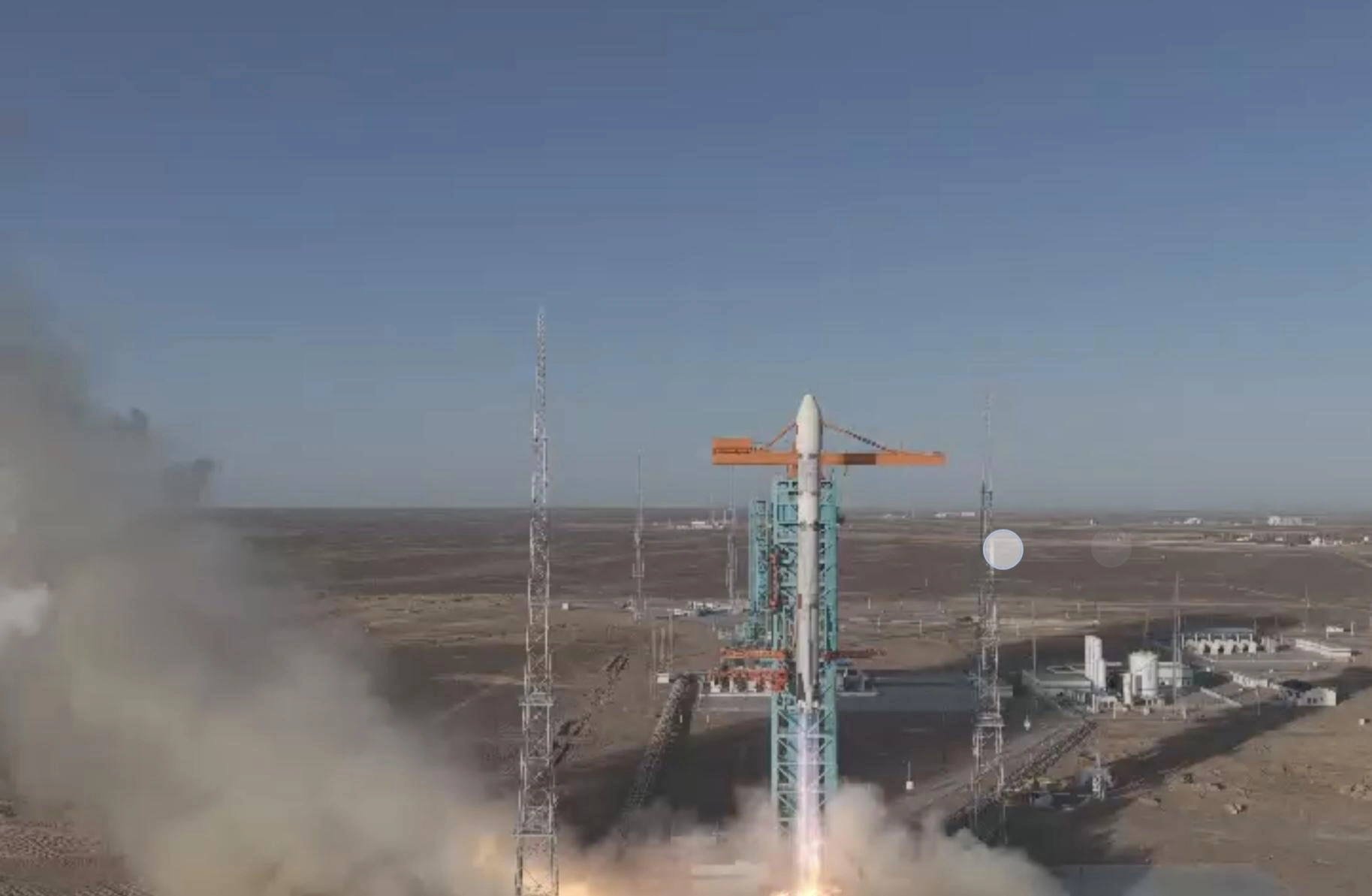
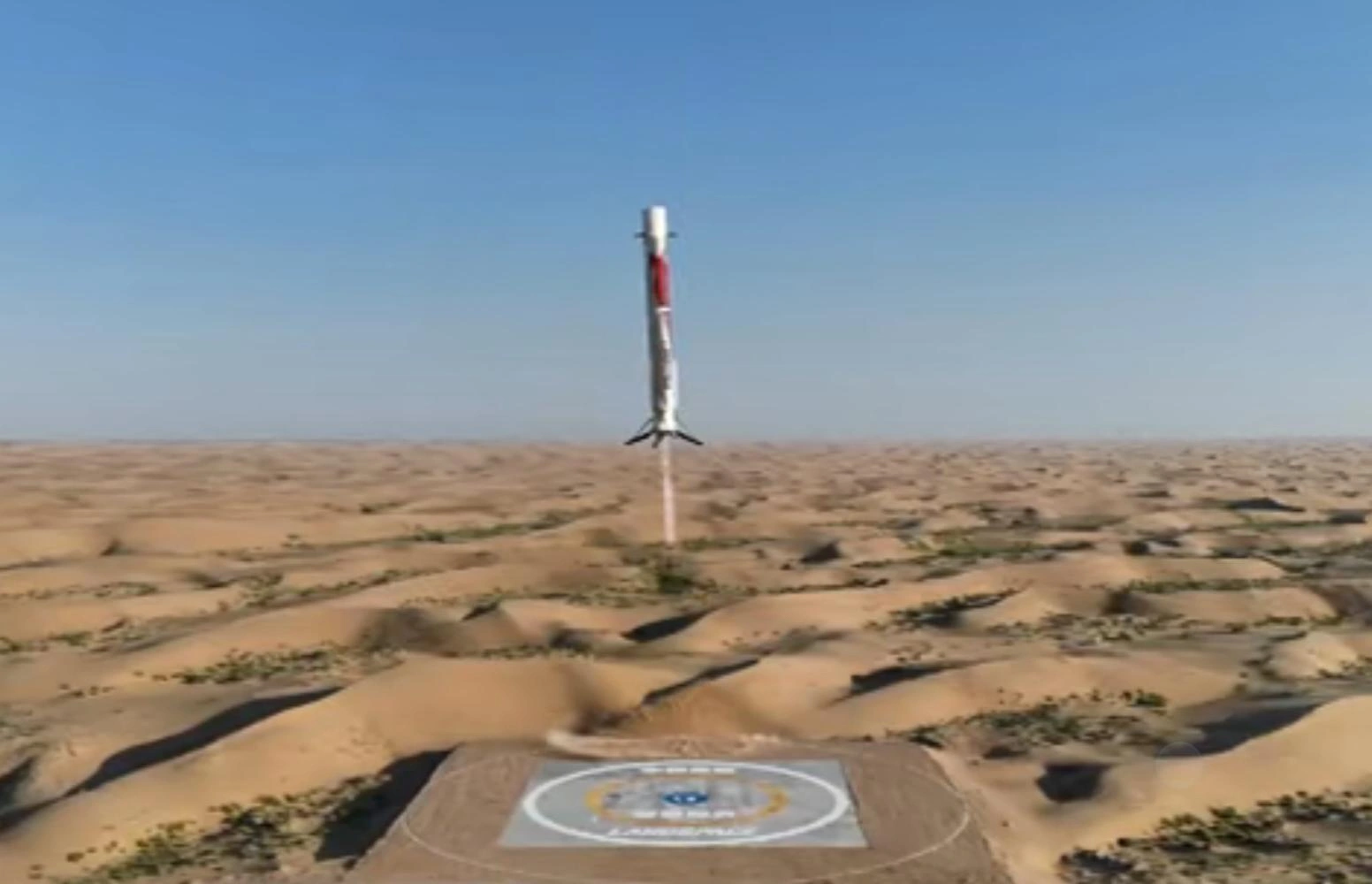
At 7:35 a.m. on August 19, Zhuque-3 Yao-2, a reusable launch vehicle independently developed by Beijing-based commercial space company LandSpace, lifted off from the Dongfeng Commercial Space Innovation Test Zone. The rocket successfully delivered its payload, the Honghu-03 satellite, into its designated orbit, while its first stage successfully completed a planned ground recovery. The flight test mission was declared a complete success.
The achievement came just one month after the Long March-10B accomplished the world’s first offshore net-based recovery of a launch vehicle on July 10. It marked another major milestone for Beijing’s “Yizhuang rockets.” Zhuque-3 Yao-2 achieved China’s first successful ground recovery of a launch vehicle’s first stage using landing legs.
With this achievement, the “Yizhuang rockets” have pioneered both sea- and land-based recovery methods for reusable launch vehicles in China, marking another major step forward in the country’s efforts to advance rocket technology toward world-class standards.
LandSpace
LandSpace, based in Beijing’s Yizhuang district, is a Chinese commercial space transportation company that has developed an integrated industry chain covering R&D, manufacturing, testing, and launch operations. The company focuses on the development of liquid oxygen–methane launch vehicles and provides satellite launch services to the global market.
LandSpace has received the Second Prize of the National Science and Technology Progress Award, becoming the first privately owned Chinese rocket company to receive the honor. It also holds multiple patents and has accumulated extensive engineering expertise in liquid oxygen–methane propulsion. The company participates in research on commercial spaceflight standards and related technologies.
Key Members
1. Zhang Changwu — Founder, Chairman and CEO
Zhang holds an MBA from Tsinghua University. He previously worked at HSBC and Banco Santander and has a background in finance and investment. He is one of the company’s actual controlling shareholders and leads its overall strategic development.
2. Zhang Chen — Co-founder, Vice President and CFO
Zhang holds a master’s degree from the University of Rochester in the United States. He is responsible for the company’s operations, finance, fundraising, and investment activities, and was an early professional in China’s privately owned aerospace sector.
3. Wang Jianmeng — Vice Chairman
A veteran aerospace industry expert, Wang was an early practitioner in China’s space launch sector and is one of the company’s founding core members.
4. Zhang Xiaoping — Researcher and Core Technical Expert
Zhang is an expert in liquid-propellant rocket engines. He previously worked at the Xi’an Aerospace Propulsion Institute and was deeply involved in the development of several liquid oxygen–kerosene and liquid oxygen–methane engine systems. He is responsible for overall technical oversight of the company’s engine programs.
Major Areas of Work, 2023–2026
1. The Zhuque-2 series
2. Key technology development and flight validation for the reusable Zhuque-3 launch vehicle
Zhuque-3
Zhuque-3 is a large-capacity, low-cost, reusable liquid-fueled launch vehicle independently developed by LandSpace for large-scale satellite constellation deployment missions.
The rocket uses a two-stage configuration. Both the first and second stages have a diameter of 4.5 meters, while the payload fairing has a diameter of 5.2 meters. The vehicle is 66.1 meters long, has a liftoff mass of approximately 570 metric tons, and generates 7,542 kilonewtons of liftoff thrust.
The rocket uses stainless steel as the primary structural material. Its first stage is powered by nine LandSpace TQ-12A liquid oxygen–methane engines and is equipped with a reaction control system (RCS), grid fins, and landing legs. Following an orbital launch mission, the first stage is designed to autonomously return with high precision and perform a soft landing at a designated recovery site for subsequent reuse. Overall, the technology has reached an internationally advanced level.
On December 3, 2025, Zhuque-3 Yao-1 successfully completed its maiden flight, achieving China’s first orbital launch of a large reusable rocket and beginning flight validation of first-stage vertical recovery technology.
A LandSpace representative said:
“For this mission, drawing on the flight-test data and engineering experience accumulated from Yao-1, we carried out a series of targeted optimizations for Zhuque-3 Yao-2, focusing on key aspects of reusable flight operations. These improvements further enhanced the rocket’s reliability, recovery capabilities, and overall engineering maturity. This was critical to the successful completion of the first-stage ground recovery using landing legs.”
Editor: Grace