



1. Let imagination seize power! (L’imagination au pouvoir!)
On technology we are either ignorant or afraid.
Technological optimists—whether self-styled experts like Elon Musk or not—remain essentially ignorant. They ignore, deliberately or otherwise, technology’s impact on the labor market. Pessimists see the impact and sink into fatalism. Recently American debate over Chinese humanoid robots has heated up again. Time, reporting on Unitree (宇树科技), lamented “a less rosy prophecy: robots concentrating wealth still further in the hands of a few under the shadow of mass labor replacement.”1
History is duller than we pretend.
In 1867 Marx already demolished the naive optimism of economists who celebrated machines. Steam engines and spinning machines, he wrote, merely turned workers into modern domestic slaves of the bourgeoisie. In the twentieth century the personal computer eliminated armies of white-collar clerks and produced the familiar polarization: high-paid professional jobs and low-paid service jobs expanding at both ends, the middle hollowed out. Since the birth of capitalism, technical progress and the devaluation of labor have been bound together. And the same arguments keep returning: either pity the worker and attack the machine, or embrace the machine and look away from the worker. Imagination has long been exhausted. We are asked to choose between labor and technology, between “backward socialism” and “productive capitalism,” yet rarely question the premise from which this dichotomy arises: capitalism itself.
2. What would Mao’s computer look like?
Beijing, 1965, on the eve of the Cultural Revolution.
A report nearly ten thousand characters long, titled Industrial Problems (工业问题), reached Mao Zedong’s (毛泽东) desk. Its author, Chen Boda (陈伯达), then deputy head of the Central Propaganda Department and vice-chairman of the State Planning Commission, tried to answer a question almost no one would ask today: whether electronic technology and socialism could reshape each other.
Chen argued that socialist construction should prioritize the then-emerging electronics industry—semiconductors, computers—and that the industry would in turn consolidate socialist relations of production. According to his later recollection, Mao finished the report in high spirits, unusually invited him to a meal, and said: “After all these years, we have finally found a path for industrial development.”2
Days later the report went to the Politburo Standing Committee. Mao, Liu Shaoqi (刘少奇), Zhou Enlai (周恩来) and Deng Xiaoping (邓小平) attended. Argument erupted at once. Deng attacked Chen’s view fiercely. The country stuck with “steel as the key line” and Seventy Articles on Industry (工业七十条) that prioritized bureaucratic management.
Yet although Chen’s line was set aside that day, the idea of a “socialist electronics industry” kept surfacing through the 1960s and 1970s—sometimes at the centre of the stage, fused with the mass line Mao favoured—before it was finally displaced, suppressed and forgotten.
Different lines had attempted to answer the same question: How could socialism take a technical path distinct from capitalism’s? How could it compete on the same stage? If the computer did not belong by nature to capitalism, what would Mao’s computer look like?
3. For whom? And how?
The question did not begin with the Industrial Problems.
In 1959 Qian Xuesen (钱学森), in New Achievements in Modern Science and Technology (现代科学技术新成就), sketched a future that still startles. Machines would replace not only physical labor but more and more “non-creative mental labor.” Factories would become unmanned; offices and libraries automated. “Then,” he wrote, “people will finally be freed from all non-creative labor and realize the communist mode of production.”3
The first half resembles today’s Silicon Valley right-wing dreams. But only the first half.
For Silicon Valley, automation lowers variable capital and raises the rate of profit. Unless workers become cheaper and more obedient than machines, employment falls. Qian saw something else: automation as the liberation of the worker from the realm of necessity. He knew capitalism could never complete that liberation. Years later, when Alvin Toffler promoted the “Third Wave” as the capitalist technical path, Qian criticized it as merely the transfer of pollution and labor to the Third World under the banner of progress.4 Instead he called for radical political change—the “communist mode of production.” In that relation of production the machine (the computer that regulates production, for example) would be part of the workers’ common property. It would not compete with them; the gains in productivity would belong to every worker.
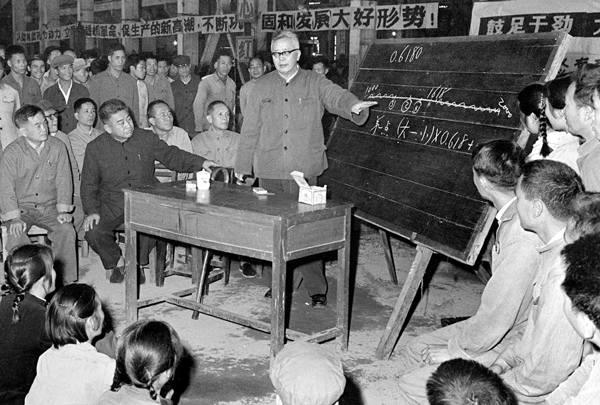 A renowned scientist, Hua Luogeng, was lecturing to workers.
The Industrial Problems turned the common speculation of strategic scientists into a concrete line of development. Having asked “for whom,” it asked “how.”
It opened by declaring that technical development followed two opposite social roads.5
A purely technical viewpoint is completely wrong. We look at the question of technical development from the standpoint of the social system. Technical development follows two completely opposite social roads: the capitalist road and the socialist road.
Capitalism, the report conceded, could also develop electronics and automation. But that automation served capital accumulation and sharpened the contradiction between productive forces and relations of production. Socialism offered another possibility: “Under the socialist system the absurd phenomenon of technology enslaving the laborer, rather than the laborer mastering technology—the phenomenon produced by capitalist society—is abolished.”
How, then, should socialism develop the electronics industry? The answer was not the planned-economy narrative later generations learned, but a form of productive democracy almost forgotten.
In capitalist society technical development relies only on a small number of experts and cannot mobilize the wisdom of the broad masses. Here, both socialist construction and production rely on the mass line, practicing the three-in-one combination of leading cadres, experts and the masses, so that the wisdom of the masses can be fully brought into play. Done well, our technical development will be better, faster and more varied than capitalism’s. The widespread adoption of new technology helps us struggle with nature and raises the cultural and technical level of the laborers.
The “three-in-one combination” came from the management experience of Anshan Iron and Steel (鞍山钢铁公司). Leading cadres, scientists and workers jointly took part in technical development and industrial production. Experts no longer monopolized knowledge; workers were no longer mere executors of orders. An electronics industry run on these lines would be not only an industrial policy but a transformation of production relations. Only then, the report envisioned, would workers escape becoming appendages of the machine in the wave of automation. Build the new machine and build the new man at the same time.
In 1960 Mao named this experience the Anshan Constitution (鞍钢宪法), drawing a clear line against the Soviet hierarchical model known as the Magnitogorsk Constitution (马钢宪法)—one-man management, reliance on experts, ministries and bureaucracy, sharp separation of mental and manual labor.
Reality was more complicated than the vision. The feasibility of a technical line also depended on its distance from the prevailing national strategy.
Back to the 1965 Standing Committee meeting. Deng pointed out that China had a large population and a weak industrial base. Electronics required huge investment, would neither fill stomachs nor raise steel output at once. Better to stick with “steel as the key line” than gamble on computers. In fact the Industrial Problems labored to show the link between electronics and the existing strategy. Electronics mattered precisely because it would become the new infrastructure of the whole industrial system. Computers would not be for offices or commerce but for industrial control—raising efficiency, creating new tools of production, and seizing the initiative in the next industrial revolution.
Defeat in that meeting did not bury the idea. In any country economic policy depends not only on objective need but on the political fortunes of a key figure. In the years that followed those two factors converged and quietly drove a “socialist computer movement” far larger than most later accounts allow.
3. Workers on the street—not geniuses in the garage
In 1974 a foreign computer expert visited Shanghai to see a domestically made integrated-circuit computer.
The machine itself was surprising enough: entirely Chinese components, 120,000 operations per second. More surprising were its makers. Not the Chinese Academy of Sciences, not a university laboratory, not a military research institute, but a neighborhood factory—Shanghai Changjiang Radio Factory (上海长江无线电厂).
The name itself hid a riddle.
A few years earlier it had been the Changning Handle Factory (长宁把手厂).
Later according to the factory’s head, Ma Qijun (马骑骏), when the plant received the order to build a computer most workers “had never seen such a machine; some had never even heard the name.”6 The small handle factory took the job anyway. With help from the Shanghai Institute of Computing Technology and Fudan University, they produced an integrated-circuit computer. On the day it was successfully tested the machine played The East Is Red (东方红) and printed the slogan “Long live Chairman Mao.” (毛主席万岁) The handle factory was renamed Changjiang Radio Factory and began serial production of the machine later known as the CJ-709 (or Fudan 719). It belonged to the same generation as the X-2 that calculated the orbit of China’s first satellite, Dongfanghong-1.
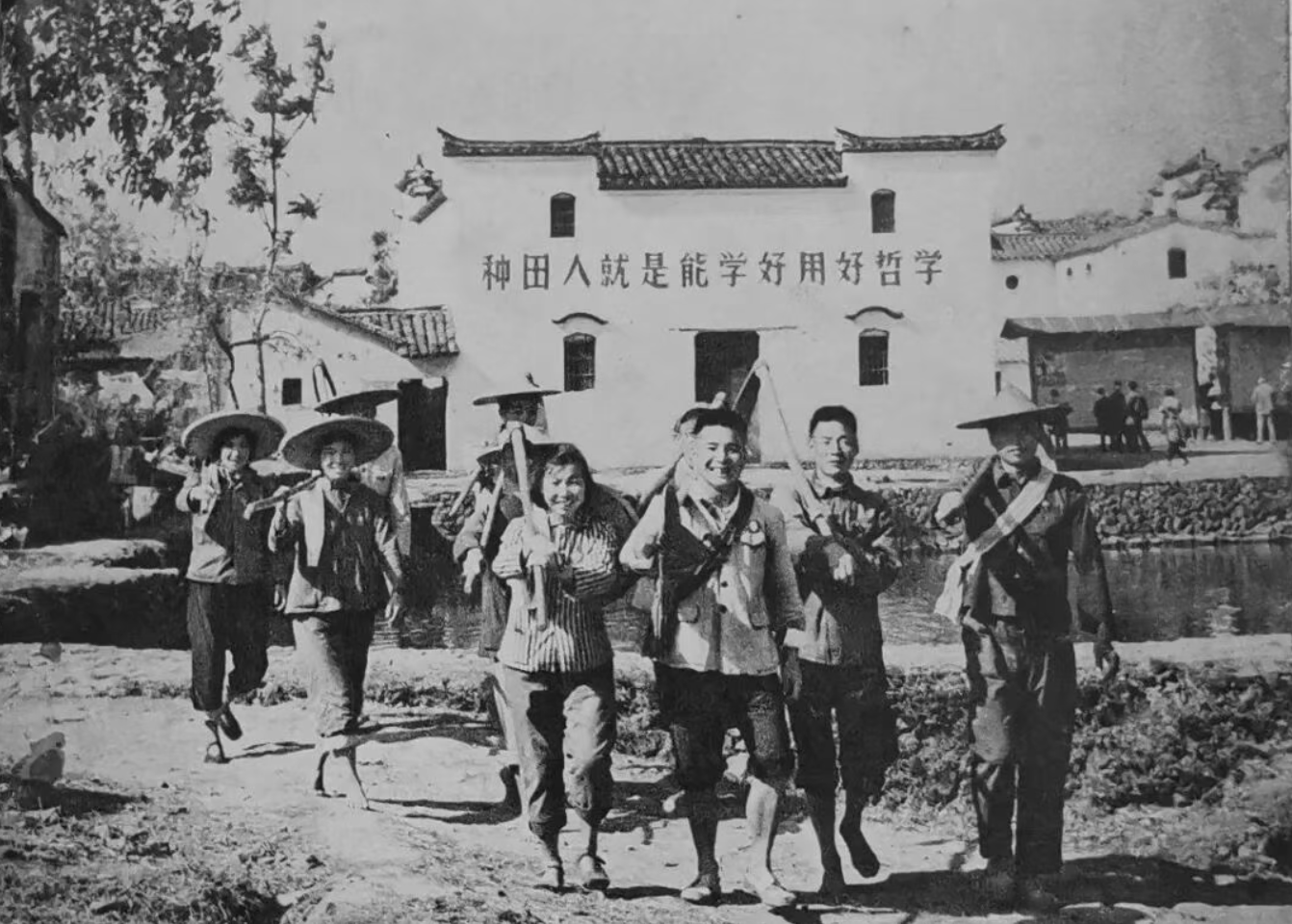 The Learning Philosophy and Using Philosophy Movement in China’s rural areas.
If the story ended there it would be merely a colourful episode in Chinese industrial history. The real question is why ordinary workers, not only scientists, took part in designing and building it. What did it mean to mobilize neighborhood workshops to produce advanced defense equipment with such political coloring?
Li Yinghua (李应华), an intellectual from Fudan who worked on the 719, left a recollection. He described no sudden flash of genius. He described learning inside the factory. “For more than a month I mixed with the masters and technicians. In the workshop I asked the workers and technicians about the function and principle of every part of the printer. In the technical office I watched engineers debug the whole machine while studying the drawings of the printer-controller logic, learning and asking, listening and noting, gathering references for later independent design.”
He also recalled fitting a magnetic head. A veteran expert produced a stainless-steel shim one micrometer thick—thin as paper—and inserted it between head and drum, judging the gap entirely by feel. Li practiced repeatedly and failed: sometimes too loose, the shim fell out; sometimes too tight, it would not come free. The sensation, he later wrote, “could only be grasped by intuition, never put into words.” Only repeated practice until his mentor nodded.7
Such memories read oddly today. We usually think of knowledge flowing from laboratory to factory, from expert to worker. Here the factory itself was the site of knowledge production. Engineers learned practical experience from workers; workers learned electronic technique; school, institute and factory together produced the computer. The “three-in-one combination” of the Industrial Problems acquired its first concrete shape. Notice what these stories serve: the real product was not only the machine but people capable of mastering it.
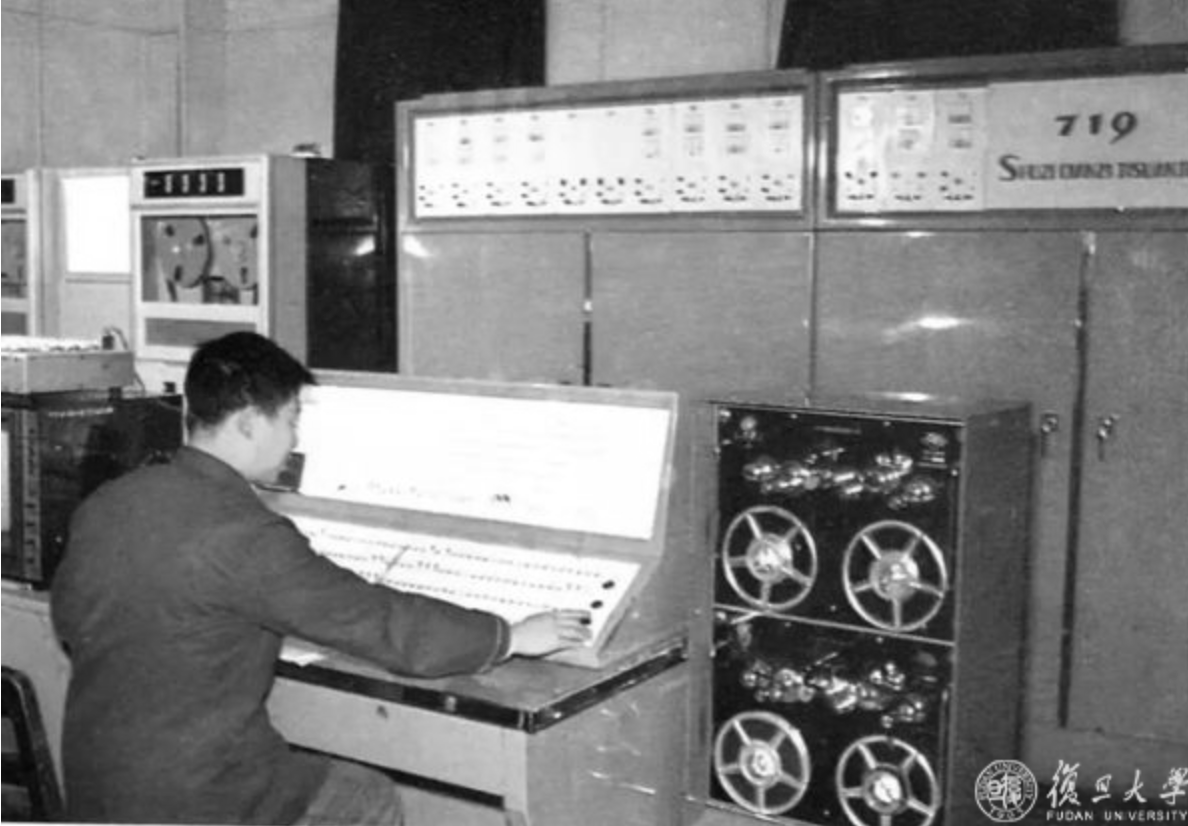
The CJ-709 Computer.
That became clearer once the computers entered production.
Today we habitually link technical innovation to patents, equity and entrepreneurs. After the 719 was completed, the results did not belong to any single scientist. They stayed with the factory. Changjiang Radio Factory eventually produced more than seventy CJ-709 machines and earned substantial revenue.8 The productivity gains from automation did not first become private wealth; they remained the development capacity of the factory as a common unit of production.
In the early 1970s the Shanghai No. 8 Woollen Sweater Factory joined a neighborhood radio plant and used a domestic computer to achieve group control of flat-knitting machines. The heavy labor of counting and remembering by mouth and mind was taken over by the machine. Efficiency rose sharply; the operators did not leave production but moved to new posts. In the same period the Shanghai woollen-sweater industry trained more than 450 “grassroots electricians” and automated over 1,500 looms. Output rose more than 50 percent above the 1966 level.
This came close to Qian Xuesen’s vision of automation: the machine not a competitor of the laborer but a means of production owned in common.
Such experiments were not isolated.
Between 1968 and 1971 local electronics expanded rapidly. Local output surpassed that of central enterprises; the number of factories rose to more than 5,200, over half of them collective. Large numbers of textile mills, neighborhood workshops and light-industry plants switched to electronics.9 The wave had complex causes, yet it was not unrelated to the Industrial Problems call to develop electronics by relying on the masses. From 1966 to 1970 the idea of a “socialist computer movement” entered public consciousness. Popular booklets and political slogans spoke of “breaking the mysticism of electronics industry” and “the vulgar are the most intelligent.” One pamphlet proudly claimed: “We are doing an extremely great thing that our predecessors never did.”10
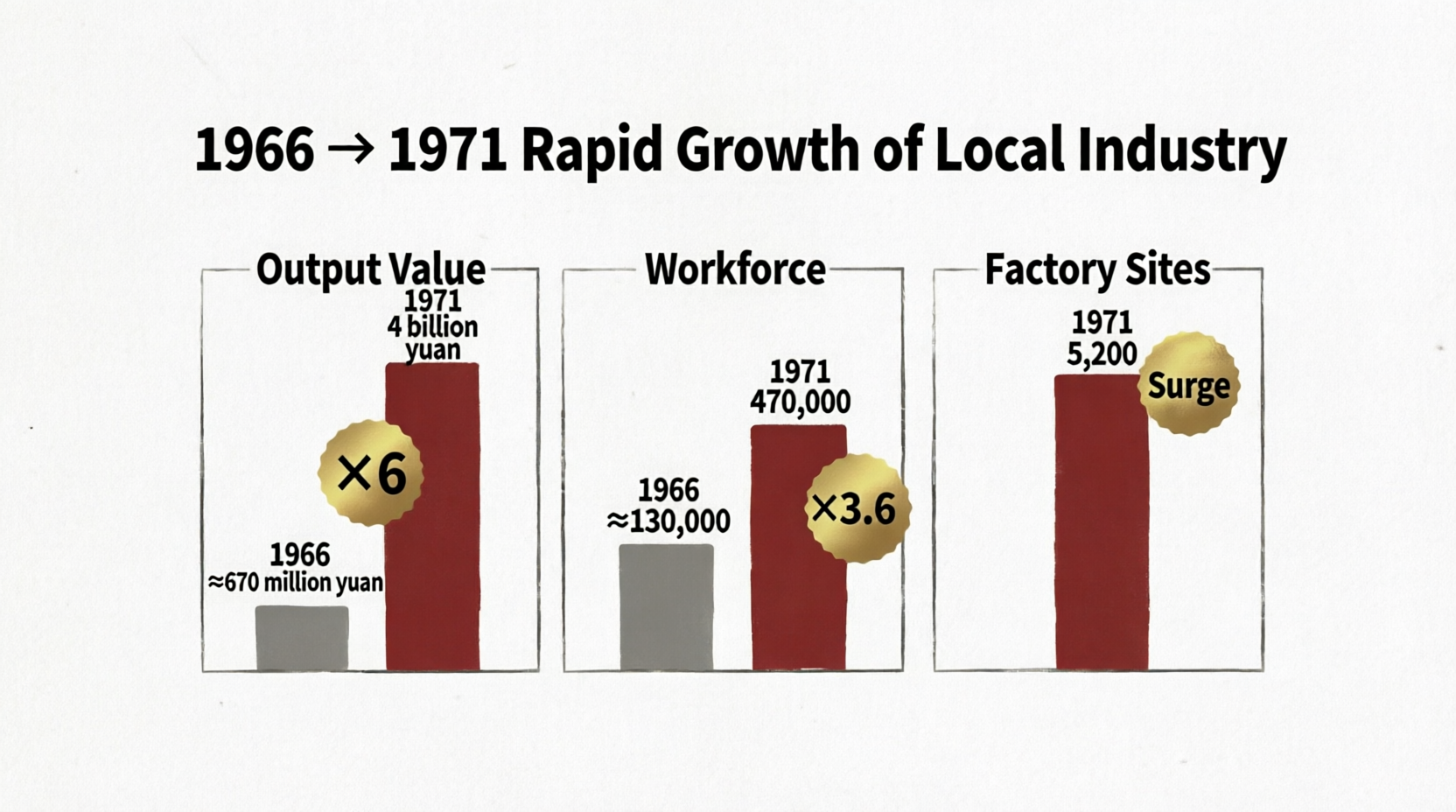 More statistics on the development of China’s local electronics industry from 60s to 70s.
4. The forgotten communist undercurrent
In fact neither predecessors nor successors did it.
A few years later, in 1977 America, Steve Jobs and Steve Wozniak built the second Apple computer, the Apple II, in a garage. Another story of starting from nothing—two geniuses, future billionaires—proved far easier to remember than that of a crowd of workers and collective enterprises. It fitted the preferred image of innovation: genius, capital, market, individualism. The “street computer” looked alien. It lacked the flash of solitary genius, the glamorous launch and the thrilling commercial triumph.
It was too plain—plain to the point of ignorance and roughness. That was also its problem. Many local electronics plants rushed in together, duplicated efforts and produced uneven quality. Not to mention that political campaigns continually disrupted normal research in that period.
Internal causes alone cannot explain its end. After the 1970s the international environment and the domestic political line both shifted. Another technical path regained dominance in the Reform and Opening-up. The Apple IIs made by California geniuses entered Chinese enterprises and were widely used for labor supervision. Workers resisted the new technical control in quiet ways—deliberately leaving computers idle, refusing to meet quotas.
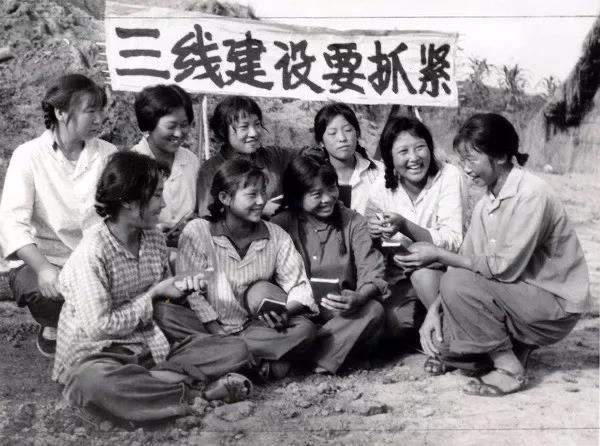 The Third Front Construction.
To believe every possibility contains the teleology of its own realization is idealist fantasy. History, however, does not leave empty-handed.
The Third Front construction, which the socialist computer movement mostly served, laid important foundations for later industry in the interior. The household-name television brand Changhong (长虹) after the Opening-up was itself a “military-to-civilian” product of the Cultural Revolution electronics system. What remained was not only factories, techniques and industries, but a once-real institutional imagination. That imagination was not fatally flawed. Given the right moment, the ghost of old Hamlet can again urge the prince to action.
Today, the arguments around artificial intelligence still echo the same tones that have resounded throughout history: either blind optimism or desolate despair. Musk continues to run his commercial empire while painting a future of abundance brought by AI in a recent interview. To quote Mao’s 1930 line—“A single spark can start a prairie fire”—may seem untimely. Yet the forgotten undercurrent may still run, like the subterranean fire in Lu Xun’s writing, silently beneath history.
Notes
1. TIME, “Unitree and China’s Human Robotics,” 23 July 2026. https://time.com/article/2026/07/23/unitree-china-human-robotics/
2. Chen Xiaonong, Chen Boda: Final Oral Recollections (陈伯达:最后口述回忆), Hong Kong: Sunshine Global Press, 2005, p. 236.
3. Qian Xuesen, New Achievements in Modern Science and Technology (现代科学技术新成就), Beijing: Popular Science Press, 1959, p. 34(cf.). Discussion of electronics history also draws on Wang Hongzhe, The Long Electronic Revolution (漫长的电子革命), PhD thesis, Chinese University of Hong Kong, 2014. Many materials are taken from that work; some citations could not be verified and are marked as “cf.”.
4. Wang Hongzhe, The Long Electronic Revolution, Chinese University of Hong Kong, 2014.
5. Chen Boda, Industrial Problems (工业问题), in Posthumous Manuscripts of Chen Boda (陈伯达遗稿), Hohhot: Inner Mongolia People’s Publishing House, 1999, pp. 295–351(cf.).
6. Editorial Board of Dialectics of Nature, “Independence, Self-Reliance, Vigorously Develop Electronic Computers—Summary of a Symposium on Electronic Computers,” Dialectics of Nature, 1974, no. 4 (total no. 6).
7. Li Yinghua, “Years Like a Song—Recollections of a Few Things in the 719 Computer Group,” School of Computer Science, Fudan University, https://cs.fudan.edu.cn/19/8b/c24293a268683/page.htm
8. Wang Shiye, “The Extraordinary 719 Computer,” School of Computer Science, Fudan University, https://cs.fudan.edu.cn/19/76/c24293a268662/page.htm
9. Wang Hongzhe, The Long Electronic Revolution, pp. 143–145.
10. The Vulgar Are the Most Intelligent (卑贱者最聪明), Beijing: People’s Publishing House, 1971, pp. 2–3.
Editor: Yida

NotChasing
Thank you. By the way, I searched Google for the second reference, the book “Final Oral Recollections”. It found critiques of the book for me, but no copy of it. I searched the publisher, Sunshine Global Press, and again found nothing. I’m in Canada.
tang361313182
Hi! You can try to search the Chinese title. The book is called 陳伯達:最後口述回憶, the editor 陳曉農,the press 陽光環球出版香港有限公司. If it still doesn’t work unfortunately, you can reach me at [email protected]. I have a digital copy(it’s in Chinese of course, but you can throw it to your GPT translator).
But PLEASE note that in this article, I try to depersonalize the work(specifically, Industrial Survey) by Chen Boda, but rather depict it as a representation of an objective political force of that time. The standpoint of Chen himself, is way more complicated and fluid, due to the political struggle in China back then. Plus, it’s also very elusive, partially because of the lack of cross-verification with regard to historical sources. It’s better if you can take care of that when looking up for Chen’s materials!