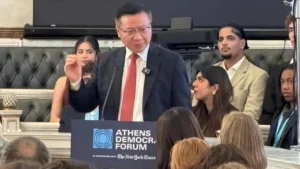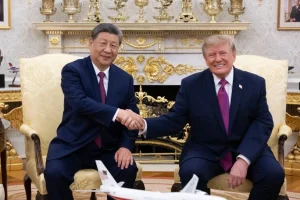


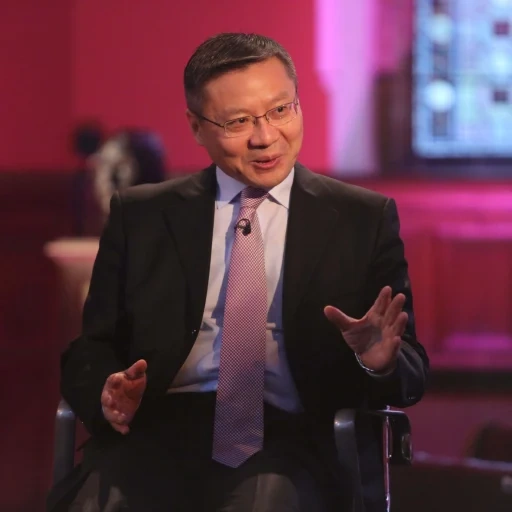
On September 6, Ms. Oksana Boyko of Russia Today’s Worlds Apart interviewed Prof. Zhang Weiwei about critical geopolitical shifts. Please find below the complete transcript of the interview.
Oksana Boyko:
Hello, and welcome to Worlds Apart. At his latest meeting with the Indian counterpart, Chinese President Xi Jinping said that it was important for the dragon and the elephant to come together and try to create a more hospitable ecosystem for the two of them. What does it mean in practical terms? And how it may affect other geopolitical animals, big and small? To discuss that, I’m now joined by Zhang Weiwei, Director of the China Institute at Fudan University. It’s a great pleasure, great honor for me to talk to you. Thank you very much for being available.
Zhang Weiwei:
Glad for me as well.
Oksana Boyko:
Now it’s no secret that president Xi has a cooperative call to India, at least partially is influenced by the common problem in the form of Donald Trump’s tariffs. Do you think this challenge is challenging enough to how the two countries to not only speak, but also to change the way of the engagement across the board and across the contested border?
Zhang Weiwei
On the part of China, things would be much easier, because China always stand for long term perspective. As Xi Jinping told Prime Minister Modi, he said, we should take a strategic and long term perspective on Sino-India relations. When he says strategic, which means you have to see this global trend from uni-polarity to multi-polarity. For the long term perspective, you have to put the Sino-India relations in our long history. We’re together peacefully, friendly with each other for thousands of years. So why not, you know, we are simply defined by border disputes by this legacy left over from the British colonialists? I think these are the long term visions. Hopefully, India will also take a strategic and long term perspective on that. My only concern is, yes, symbolically, China and India shake hands, and Russia, Putin is also there, three countries shake hands. This is very good, for demonstrating the rise of the rest vis-a-vis the decline of the west. This is a very good one. But for India, to have a long term commitment to improving Sino-India relations, it will take more effort because Indians political system is such, that for example, the Indian media has been always very hostile to China for one reason or another. But given that political system and the media growing, so there have been more to do in terms of trying to have a better relation with China.
Oksana Boyko:
Now, I’m sure you know that the Indian side would also see themselves as strategic and long term thinkers. They also take pride legitimately in the wisdom of the civilization, and I think it also has to be noted that the deterioration of relationship between India and China, especially over the border issue, took place under the watch of the same leaders, under president Xi and under Prime Minister Modi. Do you think anything substantially changed since 2020 when those clashes occurred? Anything substantially changed in order to truly move forward?
Zhang Weiwei:
There were already tremendous progress in terms of de-escalation, of the border dispute. Whatever has happened in the two sides have started this disengagement for military forces, which is positive. Now, with Donald Trump’s tariff on India, which is about 50 %, which means we don’t do any trade anymore. Obviously, India, being an independent nation, is not happy at all, and especially feeling a kind of grudge, you know, China buy Russian oil and petrol, but they can do, we cannot do. And in this India feels being discriminated against, so whether this Indians new position on the United States is understandable.
Oksana Boyko:
Can I ask you about this position? Because Indians have long been courted by the Americans. They have long been treated as a special case, getting lots of exemptions from even American sanctions against Russia. Do you think Indian new position vis-a-vis the United States, and perhaps vis-a-vis China is temporal reactive, or does it have a chance of being long term? Because it’s understandable at this point of time they are offended. But do you think it will last?
Zhang Weiwei:
This is also a question it has to do with the nature of the leadership. If you look at the Chinese leadership and the Russian leadership, both Vladimir Putin and Xi Jinping are really statesmen, they have long visions. For India, you have different voices. For instance, when United States Donald Trump launches trade, whatever on China, higher and higher and higher. I remember Indian Trade Minister, or another minister, I forgot. He was quite pleased. He said, that’s an opportunity for India. He said this openly. So from Chinese point of view, this is the very shortsighted. In other words, you fail to understand the changing world. We made a calculation, and I said openly many times back in 2018, I said the China is already bigger economy in the United States and US economically depends far more on China than vice versa. I said that when Donald Trump, during his campaign, election campaign, he said he will levy 60 % tariff on China, and I said to American reporters, make it 600 %. Your supermarket will be empty or half empty. But India at that time did not see. They still thought the United States powerful. China was weaker, and China would in the end lost a lot, lose the war, so they did wrong calculation. Hopefully, Indian leadership will learn now the famous line from Henry Kissinger: It’s dangerous to be enemy of United States, and it’s fatal to be their allies.
Oksana Boyko:
It also shows you that any geopolitical event can play out in many different ways. And sometimes what you wish upon others may happen to you as well, which, by the way, I think is one of Chinese proverbs. Now let me ask you about American policy specifically because under Donald Trump, there is so unusual that it is hard to understand whether these tariffs should be conceptualize as the US tariffs or Donald Trump’s tariffs. Determining that would also determine your reaction. Now, what do you think is the take in Beijing and in New Delhi at this point?
Zhang Weiwei:
Indeed, now Donald Trump has his own style, which is very often less predictable. Fortunately, my Institute, back to four years ago, when Biden came to power, we made a prediction openly. We said Biden administration could be transitional, four years later, the United States may well have Donald Trump again, or a Donald Trump era without Donald Trump. In other words, we are not looking at Donald Trump individual as a leader, but we look at the fundamentals.
Oksana Boyko:
The populism, the populism uprising?
Zhang Weiwei:
Because Donald Trump’s sense of the United States was more accurate than Biden. Donald Trump started each and every helpless statements in the campaign: America is a failing nation. That’s true. Donald Trump has realized the US economy has been hollowed out. For United States, the Ukraine Crisis was business, you know. For Biden, United States benefits from the war. For Donald Trump. United States loses, loses a lot in the war. So he tries to put an end to this war, different calculations. Even for the tariff, whatever it’s going up and down, the point is the United States had this accumulated debts of over $36 trillion. This is unsustainable. So you must find a solution to it. So even without Donald Trump, another leader came out, he will also impose some kind of whatever fight against other countries.
Oksana Boyko:
Now, I mentioned in my introduction that President Xi used this metaphorical reference to China and India as the dragon and the elephant. What animal do you think at this point could symbolize the United States?
Zhang Weiwei:
I like a metaphor Chairman Mao used, I think, in 1947 or 1948, even in 1950s, he said the United States, although a nuclear power, is in fact a paper tiger.
Oksana Boyko:
Paper tiger.
Zhang Weiwei:
Yeah. It looks strong, yet it’s weak in many ways, and today it is even more so. At that time, China was at least 100 times weaker than China today, even during that time, you know, in early 1950s, China was deeply involved in the Korean War, direct confrontation with the United States, which means United States today is more paper tiger than anything. So this is obviously true.
Oksana Boyko:
What occurred to me just now is that in the North American mythology, coyotes is a prominent animal. And to some extent, it’s a trickster animal. It’s smart, but it’s deceitful. It uses a lot of languages, but it also may attack you. And you’ve been talking before about this cumulative effect of the debt problem. But there are also many cumulative effects across the board, even in the way the Americans are managing, for example, their public policy or how they relate to public protests, because they encourage public protests in other countries, not realizing that people may also be learning this destructive way.
Zhang Weiwei:
Like RT.
Oksana Boyko:
For example, but I my question to you is bigger. To some extent, an argument could be made that the American system of governments has come to a major crisis with many conflicting points. And some extent all of us in the international system have to deal with it. What is the Chinese way of dealing with it? Just wait and see. How do you mitigate then this negative outburst from the American content?
Zhang Weiwei:
I have a very good conversation about 15 days ago, with Jeffrey Sacks, Professor of Columbia university who came to my institute and gave election. He used the interesting metaphor. He said, Russians play chess, Chinese play the Go, both involving strategies, comprehensive, holistic thinker. The United States play poker. Poker is always shorter, goes by new cycles. It produces a lot of showmen, but not statesmen. As a result, it’s actually hurt the United States interest. You could win here and there, one or two battles, but you lose the war. I remember I just read an article in New York Times last month. The argument discusses this US AI strategy, or not strategy, the proposal put forward by Donald Trump. The article said, soon you will see in the AI fields, not the competition between China, United States, but the competition between Shenzhen and Hangzhou or another Chinese city. In other words, without this overall thorough comprehensive, holistic strategy, for United States you have to think very hard. What’s the end game? What’s the final objective for your policy on China? You want to defeat China militarily. You want to defeat China economically. You want to defeat China technologically. None of them can be achieved. Full scope.
Oksana Boyko:
Professor Zhang, we have to take a very short break right now, but we will be back in just a few moments. Stay tuned.
Oksana Boyko:
Welcome back to Worlds Apart, Zhang Weiwei, Director of the China Institute, Fudan University. Professor Zhang, just before the break. You said that the Americans have to think hard and think long term, but do you think there’s still a capacity for that in the American system? Because I like your reference to the poker game, because poker is acting in the moment. You have a lot of courage, a lot of energy. And we see that a lot depicted in the American public policy. But to sit down and calculate your steps long term, it’s a major skill that actually gets developed not over years, but over centuries. It has to be part of, not just American, but not just the political system, but the culture. Is it there within the American society, within the American mentality?
Zhang Weiwei:
You do have, say, individual experts or leaders who may have this long term thinking, but given today’s American political system is such, is so populist. It’s so about the showmanship rather than leadership. It will be difficult to have this kind of long-term thinking. Even you have a good think tank, a good idea, but they may not adopt. I would invite them to listen to Jeffrey Sacks, but they will not listen. That’s a problem. He has a long term thinking about many issues, but the US White House or in Pentagon, deep state, refused to do that, to hurt the US own interest. Furthermore, both China and Russia are civilizational states. Civilizational states are known to have a deep culture, deep people. China also has Deepseek. This is important. As yosu said, with deep culture, deep people, people tend to have much longer way of thinking. I was in Bangkok just 3 days ago, participate in the security dialogue. We discussed differences between Chinese diplomacy and American diplomacy. I said as a civilizational state, China treats other countries different from the United States. For United States, a friend or foe. For Chinese, a friend or potential friend.
Oksana Boyko:
Yeah. Can I ask you about this specific concept of civilizational states because you are well known for it? And I know that in relation to China, you define it as essentially an amalgamation of many states or many forms of governance that China has had over history and sort of giving birth to the to the state it has today having account of all that experience. And I think in Russia, we also have a similar concept of continuity when you look at your own history, not as a harsh judge, but essentially as a psychologist, then you are looking at the forces within society that have been churning over centuries, and you try hard to balance them out, not to banish one and pick only the good ones, but how to balance them out because you understand that society, both collective and individual psyche. There is a sort of a visible part. And there’s also things that are invisible that needs to be taken account of. Is it similar?
Zhang Weiwei:
Very similar. If you look at the Chinese culture and Russian culture, we found a lot of similarities. For instance, the important role of family and the relationship between family and the state and the concept of individuals. In the Anglo-Saxon world it is atomized. You are you yourself. In the Chinese and Russian culture individuals are also societal. And also both countries have this tradition of turning suffering into inspiration or something good. So many similarities. That’s why Russian literature has all been popular among the Chinese. And that’s also why Xi Jinping and Vladimir Putin see eye to eye on so many issues.
Oksana Boyko:
Now, the United States also considers itself a civilizational state, even though it’s perhaps one of the youngest, I would say, very intolerant of others and domineering. It wants to be the one and only civilization. Do you see that as simply a matter of its relatively young age, or is it an intrinsic feature of the American mentality, of the American philosophy that we can do nothing about?
Zhang Weiwei:
For the United States, I personally would not describe as a civilizational state. For one thing, its history per se is indeed too short. It has not seen enough ups and downs. For instance, if you talk to Americans today, the United States, top secret, we cannot say the United States will become number two. You cannot say China will be a bigger economy than the United States. If you are a civilizational state, you see so many ups and downs. So normal. And that happens if you follow the right model of development: you will have cost, otherwise you will go down. Even if you ask Europeans, at least, I spent 20 years in Europe, back in 1980s and 1990s, at that time at least, if you talk Europeans to see the United States civilization, they say, “Oh, come on,” because they have a strange. But it doesn’t matter. The point is, the United States has to handle this issue of short-termism. This showmanship, this everything goes by new cycles, no more than one week if you look at Donald Trump’s style.
Oksana Boyko:
He has a style of very showy teenager, and I think essentially that’s what the United States is stuck in the teenage stage.
Zhang Weiwei:
That’s true. It’s very American.
Oksana Boyko:
It’s very American. We can make many jokes about it, but ultimately it distorts the way politics is done on the global level, because you yourself want pointed out that the Americans are treating competition very differently from China. In China, you see that as legitimate, but in America it seems that the way to make myself stronger is to weaken you, not to take care of my own population, but try to disturb your population. And interrupts the way other countries are trying to cultivate their own well-being. So there is a legitimate question of how to deal with that.
Zhang Weiwei:
But also, I think you’re right. I agree with you 100 %. But it’s also true that the American saying “if I can’t beat you, I join you”. They are very, in the end, pragmatic. We have to give some credit to Donald Trump. By far I would consider him as not the type of warlike leader. And this is a good for the United States and for the world. We’re also glad that the Putin is meeting with Donald Trump. I think these two large countries, the United States and Russia, can find whatever improving their relations, it’s good for global peace. That’s important.
Oksana Boyko:
Can I ask you specifically about that? Because there are many opinions, even within Russia of the way the kremlin has been trying to engage with the American administration and a lot of people in Europe and in Russia. And I’m sure in China were impressed by the latest meeting in Alaska with the red carpet being rolled out and the military raids. But the question still remains of whether anything has changed on the substantive level and whether anything can change in the large scheme of things between Russia and the United States. How is it viewed in China?
Zhang Weiwei:
Well. in the first place, I think Donald Trump has almost completely accepted the Russian version.
Oksana Boyko:
Is that the Russian version or just the reality of it?
Zhang Weiwei:
It’s almost the Chinese version. NATO expansion, five rounds of expansion eastward. I said to Americans, I said, even if you stop at the after four rounds of expansion, then the war would not have taken place. I said, put the Chinese in our shoes, we would not have allowed NATO expansion into Asia even once. I said we ask the Russians why you tolerate 5 rounds of expansions.
Oksana Boyko:
Maybe it’s strategic patience. It had to run out at a certain point of time.
Zhang Weiwei:
But Donald Trump also accepted this version, and also, he accepted this version very importantly. No ceasefire, peace deal. This also important. Whatever. I think the United States that Donald Trump realized, Ukraine and European cannot win this war. This is so simple, right?
Oksana Boyko:
Now, coming back to civilizational states, President Xi in his address to Prime Minister Modi stressed that India is too, a civilizational state. Do you think this makes it easier or more difficult for these two large giant neighbors to engage with each other?
Zhang Weiwei:
Indeed, I understand, Russian, in general, are in favor of China, Russia, India coming together. I remember your former foreign minister Primakov, who was among the first the radish of a multipolarity in the 1990s. And he gave the example of China, Russia, India, and then we started these three-way talks at senior diplomatic level, foreign minister level, in fact, which is on the whole very good. I’m glad both leaders mentioned civilizational states and the civilization discourse, which will help. And yet, as a scholar who advocates this whole thesis about the civilizational state, I would say very candidly: if you compare China and India, if China is a civilizational state at, say, 100, India is still lower. For one thing, because I define a civilizational state as an amalgam of the continued civilization with the modern state. In the modern state, if you look at the further dispute between China and India, to a great extent they had to do with the local military force. They were somehow from my sources, not listen to the top. They behaved in their own way, cause a lot of problems. That’s one reason, there could be other reasons. This is all about the governance capacity. If you look at the capacity between the two countries, it’s very different. We have a lot of respect for India, for Indian’s progress, but India can still do a bit more in terms of improving it.
Oksana Boyko:
Ultimately, I mean, civilization is not a race, and we all are moving at our own pace. And that leads me to my last question. I heard you say that we, as an international system, need to evolve from a sort of natural multipolarity to a multipolar world order and the ordering principle is the hardest thing of all, because it’s ultimately about your assignment of priorities and the balancing of priorities. And each state may have their own hierarchies. Do you believe we can ever come there to establish and agreed upon more or less a balanced multipolar world order?
Zhang Weiwei:
I think there are one thing which is very good. If you look at the BRICS or the larger picture, the Global South as a whole, you will find a lot of differences between countries, state parties, or treaty whatever. Yet there is one commonality: they all prefer a multipolar world order. That’s important. On this, they are united.
Oksana Boyko:
They cannot agree upon it, though.
Zhang Weiwei:
Oh, that’s important. And then, within this agreement on multipolarity, because they all agree unipolarity is not good because unipolarity is equal to, I think, absolute power corrupts absolutely. One superpower can bully everyone. This has to come to an end. I think perhaps, from Chinese point of view, we can agree at least on two major scenes for the new world order. One is priority given to development. Not only global south needs the development, but even global north need development. If you look at infrastructure in the United States, it’s breaking down. The other is peace. The West talks so much about the universal values, but they never mentioned peace in universal value. If we can agree on these two, then it’s already tremendous progress. Of course, now if you look at Chinese official discourse on multipolarity. It mentions fair, just, more democratic and pro-development. So all these elements we can negotiate and discuss. But with the rise of the rest, this will come true. I’m pretty sure about this.
Oksana Boyko:
For the time being, Professor Zhang, it’s been a great pleasure talking to you.
Zhang Weiwei:
Thank you very much.
Oksana Boyko:
Thank you for watching, hope to see you again on Worlds Apart.
Editor: Zhiyu Wang