


An entrepreneur, by dint of superior technical ability and managerial talent, founded a tech company from nothing. After more than thirty years of struggle he became the leader and cornerstone of a new round of technological revolution, and amassed a trillion-dollar fortune. Yet greedy, short-sighted politicians covet day and night the fortune he built with his own sweat, launch populist media smear campaigns to stigmatize him, and mobilize the secret police to hunt him down relentlessly. In less than half a month, they use non-market conspiracies and tricks to kick him out of his company; the next step is to persecute him personally and plunder his private property.
At this point, many liberal economists and offshore America-worshippers in China will surely first dissolve in tears, then slap the table and rise in fury, denouncing the shameless, greedy politicians for violating sacred private property rights and trampling on market rules — how could such a wicked system ever nurture technological innovation and long-term growth?
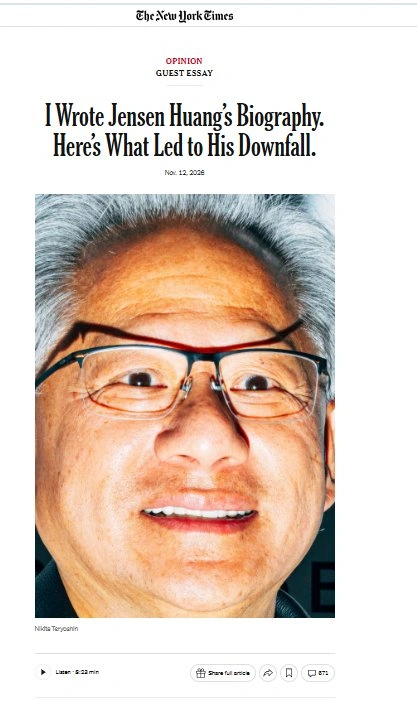
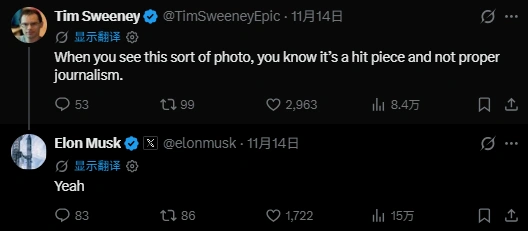
But this company is called Nvidia, the entrepreneur is Jensen Huang, the politicians belong to the American Democratic Party (and, indeed, to a broader cross-party coalition of politicians and capital), and the populist media are “The New York Times” and a whole fleet of blue outlets. Oh dear — now loyalty and filial piety can no longer both be served.
“The West Protects Private Property” Is Turning from a Sacred Myth into a Joke
As for the event of Huang being driven out of Nvidia itself, we already sorted through and analyzed it in some detail in “What Kind of American Is Jensen Huang?” The weekend brought little new information. Today I’ll talk about it from a different angle.
The 2024 Nobel Prize in Economics went to three new institutional economists represented by Acemoglu. Their core theory: institutional quality determines economic development; only by building “inclusive” institutions that respect private property rights and are democratic yet centralized (a rather delicate phrase) can long-term economic growth be achieved; while “extractive” institutions that do not respect private property rights, even if they can produce short-term high-speed growth, are bound to be doomed in the long run.
The greatest contribution of Acemoglu and his co-authors was to drape a beautiful fig leaf over the development divergence caused by Western colonial plunder in modern times: Africa, Latin America and other countries cannot develop — not because the West plundered you, but because your institutions are bad; and Western publics can enjoy welfare dozens of times better than the sweated workers of developing countries without working a day — not because the former participate in plundering the latter, but because Western institutions are good.
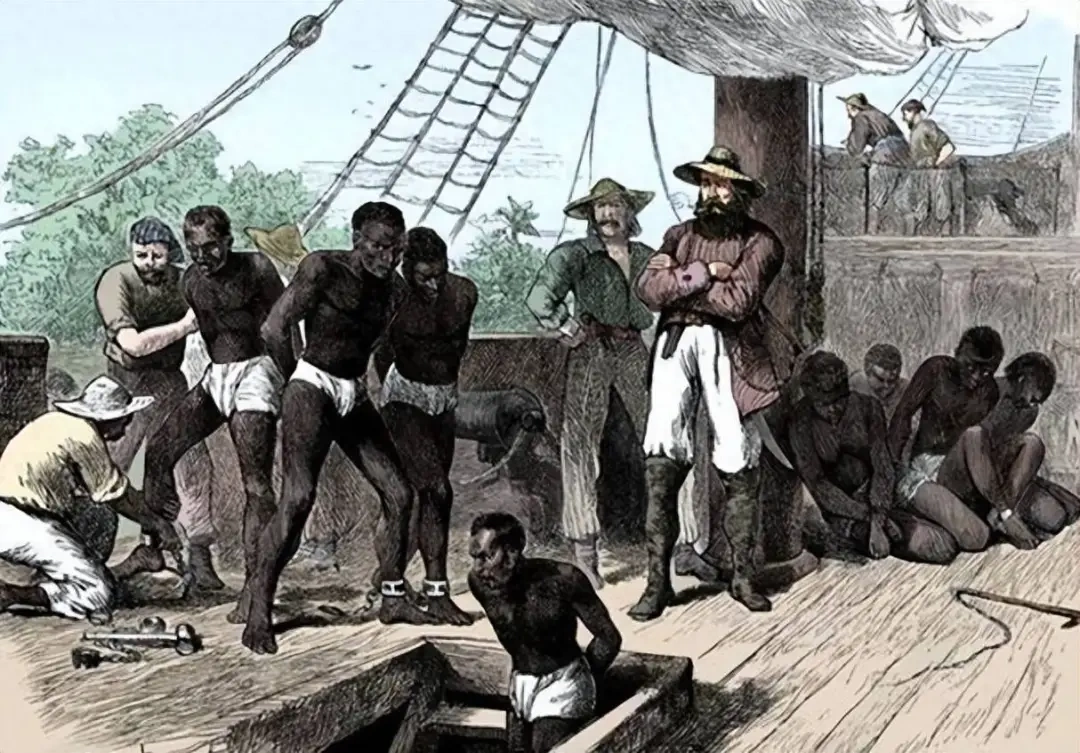
Saint Acemoglu’s prize set off a carnival among Chinese liberals and produced a flood of articles smugly insinuating things about China’s system and policies. The author has criticized this kind of theory many times, and summed it up with a plain analogy: bandits ransack a village, carry off the grain, and sell the adults into slavery. Decades later, the bandits preach earnestly to the impoverished orphans of the village: the reason you’re poor is all because you didn’t go to school! Of course, for liberals, truth and logic have never mattered; the butt is a more important organ of thought than the head.
“Protecting private property rights → economic prosperity” is a narrative concocted by the bourgeoisie to defend its own interests, by no means a scientific theory. For one thing, the “statistically significant” results that survive repeated filtering are a “causal relationship” existing only on paper, and they collapse at the first contact with historical common sense. For example, in “Reversal of Fortune,” the paper that first made Acemoglu’s name, he used instrumental variables to prove that colonies such as Latin America and India developed less than colonies such as North America because the colonizers established extractive institutions in the former and inclusive institutions in the latter.
Anyone with a little historical common sense knows that after the sixteenth century Spain gradually sank into a stray dog among colonial empires, and the Spanish-speaking colonies became the blood bank of the North American colonies and, later, the United States. Maintaining extractive institutions in Latin American countries was not the choice of the Latin American peoples; it was a requirement of the United States for maintaining its blood-sucking conduit, weaving the outer garment of the West’s so-called “inclusive” institutions out of flesh and blood. If “how many US-backed coups the country has experienced” were added to Acemoglu’s regression, the so-called institutional variable probably wouldn’t even clear three stars.
More fundamentally, the Western bourgeoisie has always been the vanguard in trampling on private property rights; how could something that never happened become the cause of something that did? Spanish colonizers never respected the Latin American natives’ property rights to the Potosí silver mines, and English privateers never respected the property rights of Spanish galleons. The King of England did not hesitate to strip the Catholic Church of its property, and during the French Revolution the rising bourgeoisie backed the confiscation of church property to the hilt. Americans killed off the landowners first and then pioneered the supposedly ownerless land; the Civil War stripped the Southern planters of a great deal of property. Even Japan, one of the showcases of “good institutions → economic takeoff” after the war, had its landlords stripped under MacArthur’s bayonets.
Nor has the West shown much respect for private property rights outside wartime. Take the endless corruption cases of America’s Gilded Age: management using related-party transactions to hollow out company assets was commonplace, and much of the corruption reached President Grant himself. Unfortunately, the great self-correction mechanism malfunctioned: Grant, steeped in scandal, still won re-election on the strength of his military record of stripping Southern planters of their property.
To this day the West has not changed its pirate nature. The storm over the Netherlands’ forcible seizure of Nexperia has not entirely subsided, and this August Jaguar Land Rover, on the grounds that BYD’s Ti 7 copied a Jaguar Land Rover model, colluded with a Dutch court to raid BYD’s Dutch office; bailiffs reportedly copied “details of the Ti 7’s launch plan, technical data, sensitive financial information relating to the vehicle, and all materials in BYD’s computer systems relating to the Land Rover Defender.”
To preserve a last shred of decency, another Dutch court played good cop these past two days, ruling the earlier search invalid and ordering Jaguar Land Rover to destroy all the stolen material within 24 hours and not to provide it to anyone.
Quite apart from the fact that it is baffling for a new-energy vehicle to copy a petrol car: in the internet age, ordering that data copied three months ago not be provided to anyone is about as effective as ordering “Weekly Bunshun” to keep a celebrity gossip story confidential. Yet a batch of Chinese experts insists that BYD has won a stage victory in protecting intellectual property — truly, they have both taken care of the overall situation of China-EU cooperation and preserved the fig leaf of “rule of law” and “protection of private property rights” of their spiritual fatherland.
Who should be protected in order to promote economic prosperity? The answer should be: protecting the right of those who actually participate in labor, drive technological innovation, and contribute social value — that is, the groups representing the advanced productive forces — to receive the reward they deserve, is a necessary condition for promoting long-term social development and progress.
In theory, the apologists substitute and narrow this law into “protecting the bourgeoisie’s private property rights,” and together with systems like “the market” and “the rule of law” they construct a mythology that both whitewashes capital’s bloody primitive accumulation and serves as missionary scripture, preached wherever capital has not yet achieved dominion over everything, to restrain government power and expand capital’s power.
The myth that apologists and blind believers maintain day after day has become a joke in the face of capitalists’ actual behavior. Private property is sacred; some people’s private property is more sacred than others’. Protect private property — but most people have no right to own private property.
Just as the “people” in slogans like “the state retreats, the private sector advances” and “competing with the people for profit” is only a tiny circle of insiders, so within the bourgeoisie itself not everyone has the right to enjoy private property. Workers invoking the sanctity of property to capitalists, small capital to big capital, semi-colonies to their metropoles, defeated nations to victors — it is truly a story of “your property, my punchline.”
Jensen Huang Has No Right to “Private Property”
For a long time, Jensen Huang, as a first-generation Chinese American, has been the avatar of the dreams of the Chinese-language DEM base, embodying the American dream, breaking the racial glass ceiling, the American tech-innovation myth, the market-economy myth, the theory comparing Chinese and American soil, and so on. But from October 29, when “The New York Times” broke the extramarital affair, to November 12, when he resigned, in less than half a month the American media and political machine easily proved that Huang, too, has no right to “private property.”
In the context of economic globalization, the trade embargoes and financial sanctions imposed by the United States have long been proven ineffective. Given time, the arbitrage instinct of businessmen will always drive them to rebuild underground circulation networks, bypass the US government’s ostensible bans, and allocate products to the markets where there is demand. How could such tempting money-making opportunities not include the US military-industrial system’s own people and the White House/Congressional lords?
For example, the American company Integra Technologies illegally exported semiconductor products to Russia and was fined $3.3 million by the Bureau of Industry and Security (BIS) of the US Department of Commerce, with the two sides reaching a settlement. Integra Technologies is a key supplier of US military radar, avionics and other systems; it exported 6.67 million worth of semiconductors to Russia, and the nature and consequences can be imagined. Yet for this “insider,” the BIS fine was less than half the value of the goods, and, thoughtfully taking Integra’s ability to pay into account, it suspended $1.5 million of the fine.
These are only the cases discovered and exposed by sanction-enforcement agencies like the BIS; who knows how many lords are running Shanxi-merchant-beyond-the-Great-Wall trade in the dark. And Huang’s exports to the Huang Le company passed BIS legality review and went to Singapore, a US ally and a vanguard of anti-China agitation in Southeast Asia. On one side, a proven Russia connection draws a token fine; on the other, an affair plus selling goods to a friendly ally gets him branded a “spy,” with the board in collective mutiny against him. Huang announced his resignation from all company positions, and he cannot even count on “at least remaining a rich man” — he is to be summoned before multiple Congressional committees for struggle sessions. This time America is determined to “bring down” Huang.
Huang’s affair is certainly immoral, but compared with the VIPs on Lolita Island who repeatedly trample on the bottom line of humanity, he already qualifies as a moral model among America’s elite. Yet apart from the island owner’s mysterious suicide, from Clinton to Bill Gates, from Dershowitz to Lutnick, not a single American VIP has been substantively punished. For example, in 2021 Bill Gates and his wife Melinda divorced, and Gates was subsequently proven to have visited the island. As a philanthropic model touted to the skies by public intellectuals and feminists, shouldn’t the “Bill & Melinda Gates Foundation” have cut ties with Bill Gates? The result: in 2025 the foundation was renamed the “Gates Foundation.” Such is the caliber of the island’s VIP guests!
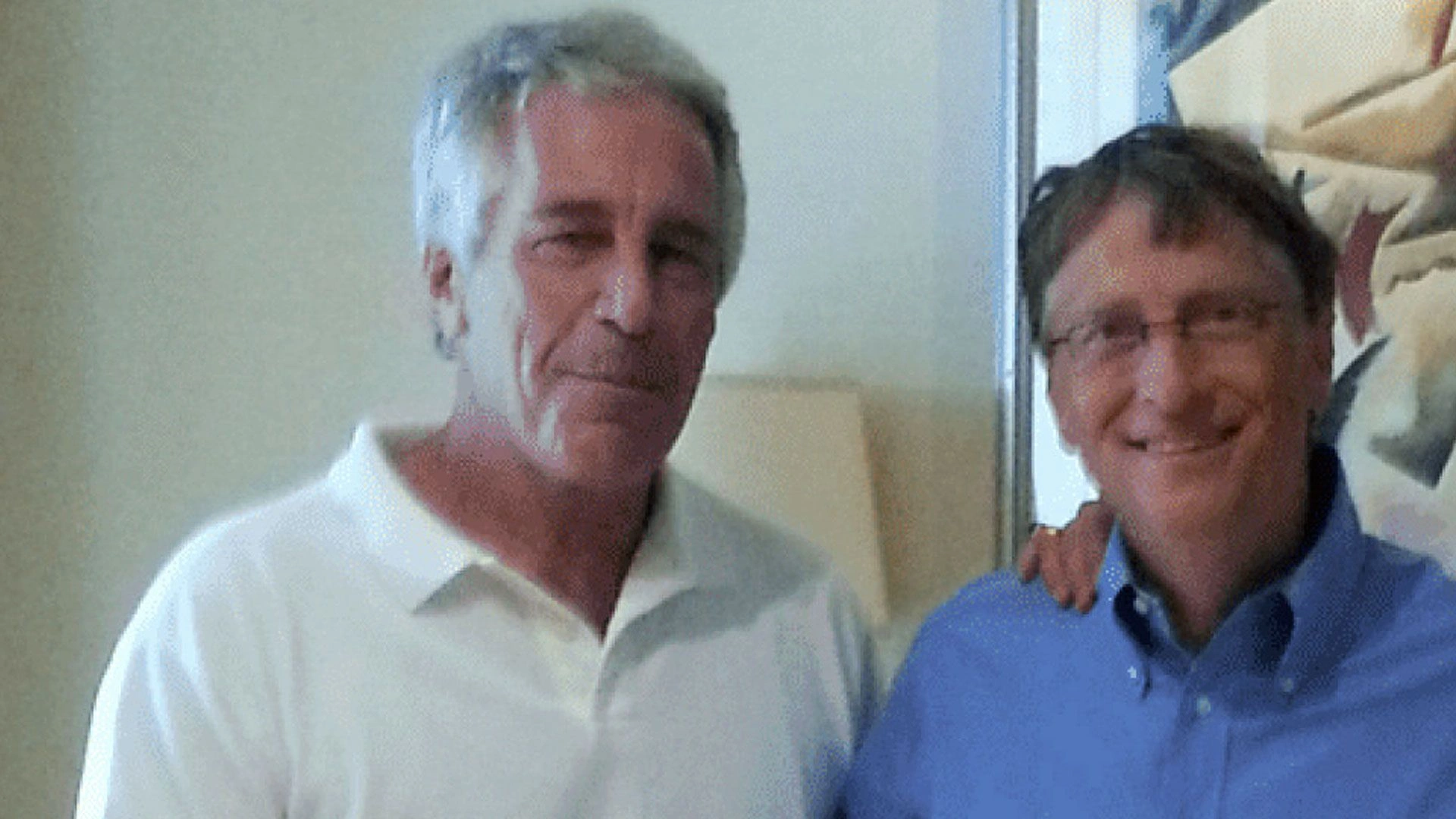
In the Lolita Island scandal, the zeal of English-language netizens for digging up and spreading dirt was far higher than that of the mainstream media. Yet in Huang’s case, the transatlantic mainstream media formed a solid matrix, hounding him relentlessly and digging three feet into the ground; the number of affair partners has now risen to three, and pieces with titles like “Bringing Shame to Leather-Jacket Enthusiasts” have also appeared. They want not only to make Huang lose his leadership of the AI revolution and control over his commercial wealth, but to put him to complete social death — knocked to the ground and trampled under ten thousand feet.
For the Chinese-language Democrats base, spreading the gospel of neoliberal snake oil is loyalty, defending America (and America’s vassals) is filial piety, and entrusting to it their dream of flipping their lot and becoming masters under the American neoliberal system is steadfast devotion. After Huang’s trouble, the US-market mid-cups try to prove that the board’s palace coup is perfectly normal business behavior, and continue to deceive themselves that “there is no racial discrimination in America,” sustaining the pipe dream that “I am respectable in America and can turn my life around.”
“An ethics scandal leading to dismissal is normal business behavior” has already become the Democrats base’s standard line. Surveying the examples they cite, only American Apparel involved a founder being kicked out, but that company is a roadside outfit that sells clothing (literally roadside). In America, professional managers are a dime a dozen, listed companies are a dime a dozen; but for a company as important to the AI revolution and the American economy as Nvidia, and a person as important to Nvidia as Huang, to be expropriated by American politicians and capital in collusion (rumor has it that the “A” beasts were deeply involved in sniping Huang — see our Friday piece) — the DEM base will never find a second case.
Great companies can make big money, but if you only think about making big money you will never build a great company. One must objectively acknowledge that, compared with many of the successive richest men in China who have fallen into the eye of money, some American big capitalists really do have idealistic visions and a technical temperament that transcend profit (of course, this is not necessarily a good thing for ordinary people — for example, the hyper-macho Silicon Valley right represented by Musk, with its technological ideals). And at a time when the technological revolution is in full swing and technical complexity keeps rising, the importance and contribution of this personal temperament to major technological innovation is constantly increasing.
Huang is one of the more moderate among America’s idealistic capitalists, unmixed with crazy social and political schemes, but with an extraordinary intuitive acuity about technology. As early as 2006, when Nvidia was still just a graphics-card company serving smelly gamers, Huang withstood Wall Street’s accusations of “wasting money and dragging down profits” and insisted on pushing the CUDA ecosystem, laying the foundation for Nvidia’s current status as the top dog in AI computing. In the past two years, Huang has been a one-man army inside the company, orchestrating all the important businesses and pushing them forward methodically. His control over Nvidia is reflected not only in the authority of a founder, but in the perfect fusion of technical and managerial ability — something no successor can replace.
Now the Chinese-language Democrats base has switched tune, writing at great length that Huang holds only 4% of the shares and has no special control structure, so it was all too easy and too normal for the board to force him out. To defend the legitimacy of America and neoliberal theory, they do not hesitate to reduce Huang to insignificance and trample on the object of their own dreams — truly undivided in loyalty, a filial piety that moves Heaven. (Or: why is it that a whole bunch of white-guy companies in Silicon Valley can set up AB-share control structures, but you, Huang, can’t?)
There are also US-market mid-cups who staunchly follow the Democratic Party line and accuse Jensen Huang of selling cards to an “enemy state.” Arbitrarily slandering Singapore — banana-skinned loyal hound and Southeast Asian shit-stirrer — as an “enemy state,” and speculating on their own authority beyond the BIS’s authoritative conclusion: truly a disloyal and unfilial lot!
Whether one compares the severity of the ethics scandal, the solidity of the evidence for colluding with and aiding the enemy, the individual’s control over the company, or the company’s importance to the American economy, no rationale can be found for America’s urgency in settling scores with Huang. Then the only explanation left is the yellow skin beneath that yellow leather jacket.
The cornerstone of the latest round of technological revolution, a super-oligopolistic enterprise that has long held and repeatedly broken the record for the world’s highest market capitalization, has no right to own private property in the hands of a yellow man; it must be a white skin that confers the sacredness of private property upon it.
The cruel fact that the Chinese-language Democrats base is unwilling to admit is that the stronger China becomes, the stronger America’s rejection and suspicion of them will grow, and the more they will look like “Chinese spies” in American eyes. Those who have already “run” to America are spies currently on mission; those who profess loyalty in the mainland are well-embedded bait “spies.” Huang has done great service for the stock accounts of all you grandees, and has rendered great service in keeping America’s AI revolution temporarily ahead; he has a direct phone line to Trump the Great Commander — yet settling accounts with him still took only ten days. Then what about the other yellow-skinned DEMs with no political or social standing at all?
Of course, in civilized countries, how can this be called violating private property rights? Even though America is robbing Nvidia, the Netherlands is robbing Nexperia, and Britain is robbing the Chinese-controlled British Steel, Acemoglu knows they are still good institutions.
But Acemoglu also cannot say clearly just how long “the long run” is in “extractive institutions are bound to be doomed in the long run.” From the standpoint of hindsight, one can of course say that the “long run” of the Spanish-speaking colonies was more than a century, and that of the Soviet Union was less than seventy years. By their theory, the US and the West, which have never “strictly protected private property rights,” would never “achieve long-term prosperity”; it is merely that their capacity for extraction is stronger and their technique more refined, so the “long run” before decline and blow-up is longer.
Editor: zhangyixincq
https://mp.weixin.qq.com/s/segKkkKxH1R8eQI1hPHCbw?scene=1&click_id=599770097
This article has been edited during translation for clarity.
NotChasing
Thank you. I’m not sure that private property is the best focus for this argument. Huang’s shares in Nvidia haven’t been confiscated; that would indeed be an outrage. But there certainly are double standards, and I agree that this attack on Huang was orchestrated.
Also, a small point about the indigenous peoples in the US, I believe that many of them did not recognize private ownership of land. So when you write that the original land owners were killed and their land claimed by ‘pioneers,’ it was more complicated than that, and in some ways worse.
方腾波
You forgot to mention the american zionists who have set up this trap for Huáng Rénxūn 黄仁勋.
Nathan Gant
I’m not convinced that Jensen Huang is guilty of anything, and there is no definitive proof that Alice Huang was ever a Chinese spy. Innocent until proven guilty in a US court. Likewise with President Nicolás Maduro and his wife, who have been falsely accused of drug smuggling. And there’s always this double standard in US wrt politics and ‘national security’. I still remember the Iran-Contra affair, especially Col. Ollie North’s involvement with the guns and drugs. He was definitely involved in all of that sordid business, and after the courts found him guilty, his conviction was reversed nonetheless. Even worse, Oliver North turned the criminal behavior from his Iran-Contra affair into fame and wealth, built a lucrative career as a bestselling author, media host, and public speaker. He is an example of how crime pays if you’re a rightwing warmonger, and he became a millionaire within just a few years of leaving the White House.