


In recent days, an AI-generated comic image has gone viral on social media. The character in the image is Liang Wenfeng, but stylized in a comic-book way, visually resembling superheroes like Superman. Netizens have remarked that this is how overseas developers see Liang Wenfeng.

What the comic aims to express is that just last weekend (July 31), after the official version of DeepSeek V4 Flash went live, its extreme cost-effectiveness reversed the AI usage landscape for global developers.
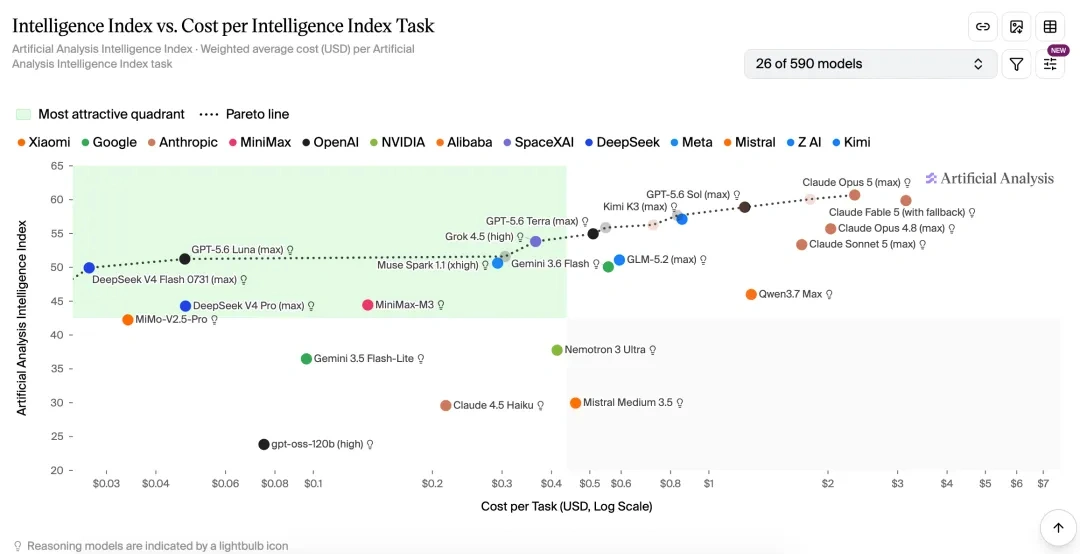
The independent overseas large model evaluation community, Artificial Analysis, after testing over a hundred large models, gradually developed a chart in which DeepSeek-V4-Flash became a dividing line.
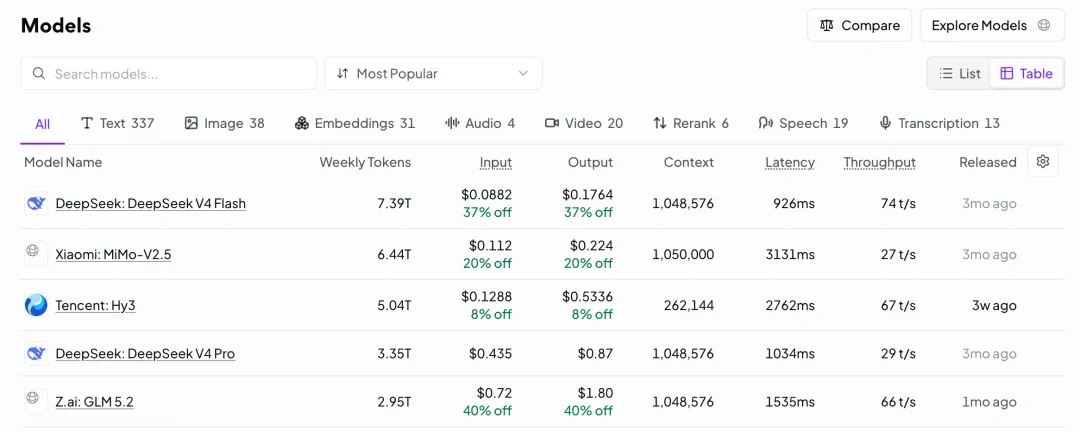
The latest weekly statistics from OpenRouter show that DeepSeek-V4-Flash has topped the platform’s chart for model call volume, while V4-Pro remains firmly in the top five. Global developers are continuously migrating their production inference traffic on a large scale to the model interfaces of this Chinese AI company.
Jay (Jayakumar), CEO of OpenCode, also posted on August 1, stating that usage of DeepSeek V4 Flash grew by 30% in a single day after its launch, and new subscriptions to OpenCode Go also grew by 30%.
For a very long time, the global large model market rules were written by Silicon Valley giants. OpenAI, Anthropic, and Google set the performance benchmarks while firmly controlling the pricing discourse. The prohibitively high inference costs built a high barrier to entry for AI entrepreneurship. Overseas developers who wanted stable, high-quality large model services seemed to have no choice but to passively accept the pricing of closed-source giants.
Now, the industry landscape has reached an irreversible inflection point. Relying on continuously iterative model capabilities and extremely compressed cloud API pricing, DeepSeek has drawn a clear “Kill Line” in the global developer market.
DeepSeek V4 Flash Tops Again, Chinese Large Models Take the Top Five
The so-called “Kill Line” does not merely refer to a performance watershed but the critical balance point between performance and price: among models in the same capability tier, those priced significantly higher than DeepSeek will continue to lose small and medium-sized developers; products with weaker performance than DeepSeek yet higher costs will see their living space rapidly shrink.
In the latest cycle, OpenRouter’s public Token call data shows that DeepSeek-V4-Flash has taken the first place in platform-wide single-model call volume. Spots two through five are respectively held by: Xiaomi MiMo-V2.5, Tencent Hy3, DeepSeek V4 Pro, and Zhipu GLM5.2. When aggregating the total call volume of all domestic Chinese models, it has surpassed the sum of closed-source models from American companies for multiple consecutive weeks. Notably, developers from the United States and Europe account for nearly half of the access traffic. A large number of Agent automation projects, code assistance tools, and long-text processing applications are actively switching their default models to DeepSeek.
In stark contrast, the call growth rate for mainstream versions of Claude and Gemini flagship models is continuously slowing down, and the market share of traditional overseas closed-source leading models is steadily shrinking. Several founders of overseas AI startups have publicly reviewed their strategies on X, stating that after migrating their teams entirely to DeepSeek, monthly inference costs dropped by 60% to 85%. For small and micro AI companies that are not yet profitable and have tight cash flows, such a huge cost difference is enough to determine whether a project can survive.
The market is gradually splitting into two tiers. Large multinational enterprises, due to data compliance and supply chain risk considerations, still tend to procure services from local providers like OpenAI and Google. However, the more flexible and extremely cost-sensitive small and medium-sized developer community has already begun a massive migration.
Many industry observers believe that OpenRouter’s data has torn away a layer of industry facade: in the past, many teams chose Silicon Valley giant models not because they believed their performance was irreplaceable, but because they had long lacked an alternative with sufficiently high cost-effectiveness. When a low-priced model with top-tier capabilities emerged, the demand side immediately shifted its choices.
Of course, data from third-party aggregation platforms has its natural limitations. Traffic volume does not equate to enterprise revenue scale, as a large amount of calls are concentrated on low-priced, lightweight Flash versions; also, the platform sample cannot represent the government and enterprise large-account market. But it is undeniable that the developer community is the source of innovation for the AI industry. Capturing developers means capturing the foundation of the future application ecosystem.
Still the King of Cost-Effectiveness
On the very day DeepSeek released V4 Flash, Artificial Analysis tested 128 large models. The term “Kill Line” originated from this. Developers generally believe that merely low prices without competitive performance, or merely high performance without the ability to shake up the existing market, are insufficient. Only when a model reaches near-top-tier performance while simultaneously forming a cliff-like price advantage can it create a sustained squeeze-out effect on competitors.
Reviewing the evolution of DeepSeek’s pricing strategy, one can clearly see how it built its price barrier step by step. In May 2026, DeepSeek-V4-Pro announced a permanent price cut of 75%, turning a short-term promotion into a long-term baseline price, breaking the price floor for high-end reasoning models globally at the time. Subsequently, V4-Flash was officially launched, combined with a dialogue caching mechanism and peak-valley differential pricing strategy, further lowering the input Token cost in cache-hit scenarios.
A horizontal comparison of the current public cloud API pricing for mainstream large models (per million Tokens, in USD) shows a glaring gap: DeepSeek V4-Flash output pricing is $0.28 per million tokens; even after multiple rounds of price cuts, GPT-5.6 Luna has an output price of about $1.2 per million tokens. Claude Sonnet and Gemini flagship models in the same tier are generally priced several times, or even nearly ten times, higher than DeepSeek.
This set of data has fostered a consensus in the overseas developer community: for the vast majority of B2C and small-to-medium B2B commercial scenarios, there is no commercial viability in bearing dozens of times the inference cost for slight performance improvements. Any competing product that falls above this “Kill Line” has only two paths left: proactively slash pricing significantly, or completely abandon the mass developer market and focus on high-end enterprise clients with ample budgets and a focus on supply chain stability.
Facing the continuous diversion of traffic, OpenAI urgently lowered the pricing of its GPT series models; European manufacturer Mistral readjusted its commercialization plan, relying on an open-source, free-to-use strategy paired with cloud discounts to hold onto its developer base; a number of small and medium-sized open-source model service providers were forced to recalculate costs and give up the illusion of profiting from high API margins.
More crucially, DeepSeek has long been known within the industry for its low pricing. This is not a subsidy-driven price war strategy but is achieved through ongoing engineering optimizations at the foundational level—such as efficient inference architectures, dynamic KV caching, traffic peak-valley scheduling, and long-text optimization solutions—all of which collectively drive down the single Token inference cost.Internally, Liang Wenfeng stated that the low-price strategy allows more developers to use DeepSeek, which is highly motivating within the company.
The cost-effectiveness Kill Line brings a new industry proposition: the core metric of large model competition is shifting. In the past, the industry competed on parameter count, training compute, and benchmark scores; now, the first metric developers calculate is “how much effective output can be obtained per unit cost.”
48 Hours That Stirred Social Media
Data on performance and pricing ultimately translates into real community word-of-mouth. X, the Reddit r/LocalLLaMA section, Hacker News, and the LMSYS Chatbot Arena constitute the main battlefields of overseas public opinion. On X, a large number of frontline developers and AI entrepreneurs continuously post actual testing content, pushing DeepSeek’s popularity to a sustained high, with public opinion showing clear layering.
Cleverly, just one day before the official release of DeepSeek V4 Flash, OpenAI had just announced an 80% API price cut for GPT-5.6 Luna. The next day, some posted DeepSeek comparison images in the comment sections, while others thanked Chinese AI models, saying they had made OpenAI panic, which benefits developers.
Many individual developers also expressed great fondness for DeepSeek, not only for its high cost-effectiveness but also for its fast response times, describing the user experience as “silky smooth.”
Wall Street analysts have slightly divergent views. The optimists believe that the price competition initiated by DeepSeek will accelerate the implementation of AI applications and lower the global threshold for innovation. Pessimists worry that a sustained price war will compress industry-wide profits, weakening the financial capacity for long-term model research and development.
The cost-effectiveness Kill Line drawn by DeepSeek essentially represents a head-on collision between two global large model development paths.
One is the path represented by Silicon Valley giants: invest heavily in training closed-source flagship models, maintain relatively high gross margins, focus primarily on large enterprise clients, obtain revenue from high-value B2B orders, prioritize pushing the upper limits of capability, and react relatively slowly to pricing changes in the mass developer market.
The other is the path represented by DeepSeek: rely on engineering optimization to compress inference costs, balance the open-source ecosystem with cloud services, follow a high-volume, low-margin route, prioritize capturing the developer community, spread costs through scale effects, and rapidly expand global market share through cost-effectiveness.
There is no absolute right or wrong between these two paths, but DeepSeek’s rise proves a core fact: competition in large models is no longer just a contest of cash-burning scale. Computing power investment is only the foundation; inference efficiency, commercialization pricing, and ecosystem strategy can also rewrite market share.
The global large model reshuffle triggered by cost-effectiveness is far from over. Price competition is just the prelude. What follows—the long-term contest in model capability iteration, global service capabilities, compliance solutions, and commercially viable profit models—will determine who can stand firm. Just this Monday (August 3), MiniMax officially open-sourced its general video model H3, aiming to replicate the DeepSeek effect in the multi-modal domain. On the same day, Alibaba’s Qwen3.8-Max large model also officially went live, with a total parameter count of 2.4 trillion, making it the most powerful model in the Qwen family to date. The model weights will be open-sourced next week.
For millions of AI developers worldwide, the most tangible change has already happened: more choices are available, costs are decreasing, and the threshold for innovation is being continuously lowered.
Editor: zhangyixincq