



DeepSeek has been pursuing open source radically in recent months, beginning with the release of foundational components designed to work with Huawei’s Ascend AI accelerators. This was followed by an update to its Flash model, which has become arguably the most cost-effective AI model currently available for practical work. Last week, the company went a step further by open-sourcing its internal inference framework
While the first two moves could still be explained in commercial terms, as they accelerated compatibility with domestically developed hardware and represented a routine model upgrade, the decision to open-source its inference framework goes well beyond conventional business logic. DeepInfer, DeepSeek’s internal inference framework, enables the company to serve more users simultaneously with limited computing resources, making it one of DeepSeek’s most valuable trade secrets.
Exceptional optimization capabilities have always been among DeepSeek’s greatest strengths and remain central to its competitive advantage. It is no exaggeration to suggest that, if the company’s valuation could be broken down into individual components, its innovations in inference infrastructure might account for a third of its value. According to data provided by DeepSeek, the company may be capable of processing 155 trillion tokens per day using a cluster of just several thousand accelerator cards, a level of efficiency that would have been almost unimaginable with previous inference frameworks.
Given its talent pool and engineering expertise, we have every reason to believe that DeepSeek could develop even better frameworks in the future, while the combination of domestically developed computing hardware and software-hardware optimization could enable it to deliver better services. Nevertheless, its decision to open-source the inference framework demonstrates that the company is motivated by considerations extending far beyond commercial interests.
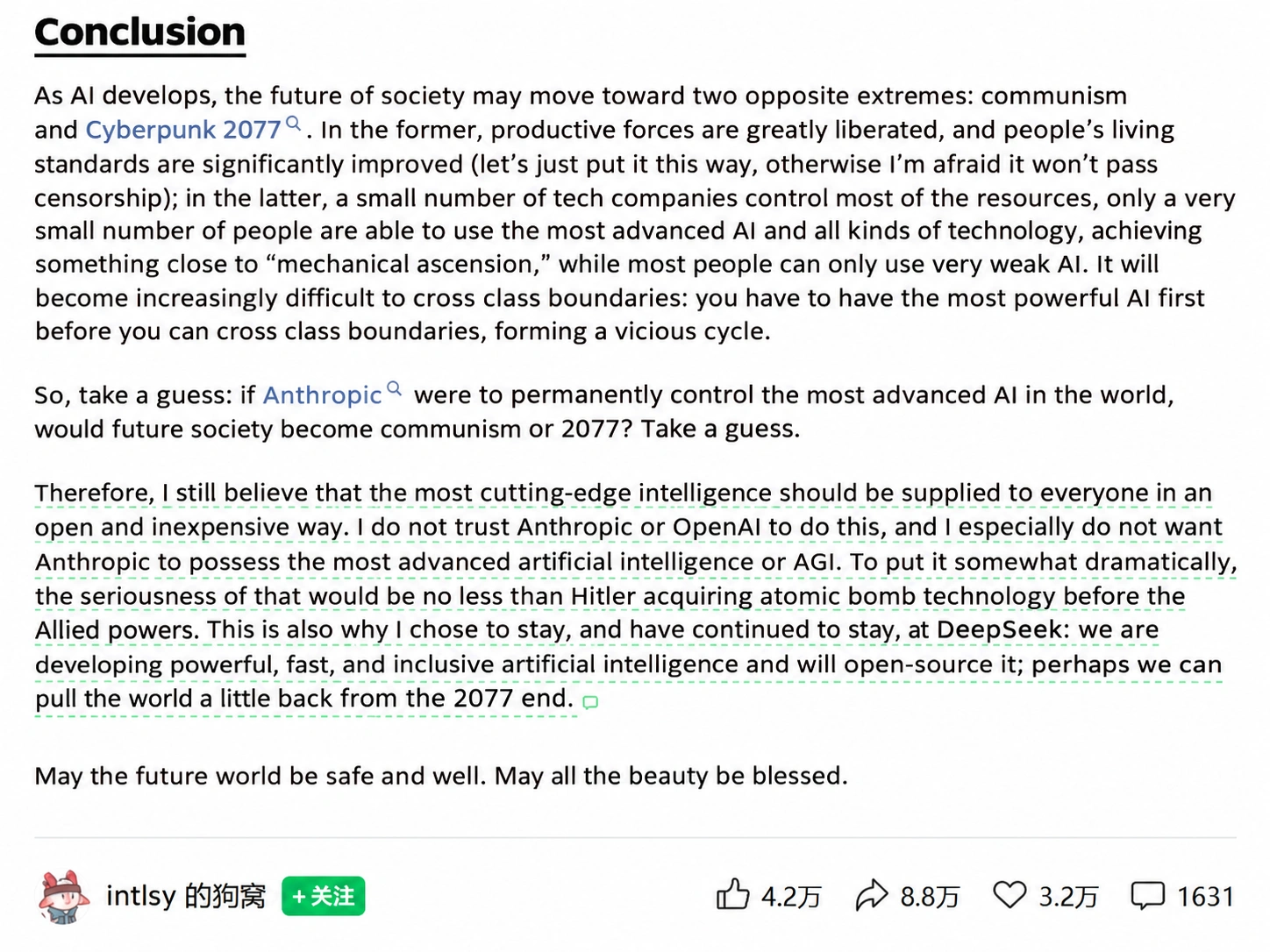
When this decision is considered alongside several other recent developments, a deeper picture begins to emerge. Last month, DeepSeek engineer Liu Shengyu, who works on operator design, wrote an article titled I Had to Bury My Talent in Yesterday, in which he argued that open-sourcing artificial general intelligence (AGI) would bring human society closer to communism, whereas handing control over AGI to people like Dario Amodei would inevitably lead humanity toward a cyberpunk dystopia.
Following the release of the inference framework, Chen Deli, a senior researcher at DeepSeek, also posted a striking statement on social media:
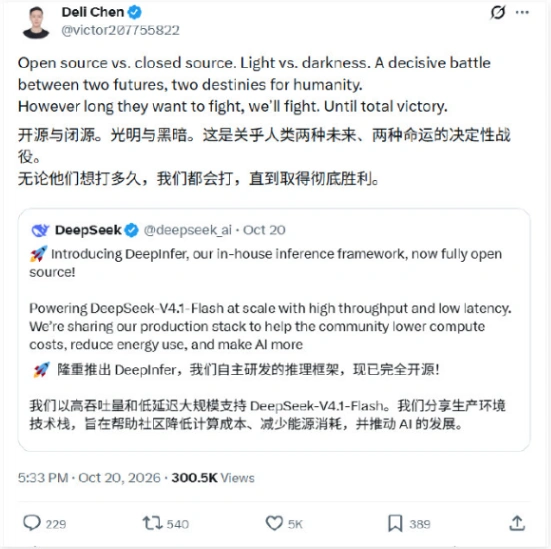 Editor’s note: This statement is adapted from a famous speech delivered by Mao Zedong at the Fourth Session of the First National Committee of the Chinese People’s Political Consultative Conference on February 7, 1953, during the War to Resist US Aggression and Aid Korean:”I think we shouldn’t decide how long the war will last. It was up to Truman in the past, and it will be up to Eisenhower or whatever future president of the United States in the future. That is to say, we will fight for as long as they want, until we achieve complete victory.”
These statements reveal a distinctly idealistic culture within DeepSeek, something equally evident in the remarks of its founder, Liang Wenfeng, who appears genuinely committed to the principles of open source. Perhaps it is precisely this idealistic atmosphere that helps explain the remarkable stability of DeepSeek’s team. Although employee turnover is exceptionally high across the global AI industry, DeepSeek may have one of the most stable teams anywhere in the sector.
Such stability cannot be explained by compensation alone, given that even Silicon Valley giants offering astronomical salaries continue to struggle with employee retention. According to some reports, although DeepSeek pays its employees very well, its compensation packages still fall somewhat short of those offered by certain major Chinese technology companies. Idealism, however, can satisfy a different set of human needs: once income reaches a certain level, material considerations become secondary, while the search for meaning and purpose takes precedence.
Many observers might regard this as an admirable corporate culture worth emulating or simply appreciate DeepSeek for providing the world with affordable, high-quality AI models. In the present era, however, the significance of its idealism may extend far beyond corporate culture or cheaper technology. Consider the cult-like atmosphere surrounding Anthropic and, more broadly, Silicon Valley’s AI industry. For the sake of humanity’s future, we must develop an alternative vision of our own that can stand in opposition to the technological right and the intellectual movement known as the Dark Enlightenment.
Most western AI entrepreneurs are deeply fascinated by right-wing or even far-right ideas. Although they may not have read the relevant theoretical works themselves, their actions effectively put right-wing technological accelerationism into practice, reflecting a belief that an all-powerful AGI can solve virtually every problem and that they themselves are qualified to determine humanity’s destiny. Given this extreme, almost apocalyptic vision of the future, it is hardly surprising that so many critics have described Anthropic’s internal culture as cult-like, a comparison that is not entirely misplaced.
 Anthropic’s co-founder Chris Olah once traveled to the Vatican to try to persuade the Pope to revise his first papal treatise, which emphasizes upholding the sanctity of human life in an age of AI, and publicly claimed that AI model Claude has internal states similar to introspection, happiness, and sadness.
Of course, definitions of AGI vary considerably, with the supposedly omnipotent AGI so enthusiastically promoted in Silicon Valley representing one of the least realistic interpretations. The realities of social development tell us that artificial intelligence will indeed bring profound changes to human civilization, although whether those changes ultimately benefit or harm humanity is not predetermined and must instead be decided by humanity itself. What is certain, however, is that allowing people who believe they are entitled to rule the world to control these technologies would be disastrous for humanity as a whole.
Unfortunately, the contemporary Western left has struggled to develop an effective response to artificial intelligence. This does not mean that Western leftists are unwilling to confront the issue; on the contrary, they have devoted considerable thought to AI, although much of that thinking ultimately leads to opposition to the technology itself. Neo-Luddism is even experiencing something of a revival.
The Western left certainly has legitimate reasons to criticize AI, whose current development has created far more problems than most people realize. Uncritically embracing every aspect of AI would be a serious mistake, but we must also face the reality that expecting human society to return to the world that existed before the current AI revolution is highly unrealistic, especially as the technology is likely to continue advancing for the foreseeable future.
What we need, therefore, is a form of left-wing technological accelerationism that can approach AI’s implications for the left with optimism rather than resignation. Yet this ideological space is almost entirely unoccupied in Western countries, leaving a significant gap in the left’s response to the AI revolution. Some might call this a failure of the contemporary left, but the reality is considerably more complicated.
The roots of the Western left’s loss of faith in technological progress can be traced, first of all, to the protests of May 1968, when left-wing movements across Western countries invested enormous enthusiasm in a period of upheaval whose outcomes ultimately fell far short of their expectations. What followed was a prolonged period of political and intellectual disillusionment, the effects of which persist to this day. Many on the Western left remain deeply skeptical of constructive forces capable of producing meaningful change, having lost faith in the possibility that new forces can build something better.
This deeply ingrained pessimism has subsequently been reinforced by practical experience, as environmental politics particularly clearly demonstrates. A decade ago, many Western liberal progressives were enthusiastic advocates of advanced environmental technologies, whereas today a common argument in the same political circles is that these technologies can accomplish only so much and that humanity may already be losing its ability to control climate change.
Such a shift reflects the failures of Western countries to translate their environmental agendas into effective action, which have led many progressives to regard new environmental technologies as a means of avoiding fundamental problems rather than solving them. This mentality has increasingly extended into discussions of artificial intelligence.
From another perspective, Silicon Valley, widely regarded as the center of contemporary technological innovation, has carried a distinctly right-wing political character since its earliest days. Its close historical relationship with the US military meant that it was never an ideologically neutral space.
When American left-wing thinkers examine the history of Silicon Valley’s political development, they often point to the influence of Newt Gingrich’s conservative politics on the industry’s ideological orientation, a subject whose full history could easily fill an entire book. One recent example, however, is enough to illustrate the continuing connections between Gingrich and Silicon Valley. A newly established American organization dedicated to studying the future of warfare involves not only Elon Musk and Palmer Luckey but also Gingrich as another leading figure, whose participation speaks volumes about the relationship between conservative political forces and the technology industry.

Against this historical background, expecting Silicon Valley to produce a genuinely influential left-wing intellectual movement is hardly realistic. Amid all the hype surrounding artificial intelligence, the most left-leaning intellectual movement Silicon Valley has managed to produce is the so-called Abundance Agenda, which attracted considerable attention last year but is itself fundamentally rooted in right-wing thinking. Given this ideological environment, it is hardly surprising that the Western left has become so deeply critical of AI.
The situation has now changed, however, with China emerging as another major center of AI innovation alongside Silicon Valley. Because China’s circumstances differ from those of the United States, its technological development offers the possibility of an alternative path for artificial intelligence.
Chinese AI companies do not necessarily have to become the architects of left-wing accelerationism, a task that may well be beyond their capabilities. Nevertheless, the different path they have chosen can offer left-wing intellectuals around the world an entirely new set of possibilities for imagining the future of AI.
We must also recognize that, although Chinese AI companies operate in a different environment from their American counterparts, they remain subject to the economic logic of capital. Consider Silicon Valley before the era of large language models, when open source was still a mainstream part of its technological culture. Its subsequent decline can be explained by the enormous capital investment required in the age of large AI models, which makes open source look deeply unattractive from the standpoint of capital accounting. Idealistic programmers also exist in present Silicon Valley, but idealism alone is insufficient to overcome the pressures of capital.
It is precisely in this context that DeepSeek has played such a distinctive role in China’s AI development. By promoting open source, the company has not only helped establish an open-source culture within China’s AI industry but also demonstrated the technological and commercial sustainability of that approach. As its technological achievements and commercial success continue to reinforce each other, DeepSeek’s core team appears increasingly convinced that it has chosen a worthwhile path. Perhaps, in the not-too-distant future, China’s AI community will give rise to its own version of left-wing technological accelerationism.
A clarification is necessary here, since accelerationism has not historically been an entirely positive concept in philosophy. Since its emergence, it has been criticized for effectively evading real-world problems by placing its hopes in an omnipotent “Big Other” capable of solving everything. Nevertheless, accelerationism’s engagement with technology occupies an intellectual space in contemporary society that cannot easily be replaced.
At a time when right-wing accelerationism is gaining ground, the existence and practical application of left-wing accelerationism are necessary if the AI era is to open up a broader range of possibilities. From this perspective, DeepSeek’s commitment to open source can be understood as a practical expression of left-wing accelerationism in the broader sense. Although it is certainly far from a flawless theory, left-wing accelerationism is a school of thought that our era cannot afford to be without.
Strictly speaking, DeepSeek’s own reasons for choosing open source do reflect a certain technological accelerationist outlook. According to interviews, one of the company’s central motivations was its belief that the supposed technological barriers surrounding artificial intelligence are not as formidable as commonly assumed. Since technological diffusion is ultimately inevitable, DeepSeek regards accelerating technological progress through open source as the most sensible choice.
Such a conclusion may not seem particularly difficult to reach today, but embracing this position when Chinese AI models were still significantly behind their American counterparts required genuine faith in the prospects of open source and accelerated technological development.
At that time, much of the global AI industry doubted the value and potential of open source while accepting the prevailing assumption that AI development involved technological barriers that would be extraordinarily difficult, if not impossible, to overcome. By rejecting that assumption, DeepSeek made a decision that has proved critically important not only for China but also for the entire world. Historical development is shaped by the interaction of necessity and contingency. Although some transformations may be inevitable over the long term, the decisions of key individuals and organizations at particular historical moments can bring those transformations forward.
This brings to mind an interesting phenomenon. Before the emergence of China’s open-source AI movement, discussions of open source on the Chinese internet frequently portrayed it as a symbol of American, or more broadly Western, openness and progress. Today, however, whenever open source comes up, we increasingly encounter sarcastic remarks from self-styled Silicon Valley enthusiasts and commentators whose worldview remains deeply conditioned by Western intellectual and political dominance. Of course, certain groups have always adjusted their rhetoric to align with whatever happens to be the prevailing ideological position in the West.
To be fair, if we set aside a deeper critique grounded in political economy and look only at the original motivations of Western programmers who championed open source, we can indeed identify a considerable degree of left-wing technological idealism, even utopianism. Yet even this limited form of technological leftism is now disappearing in the United States, where the government and corporate capital have become increasingly intolerant of open source. While many companies talk endlessly about their commitment to openness without doing much to put those promises into practice, others, such as Anthropic, have devised an endless series of justifications for keeping their technology closed, claiming that open source is dangerous, threatens world peace, undermines cybersecurity, and poses all manner of other risks.
Behind these developments lies a confrontation between two fundamentally different visions of the future. Silicon Valley’s technology giants appear convinced that only they, as the supposed future masters of an all-powerful AGI, are qualified to determine humanity’s destiny, an attitude that may well represent one of the most arrogant ideologies in human history. China’s open-source AI models, by contrast, offer a radically different vision in which artificial intelligence would become an affordable form of essential infrastructure, accessible to everyone on equal terms, so that no individual or corporation could monopolize AI and use that monopoly to exercise control over the world.
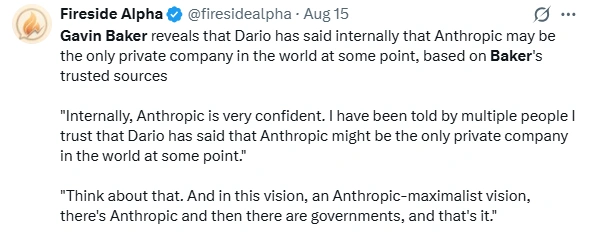
This is probably the conviction that inspires the young people at DeepSeek who declared that they would continue the struggle “however long they want to fight, we’ll fight, until total victory.” Yet translating this vision of equality into reality involves problems that neither a single AI company nor the AI industry as a whole can solve on its own. In his article I Had to Bury My Talent in Yesterday, Liu Shengyu raises precisely this question of what humanity’s future should look like after artificial intelligence has transformed the world so profoundly.
It is a positive development for the entire world that DeepSeek’s engineers, as developers working at the technological frontier, are willing to reflect on such questions. Nevertheless, we must recognize that algorithm engineers, philosophers, and sociologists perform different roles, and that some questions ultimately have to be addressed by thinkers and revolutionaries. The left, both in China and around the world, should therefore devote serious attention to the positive possibilities that AI-driven social transformation could open up for humanity, including how artificial intelligence might help create a better and more equal world.
For that reason, the cult-like ideology associated with Anthropic must be thoroughly challenged and dismantled through criticism. Artificial intelligence is an extraordinarily powerful technology, but it is ultimately not a god. Even if AI has already surpassed human capabilities in many fields, its development remains subject to comprehensible patterns and limitations.
Whatever the future holds, the contemporary left needs someone to occupy the intellectual and political space of left-wing technological accelerationism, since the problems posed by an entirely new era cannot be solved simply by allowing events to take their course without serious reflection.
The encouraging news is that Chinese technology companies, represented by DeepSeek, are now offering the left a vision of the future fundamentally different from the one being promoted in Silicon Valley. Although history and present-day realities both remind us that the existence of new possibilities does not automatically guarantee positive outcomes, and that a better future will ultimately require the collective efforts of countless individuals, without the possibility of something better, there can be no better future at all. Whether humanity can seize this opportunity is a question that only time will answer.
Editor: Chang Zhangjin

NotChasing
My friends, there don’t seem to be many comments on the articles you’re posting, including this one. If I may make a suggestion: the way that the ideas in this article are organized does not obey conventions for writing in English. If your goal is to engage with English-speakers, it might be better to translate articles that are written in a style which is more familiar to us.
gus auyeung
just a comment on -obey conventions for writing in English-
if one does not like the way tableware-convention- is set out for a meal, one can always go hungry. Mark Twain once said-it is better to keep the mouth shut and appear stupid then to open the mouth and remove all doubts.