



Atlantic waves have long lapped against Cabo Verde’s shores. This early summer, the World Cup has carried their echo far across the globe.
Home to just over half a million people, this West African archipelago stretches across the Atlantic Ocean, and its national football team is known as the Blue Sharks. At this World Cup, the Blue Sharks fought their way to the Round of 32, before falling narrowly 2-3 to defending champions Argentina in the knockout stage. Though their tournament run ended there, Cabo Verde stepped into the global spotlight for the first time.
 Fan creations of Cabo Verde goalkeeper Vozinha have gone viral on Chinese social media. Users compare Vozinha, as seen in photo above, to a surfer named JKL from SpongeBob SquarePants Season 6, often with the caption “This is the wave I’ve waited my whole life for” — a fitting metaphor for Vozinha’s career (Photo generated by AI)
Cabo Verde is one of the few Portuguese-speaking nations in West Africa. It’s just an hour’s westbound flight from Dakar, Senegal, where the correspondent is based. In May, on a reporting trip to Cabo Verde, the correspondent immediately sensed an atmosphere distinctly different from mainland West African countries that the correspondent is familiar with. More surprisingly, the presence of China emerged earlier and more extensively here than anticipated. Upon landing, Chinese-manufactured security screening equipment can be seen inside the airport terminal; in downtown Praia, the capital, Chinese-run supermarkets and grocery stores are everywhere, some bearing signs in Chinese. Few readers may realize that China-Cabo Verde ties have long been woven into the fabric of local daily life.
1. Difference Made by the National Stadium
In its first World Cup campaign, Cabo Verde made it to the Round of 32.
After the tournament, the president of Cabo Verde José Maria Neves took to social media to praise the Blue Sharks for their talent, courage and determination. The team, he wrote, had put Cabo Verde on the world map and charted a path for the country’s future. Reporting from across Cabo Verde, the correspondent found that the small nation’s football ambitions are built not just on raw talent, but on increasingly solid foundations.
Football is deeply loved across the archipelago, played everywhere from street pick-up games to inter-island and inter-school tournaments. Through its youth system, Cabo Verde sends young talent to train in Portugal every year. Many players in this World Cup squad grew up or were even born in Europe, supported by the country’s large overseas diaspora. President Neves hailed the team’s World Cup breakthrough as “a symbol of growth for all Cabo Verdeans around the world.”
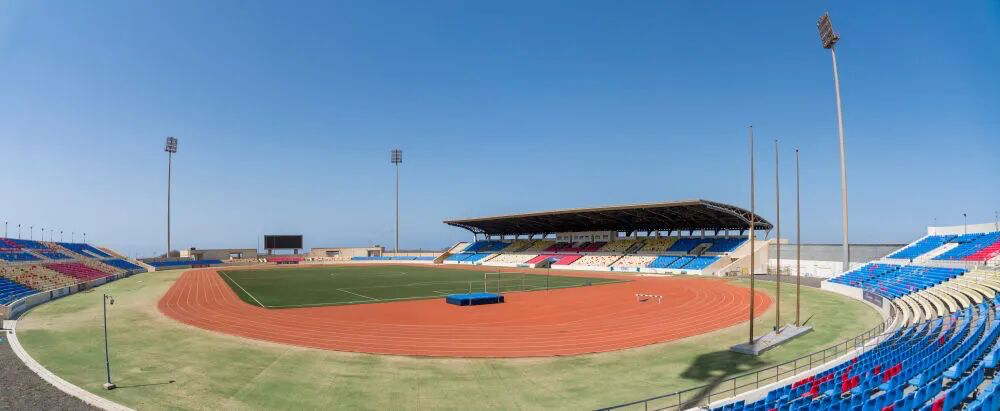 Interior view of Cabo Verde National Stadium (Photo by Xie Jianfei)
The role of infrastructure in this progress cannot be overstated. The correspondent visited the Cabo Verde National Stadium, a Chinese-aided facility handed over in 2014 with a seating capacity of around 15,000. It serves as one of the national team’s regular training venues.
“In my view, Cabo Verde’s sports development is split into two eras: before the national stadium opened, and after,” said Orlando Mascarenhas, head of the stadium’s management authority. “It was the first large-scale, multi-purpose national sports facility built since Cabo Verde’s independence, and it remains the largest sports infrastructure in the country to this day.”
A stadium alone does not account for the team’s miracle to the Round of 32. But in Cabo Verde, reliable training pitches, venues fit for international events, and public spaces that bring the national team closer to its people are all integral to the sport’s growth. Players train here, fans gather here, and young children grow up, taking the “national team” as their own dreams.
During the World Cup, local football academies in Praia saw a surge in public interest and new registrations. On training grounds, children see national team players not as distant celebrities, but as attainable role models. Ten-year-old goalkeeper Diego Silva Carvalho trains in a pair of boots signed by national shot-stopper Vozinha. For him, the boots are way more than a souvenir — they are an inspiration. “I work hard every day in training so that one day I can represent my country, just like Vozinha,” he said.
On July 5, the national team returned to Praia at the end of their World Cup campaign. Crowds had gathered outside the airport long before the plane landed; as the players stepped out of the terminal, they were greeted by roaring applause, songs and a sea of waving national flags. The day coincided with Cabo Verde’s Independence Day, and the welcoming parade stretched all the way to the seaside.
Through four grueling matches, the World Cup debutants showed unyielding spirit, proving that success in football is never measured by a country’s land area or population size.
2. The Ledger of a Tiny Archipelagic Nation
The World Cup has showcased Cabo Verde’s relentless drive to the outside world. Beyond the football pitch, less glamorous yet fundamental questions shape the island nation’s daily ledger: where to source freshwater, where locals receive medical care, where children attend school, and whether young people can settle down in their homeland.
Cabo Verde is a small country made up of ten main islands scattered across the Atlantic Ocean. Its unique geographic location secured its place in early European maritime history. No human settlements existed on the islands before the mid-15th century. After that, merchant ships, colonial rule, slave trade and human migration. Diverse languages and lifestyles have been intertwined across the archipelago, giving birth to the inclusive Creole culture.
The capital Praia sits on Santiago, the largest and most populated island, while another major city, Mindelo, lies on São Vicente Island. Having visited only these two islands during this reporting trip, the correspondent already witnessed tangible challenges stemming from geographic fragmentation: in continental nations, travel between cities is merely a matter of distance; in Cabo Verde, islands are separated by flights, ferries, weather conditions and costly transport fees. Seeking medical treatment, attending school, working and visiting family always require island-hopping journeys.
For tourists, islands and the ocean mean scenic landscapes. For local residents, the ocean means fragmented public service delivery. Schools, hospitals, water supply systems, power grids and good transportation all require cross-island coordination. Deciding where to build a project, which communities it will serve, and how staff will travel between sites are never easy tasks for this small nation.
Cabo Verde was once classified as a Least Developed Country (LDC) by the United Nations, before graduating from the category in 2007. It suffers from limited natural resources and a small domestic market, with most consumer goods dependent on imports. Many young people travel overseas to seek greater career opportunities. The flexibility and limitations of a small nation coexist here side by side.
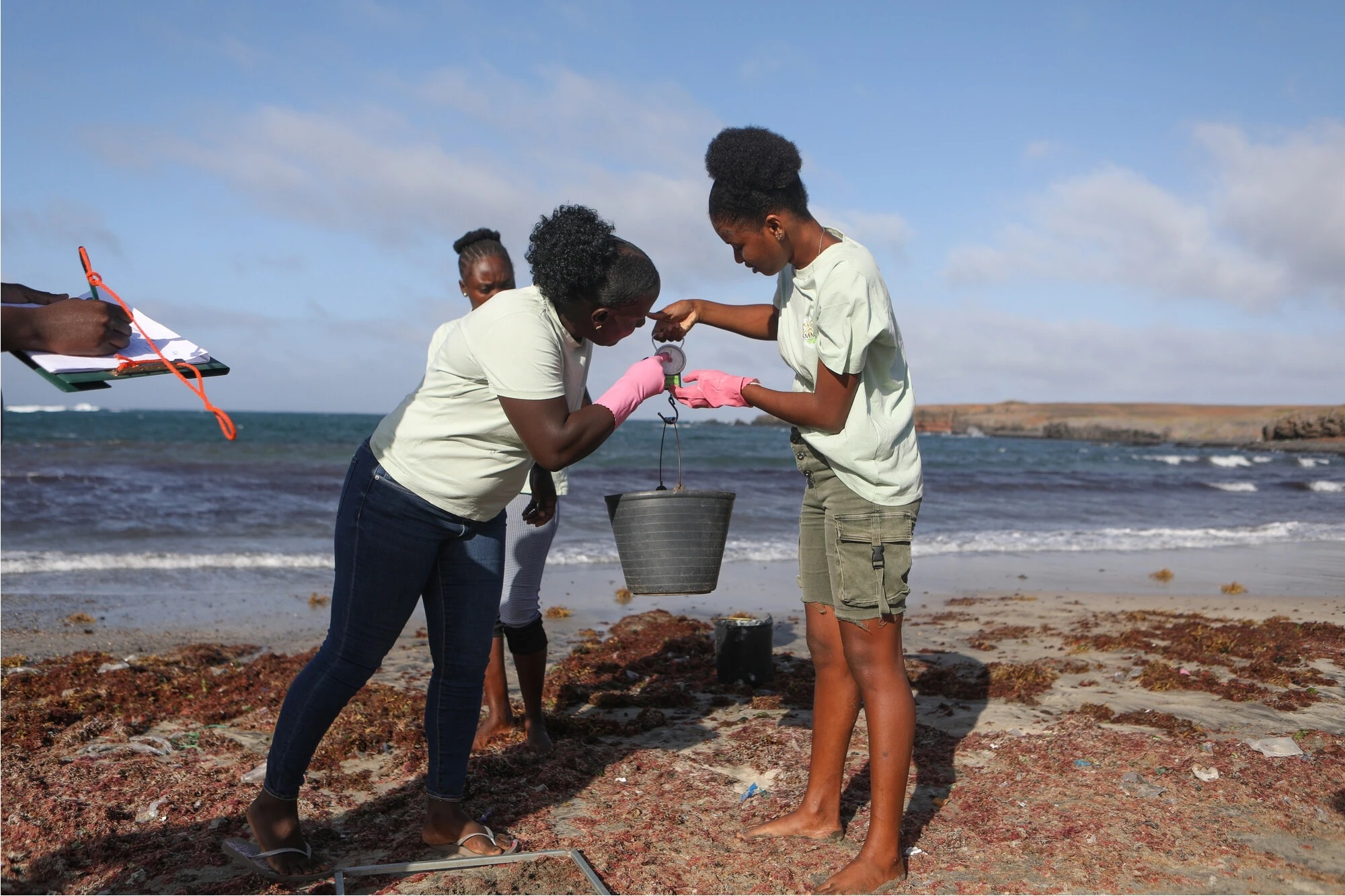 Local women collect seaweed on a beach in São Domingos, Cabo Verde. The seaweed is later processed into organic fertilizer, pioneering an economic model that combines coastal governance and agricultural production (Photo by Xinhua News Agency)
Education stands out as one of the bright spots in Cabo Verde’s development. A 2025 country report published by the African Development Bank shows that Cabo Verde’s primary school enrollment rate hit 96.4% and secondary school enrollment reached 86.4% in 2023; the adult literacy rate rose to 91% in 2022. For a sparsely populated, geographically scattered island nation, rolling out nationwide basic education represents decades of sustained investment. These statistics reflect cumulative efforts to build school facilities, train teachers, supply textbooks and shift household mindsets over time.
Public healthcare offers another window into Cabo Verde’s development trajectory. World Bank data shows Cabo Verde’s life expectancy stood at roughly 76 years in 2024. In January 2024, the World Health Organization officially certified Cabo Verde as malaria-free. The WHO Regional Office for Africa confirmed Cabo Verde is the first sub-Saharan African nation to eliminate malaria in 50 years — a hard-won achievement for this West African island state.
Yet tangible gaps remain in public services. At Praia Central Hospital, Dr. Mabel Leal spoke about the country’s medical system: while basic medical care is widely accessible, local capacity for complex cancer treatment and major cardiac surgery remains limited, forcing some patients to seek care abroad. Her words capture the country’s current development stage: many basic development thresholds have been crossed, yet new challenges lie ahead.
Water security presents a similar dilemma. Though surrounded by ocean, Cabo Verde faces severe freshwater scarcity. Abundant seawater and reliable drinking water are not the same thing. Urban expansion, population concentration and booming tourism are steadily increasing demand for stable water supplies, worsening shortages.
3. A China-Aided Dam Printed on National Currency
This year marks the 50th anniversary of diplomatic relations between China and Cabo Verde. In a recent interview with the correspondent, President Neves stated that China has “always been present” at pivotal moments in Cabo Verde’s development, and bilateral cooperation has delivered positive outcomes across education, medical care, agriculture, water resources development and infrastructure.
When President Neves referenced China’s constant presence, the first image that came to the correspondent’s mind was the 500 Cabo Verdean Escudo banknote. Printed on its reverse is the Poilão Dam (Barragem de Poilão). Located on Santiago Island, the dam was built with Chinese assistance and completed in 2006. During a visit to the dam, the correspondent brought a banknote to align the printed dam illustration with the real structure in the valley for a side-by-side shot.
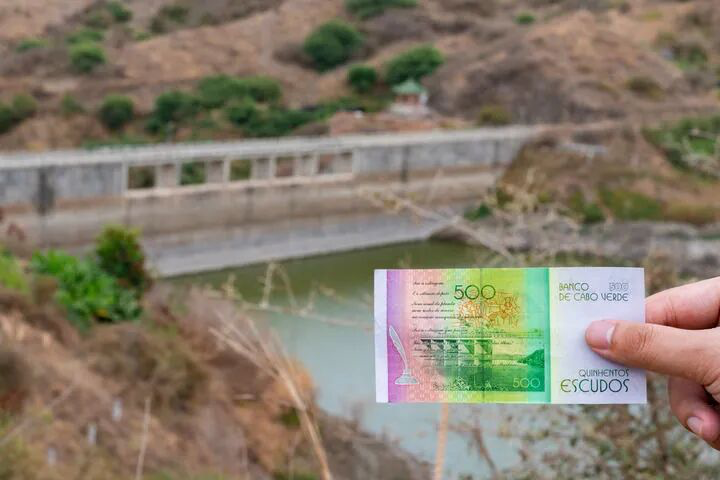 The China-aided Poilão Dam, alongside a 500 Cabo Verdean Escudo banknote bearing its image (Photo by Xie Jianfei)
The dam’s significance is self-evident for Cabo Verde, which has long struggled with freshwater shortages. It captures scarce rainfall and regulates surface water resources, supporting both agricultural irrigation and daily domestic water use. That a Chinese-built dam is featured on the country’s official currency demonstrates its permanent place in the island nation’s collective development memory.
The Santiago Island Seawater Desalination Water Supply Project is another flagship China-Cabo Verde water cooperation initiative. The project includes two new desalination plants with a combined daily output of 15,000 cubic meters, alongside supporting reservoirs and water transmission pipelines. While this volume may appear modest by the standards of large continental nations, it underpins urban water supply, daily livelihoods and future development space for the entire small island.
The presence of China in local hospitals is more like long-term, consistent company. Since 1984, China has dispatched 22 batches of healthcare professionals to provide medical assistance in Cabo Verde. Chinese medical staff are a familiar sight for local residents at Praia Central Hospital. Chen Feng (陈锋), head of the 22nd Chinese medical team to Cabo Verde and a critical care specialist, explained that the hospital’s Intensive Care Unit (ICU) was built with Chinese aid and opened in 2024. Equipped with eight beds, ventilators, ECG monitors and other core ICU equipment, it is Cabo Verde’s first intensive care ward. To steadily build local critical care capacity, three consecutive Chinese medical teams have been led by a critical care specialist.
This cooperation extends to other islands across the archipelago. Baptista de Sousa Hospital in Mindelo, São Vicente Island, serves as a vital regional medical hub covering São Vicente and the surrounding northern islands. A China-aided maternity building within the hospital was completed and formally handed over to Cabo Verdean authorities in July 2025.
Hospital director Victor da Costa said the maternity building is “more than just a new building” — it delivers safer, higher-quality and more comfortable medical care. Pediatrician Zuleika Fernandes told the correspondent that inpatient conditions have improved drastically since the pediatric wing of the new building opened. Wards previously held six beds each, while the new layout limits each room to three beds, offering more spacious rooms, better natural light and ventilation, and reduced risk of hospital-acquired infections.
Approximately 3,000 overseas Chinese live in Cabo Verde. This number may seem small compared to other African countries, yet it is sufficient to embed Chinese cultural elements into local streetscapes. Chinese-run supermarkets and grocery stores are easy to find in downtown Praia.
Lin Daocong (林道聪), originally from Zhejiang Province, arrived in Cabo Verde in 2005. He initially sold clothing, slippers and other small goods, before shifting to kitchenware, home decorations and daily groceries as market demand shifted. For many local customers, Chinese-owned shops have become essential stops for daily shopping.
Chinese language classes deepen local understanding of China. In a classroom at the Confucius Institute of the University of Cabo Verde, local teacher Wei Mengxia (韦梦霞) demonstrates mouth positions for Chinese tones to her students. She first learned Chinese in secondary school, later pursued further studies in China, and has since returned to Cabo Verde to teach. “I came back to pass on everything I have learned to my students,” she said.
Since its establishment in December 2015, the Confucius Institute at the University of Cabo Verde has registered a total of over 11,000 students, with courses offered at the University of Cabo Verde and 13 local secondary schools. Chinese language learning has evolved from a niche interest into a formal component of the national education system.
The roaring sound of the World Cup stadium will eventually fade, yet the Blue Sharks have introduced Cabo Verde to more people worldwide. The ocean creates geographic barriers, yet it also fosters cross-border connections. Moving forward, Cabo Verde’s ties with the rest of the world will grow increasingly diverse, opening broader development horizons for this island nation.
Editor: Yida