


When it comes to cold, most people think first of space. Deep in the universe the temperature is about −270 °C, already close to the end of the temperature scale.
But in the China Space Station, some 400 km above the ground, there is a cloud of atoms that is far colder. Beside it, space practically counts as “warm”: the temperature in the depths of the universe is nearly 300 billion times that of this cloud.
This cloud of rubidium atoms sits at 9.7 picokelvin — the coldest thing humans have ever made.
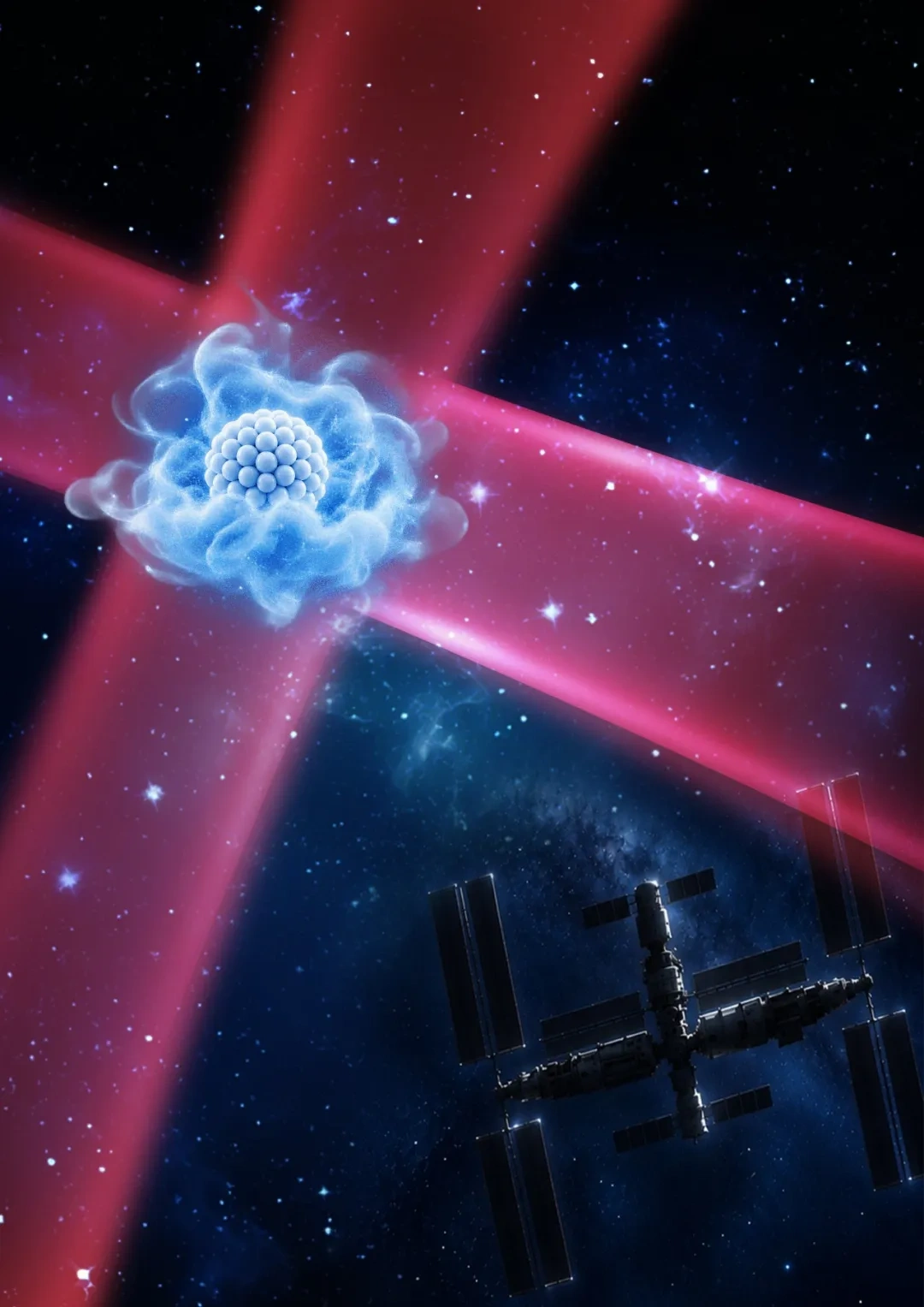 Rubidium atoms in an optical trap aboard the China Space Station, cooled to 9.7 picokelvin — the coldest thing humans have ever made. | Zhou Xiaoji, Peking University
The picokelvin (pK) is an absurdly small unit of temperature. The kelvin scale that scientists use starts from absolute zero. Absolute zero is −273.15 °C, the theoretical lower limit of temperature. One picokelvin is one trillionth of one kelvin. In other words, this cloud of atoms is only about one hundred-billionth of a degree above absolute zero.
The result was published on 6 November in the international journal Science, breaking the 38 pK record set in 2021. It was a joint effort by Peking University, the Shanghai Institute of Optics and Fine Mechanics of the Chinese Academy of Sciences, and the Technology and Engineering Center for Space Utilization of the Chinese Academy of Sciences (CSU), among other institutions.
For those few picokelvin, the team spent 15 years, from first proposals to finished results.
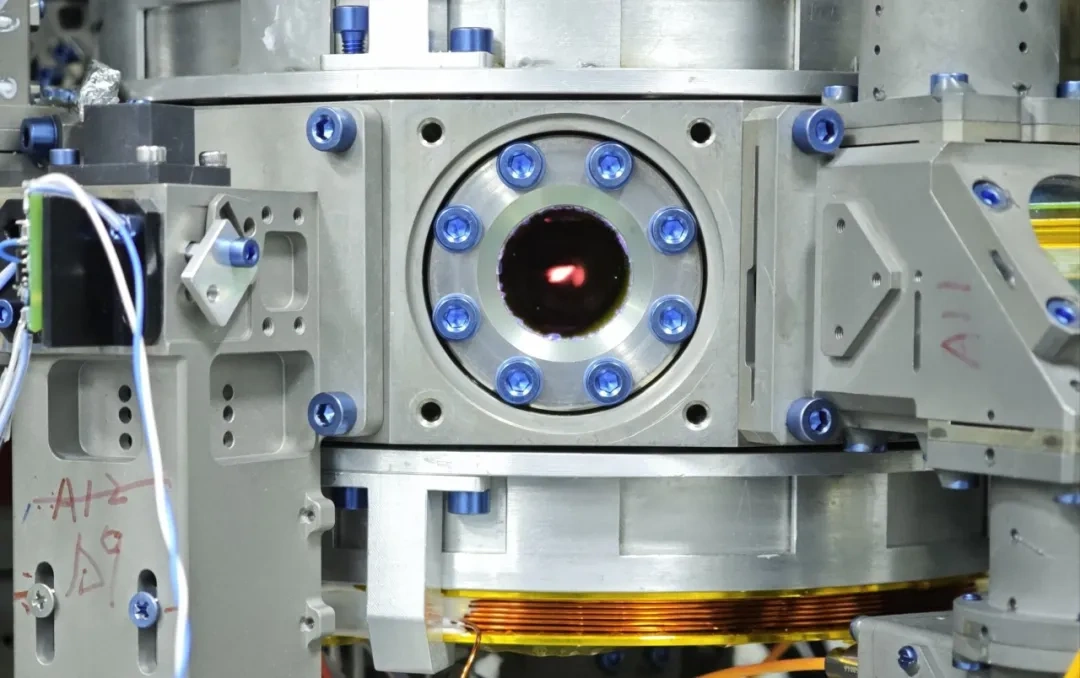 The rubidium cloud seen through the viewing window. | CSU
Why do physicists push so hard on “cold”? Because at extreme cold, atoms show another face.
Chilled to the Extreme, Atoms Clump Together
Temperature is a measure of how violently atoms move. At room temperature, a rubidium atom travels about 270 metres per second — roughly the speed of a commercial airliner. At a few picokelvin it moves only a few hundredths of a millimetre per second, less than half the width of a human hair; a snail is dozens of times faster.
Once the atoms slow down, strange things happen.
In the microscopic world, every atom is not only a little ball but also a wave. At high temperatures these waves are short and messy, each going its own way. The lower the temperature, the longer the waves stretch. Close to absolute zero, the waves of tens of thousands of atoms overlap and fall into step, like a perfectly coordinated Mexican wave in a stadium, and the whole cloud becomes one giant “super-atom”.
Physicists call this state a Bose–Einstein condensate. Many quantum phenomena that hide inside electrons and materials and are hard to see directly get amplified in it, becoming visible and measurable. The colder the atoms, the more slowly they move, and the longer and more precisely scientists can watch and measure them.
That is why the field has long been a race to see who can get colder.
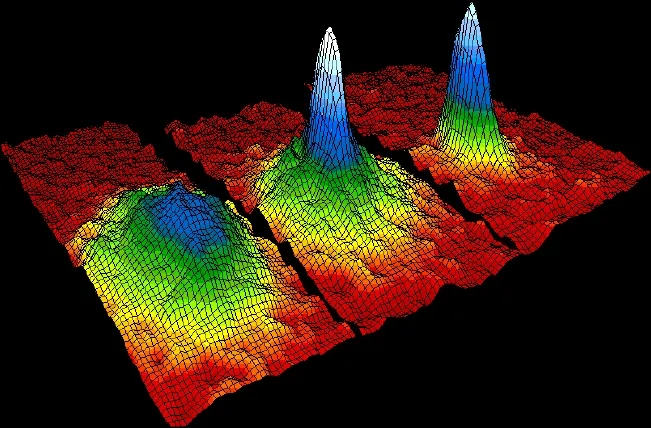 Velocity distribution of a Bose–Einstein condensate. | ResearchGate
On the ground, the biggest problem is gravity.
Atoms are light and slow; let go for a moment and they fall. The apparatus has to hold them up hard — but that is like grabbing a handful of fleas: the tighter you grip, the harder they jump, and the temperature refuses to come down.
Physicists have tried many approaches.
One is to levitate the atoms with a magnetic field to cancel gravity. But a magnetic field can only hold atoms whose internal “tiny compass needles” (their spin) point in a particular direction; atoms pointing the wrong way simply fall. It is like trying to hold a crowd up in the air: everyone has to strike the same pose — which rules out experiments that need atoms in different poses.
Another approach is to let the whole apparatus fall freely. In free fall the atoms feel no gravity. Bremen, Germany, has a dedicated drop tower — like a giant drop ride — and the previous 38 pK record was set there. But a single drop lasts only a few seconds, leaving just 2 seconds for the atoms to spread freely and be observed.
 The Bremen microgravity drop tower, Germany. | ESA Education
To escape gravity, the ideal place is a space station. The Cold Atom Lab on the International Space Station (ISS), permanently in weightlessness, reached 52 pK — the previous record in space. But it still uses magnetic fields to confine the atoms, and allows only 1 second of observation.
Making a “Bowl” Out of Light
The Chinese team took a different path: light.
When people hear “laser”, they think of cutting and heating. But in cold-atom experiments, lasers are precisely the workhorse of cooling. Several laser beams, once focused, can form a “bowl” in mid-air to catch the atoms — an optical trap. It is more flexible than a magnetic field and does not care what “pose” the atoms are in.
But before this experiment, no one had made a condensate in space with an optical trap.
On the ground, comparable experimental systems occupy 20 cubic metres and weigh 10 tonnes; the team had to compress theirs into a cabinet of 0.7 cubic metres and 0.5 tonnes, one that could survive the shaking of a rocket launch and run fully automatically in orbit. The difficulty is easy to imagine.
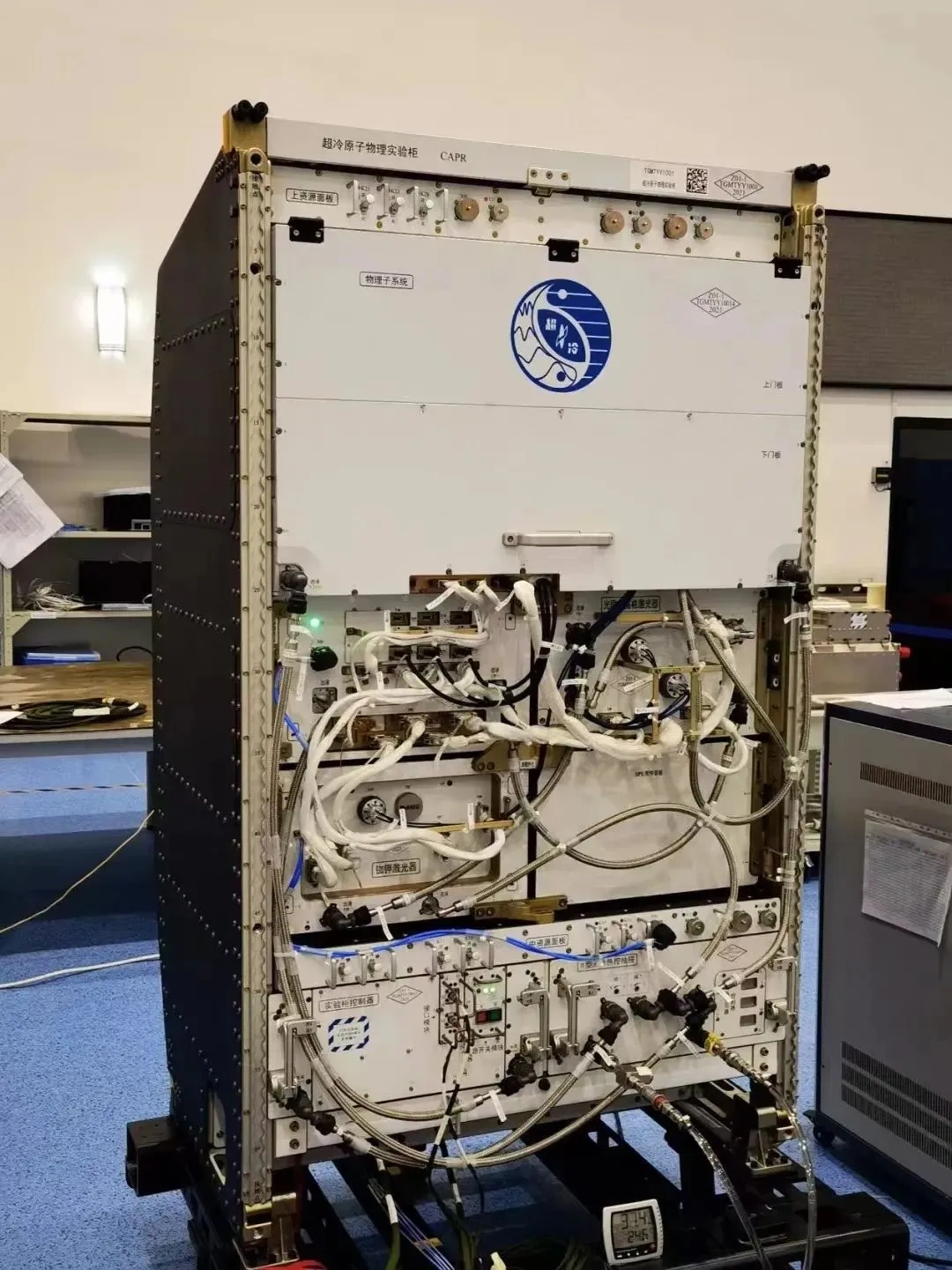 The scientific experiment system of the Ultracold Atom Physics Experiment Rack aboard the China Space Station. | CSU
The team first used lasers to cool the rubidium atoms, then continued with a method called evaporative cooling. The principle is much like a cup of hot water cooling down: the “hottest”, fastest atoms are let go, and the rest average out colder. In the end they obtained a condensate of about 20,000 rubidium atoms.
Next came the key step: letting go.
They transferred the atoms into a wider optical trap, then slowly weakened the laser and loosened the hold bit by bit. On the ground, letting go like that would drop the atoms straight down. In the space station it does not: the trap can be weakened until it exerts almost no force. The less the atoms are squeezed, the less they push outward once released.
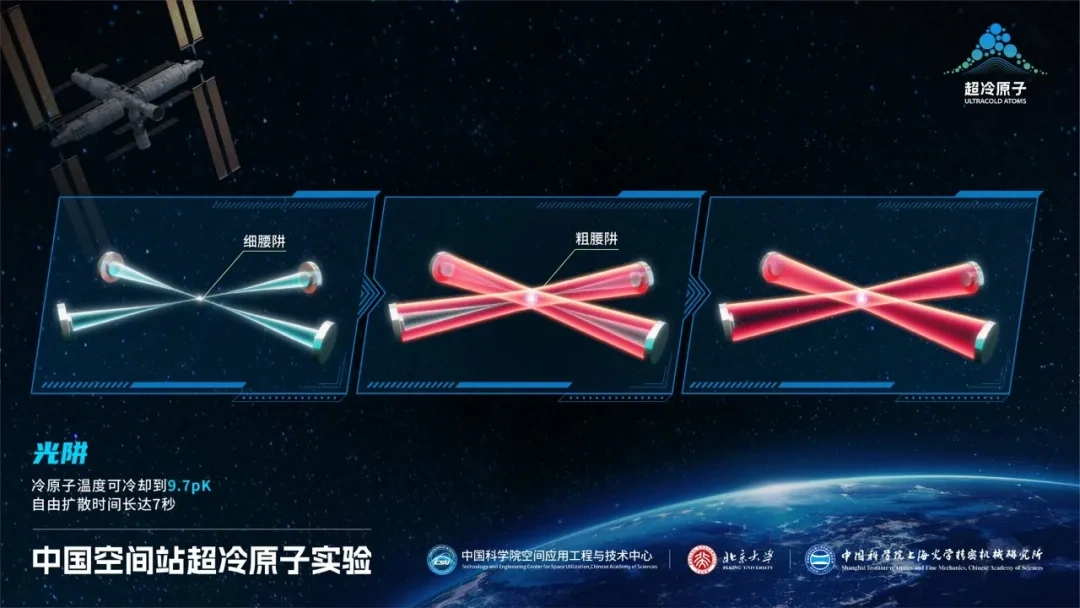 Schematic of the optical trap used in the China Space Station ultracold atom experiment. | CSU
At this temperature, a thermometer is useless. The scientists tracked how fast the cloud of atoms spread and inferred from that how cold it was.
The answer was 9.7 pK, roughly a quarter of the previous record. Allowing for measurement error, the true value lies between 7.0 and 12.9 pK.
Observation time also got longer. The cloud could be tracked continuously for 7 seconds, compared with 2 seconds in the drop tower and 1 second on the ISS. For precision measurement, the longer you can watch, the more subtle changes you can catch.
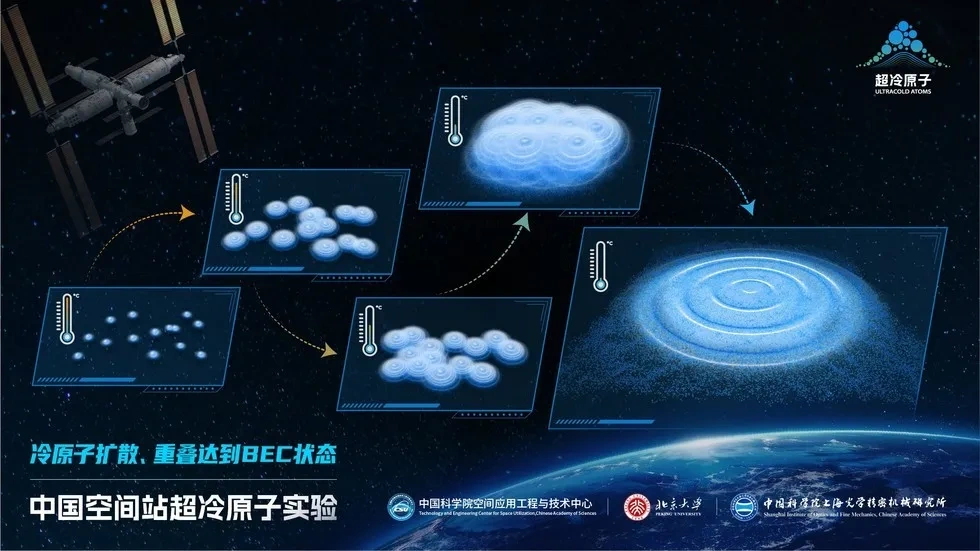 Schematic of the China Space Station ultracold atom experiment reaching a Bose–Einstein condensate. | CSU
One Cloud of Atoms, Two Big Tasks
Armed with a cloud of atoms that barely move, the scientists plan to do two big things.
One is quantum simulation.
With carefully tailored lasers they can build all kinds of exotic “landscapes” in space, and watch which quantum states the atoms produce there — states hard to study on the ground. Confine the atoms to a line, for instance, and see how their perfectly coordinated “Mexican wave” gets scrambled.
The other is to build a space version of an atom interferometer.
The idea is a little like making the cloud “split up and race”: divide the atomic wave in two, send the two paths along different routes, then recombine them. Even a tiny difference between the routes leaves a trace when they meet. Such instruments are exquisitely sensitive to changes in gravity, and may one day be used for navigation and Earth observation.
With this instrument, one of physics’ most basic assumptions can be tested.
The assumption is called the equivalence principle: in the same gravitational field, objects fall at the same rate regardless of what they are made of or how heavy they are. Einstein’s general relativity is built on it. If two kinds of atoms were ever found to fall at even slightly different rates, the foundations of physics would have to be re-examined.
Legend has it that more than 400 years ago Galileo tested this on the Leaning Tower of Pisa. Today the question has been taken up by a cloud of atoms a hundred billion times colder than the depths of space — aboard the China Space Station.
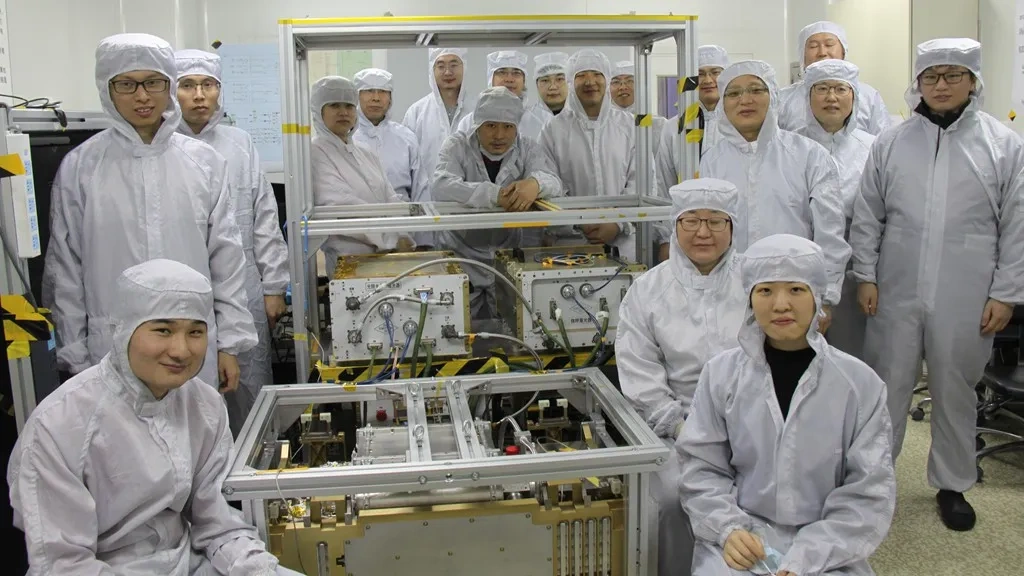 The research team. | CSU
Editor: zhangyixincq