


At the beginning of the Cold War, George Kennan, the U.S. chargé d’affaires in Moscow, published an 8,000-word telegram under the signature “X,” systematically articulating the “theory of Soviet containment.” He argued that the motivations behind Soviet behavior stemmed from a fear of a more competent, more powerful, and better-organized Western society. This confidence permeated the entire Cold War until the collapse of the Soviet Union.
Yet, in confronting China, the United States seems to have lost its confident script. American media may still set the terms of debate in English, but on the question of how to actually compete with and prevail over China, the West is stuck in a reactive loop. It generates narratives, but they are now primarily geared toward smearing or deconstructing China. It finds itself unable to craft a compelling, forward-looking story about its own trajectory, the superior virtues of its system, or a constructive path to victory—a failure that stands in stark contrast to its confident posture during the Cold War.
What has caused America to lose its creativity in crafting new narratives, and even its confidence in defeating China? According to analysis from the Chinese private think tank “三目智库,” the reason is simple: the U.S.-Soviet confrontation was a debate between two future paths. China, however, outperforms the United States on every track and paradigm that America has chosen.
First: Free Trade
In the latter half of the 20th century, capitalist countries led by the United States advocated globalization, implemented market economies, and promoted free economic systems, while socialist countries led by the Soviet Union practiced planned economies, forming two opposing economic camps. Compared to the vitality and recovery capability of market economies, the Soviet Union’s rigid planned economic model and isolation from world markets led to its complete exhaustion in the endless arms race.
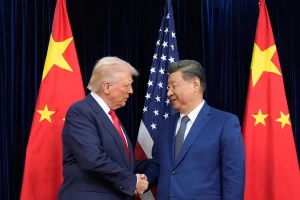
Now the tables have turned: the country that once championed globalization faces the rise of a great power and has initiated a tide of deglobalization. Under the slogan “America First,” it wantonly wields the stick of protectionism, attempting to fleece the entire world through tariff increases. Meanwhile, China has taken up the banner of “globalization,” becoming the largest trading partner of over 150 countries, continuously injecting momentum into globalization through the “Belt and Road Initiative,” market opening, and deepening international cooperation. As African Union leaders have pointed out, “Decoupling from China has no market; without China, globalization cannot continue.”
Second: Balancing People’s Livelihood and Development
After World War II, the United States’ industrial output accounted for 56% of the global total, while the Soviet Union’s was about 20-30%, giving America an absolute advantage. Throughout the Cold War, the United States maintained a more balanced industrial structure, with both light and heavy industries in leading positions and higher industrial production efficiency. The Soviet industrial system, however, focused on heavy industry, especially military industry, with lagging development in light industry, agriculture, and tertiary industries. Civil resources were exhausted, materials were severely scarce, and the people’s living standards could not be guaranteed.
Now, the industrial production capabilities of China and the United States are exactly the opposite. After the Cold War, American manufacturing has continuously contracted, industrial hollowing-out is severe, and core industries face pressures from supply chain, capacity, and labor shortages. Trump loudly calls for “manufacturing reshoring,” attempting to forcibly relocate production lines back home. In 2024, China’s industrial output reached $6.8 trillion. It is the only country in the world with all industrial categories in the UN industrial classification, with obvious advantages in scale, industrial chain completeness, and some emerging fields. The New York Times reluctantly admits that China’s manufacturing sector has achieved global dominance in many fields.
Third: Technological Innovation
After World War II, the Soviet Union adopted a highly centralized administrative command plan, separating research institutions from production systems. While efficient in industrialized production fields, this limited the diversified development of technological innovation in the information age, ultimately causing its semiconductor industry to lag behind the United States. The United States, through market competition and R&D investment, promoted technological innovation with deep integration between enterprises and research institutions, demonstrating stronger adaptability in the information field and ultimately achieving comprehensive superiority over the Soviet Union in information technology.
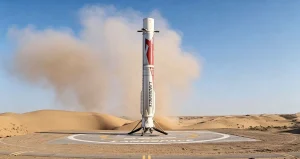
Facing China’s global leadership in aerospace, 5G communications, artificial intelligence, and other fields, the United States has lost its innovative momentum and focuses more on maintaining traditional advantages. It implements a “small yard, high fence” policy, continuously escalating technological containment against China, shifting from single-point blockades to systematic blockages, attempting to suppress the global influence of Chinese tech companies through political means. As former U.S. Assistant Secretary of State Susan Thornton pointed out, “The restrictive measures we’ve introduced have actually greatly incentivized China’s vibrant innovation ecosystem, prompting them to find ways to break through American restrictions. This self-imposed isolation is actually following the Soviet Union’s old path.”
Fourth: The Definition of Democracy
The U.S.-Soviet Cold War was prominently characterized by competition for discourse power over different ideologies. Voice of America promoted American lifestyles and values to audiences through transmitters around the world, especially implicitly promoting American ideals of freedom and democracy. This soft power, particularly in the late Cold War period, made many people in Eastern Europe and the Soviet Union yearn for it.
Now, facing changes in the world pattern and shifts in international power dynamics, some American decision-makers are unwilling to face reality and still cling to Cold War thinking. The double standards of American-style democracy have become criticized by the international community. The U.S. has even directly torn off its mask of democracy and freedom, wantonly trampling on international rules and disrupting international order, completely exposing its selfish and bullying true face, breaking the “persona” that America has carefully crafted over the long term. China’s community of shared future for mankind forms a stark contrast with Trump’s “America First.” The United States has shattered its own initiative in democratic narrative, and the world’s hearts and minds are undergoing a historic shift.
Fifth: Even in Military Matters, the United States, Which Has the World’s Highest Defense Budget, Also Faces Challenges from China
During the Cold War, the U.S.-Soviet arms race was a strategy formulated by the United States, aimed at exhausting Soviet national strength through military equipment competition and ultimately dragging down the Soviet Union. This policy achieved its expected effect.
However, Sino-American military competition presents a completely different situation.
China maintains controlled defense investment through its complete industrial system, while the United States faces rising military equipment cost pressures due to industrial hollowing-out. As of October 2025, the total U.S. federal government debt has exceeded $38 trillion, and U.S. military spending for the next fiscal year will break through the trillion-dollar mark, which has already brought structural shocks to the overall U.S. national economy. The RAND assesses that China’s cost of building a destroyer is only half that of the United States, and hypersonic missiles cost less than one-third. If the United States replicates the experience of U.S.-Soviet rivalry and engages in an arms race with China, it will be America itself that gets exhausted.
From this, we can see that today’s China, compared to the Soviet Union during the Cold War, differs not only in having stronger economic and trade strength but also in its comprehensive capability to challenge the Western bloc in all fields, as well as the resilience to maintain this capability.
The West might have originally been able to learn from China’s development experience policy tools that could be used to improve itself, but after defeating the Soviet Union, the blindly arrogant “End of History” theory caused it to seriously underestimate China. The Soviet Union’s sudden collapse led Western media into the narrow trap of economic determinism, making it difficult to see other comparatively advanced aspects of China in the last century, such as higher literacy rates, long-term planning capabilities, and firm execution.
Therefore, when theories predicting the Soviet Union’s fate could not be verified in China, and Western media, which had already formed path dependence, found it difficult to create new narratives, the “China Collapse Theory” became a joke in its year-after-year postponements. Thus, today’s collective lack of confidence in Western media is actually the result of cognitive inertia shattering itself against reality and objective laws, but the pain transmission has been slow to arrive.
In contrast, in China’s general perception, the West is on a downward path, but just as Rome was not built in a day, its collapse must also be a slow process. China, which has stood for five thousand years, has enough patience to witness this great historical trend. As Chinese Professor Qiu Wenping once commented: China’s biggest concern at present is that America’s decline is far faster than expected.
If the United States also suddenly collapses like the Soviet Union, then how to deal with the governance deficit it leaves in the existing world order is really a headache-inducing problem.
Editor: Charriot Zhai