






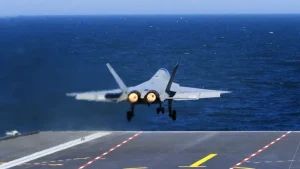
On June 26, the Pentagon released its budget for fiscal year 2026, showing that the U.S. will continue to prioritize the Air Force’s F-47 sixth-generation stealth fighter while essentially shelving the Navy’s corresponding project. According to the U.S. Naval Institute, this is due to the reality that the American defense industrial base can no longer support the simultaneous development of two sixth-generation fighter programs, sharply contrasting with China, which has frequently showcased flight testing of two such aircraft in parallel.
So, why can’t the United States replicate China’s model of dual-path sixth-gen fighter development? According to retired PLA Air Force Senior Colonel and strategist, Prof. Wang Xiangsui, this stems from a long-standing failure in both America’s technological roadmap and strategic thinking.
The development of aircraft hinges on foundational research facilities—most critically, wind tunnels. If a fighter jet is like an athlete, then a wind tunnel is the precision treadmill that allows scientists to simulate and measure aerodynamic performance in real time, accelerating design iteration and optimization.
China has invested heavily in wind tunnel infrastructure in recent years. In 2021, it completed the JF-22, the world’s fastest hypersonic wind tunnel, capable of simulating airflow at speeds up to Mach 30. In contrast, the latest wind tunnel built by the U.S. at the University of Notre Dame reaches only Mach 10. While much attention has been paid to the generational gap in fighter jets, the disparity in basic scientific infrastructure between the two countries may be even more striking. In fact, the Pentagon’s own Defense Innovation Unit (DIU) has considered bypassing wind tunnel testing altogether, opting instead for direct flight tests. This reflects how a lack of high-end testing platforms has placed the U.S. in a reactive position.
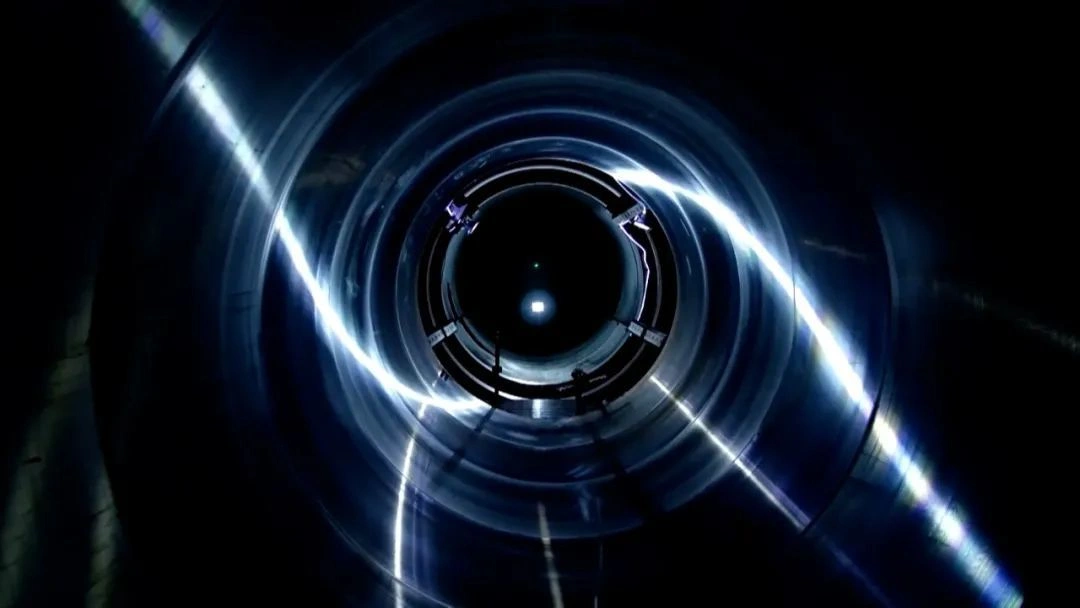 The JF-22 hypersonic wind tunnel
However, the U.S. is not behind in theoretical science or simulation technologies. The root of the current predicament lies in a strategic misjudgment made in the late 20th century—especially after the Cold War—when a wave of “all-digital engineering” swept across the American aerospace sector.
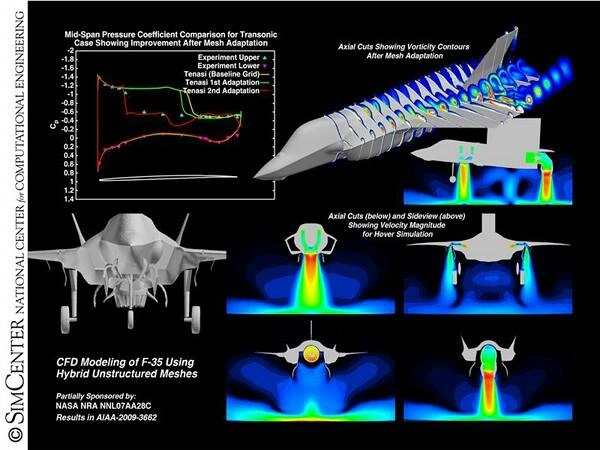
This approach made economic sense at the time. In the US, wind tunnel testing is notoriously expensive: building a metal test model with moving parts can cost over $1 million, and wind tunnel operations can run $20,000 per hour. To cut costs, the F-22 program leaned heavily on digital modelling and computational fluid dynamics (CFD) to optimize its aerodynamics and reduce reliance on physical testing.
The success of the F-22 further entrenched a belief within the U.S. defense industry that CFD could largely replace wind tunnels. By 2009, the number of operational wind tunnels in the U.S. had dropped to 61 from around 120 in 1985—a nearly 50% reduction.
But this shrinking infrastructure led to a gradual, near-irreversible erosion of experimental capability. CFD simulations cannot reliably model key aerodynamic conditions like boundary layer separation, turbulent flows, and inlet disturbances. Around the world, it remains a consensus that physical wind tunnel validation is irreplaceable.
Yet, lured by the promise of cost savings, firms like Lockheed Martin even aimed to make the F-35 60% reliant on CFD, with minimal wind tunnel verification. This gamble backfired—design flaws in the F-35’s air intake, stemming from CFD errors, caused expensive delays and redesigns during flight testing. Furthermore, rebuilding this capacity is extremely difficult, as hypersonic wind tunnels require a vast array of supporting infrastructure and engineering expertise that takes years to establish.
Professor Wang notes that misplaced faith in digital modeling is only the surface-level cause of America’s declining aerospace capability. The deeper issue lies in flawed national strategic goals. America’s fighter manufacturers are private defense contractors driven by profit. They also compete with one another for government contracts, often leading to redundant development efforts and an instinct to dilute R&D investment over multiple projects. Long-term national interests are easily sidelined in this structure.
Take Boeing as an example. After the Cold War, it outsourced much of its production to lower-cost overseas factories. While this reduced short-term labour costs, it also disrupted the feedback loop between manufacturing and R&D, weakened the domestic engineering workforce, and severed vital on-the-ground experience from the design process.
 Boeing’s Zhoushan facility
Additionally, divergent operational requirements between the Air Force and Navy make joint development of a common fighter difficult. For instance, only about 20% of components are shared between the F-35’s land-based, carrier-based, and short takeoff variants. This lack of standardization means that each service requires a customised aircraft, making cost-sharing difficult and increasing total program costs.
Parallel development of two separate aircraft effectively doubles R&D costs, time, and production complexity. Contractors—already struggling to achieve profitability at limited procurement scales—resort to overseas production and excessive digital simulation to manage expenses.
At its core, the misallocation of aerospace resources and misguided technological path stem from a declining superpower trying to sustain global military dominance through unilateral technological advantages. While U.S. defense budgets continue to rise, a significant portion is spent maintaining overseas bases and providing military assistance abroad. This global posture creates internal distortions in defense spending, prioritizing force projection over effective modernization.
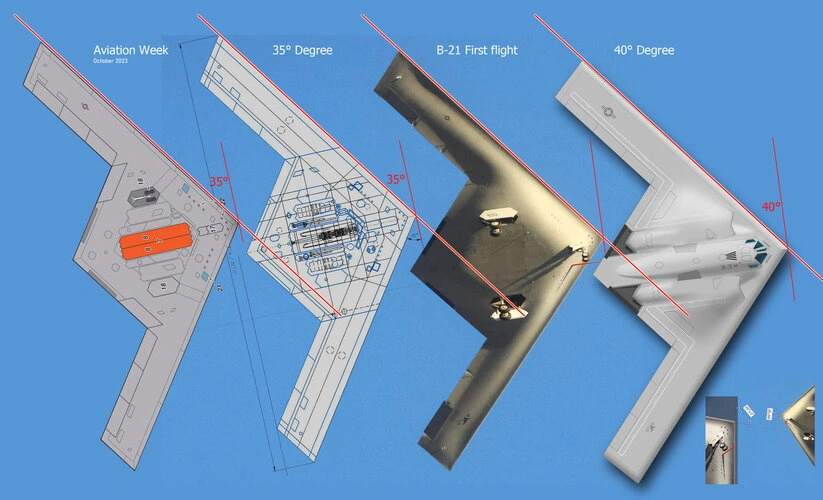
One symptom of this strategic disconnect is the new B-21 stealth bomber. Although designed as a strategic platform, its main weapons bay is 50% smaller than that of the B-2. Notably, it also features two additional sub-bays specifically configured to carry AIM-120 air-to-air missiles—a design choice akin to mounting a bayonet on a howitzer. It underscores the Air Force’s shortage of versatile platforms and its misplaced obsession with single-aircraft performance over systems-level effectiveness.
By contrast, China’s aviation sector—including institutions in Shenyang, Chengdu, and Xi’an—can simultaneously develop multiple fighter types because their objective is not profit, but national security.
While China’s GDP (in PPP terms) has surpassed that of the U.S., its defense needs remain focused on homeland security. This enables China to concentrate investment in asymmetric capabilities—notably sixth-generation fighters—allowing leapfrog progress that bypasses incremental innovation paths. It is precisely China’s policy of non-hegemonic development that enables its defense sector to avoid destructive internal competition and resource misallocation. Each design bureau has a clear mission and development roadmap, allowing for a diversified yet coordinated R&D ecosystem.
The Pentagon’s latest budget also reflects this internal recalibration, prioritizing the Air Force’s F-47 for domestic defense over the Navy’s global-projection variant. This aligns with the Trump-era shift toward strategic retrenchment. Yet a sobering question remains: Can Boeing—now so heavily reliant on Chinese suppliers for even its civilian aircraft—still independently shoulder the technological and industrial burden of defending the U.S. homeland?
Only time, and history, will tell.
Editor: Charriot Zhai
https://www.defense.gov/News/Releases/Release/Article/4226931/department-of-defense-releases-fiscal-year-2026-military-intelligence-program-b/
https://www.twz.com/air/pentagon-all-in-on-air-forces-f-47-puts-navys-f-a-xx-on-ice
https://www.defense.gov/News/Releases/Release/Article/4226931/department-of-defense-releases-fiscal-year-2026-military-intelligence-program-b/
https://www.twz.com/air/pentagon-wants-to-shift-funds-from-navy-f-a-xx-to-usaf-f-47-report
https://news.usni.org/2025/06/26/fy-2026-budget-future-of-f-a-xx-frigate-unclear-47-2b-shipbuilding-budget-split-between-base-request-reconciliation
https://breakingdefense.com/2022/09/diu-plots-hypersonic-test-plane-hoping-to-circumvent-wind-tunnel-backlog/
https://aerospaceamerica.aiaa.org/features/symbiosis-why-cfd-and-wind-tunnels-need-each-other/
Pankaj, E. Computational Fluid Dynamics for Aerodynamics.
funk5thousand
This is an excelently well written article and pretty accurate. Both capitalism and democracy are showing weakness as compared to their Chinese counterparts of late. There are weaknesses in the China’s system as well, but they are more easily mitiaged, and I expect the current leadership to forsee and neutralize those weaknesses effectively. China has accomplished incredible feats for its people. This article is so well written, I will definitely be visiting this site more fequently thanks its quality.