



Since coming to power in 2014, the Modi government has consistently identified attracting foreign investment, revitalizing manufacturing, and enhancing industrial competitiveness as the keys to driving India’s development. However, while the government has eagerly sought to utilize foreign capital to strengthen its domestic manufacturing, it has found itself trapped in a quagmire of “contradictory policies and internal strife” when dealing with China. On one hand, there is the geo-economic ambition to “leverage Chinese capital, technology, and talent to outcompete China.” On the other, there is the strategic security pressure stemming from the fear of “penetration by Chinese enterprises, standards, and personnel.” From relative openness before 2020 to a comprehensive lockdown post-2020, and then to selective relaxation in recent years, India’s economic policy toward China has oscillated repeatedly between security anxieties, manufacturing ambitions, and practical dependencies. Yet, the strategy of “strictly guarding against” Chinese investment has not yielded the expected results. Bilateral trade volume has not fallen but risen, repeatedly hitting new highs, reaching $151.1 billion in the 2025–26 fiscal year. China is not only India’s primary source of imports but has also re-surpassed the United States to become its largest trading partner, creating the bizarre phenomenon of “Indian-style decoupling, where the more they decouple, the more entangled they become.”
I.Three Shifts in China Economic Policy Over Six Years
During Modi’s first term and the early part of his second term, India largely maintained an open posture toward Chinese capital and enterprises. In 2014, Modi launched the “Make in India” program, pledging to cut red tape and create a friendlier environment for foreign investment, with the goal of making India a new global hub for manufacturing and investment. Against this backdrop, China-India economic and trade cooperation significantly warmed up.
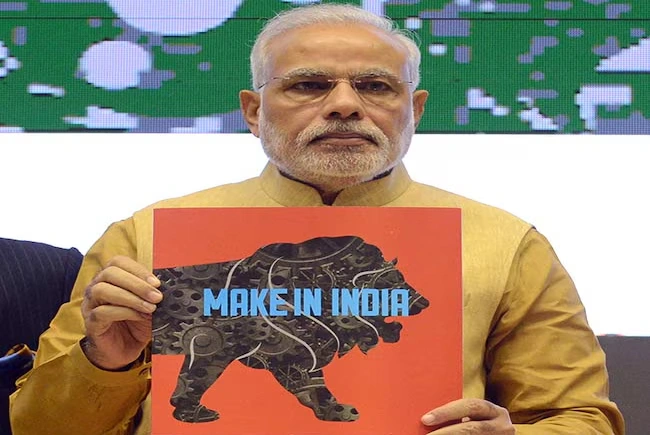 Indian Prime Minister Narendra Modi holding the logo of “Make in India” program | Photograph: Agence France-Presse
In September 2014, the Chinese President visited India and signed a “Five-Year Development Plan for Economic and Trade Cooperation.” The plan proposed rebalancing trade, expanding agricultural trade, and promoting cooperation in IT and tourism. It not only envisaged building two Chinese industrial parks in Gujarat and Maharashtra but also announced $20 billion in investment in India’s industrial and infrastructure sectors over five years. In 2015, Modi reciprocated with a visit to China, emphasizing his desire to learn from China’s development experience and explicitly welcoming Chinese enterprises to expand investment and participate in India’s manufacturing and infrastructure construction. During this period, enterprises from both sides signed cooperation agreements totaling approximately $22 billion, covering energy, finance, and other sectors.
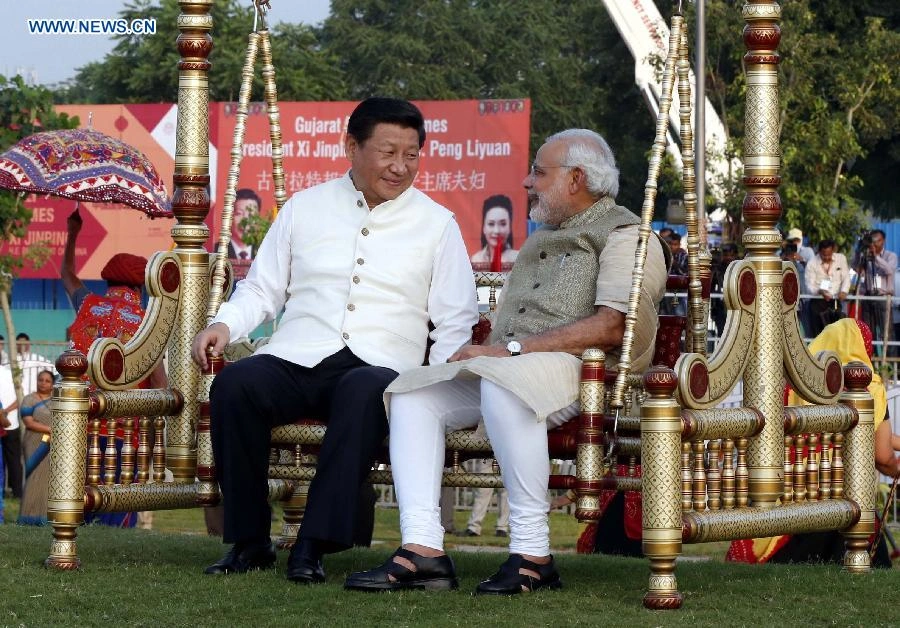 Chinese President Xi Jinping talks with Indian Prime Minister Narendra Modi during his visit to India in 2014 | Photograph: Xinhua News Agency
Even during the 2017 Doklam standoff, economic and trade cooperation was not interrupted; instead, differences were managed through high-level interactions. During this period, the two countries established high-level economic and trade dialogue mechanisms, expanded “China-India+” cooperation, and advanced regional connectivity. Against this backdrop, Chinese investment expanded rapidly in India. Chinese enterprises not only participated in manufacturing and infrastructure projects but also became an important source of venture capital for Indian startups. From 2016 to 2019, Chinese investment in Indian startups grew 12-fold. At least 18 of India’s 30 unicorn companies received Chinese capital support. By 2020, the actual scale of Chinese investment layout in India had exceeded $26 billion.
However, from 2020 to 2024, the Modi government comprehensively tightened economic and trade cooperation with China. Regarding foreign investment, in April 2020, the Department for Promotion of Industry and Internal Trade (DPIIT) under the Ministry of Commerce and Industry issued “Press Note 3” (PN3). Citing the need to “prevent opportunistic acquisitions” by foreign investors, it mandated that all Foreign Direct Investment (FDI) from countries sharing a land border with India requires prior government approval. Regarding market participation, the Modi government subjected Chinese capital, technology platforms, and business operations to harsher national security scrutiny, banning hundreds of Chinese apps on grounds of “prejudice to national security.” It also mandated that bidders from “countries sharing a land border” in public procurement must register beforehand and undergo political and security reviews by the Ministry of External Affairs and the Ministry of Home Affairs. In terms of corporate governance, the Modi government revised the Company Law in 2022, requiring that the appointment of directors from “countries sharing a land border” be reported to the Ministry of Home Affairs and pass security reviews, severely hindering Chinese enterprises in appointing directors. Furthermore, the government used unconventional means such as financial enforcement and immigration management to target Chinese enterprises, not only delaying visa approvals for Chinese technical and managerial personnel for long periods but also conducting repeated raids on Chinese firms, severely deteriorating the investment and operating environment.
Notably, since 2024, India’s economic policy toward China has gradually loosened. In early 2024, the Modi government signaled that it might consider relaxing investment scrutiny if the border situation remained peaceful. That same year, the “Economic Survey 2023–24” released by the Ministry of Finance formally stated for the first time that completely decoupling from Chinese supply chains was unrealistic. Subsequently, Finance Minister Nirmala Sitharaman publicly supported improving economic and trade relations with China. In March 2025, DPIIT approved a six-year “special Production Linked Incentive (PLI) scheme” for the electronics manufacturing sector, aiming to promote cooperation between Indian electronics manufacturers and Chinese enterprises. In August, the government again released information indicating that restrictions on Chinese FDI might be relaxed as part of a thaw in relations.
In March 2026, DPIIT issued “Press Note 2” (PN2), allowing foreign enterprises from non-land neighboring countries with a non-controlling beneficial ownership of no more than 10% in a land neighboring country to invest in India through an automatic approval process. This effectively lifted restrictions on international funds containing minority Chinese components investing in India. Subsequently, the Modi government announced the relaxation of foreign investment approval for six key industries: rare earth processing, rare earth permanent magnets, polysilicon and silicon ingots/wafers, advanced battery components, electronic component manufacturing and electronic capital goods, and capital goods manufacturing. Applications for enterprises where Chinese shareholding does not exceed 49% and Indian entities hold majority control can be approved within 60 days.
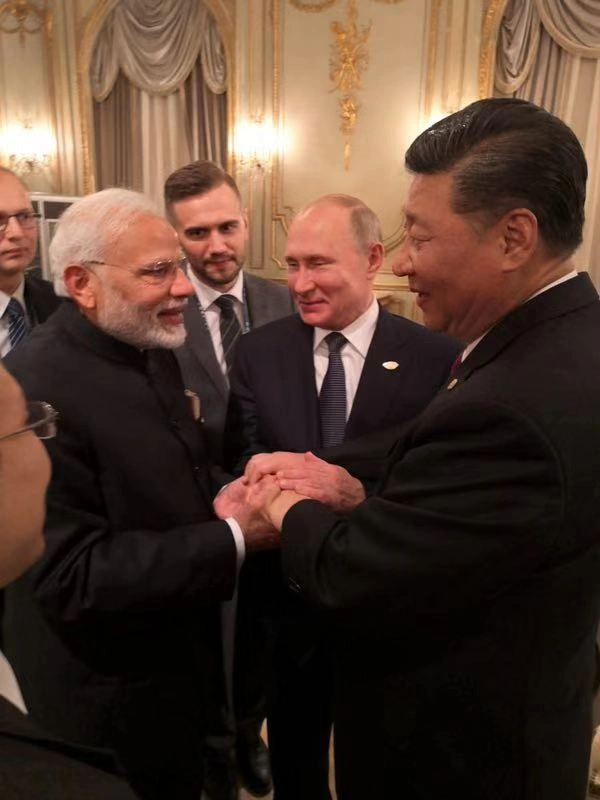 Chinese President Xi Jinping, Russian President Vladimir Putin and Indian Prime Minister Narendra Modi during an informal meeting on the sidelines of the G20 summit in Argentina’s capital Buenos Aires, 2018. | Photograph: CCTV
II.Structural Roots of Policy Oscillations
The Modi government wishes to maximize the use of foreign capital, technology, and talent for its own development, yet imposes comprehensive restrictions on the Chinese capital and enterprises most likely to invest in and empower India. The root of this contradiction lies in the constant swinging of Modi’s policy between the economic rationality of attracting investment and technology, and the political rationality of catering to aggressive nationalism.
PN3 was not the first instance of the Modi government “shooting itself in the foot.” In domestic industrial policy, the government uses the “Production Linked Incentive” (PLI) scheme to attract enterprises to expand production scale, while simultaneously using the “Self-Reliant India” (Atmanirbhar Bharat) campaign to raise import tariffs on finished goods, intermediate goods, and key components, comprehensively increasing the cost of industrial inputs. In foreign economic policy, India loudly proclaimed its intention to integrate into global supply chains yet withdrew from negotiations for the Regional Comprehensive Economic Partnership (RCEP) in 2019. The border conflicts between China and India since 2020 rapidly catalyzed economic and trade cooperation into a highly emotional and politicized national security issue, turning economic rationality into a political “forbidden zone.”
Consequently, even after PN3 was issued, repeated warnings from policy and think tank circles that comprehensive controls on Chinese capital would significantly raise manufacturing costs and slow the “Make in India” process were ignored, as political rationality completely overrode economic rationality. This indicates that the Bharatiya Janata Party (BJP) had no intention of bearing the political costs of relaxing control policies. This policy orientation was jointly pushed by multiple departments within the Modi government. Following the Galwan Valley clash in 2020, Indian national security agencies believed a “firewall” must be set up between China and India. For instance, National Security Advisor Ajit Doval advocated restricting Chinese investment and reducing economic ties with China. The issuance of PN3 also received support from Home Minister Amit Shah, Finance Minister Nirmala Sitharaman, External Affairs Minister S. Jaishankar, and Commerce Minister Piyush Goyal.
Economic nationalist groups provided public opinion support for the restrictions. The Swadeshi Jagran Manch (SJM), an economic nationalist organization under the Rashtriya Swayamsevak Sangh (RSS)—the BJP’s ideological parent—has long opposed foreign capital entering India and is particularly hardline on economic relations with China. Its convenor, Ashwani Mahajan, claimed that some Chinese manufacturing enterprises investing in India were merely doing so to circumvent tariffs. Meanwhile, local business forces also benefited from restricting Chinese capital. The Confederation of All India Traders (CAIT), representing small and medium merchants, has long opposed large foreign enterprises entering India.
These three forces combined on the issue of “controlling Chinese capital.” Coupled with the rising tide of global protectionism and the Biden administration’s continued courting of India through the “Indo-Pacific Strategy” and the “Quad” mechanism, India believed the losses from restricting China could be offset by leaning towards the US. This calculus ultimately drove the Modi government to implement comprehensive controls on its economic policy toward China.
After 2024, India’s macroeconomy weakened, FDI inflows slowed significantly, and pressure to attract foreign investment to manufacturing rose. Meanwhile, after years of fluctuations, China-India relations saw a turnaround, leading to a renewed emphasis on economic rationality. The Ministry of Finance took the lead in providing policy justification for introducing Chinese capital. For example, Chief Economic Adviser V. Anantha Nageswaran and Prime Minister’s Economic Advisory Council member Sanjeev Sanyal argued that if India wanted to enhance manufacturing competitiveness and seize “China+1” opportunities, it should not proactively exclude Chinese enterprises, capital, and supply chains.
Some policy think tanks also began advocating for adjustments to PN3. NITI Aayog pointed out that PN3 had caused long-term delays in larger investment proposals. Harsh V. Pant, Vice President of the Observer Research Foundation (ORF), also stated that if India wanted to become an Asian manufacturing hub, it should connect to Chinese supply chains. The demands of the industry were even more direct; industry organizations represented by the India Cellular and Electronics Association (ICEA) and the Manufacturers’ Association for Information Technology (MAIT) advocated for relaxing restrictions on Chinese technical personnel and cooperation with Chinese enterprises, supporting joint ventures between Indian and Chinese enterprises under the premise of Indian majority control and capped Chinese equity.
III.An Awkward Balance Sheet
Five years after the implementation of PN3, India received a rather awkward balance sheet. Chinese FDI was almost frozen, and the policy became a major obstacle to India attracting diversified foreign investment—as manufacturing enterprises tightly integrated with Chinese supply chains found it difficult to enter the Indian market, many multinational companies hesitated to transfer business to India. More awkwardly, India controlled Chinese capital but failed to control Chinese goods. Over the past few years, the scale of local manufacturing did expand, particularly in consumer electronics represented by mobile phones. However, assembly expansion does not equate to a manufacturing rise; increased production capacity instead drove huge demand in the Indian market for imported components, equipment, and intermediate goods from China. Consequently, India’s trade deficit with China widened from $44.025 billion in 2020 to $112.162 billion today.
Fundamentally, “Modinomics” attempted to replicate China’s manufacturing rise through subsidies, infrastructure, and policy selection, yet underestimated that industrial capability cannot be generated by mere policy decree. The Modi government might be able to use subsidies to attract foreign factories to land, but it cannot buy a complete supply chain in the short term. This has put India in a “lose-lose” dilemma: it has neither truly weakened its dependence on Chinese supply chains nor achieved so-called economic autonomy.
Against the backdrop of global supply chain restructuring, the US brandishing tariff batons, and Chinese enterprises accelerating their global expansion, the Modi government’s relaxation of Chinese investment approval in key industries indicates it has not abandoned its economic security logic. Rather, it is attempting to use institutional loosening to replace the previous blanket ban, introducing Chinese capital, technology, and supporting capabilities within a controllable range. Chinese capital, initially locked out as a “risk,” is now being re-introduced as a “resource.” This dual mentality of viewing China simultaneously as a security threat and an economic resource may well be the “Achilles’ heel” of India’s economic policy toward China.
Editor: Chang Zhangjin