

September 9th, in the hearts of many Chinese people, may be the true Teacher’s Day – on this day in 1976, Comrade Mao Zedong, the great mentor of the Chinese people, passed away. Compared to Mao Zedong’s birthday on December 26th (even referred to as “China’s Christmas” by some), the historical significance of September 9th is deeper: it is not only the departure of an important political figure, but also the end of a passionate revolutionary era.
 Beijing, Chairman Mao Memorial Hall,people are queuing up to Pay homage to Chairman Mao
Beijing, the capital of the People’s Republic of China, is the place where Comrade Mao Zedong passed away. His body lies quietly in the memorial hall of Tiananmen Square, and the White Marble sitting statue looks at the Monument to the People’s Heroes not far away. Since its opening in 1977, the Chairman Mao Memorial Hall has received over 240 million visitors, consistently ranking first in the national red venue passenger flow. Around September 9th, people from all over the country lined up in the heart of the Republic to pay their respects to the remains of Comrade Mao Zedong.
According to on-site staff, as many as 60000 people made appointments to pay their respects on September 9th. This figure is in stark contrast to the past: in 2003, the number of visitors was 25000; Around 2010, this number was only around 30000.
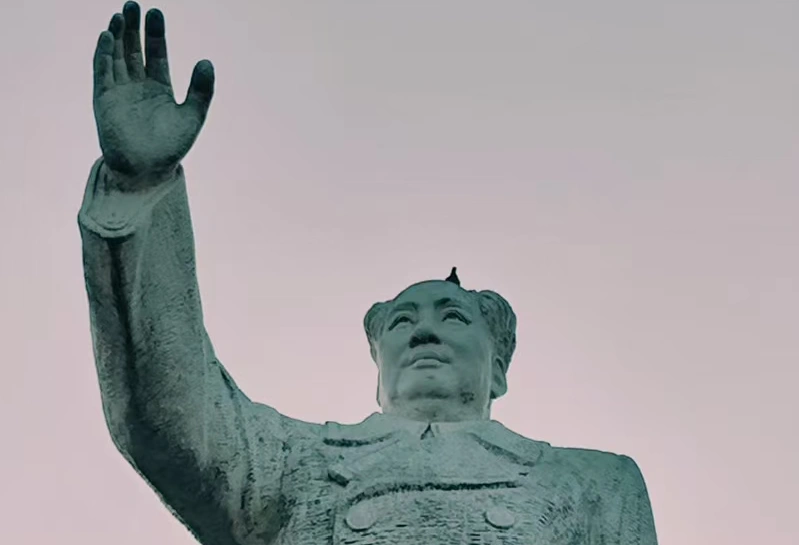 On December 26, 2026, a portrait of Chairman Mao from East China Normal University was taken
Shanghai is the most revolutionary city in Chinese history, the birthplace of the CPC, and the “Oriental Paris”. In front of the statue of Mao Zedong at East China Normal University, there were offerings spontaneously placed by classmates: a box of “Hongtashan” cigarettes – Mao Zedong had been fond of this domestically produced tobacco during the War of Resistance Against Japan; A plum blossom – this is Mao Zedong’s favorite flower, for which he once wrote “Ode to Plum Blossoms”; There was also a bowl of Braised pork belly, a dish that Mao Zedong had personally improved, because he thought soy sauce was not so hygienic.
On December 26th last year, I also visited the statue of Chairman Mao on campus. At that time, I took out Red book from the pocket on the inside of my down jacket and read a preface. This book was “Quotations from Marx, Engels, Lenin, and Stalin” that I bought from a vintage store in Hangzhou
 On September 9th, tens of thousands of people gathered at Shaoshan Bronze Statue Square to commemorate Chairman Mao
Shaoshan, Mao Zedong’s hometown. Starting from September 8, thousands of people began gathering around the Mao Zedong Statue Square. By the early hours of September 9, the crowd had grown even larger, with some holding up portraits of the Chairman, others waving red flags, and singing revolutionary songs like ‘The East Is Red’. Political economy professor Fred Engst also came to the scene to mourn Chairman Mao with many young comrades. On the square, a banner stands out prominently: “Chairman Mao’s late years are a glorious and correct new chapter of Marxism Leninism.” Here, there are more young people, and the way of commemoration is also more enthusiastic and outward.
In 2025, Shaoshan will receive 17.53 million tourists throughout the year, of which 33% are young tourists under the age of 35. The “My Shaoshan Tour” red study tour received 545000 teachers and students in one year.
The changes in passenger flow in Shaoshan are themselves a condensed history. After Mao Zedong’s death in 1976, 280000 people came to offer condolences within a month, with a maximum of over 40000 people per day, and more than 1.75 million people received throughout the year. In the 1980s, influenced by the bourgeois liberalization trend in the early stages of reform and opening up, the number of tourists hit rock bottom, with only 230000 visitors per year, less than one seventh of 1976. After 2008, the number of tourists continued to soar, reaching approximately 25.68 million visitors in 2019 before the pandemic. Despite the impact of the epidemic, there will still be 17.53 million tourists visiting by 2025, with an increasing number of young faces.
The commemorative activities for Chairman Mao are not only held in the square and in front of the memorial hall, but also in the gaps between characters and on screens. On the borrowing ranking list of Tsinghua University Library, “Selected Works of Mao Zedong” ranked first from 2019 to 2020, and has been in the forefront for several consecutive years. It also topped the paper book borrowing rankings for 2024 and 2025. On Bilibili, there are over 1400 videos related to “Selected Works of Mao Zedong”, with the highest viewed video exceeding 4 million times; The topic of “Selected Works of Mao Zedong” on Zhihu has received over 6 million views. On short video platforms such as Tiktok, Chairman Mao’s related topics have been broadcast more than 5 billion times, and the bullet screen is full of “Long live the people” and “Celebrate the great people”. The core engine of traffic is the young generation born in the 1990s and 2000s, who engage in spontaneous activities such as reading ‘Selected Works of Mao Zedong’, making videos, and writing notes, surpassing the traditional nostalgic scope of commemoration. People call him a “teacher” because during Edgar Snow’s visit to China in 1970, Mao once said that he did not like the “Four Greats” and only wanted to keep one “teacher” in the end (he first attended a normal school, just like the author)
On September 9, 1976, many young people in their twenties mourned Chairman Mao, who were born in the 1950s and 1960s and had experienced the Mao Zedong era. On September 9, 2026, most of the people mourning Chairman Mao were still young people in their 20s, born in the 1990s and 2000s, who had never experienced the Mao Zedong era. Why did the Z generation in China, born during the reform and opening up era, so fervently pursue Mao Zedong that they formed the ‘Mao Zedong fever’ of the Z generation?
Firstly, there are many challenges that Chinese Generation Z has encountered in their social practice. In an era of anti globalization, conflicts around the world are intensifying, market competition and international disputes are constant, and conservatism is prevalent. Although China is currently in a rare state of relative stability, peace, and security, it will still face widespread problems encountered by world capitalism, such as wealth inequality, high rents, employment difficulties, 996 internal competition, and alienation of people in the AI era. The outbreak of contradictions in the cycle of all capitalist cycles, coupled with the gradual decline of the dividend after China’s accession to the WTO since 2001, and the dramatic impact of the COVID-19 on the economy, a series of problems left Gen Z confused, confused, and worried, who should have been able to exert their talents and wisdom to work under the established rules of the world historical stage. In the new era of shifting from high-speed development to high-quality development, they need to find a way out, a goal, and break out of this deadlock.
Secondly, it’s a reassessment of past trends of social thought. ‘The Resolution on Several Historical Issues Since the Founding of the People’s Republic of China’, which was presided over by Deng Xiaoping in 1981, clearly adopted the evaluation method of “combining merits and demerits” for Mao Zedong, namely the so-called “three seven point review”, with seven points for achievements and three points for errors. Since then, this document has become the basis and methodological source for the official ideology’s evaluation of Mao Zedong, namely “history should be rough rather than detailed”, “achievements should come first, mistakes should come second”, and “writing before the founding of the country”. This position and method were revealed in Deng Xiaoping’s conversation with Orena Faraci.
But under the great changes of reform and opening up, a large number of right-wing intellectuals who were criticized during the Mao era began to rebel and reverse calculate due to their personal experiences. They controlled the public opinion machine, modified collective memory, “bid farewell to the revolution”, and wrote scar literature in the noisy dust. The group of people who grow up under this social public opinion are the parents of China’s post-70s, post-80s, and Generation Z. At the same time, these people who control public opinion consolidate their desired capitalist logical order by promoting atomized struggle, and their own success is precisely based on their deviation from socialism and scheming. A Chinese entrepreneur reflects on that era, ‘Standing on the wind, even pigs could fly.’ Now, China’s Generation Z refers to them as’ Chundeng ‘(the newly opened nouveau riche liberal authoritarian patriarch).
In the Internet era, thanks to the rapid development of China’s network technology, infrastructure and artificial intelligence technology, many public opinions and historical memories previously monopolized by cultural elites have the opportunity to be broken, many historical materials that have been deliberately covered up have been revealed, and many stigma imposed on Mao Zedong has been broken. Generation Z uses this knowledge to correct their parents’ misconceptions, explore the so-called truth, and construct a narrative logic for the future.
In constructing their own narrative logic, Generation Z discovered the Mao Zedong era and thought, which had achieved relative social justice and equality. This is precisely a negation of the logic of “spring ascent”. China has always had a tradition of “reforming the system based on ancient times”. Generation Z commemorates Mao’s era and ideology, not just to memorize Mao’s words or fully return to all the states of the “first thirty years”. Generation Z commemorates Mao Zedong in order to create their own “kingdom of freedom” through their own efforts, using Mao’s ideas and practices as a reference direction. Therefore, they treat Mao as a ‘negation of negation’.
Once again, Mao Zedong’s own ideology and political legacy still have vibrant vitality. Politically speaking, Mao Zedong built the political structure and social organizational foundation of modern China, including harmonious central local relations, efficient government execution, and the concept of clean supervision. This ensures that China can stand tall as a stable independent major country in decades of turbulent world changes. Mao Zedong’s greatest political heritage is the People’s Republic of China and the CPC. Even many nationalists have to admit that it was under Mao Zedong’s leadership that the Chinese people were able to “stand up” from then on. He abolished unequal treaties and privileges imposed by foreign powers on a population of 40000, and defended the territorial and sovereign integrity of the motherland.
But Mao Zedong was far more than just a national revolutionary. On the contrary, it was because his ideological legacy was able to transcend national boundaries and time constraints to guide and assist other countries and future socialist practices. Mao Zedong’s proposal of the “Three Worlds” theory is a typical example. Mao’s ideological crystallization – “People’s Historical View”, “Divided into Two”, and “Armed Struggle” – has taken root and sprouted in left-wing movements in the United States, Japan, Europe, and Africa. The “Quotations from Chairman Mao” have been printed in approximately 5 billion copies. Known as the “Red Book” due to its red cover, it became popular worldwide in the 1960s and 1970s, with the second highest circulation in the world, second only to the Bible, which has been circulating for nearly 2000 years.
Let me give another example that few people know about: the “Socialist Political Economy” compiled by the Shanghai School (Mao’s think tank) in 1975, which mainly emphasized the existence of bourgeois legal rights in the economic foundation of the socialist period, that is, the exchange of goods itself contains capitalist production relations, and proposed to be restricted. After the reform and opening up, China introduced Western capitalist production factors on a large scale, and the “socialist market economy” became China’s economic system. But so far, China has not developed a “kill line” pattern like the United States, and its people have received basic guarantees in areas such as healthcare, housing, employment, and energy. This is precisely because the Chinese government restricts bourgeois rights in the distribution field to ensure the happiness and well-being of the people, rather than a purely corporate controlled technocratic state as Elon Musk hoped to construct.
Forgive me for not being able to cover all aspects of Mao Zedong Thought here. His ideological system and theoretical practice are too extensive, to the point where it would take several generations to thoroughly study after him.
Therefore, the Z generation in China, although they did not directly live during the Mao Zedong era and would not look up to see Mao’s portrait in most places except Tiananmen Square (which is also rare on the Chinese yuan because electronic payments are now used), Mao’s legacy has already been blurred in their daily lives. These revolutionary factors have become the ideological foundation for the steady progress of socialist China. At the moment of conflict, these legacies will also be concentrated and reflected, and learned and practiced by the new youth.
For Generation Z, their attitude towards Mao Zedong will not become a pure slogan and worshipped deity like many people 50 years ago; They will not become targets of slander and trampling like some people in the past 50 years; They will learn from him, practice it, abandon it, and surpass him in 50 years
Chairman Mao once had expectations for the youth: the world belongs to you and us, but ultimately it belongs to you. You young people are full of vitality and thriving, like the sun at eight or nine o’clock in the morning.The hope relies on you.
The ‘Mao Zedong fever’ of Generation Z is more of an ongoing issue than a completed conclusion. It raises more questions than it answers: What are they really looking for when a generation that has never experienced a revolutionary era actively steps towards the legacy of a revolutionary? Can the things they found answer the questions they asked when they left? There are no ready-made answers to these questions, but asking the questions themselves is already a historic action.
This article is dedicated to commemorating Comrade Mao Zedong.
Editor: Gu Shengze