


The rise of China is essentially economical. But economic rise leads to political and military rise. This is exactly in line with the Marxism political economy principle that the economic base determines the superstructure.
During the rise of China, the West went from welcoming it to blocking, yet somehow giving a massive assist along the way.
In the early days of the Reform and Opening-up, China was starting from scratch. You can keep harping on about the ‘first 30 years’ and the analogy of the ‘nine buns versus the tenth one’ if you want, but the reality is that at the beginning of the Reform and Opening-up, China was in desperate need of its first pot of gold, and equally urgent was the need to get a foot in the door of modern manufacturing.
At that time, the undisputed leader was Guangdong. Without doubt, the focus was on exported-oriented light industry,such as clothing, toys, shoes, hats, and all sorts of knick-knacks. If it could be exported and brought in quick returns,it was rushed into production. Start-up capital and technology often came from overseas (not so much from Europe and the US at the time, but mainly from Hong Kong and Macao, with a bit from Taiwan). In this stage, Europe viewed China purely as an inexhaustible source of cheap labor. The market size brought by China’s population was secondary, simply because the purchasing power of the Chinese people was too low.
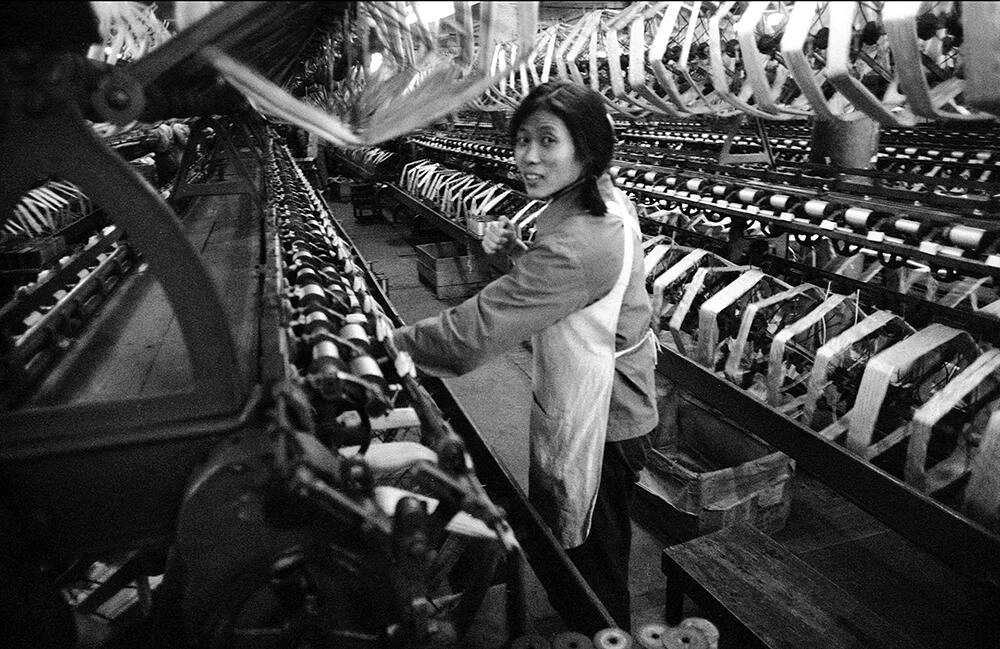 In 1980s, a clothing worker in Guangdong
I remember back in the late 70s and early 80s, the most iconic cigarette was State Express 555, and the most famous soap was Lux. Having a 555 cigarette dangling from your lips while smelling faintly of Lux soap was the ultimate signature of a trendy person back then. While 555 might not be as famous today, at least most people still know the brand. But how many people still know about Lux soap? True, the brand still exists. Lux has always been an exclusive brand of Unilever, and it became popular in mainland China through Hong Kong. Actually, whether it’s 555 or Lux, both can be seen as ‘Asia-Pacific exclusives’ with little presence in European and American markets, so they can hardly be called ‘world-famous brands’. Yet back then, they were untouchable status symbols in China.
The most iconic car was undoubtedly the Santana. In Europe and the US, it wasn’t exactly bottom-tier, but it certainly wasn’t a luxury or famous brand either. It was basically just ‘John Doe’ in automotive history—a completely forgettable nobody.”
Thanks to such precedents, for a while, every Tom, Dick, and Harry of European and American brands flocked to China to strike it rich. Of course, that was back in the early 21st century.
This was also the era when Chinese manufacturing operated on the model of ‘massive imports and exports, with both ends outside’—relying primarily on imported raw materials and overseas markets. Due to the nature of my work back then, I had quite a bit of exposure to the textile and chemical fiber industries.Domestic chemical fibers were basically just smooth, solid threads. They were tough, sure, but absolutely terrible at being breathable, sweat-absorbent, or thermally insulating. Worse still, the moment a single thread snagged, the whole fabric would fall apart. Pure polyester was particularly notorious for this: it was stiff and colorfast, but the wearing experience was exactly like putting on a plastic raincoat—freezing in the winter and sweltering in the summer.Imported fabrics, on the other hand, used crimped and hollow polyester fibers. Even though they were made of the exact same base materials, their texture and feel were akin to cotton or silk. They were breathable and sweat-wicking, making them vastly superior to domestic products.Zippers were the same story. Imported plastic zippers were far more durable than their domestic copper or aluminum counterparts. Plus, they could be color-matched to the fabric and were guaranteed not to get stuck. We even had to import buttons; when it came to colors, shapes, and material textures, domestic products simply couldn’t compete with the imported ones.
Back then, the West didn’t restrict the export of technology or equipment in these areas—you could buy them if you had the cash. The problem was, the Chinese simply couldn’t afford them. Guangdong imported a massive amount of second-hand equipment for small chemical fiber plants. We would go inspect them and then try to reverse-engineer them. But even after we completely understood how their equipment worked, our domestic mechanical processing capabilities just couldn’t keep up. For example, the nozzles on a spinneret had to be even finer than a human hair, perfectly round, and capable of extruding hollow fibers. On top of that, they had to withstand the constant wear and tear of molten polyester being continuously forced through them. The Shanghai Textile Machinery Factory couldn’t do it. In the end, we had to go to an aerospace facility to ask for help. Only then were we able to trial-produce a prototype. But once they helped us build the prototype, that was it—they washed their hands of it. Figuring out how to mass-produce it was entirely up to us.
China wasn’t completely without domestically produced precision CNC machine tools, but they were all essentially hand-crafted. In terms of price, reliability, maintenance, product flexibility, and adaptability, they fell far short of market demands. We had no choice but to import them, only to get completely fleeced. The first rule of capitalism is: charge what the market can bear.
On the one hand, there was a massive demand in the domestic market. On the other hand, the original supply and sales chains of the equipment manufacturing industry had collapsed, leaving these factories with no work to do. The two sides perfectly matched each other’s needs, and that is exactly how China’s equipment manufacturing industry was reborn. However, not everyone got to experience this rebirth; in fact, the vast majority simply withered and died. In this regard, movies and novels actually depict historical facts accurately—it’s not fiction that old welders had to make BBQ grills just to make a living.
On the other hand, fabrics, zippers, and buttons were also undergoing domestic substitution. The surge in new production capacity, in turn, further propelled the development of equipment manufacturing.
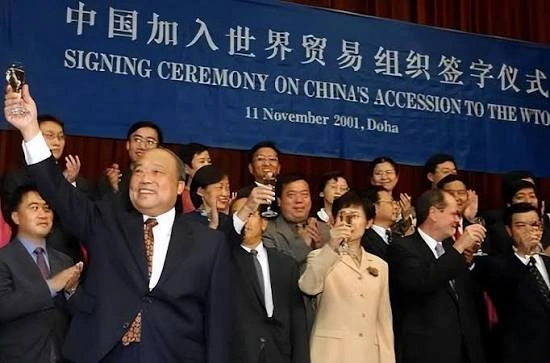 China’s accession to the WTO in 2001 opened the door to its rapid development.
In this way, Chinese manufacturing began with consumer goods and developed through an iterative process alongside equipment manufacturing. The electrification and digitalization of consumer goods gave rise to the chip and software industries, while the manufacturing of capital goods (durable goods not directly used for personal consumption, but for producing other goods or services—such as machinery, equipment, factories, and vehicles) spurred research into fundamental materials and technologies. This is how Chinese manufacturing gradually grew into a flourishing, deeply rooted tree.
What’s fascinating is that the West often only realizes it needs to ‘choke off’ China after a certain industry has already matured. Ironically, this is usually the exact moment China has just broken through its bottleneck. Before reaching that bottleneck, the West never believed China had the ambition or the capability, so they saw no need to impose restrictions. It was much more direct and profitable for them to simply extract maximum profits by exporting capital goods to China.
However, once China breaks through, any subsequent attempts by the West to impose blockades can only force China to build its own independent ecosystem. Some industries move faster than others, but they almost never miss the mark.
Microsoft once turned a blind eye to pirated Office software, hoping to cash in on legitimate sales later. But once China’s office automation market was fully cultivated, WPS—which was originally clinging to life—suddenly found its footing and thrived the moment Microsoft tried to charge for its software. The US tried to strangle Huawei by banning the use of Android, but the result was Huawei’s HarmonyOS officially stepping out of the shadows to become its main operating system. When the US blocked ASML from selling its equipment, it only pushed China to crack the code on its own. The exact same story applies to EDA software. Aero-engines were originally being developed at a snail’s pace, but the moment the Trump 1.0 administration threatened to embargo the LEAP-1C engines, the development process suddenly shifted into high gear. Of course, there are also current examples like AI and humanoid robots. However, since these fields are largely on the same starting line globally, the dynamics are a bit different.
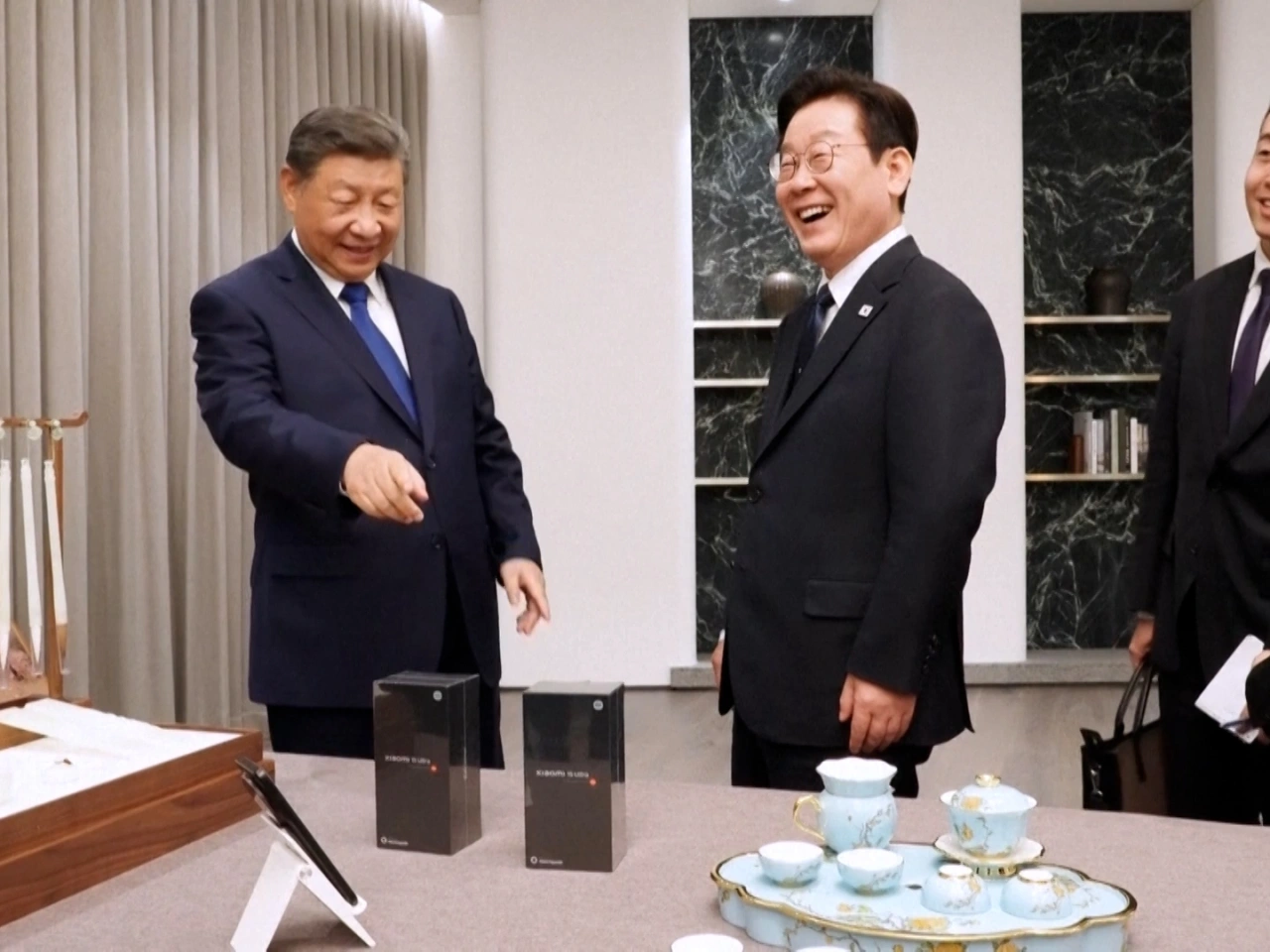 Chinese President Xi Jinping presented South Korean President Lee Jae Myung with Xiaomi smartphones as gift during the APEC summit in Gyeongju, South Korea, in November 2025.
Sometimes, one can’t help but wonder: if the West had kept its export policies largely open (excluding military goods) as it did 20 years ago, domestic substitution wouldn’t have been completely abandoned, but the pace would have been much slower. After all, path dependency is a comfortable path to walk. However, the cost advantage of domestic alternatives is simply too massive, making it an inevitable outcome sooner or later. The West couldn’t just sit back and do nothing; it is naturally unwilling to watch its highly lucrative markets being eaten away. More importantly, being replaced in strategic industries is even more detrimental to controlling the speed and direction of China’s rise. The West’s only hope is to maintain a permanent lead. But as things stand, once China breaks through a bottleneck and establishes its own domestic ecosystem, its pace of development is simply too fast for the West to keep up.
The political and public perception of Chinese manufacturing in the West often remains stuck on consumer goods. However, China already dominates the capital goods sector, which is precisely why Western trade wars have ended up hurting themselves more than China. Ironically, the West’s current push to ‘de-risk’ its supply chains from China has become the biggest catalyst propelling China’s capital goods manufacturing and exports to unprecedented heights.
Twenty years ago, China’s export advantages were concentrated in daily consumer goods like apparel, furniture, and home appliances. Today, the main engines of export growth are machinery, industrial equipment, energy storage systems, electronic components, and AI and digital tech products.
The West’s attempt to decouple its supply chains from China requires a two-pronged approach: 1) ‘Friend-shoring,’ which essentially means accelerating the industrialization of the Global South; and 2) ‘Reshoring,’ or the re-industrialization of the West.
The Global South is still rapidly advancing through industrialization, urbanization, and infrastructure development, leading to a continuous surge in demand for power grids, industrial equipment, transportation systems, and energy infrastructure.
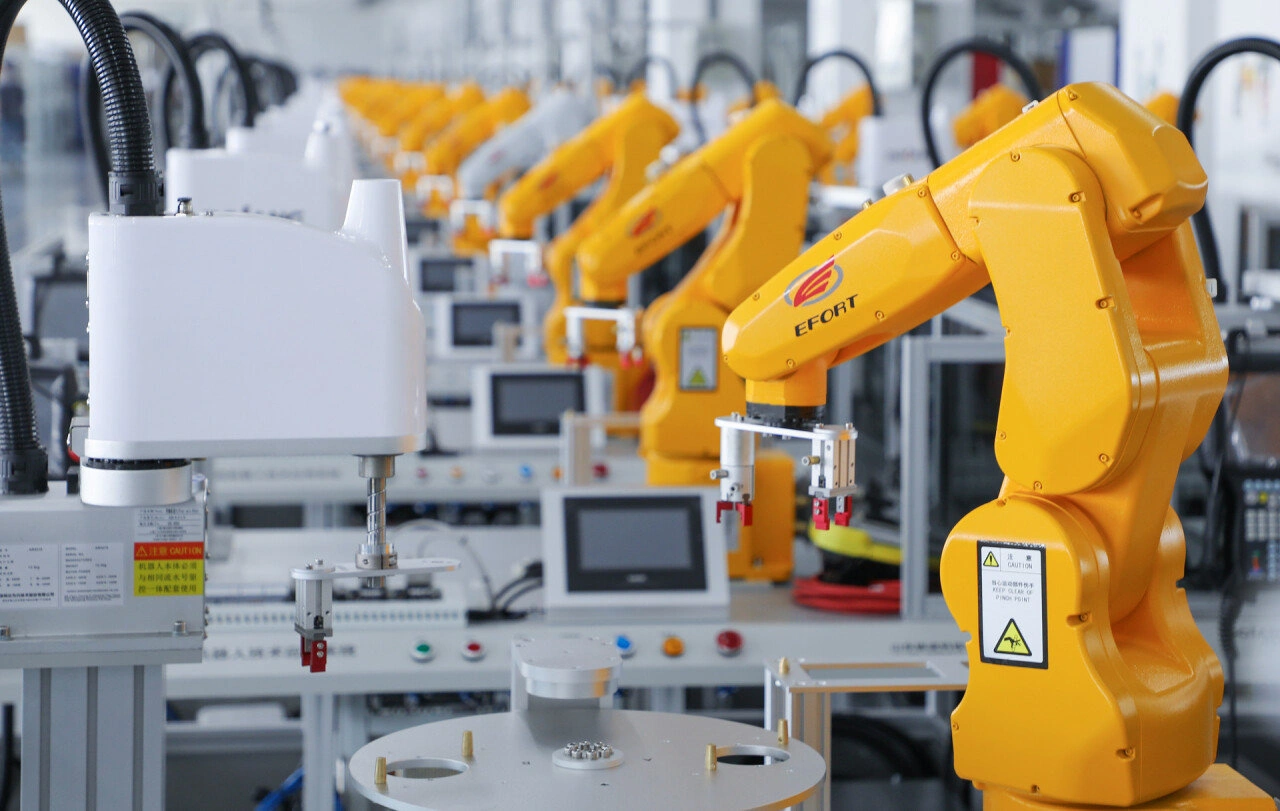 China’s automation industry chain
Meanwhile, advanced economies are attempting to enter a new cycle of re-industrialization. They are heavily investing in AI, data centers, new energy, and high-end manufacturing, which is constantly driving up the demand for semiconductors, industrial automation equipment, power infrastructure, and industrial intermediate goods.
Although these two types of economies are at different stages of development, they are simultaneously creating a massive demand for capital goods and means of production, while traditional consumer goods demand is actually declining. China is gradually shedding its old model of relying on labor-intensive consumer products for international competition. Instead, it is forging a new global competitiveness based on its complete manufacturing system, engineering and R&D capabilities, and a massive industrial ecosystem. In other words, the strategic competition aimed at curbing China’s industrial upgrading has inadvertently accelerated the structural reforms China had long desired. China’s recent export boom is not merely a cyclical recovery; it reflects a comprehensive restructuring of its industrial capabilities, export structure, and overseas market layout.
An ancient Chinese saying goes: better to teach a man to fish than to give him a fish.
China is still selling fish, but it is also selling fishing gear. More importantly, China is a world leader in manufacturing fishing gear. Thanks to the price advantage, reliable performance, and swift service of its capital goods, Chinese-made fishing gear will not only enjoy a long-term advantage but will also primarily benefit Chinese fishermen.
The world is dynamic and constantly evolving. Competitive advantage doesn’t come from drawing lines in the sand to protect your turf, but from staying one step ahead of your rivals. The West knew this truth long before China, but when it comes to putting this principle into practice, the West has fallen far behind China, and there is currently no sign of catching up.
The West’s fatal mistake was this: once they started buying fishing gear, they fished less and less, and eventually stopped fishing altogether. But the continuous improvement of fishing gear comes from the experience and research of actually catching fish. Today, China is both selling fishing gear and catching fish, and is highly mindful of not repeating the West’s mistakes. People often say China is the best student. The hallmark of the best student is making the fewest mistakes—especially by observing the mistakes of others and consciously avoiding them.
Editor: Gu Shengze