


China has recently become the focus of attention for people in Brazil because of a change thousands of miles away, and has even been regarded by some as “the beacon of hope for humanity.” In the first round of Brazil’s presidential election, Flávio Bolsonaro, son of right-wing former President Jair Bolsonaro, received 47.03%, while incumbent left-wing President Lula received only 45.16%.
Seeing the right wing about to make a comeback, Brazilian leftists who were emotionally overwhelmed began to reflect, and China, which has good relations with the Lula government, became the model to emulate: Why is public security so bad in Brazil? Why do voters believe in the pie in the sky drawn by the right wing? Why do Brazilian right-wingers dare to openly commit treason and clamor for the United States to interfere in domestic politics? Look at China—it doesn’t seem to have these problems. Therefore, they conclude, Brazil must learn from China.
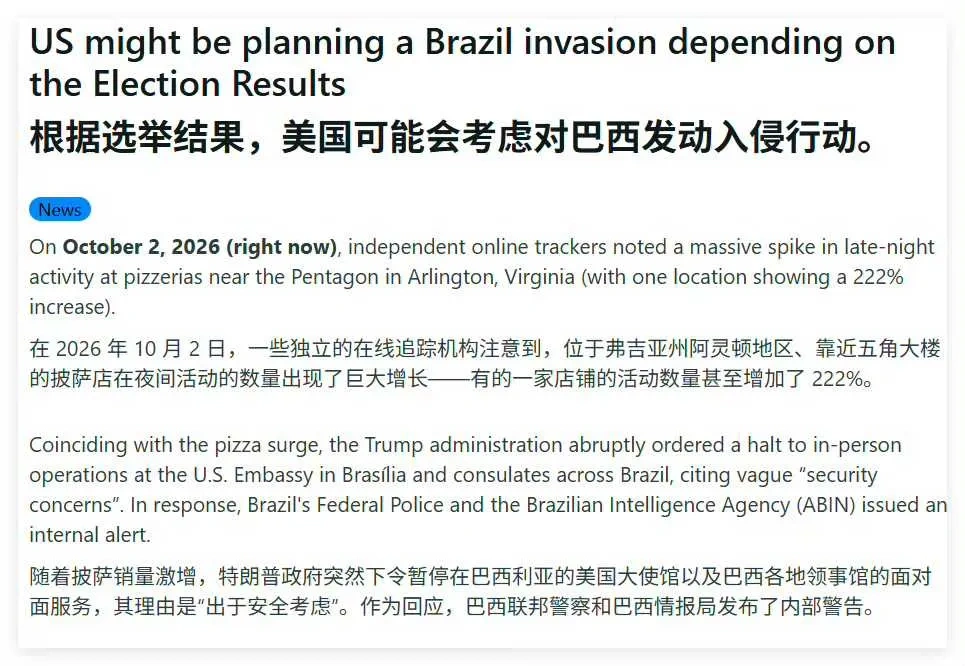
Some Brazilian leftists have gone even further, learning Mandarin and preparing to emigrate to China, while others are calling on China to send troops to help Brazil resist U.S. interference.
All kinds of remarks have given Chinese netizens an unprecedented breadth of understanding of the current state of the Brazilian left, and what followed was unprecedented astonishment:
Why is the Brazilian left so aggressively promoting gender diversity and identity politics, advocating the abolition of the death penalty, and opposing harsh crackdowns on crime?
Who Is “Progressivism” Making Progress For?
Apart from speaking different languages, the Brazilian left and the left wing of the U.S. Democratic Party can be said to seamlessly share many views—for example, that the root cause of crime is systemic oppression and that criminals should not be cracked down on more severely; that social welfare must be increased, and as for where the money comes from, don’t worry about it; and that diversity and political correctness, transgender issues from childhood, and so on, are necessary. Tracing this back, these are not new ideas formed in this century. Rather, Western Marxism in the 1950s shifted class oppression in classical Marxist theory from the economic sphere to the spheres of culture, psychology, gender, and sexuality. After many historical evolutions, including the American civil rights movement, it formed what is now popular in Europe and America as so-called “progressivism.”
By contrast, the Latin American right, represented by Argentine President Milei and Salvadoran President Nayib Bukele, naturally likes to follow the U.S. Republican Party and sing Trump’s song of “valuing family and tradition,” “building big prisons and cracking down hard on crime,” and “only by reducing welfare and cutting taxes can the economy be run well.”
Chinese people will naturally feel astonished. Brazil’s public security is relatively poor even by South American standards. Rio de Janeiro’s danger level can rank third in the world. Not to mention the favelas—even the city center becomes a no-go zone for tourists at night. Many football fans know that Brazilian football stars often come from favelas. If Brazilian teenagers who grow up in favelas cannot make it out through their football skills, they are very likely to become drug dealers.
For Chinese people, drugs must be banned and bandits must be suppressed. Even in ancient times, when “imperial power did not reach down to the county level,” if the court could not even govern the area under the emperor’s feet and sat by while thousands of bandits openly carried weapons, murdered, and robbed, then that dynasty’s days were numbered. When the best city in the country has become a stronghold of organized crime, and the government still does not hurry to crack down on crime, how can that make any sense?
China has its own nuanced understanding of progressivism. At the end of the day, why do the Chinese open up the Tianshan Mountains, build the Heavenly Road, and carry out targeted poverty alleviation? Why do the Chinese emphasize that women hold up half the sky, that not one person should be left behind, and the “Two Assurances and Three Guarantees”? Because protecting vulnerable groups, respecting ethnic equality, and improving social welfare are long-standing common pursuits of Marxists.
On the contrary, historically Western right-wing forces engaged in racism, persecuted homosexuals, suppressed the workers’ movement, carried out inhuman colonial plunder, and launched genocides against American indigenous peoples, African indigenous peoples, Jews, Slavs, Indians, Bengalis, and other groups. Today’s Latin American right is merely picking up others’ leftovers, pledging loyalty to Trump and Netanyahu on the one hand, and on the other advocating hitting criminal organizations hard, cutting taxes for big businesses, and slashing labor welfare.
Without engaging in colonial plunder, simply cosplaying as colonizers certainly cannot enrich the country and strengthen the people. General Pinochet, the economic wizard praised by “liberals,” merely caught a high point in copper ore prices and also relied on being pro-American to have sanctions lifted. Can an external factor like avoiding U.S. sanctions by electing a right-wing government really prove that the Latin American right is good at governing
The biggest problem with the currently popular “progressivism” is that it mainly focuses its efforts on culture, so much so that the right calls it “cultural Marxism.” As for how to transform society and reform government, it has few solutions—one could even say it tacitly accepts that the superstructure and economic structure cannot be changed. Sanders can be counted as the most left-wing among America’s old-guard politicians, but even he only wants to raise taxes on billionaires and big corporations, increase welfare for the people, make university tuition free, and strengthen financial regulation to prevent big corporations from interfering in politics. He does not dare to propose a more forceful government reform plan.
Lula has already governed twice, and Brazil is still a Brazil that relies on resource exports, has an enormous wealth gap, and is rife with organized crime and evil forces. His first term had impressive economic data, but the root cause was that China and other emerging economies urgently needed large amounts of resources at the time. By exporting crude oil, soybeans, meat, and iron ore, Brazil’s economy naturally rose with the tide. The poor economy during the term of Lula’s protégé Rousseff does not prove that Rousseff was truly incompetent; she simply encountered the international trend of reduced demand for raw materials.
During Bolsonaro’s term, Brazil’s economy continued to deteriorate to the point that ordinary people all missed Lula. Now President Lula, laid off and re-employed, can improve the economy to a certain extent, but this also benefits from the international situation—after all, some fellow oil-selling countries are now busy fighting wars and cannot sell oil.
As for Brazil’s superstructure, one can only say that no matter who is in power, the security forces will rot when they should rot. What makes me most uneasy about “progressivism” is that it uses psychological equality to cover up economic inequality. It can be said to be based on the premise that the existing economic and political order of Western countries is “sacrosanct,” whitewashing injustice and giving psychological massages to the exploited. When the British Labour Party came to power, the royal family and aristocracy remained superior beings, the City of London continued to earn excess profits, and workers still could not keep their jobs. During the four years when Biden replaced Trump, Wall Street still flourished intensely, the military-industrial complex still made huge fortunes, and homeless people still struggled on the brink of death.
For Brazil and other Latin American countries, to thoroughly transform the country requires a thorough revolution, and the cost of revolution may be long-term civil war and imperialist invasion. Ordinary people may live badly now, but not so badly that they would starve to death without revolution. On the contrary, if war breaks out, they might live even worse than now.
Since the underlying code remains unchanged, left-wing governments can only accept the facts that their independent industrial capacity is insufficient, they are unable to absorb young labor, and public security is destined not to be turned around. Ultimately, this leads to a conclusion that seems extremely absurd to us: the more a government cares about the “democracy and freedom” of the people at the bottom, the less it can eliminate poverty and unrest, and the less it can severely crack down on drug trafficking and criminal organizations.
Everyone Needs to Eat, but Does Everyone Need to Drink Cola?
Chinese author Lu Xun once said, “Literature has a class character. In a class society, although writers imagine themselves to be ‘free’ and believe they have transcended class, unconsciously they are ultimately governed by the class consciousness of their own class; those creations are not the culture of another class.”
There used to be a popular term, “universal values,” as if the American two-party system, federalism, neoliberal economics, the common law system, and so on were all good things applicable to all humanity. Admittedly, many countries do speak through one microphone: whether it is “forced labor” or “Pride Month,” anyone who does not agree seems to be cutting themselves off from the earth.
However, if there really is any principle in this world that applies everywhere, it is probably only that “people need to eat.” As for what they eat, that is personal freedom. Internationally, some countries are suited to a multiparty system, some countries like to kowtow to a royal family, and some countries do not even want a constitution—only a holy book. This is reality.
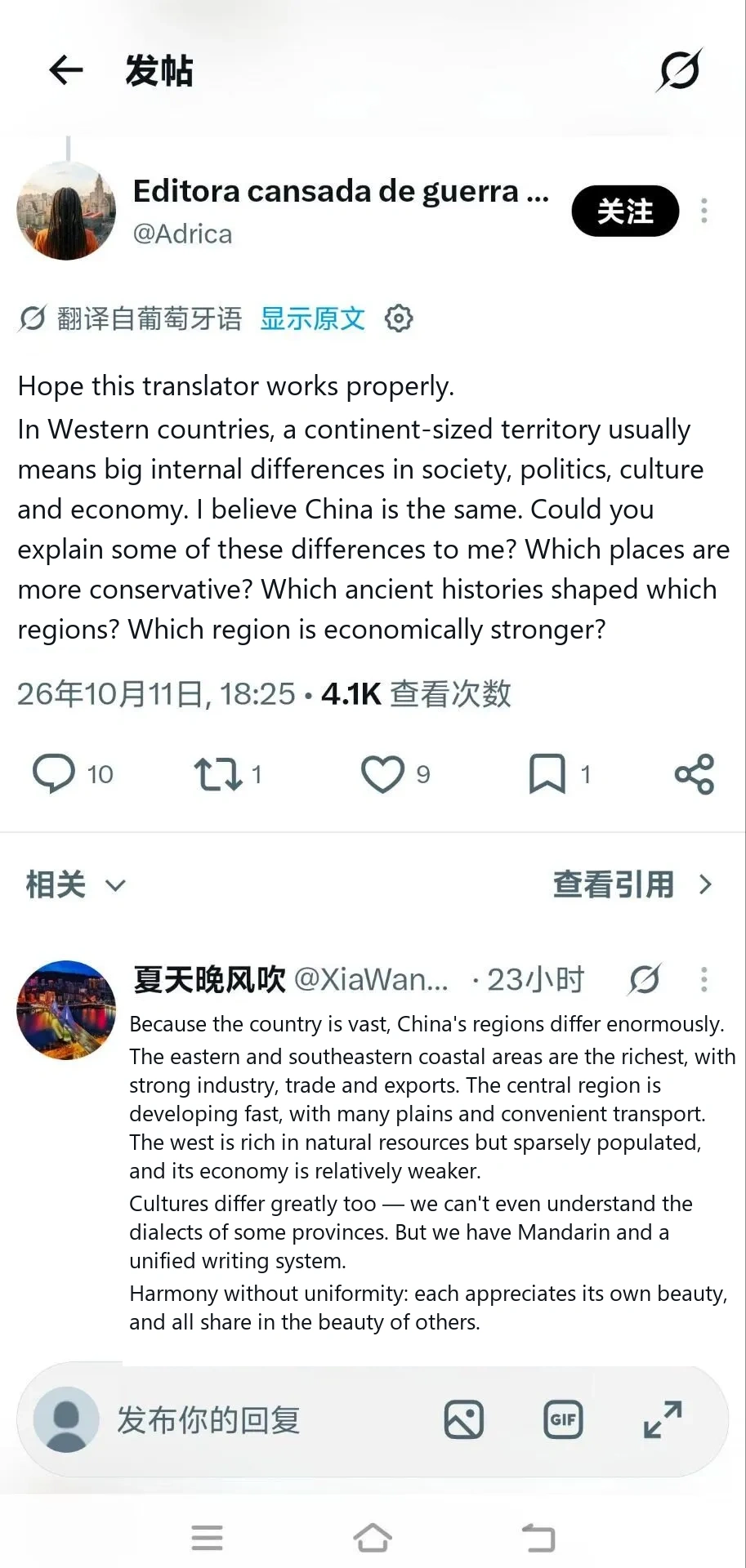
In Latin America, which the United States regards as its backyard, countries inevitably come under American influence. For Chinese people, ideas basically began to be influenced by the United States only after the 1980s, whereas Latin American countries began learning from and drawing on the United States from the moment they were founded. Two hundred years ago, Brazilian university students could already study classical liberalism. Before a political theory with its own characteristics has been established, a foreign, complete theory that appears “universally applicable” in one’s own country will inevitably occupy the brains of Brazilian elites. President Lula is naturally pro-China, but do not forget that his second election also benefited from the fact that the U.S. Democratic Party was in power at the time. Compared with the pro-Trump Bolsonaro, Biden was more willing to accept Lula.
The two world wars should have been enough to teach us that racism is a dead end. Today the Trump administration also frequently exposes the true colors of the Western right. Who are our enemies? Who are our friends? People who engage in racial discrimination and social Darwinism will certainly not be our friends. The Brazilian left certainly has this or that problem, but at least it knows it must cooperate with us. And to solve the industrial structure problems troubling Brazil, only the world’s top industrial power can come up with a solution.
After this round of dialogue between Chinese and Brazilian netizens, some people said that Chinese netizens are too arrogant and criticize the Brazilian left without regard for Brazil’s national conditions. I think the criticism is not due to arrogance, but out of frustration that iron has not become steel. Bolívar, the hero who laid the foundation for the electoral systems widely implemented in Latin American countries, also began to criticize the electoral system after many years of political practice: “We will avoid elections, because they always lead to… anarchy.”
Who could love the Latin American people more than Bolívar? Of course Bolívar did not want to make himself king or emperor, nor did he want a military government dictatorship. He simply discovered that a loose and weak government absolutely could not defeat the big landowners, end the hacienda economy, and nurture a strong national bourgeoisie.
Some people in the United States also discovered this, and so in the war with the heaviest casualties in American history, the Southern plantation economy gave way to Northern factories under the intervention of the state apparatus. President Lincoln did indeed tear up the Constitution, but the federal government established its authority and embarked on a path completely different from that of Latin America. Without a strong national bourgeoisie, there will naturally be no industrialization. Without enough industrial workers, no matter how high the welfare standards implemented by a left-wing government, they lack meaning, because what dominates the lifeline of the national economy is still big landowners and compradors. The premise of American deindustrialization is that America once had industrialization, whereas Latin American countries have never truly possessed industrialization.
The world is fair. Latin American countries stayed away from violent revolution and world wars, and the left and right took turns in power through elections. Therefore, they inevitably had to pay the price of insufficient central authority. Che Guevara firmly believed that a small number of guerrillas could complete a revolution. Allende ignored Premier Zhou Enlai’s warning that “the army may rebel,” and ultimately died fighting in the presidential palace. Even María Corina Machado, the Nobel Peace Prize laureate who openly praised Israel’s “illustrious military exploits” and called for the United States to invade her own country, was still able to move freely in Venezuela during Maduro’s time and was only briefly arrested once. We feel sorrow for this, not because we look down on the Latin American people, but because we too were once mired in the same quagmire.
Editor: zhangyixincq