



Here’s a hunch I can’t shake: the era of open oceans might be ending. And we need to start preparing for a fight over maritime power and the safety of shipping lanes that’s coming whether we’re ready or not.
When the Ones Who Benefit From the Seas Aren’t the Ones Who Control Them
In 2025, China came out ahead in the tariff war and the sanctions war with the US. Trump found himself holding a weak hand, and had to call off the economic fight, settling for temporary compromise to buy time — which is how we got his notably humble visit to China, and talk of a “constructive, strategically stable” US-China relationship.
But did Trump actually accept the outcome? Did America’s strategic establishment? Based on what I’ve seen, the answer to both is no. “Constructive strategic stability” hasn’t become the consensus view in Washington’s foreign policy circles. Some believe the US is quietly loading its next move — building leverage against China’s weak points, waiting for the right moment.
One of those weak points is obvious: sea lanes. China is the world’s largest trading nation, and roughly 95% of its foreign trade moves by sea. Yet control of the oceans still sits with the US and its allies. Part of that is a 600-year-old inheritance — after the fall of the Southern Ming, the Chinese nation walked away from its own maritime ambitions and handed the age of exploration to Europe. Part of it is a more recent strategic choice: in the 1970s, China partnered with the US to counter Soviet expansionism, and one side effect was reinforcing Anglo-Saxon control of the seas over the Eurasian landmass.
Over the past fifty years, China’s industrialization has pulled the center of global manufacturing and trade away from America’s West Coast toward China’s southeastern coastline. The US-China economic relationship has shifted from mutual dependence to competition. Which raises an uncomfortable question: when the country that depends on sea trade and the country that controls the seas go from cooperating to competing, the era of open oceans may not survive that shift.
Back during COVID, some US military strategists were already floating the idea of “letters of marque” against Chinese merchant vessels — essentially licensing private and allied naval forces to harass Chinese shipping on Washington’s behalf. Since the second half of 2025, a string of geopolitical flashpoints have lit up around the world’s key maritime chokepoints — first the Panama Canal, then the Arctic route and Greenland, then Iran’s Strait of Hormuz. These aren’t isolated incidents. They’re warning signs that the age of open seas is winding down.
To be clear, we don’t think the US is about to broadly shut down Chinese shipping on the high seas anytime soon. What’s more likely is that they’ll tighten their grip on the key nodes, creating a manageable, controllable kind of tension — like holding a small knife near your throat and moving it around just enough to keep you anxious, without ever actually cutting.
The Chokepoints That Will Define the Next Fight for the Seas
Looking at the world’s shipping lanes, a handful of locations stand out as the coming battlegrounds for maritime control.
The Suez Canal connects the Mediterranean to the Red Sea. Lose access to it, and shipping between Europe and Asia has to detour around South Africa’s Cape of Good Hope. This is the canal Britain, France, and Israel jointly invaded Egypt over in 1956 — only to be forced to back down by both the US and USSR. There are rumors Israel may be planning to dig an alternative canal at the northwest end of the Red Sea, essentially retiring Suez altogether.
The Strait of Hormuz connects the Persian Gulf to the Indian Ocean, and it’s the main artery for Gulf oil and gas reaching global markets. The recent US-Israel-Iran conflict saw the strait effectively double-blocked, and energy prices nearly doubled in a matter of days. Nearby, the Bab-el-Mandeb Strait — connecting the Red Sea to the Indian Ocean, between Somalia and Yemen — has its own dangers: Somali pirates, plus Houthi drones and missiles. The Houthis are a core part of Iran’s so-called “Axis of Resistance,” so a blockade at Bab-el-Mandeb tends to move in lockstep with tension at Hormuz. When Saudi oil can’t get out through Hormuz, it can pipe west to the Red Sea coast instead — but if the Houthis control Bab-el-Mandeb, those tankers have to reroute around the Mediterranean, the Atlantic, and South Africa before finally reaching Asia. That’s nearly ten thousand extra nautical miles, and a month longer at sea.
The Strait of Malacca connects the Indian Ocean to the South China Sea, jointly managed by Indonesia, Malaysia, and Singapore. It’s the narrow passage China’s shipping depends on more than any other. Block it, and ships have to reroute through Indonesia’s other straits — Lombok, Makassar, Sunda. China once floated the China-Pakistan Economic Corridor as a land-based workaround to the “Malacca Dilemma,” but in practice, that route solves only a small fraction of the problem.
The Taiwan Strait, off the northwest coast of Taiwan, connects China’s South China Sea and East China Sea — though as a shipping route, it’s actually not that critical. What matters more is what lies just southeast of Taiwan: deep ocean trenches, in contrast to the relatively shallow Bohai and East China Seas. If China ever bases strategic nuclear submarines on Taiwan’s eastern side, they could slip into the Pacific with far greater stealth — which is exactly why the US military watches the Taiwan question so closely. The Bashi Channel, between Taiwan and the Batanes Islands, is the single most important passage connecting China’s South China Sea to the Pacific — both commercially vital and militarily critical, and the key gateway in what’s known as the “first island chain” in East Asia.
The Bosphorus and Dardanelles, controlled by Turkey, connect the Black Sea to the Mediterranean and serve as the maritime lifeline for Ukraine and other Black Sea states. Since Turkey is a NATO member, these straits currently sit firmly in NATO’s hands. Fun historical footnote: the Varyag — the ship that eventually became China’s first aircraft carrier, the Liaoning — was sold to China so cheaply partly because Ukraine was confident a military vessel that size could never make it through these straits. They were wrong. If NATO were ever to dissolve, access through this passage could open up considerably.
The Arctic sea route has become a major focus for great powers in recent years. As the climate warms and icebreaking capability improves, the Arctic Ocean is becoming a viable summer route between Europe and Asia. Russia is trying to use its icebreaker fleet to control Arctic shipping, while the US and Europe are angling to claim a share based on geographic proximity. The Bering Strait, the gateway to Arctic shipping, is jointly controlled by Russia and the US — and once Arctic routes fully open up, it will become the critical chokepoint for the shortest Europe-Asia and Asia-America shipping lanes, and a major flashpoint for great-power competition.
The Panama Canal connects the Atlantic and Pacific. Cut it off or bring it under hostile control, and shipping from Asia to Latin America, eastern Canada, Brazil, and the Caribbean has to detour thousands of extra miles and weeks of extra time around the Strait of Magellan at the tip of South America.
The Strait of Gibraltar (connecting the Mediterranean to the Atlantic), the Danish Straits (the Baltic’s only sea outlet), and the English Channel (between Britain and continental Europe) have all played critical roles throughout European military history.
Beyond straits and canals, a handful of islands and ports carry outsized strategic weight — Diego Garcia in the middle of the Indian Ocean, Taiwan, the US-and-Japan-controlled Ryukyu Islands, Greenland near the Arctic, Hawaii and Guam in the Pacific, the Andaman Islands guarding Malacca’s western mouth, and Scarborough Shoal, right next to the Philippines. Each either commands a critical shipping route or functions as a strategic military base.
Certain deepwater ports matter just as much for understanding where this competition is headed — especially the ports China has poured serious money into recently: Chancay in Peru, Yun Rang in Cambodia, Kyaukpyu in Myanmar, and Gwadar in Pakistan. These are all potential future flashpoints.
How Modern Technology Is Eroding the Advantage of Sea Power
History moves in cycles, and technology is one of the biggest drivers of change. Every era brings different technical realities — and with them, different geopolitical logic.
Better shipbuilding and accumulated astronomical and geographic knowledge made the Age of Exploration possible, and sea power gradually eclipsed land power. Then aviation and nuclear weapons made air and nuclear superiority the real prize of the 20th-century superpower arms race. When we think about maritime security in the 21st century, we can’t ignore what the newest wave of technology is doing to that old hierarchy.
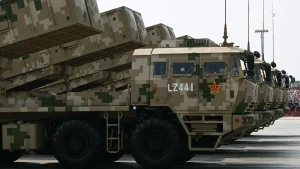
First: drones. Drones and missiles are converging — longer range, cheaper, smarter, bigger payloads, faster. This has given small and mid-sized countries, even non-state actors like the Houthis, a real, localized ability to push back against major naval powers. American carriers now have to retreat a thousand miles deeper into the Indian Ocean to avoid saturation drone-and-missile attacks from Iran and its allies. A thousand miles from the Iranian coast, US aircraft lose much of their combat effectiveness. The old advantage of sea power over land power is eroding fast.
Second: satellite reconnaissance. One of sea power’s biggest historical advantages was surprise and mobility. But as remote sensing technology matures and spreads, land powers can now track an adversary’s naval deployments and movements with real precision. China and the US currently hold a massive lead in satellite reconnaissance capability over everyone else — but both countries can share that intelligence with allies, extending the same tracking power to friendly states. That further erodes the mobility and surprise advantage the seas used to provide. Carrier groups, even submarines, can now be tracked persistently by remote sensing.
How Should China Respond to the Coming Challenge?
First: retreating and avoiding the issue is not a real option.
Some argue China doesn’t need to go head-to-head with the US at sea — that we could lean on land-based routes instead, building a land-based Silk Road to replace the maritime one, since overland routes can reach three continents: Europe, Asia, and Africa. But run the actual numbers, and this doesn’t hold up. The entire annual freight volume of the China-Europe Railway Express, measured by weight, is roughly equal to just two days’ worth of cargo through the Port of Ningbo. These aren’t remotely the same order of magnitude. And structurally, sea trade runs in parallel — block one route, and you just take a longer, more expensive detour. Land trade runs in series — block one country along a single overland rail corridor, and the entire line shuts down.
Bismarck’s German Empire offers a sobering historical lesson here. Germany, at the time, decided it should be satisfied with continental dominance in Europe and avoid contesting Britain and France for global colonies or naval supremacy. Even Kaiser Wilhelm II, ambitious as he was after 1890, capped German naval tonnage at 70% of Britain’s. Even after World War I broke out, Germany still held back from an all-out naval confrontation with Britain. In the end, the German imperial navy — the world’s second-largest by tonnage — wasn’t destroyed in battle with the British. It was scuttled by its own crews, ignominiously, in its own harbor.
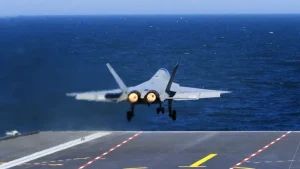
As of this writing, in 2026, the handover of maritime power between China and the US is still incomplete. China’s navy is in the process of overtaking America’s: it already has more ships by number, though not yet by total tonnage. Its equipment is starting to surpass American technology, but the PLA Navy still lags in operational experience. On raw bilateral strength, China is closing the gap fast — but factor in America’s network of allies and roughly 800 overseas military bases, and the US is still comfortably ahead.
The Anglo-Saxon world has held maritime dominance for nearly 300 years. That’s not something China takes back in a three-day naval battle or a three-month diplomatic campaign. Realistically, this is probably a 30-year project — steadily building leverage and access over ports, straits, canals, and shipping lanes across the globe, one step at a time. Until then, we should take seriously the real possibility that parts of China’s sea-dependent trade face disruption, or even direct pressure.
Building real maritime power requires two tangible things: better naval hardware, in both quality and quantity, and a global network of supply and resupply bases built through sustained diplomatic and military effort over time. Beyond that, there are two intangible foundations. One is a shared national consciousness — the recognition that China’s future doesn’t stop at the edge of East Asia, that retreating and staying cautious will never earn peace or respect, and that only by embracing the ocean, mastering it, and reclaiming it can the Chinese nation truly secure its future. The other is capital flow — connecting military spending, trade, and fiscal policy into one continuous loop, so that returns from global trade and investment feed meaningfully back into national finances, and those finances in turn sustain long-term military growth. That requires real coordination between government, military, and the private business sector.
The descendants of the dragon will, in the end, command the stars and the seas.
Editor: Yangwen
CA
When the Seas Close: China, America, and the Coming Fight for Maritime Power