


Today, let’s talk about the meeting between Zelensky and Trump at the White House.
Overall, this meeting was highly noteworthy for several reasons. First, from the perspective of the Russia–Ukraine conflict, everyone is paying close attention to its future trajectory. In particular, considering that the last time Zelensky visited the White House he had a public falling-out with Trump, a key point of interest is whether their relationship can now be effectively adjusted and reconciled.
Second, it is notable because Trump has already held a meeting with Putin in Alaska. From a broader Western perspective, Zelensky’s meeting with Trump is largely seen as one of significant symbolic importance. The question on many minds is whether the West can maintain the unity it has shown in the Russia–Ukraine conflict, avoiding a scenario in which European countries remain tightly united in supporting Ukraine against Russia, while Trump suddenly withdraws, creating a highly strange and destabilizing situation.
Thus, this meeting carries both symbolic and substantive dimensions for observation.
In terms of symbolism, the fact that a European delegation escorted Zelensky to the U.S.—including the leaders of the U.K., France, Germany, Italy, Finland, as well as representatives from the EU and NATO—made a very striking impression. It was as if the “Seven Odd Europeans” were personally shepherding Zelensky into the White House to meet Trump, creating a scene with the tension and surreal quality of magical realism.
Beyond that, there were other details under scrutiny, such as whether Zelensky wore a suit or expressed thanks to Trump. In the end, we saw Zelensky wear a suit for the first time. However, he maintained a final touch of defiance: he didn’t wear a traditional dress shirt and tie. Instead, he wore a black, collared shirt resembling a T-shirt or short-sleeved shirt, layered under a suit jacket. The suit itself was not the formal kind typically suited for diplomatic occasions, and no tie was worn.
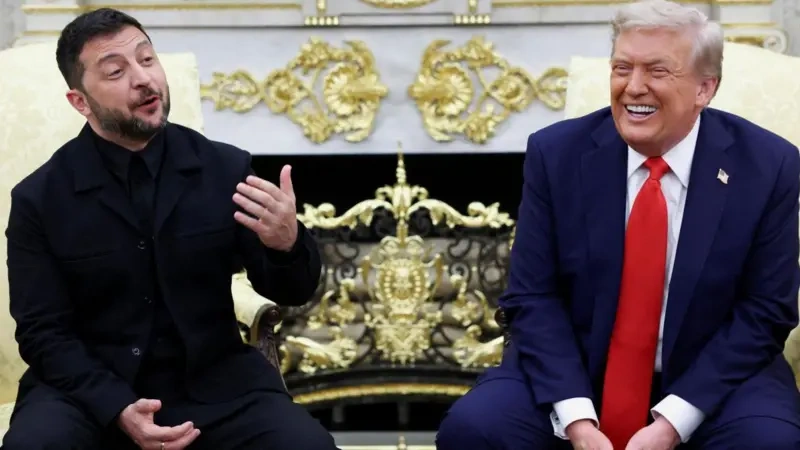
As for expressing gratitude, some observers noted that Zelensky said “thank you” dozens of times in a short span, ensuring that Trump fully received the message. Meanwhile, when the European leaders met Trump, each of them offered some form of positive affirmation, delivering ample emotional reinforcement.
Some understood the situation as a kind of soft coercion: everyone, smiling and well-dressed, expressing positive sentiments toward Trump. What is “soft coercion”? In the Alaska summit between Trump and Putin, one widely noted point of concern was the overall framework for subsequent Russia–Ukraine negotiations: should talks begin with localized or broad ceasefires as a prelude to a peace agreement, or jump straight into a peace accord without addressing ceasefires?
This is essentially the root of the differences in the Russia–Ukraine conflict. For Ukraine and its backers—including certain European nations and some figures within the U.S.—the goal is not to end the conflict through negotiation. Instead, they hope to use the negotiations to gain breathing space for Ukraine and influence Trump’s policy toward stronger support for Ukraine. Their aim is to achieve a ceasefire, with specific conditions that disadvantage Russia and favor Ukraine.
However, after the Alaska talks, it appeared that Trump had accepted Putin’s approach: beginning with discussions of a peace agreement, while combat operations continued and no explicit terms for a ceasefire or temporary halt were established. This was seen as an ominous signal, raising concerns that Trump might be overly aligned with Russia. As a result, Western countries sought to use the Washington meeting to bring him back on track.
Discussions about a peace agreement essentially concern Ukraine’s future. Currently, Ukraine lies at the heart of the conflict, involving its vital interests.
First, territorial questions need urgent resolution. How should the areas currently occupied by Russia be handled? Should they be returned, and if so, how? Should formal recognition be required, and if so, how much territory would be acknowledged? In total, Russia holds five regions if counting from 2014, or four regions if counting from the outbreak of the 2022 conflict. These areas together account for roughly 20% of Ukraine’s total territory. Territory is a core value for sovereign states, making this issue crucial.
Second, even under Russia’s proposals, the maximum territorial demand—five regions entirely under Russian control—raises urgent questions. How should Ukraine respond? How can its security be guaranteed? Putin has already set conditions: Ukraine cannot join any military alliances, especially NATO; its military capacity must be limited; Russian should be a primary language; and Western sanctions imposed since 2014 must be lifted to achieve a security guarantee. But what kind of security guarantees do Western countries expect?
At the Washington summit, a central keyword was “security guarantee.” The meeting called for Trump to provide a clear commitment regarding Ukraine’s future security: would the U.S. go beyond reconnaissance and intelligence support, sending troops and military assets to maintain a persistent presence? Such a pledge would ensure that even if the current conflict subsides, Russia could not launch similar attacks in the future.
From Russia’s perspective, however, this Western security demand hits a fundamental issue. One of Russia’s main reasons for military action in Ukraine is to prevent Ukraine from joining NATO or hosting NATO military assets on its territory—so this condition is effectively unacceptable to Russia.
Is a compromise solution possible? This is the key point of observation: at the White House summit, Trump, Zelensky, and representatives from seven European countries and organizations discussed two core substantive issues.
The process can be divided into three stages: first, a press conference; second, a closed-door meeting; and third, a joint media statement. Across all three stages, there were some dramatic details. For instance, Zelensky was indeed asked about his suit, which received praise. Trump, as expected, launched into commentary on U.S. domestic politics, delivering what amounted to a lengthy freeform monologue. Vice President Pence remained silent, while Zelensky worked hard to manage his emotions, successfully making it through the first stage and into the second.
During the second stage, the closed-door meeting, two small dramatic details stand out. First, Trump displayed a map in his White House office. Trump sat on one side of the desk, with others arranged on the opposite side like children in a row. The areas occupied by Russia were marked in red. Although no one knows exactly what was written on the map or what was discussed, it revealed a stark and chilling reality.

Trump’s strategy was very direct: “I know you’re here to pressure me to change my mind. You’re essentially presenting me with values, moral arguments, norms, and the broader Western diplomatic and strategic stance toward Russia and other global issues. But I choose to start with the details: these areas are already occupied—what do you propose we do about them? I believe they can’t be taken back. Do you have the ability to reclaim them? Without my help, how long do you think it would take?” The appearance of this map became a crucial detail.
Of course, using the somewhat polished language favored by Western media, one could describe Trump’s approach as a kind of live shuttle diplomacy. He first spoke with Zelensky on one side, while having already spoken with Putin beforehand. After some discussion, he quickly called Putin, who appeared to be expecting the call. What they specifically discussed remains unclear. However, one intriguing piece of information emerged afterward: there could be more meetings of this kind in the future.
Based on the materials released so far, several features of this meeting stand out:
First, all the content was conveyed orally—no written documents were produced. In other words, procedurally and formally, the outcome is more optimistic than expected. It demonstrates a certain baseline political alignment among Western countries regarding Russia and the Russia–Ukraine conflict, maintaining at least the most basic appearances, but lacking technical details and substantive content.
Second, Trump mentioned the issue of security guarantees. Witekoff, Trump’s Middle East envoy and an important interlocutor in the Russia–Ukraine negotiations, even stated that the U.S. agreed to provide Ukraine with what he called a “NATO Article 5–style” security guarantee. Some Western media reported that upon hearing this, Western countries were almost euphoric, exclaiming, “See, we finally got the most crucial point!”
However, what exactly does a “NATO Article 5–style” security guarantee entail? How would it be implemented, and how could Russia be persuaded? Particularly if it involves troop deployment, would U.S. forces need to intervene? From Trump’s perspective, his original intention was to extricate the U.S. from the conflict, but not only has he not done so, he has instead sent U.S. military assets—though the specific operational details remain vague, with only broad concepts described. Nevertheless, security guarantees have not been ignored. Additionally, territorial exchanges were not mentioned, indicating that Ukraine still maintains certain positions.
It is also clear that, although Trump stood alone against the so-called “soft coercion” from the eight European leaders, he was still unable to get Zelensky to agree explicitly to a territorial exchange or to relinquish any territory. This issue has effectively been shelved and will likely become a major challenge in the future—an urgent problem yet to be resolved.
This opens up an imaginative scenario: reportedly, under Trump’s mediation, Ukraine and Russia are exploring the possibility of a future trilateral U.S.–Russia–Ukraine meeting, as well as direct Russia–Ukraine dialogue, engaging in preliminary communication. If this process moves forward and achieves substantive results, it could be seen as a notable success for Trump’s diplomatic maneuvering.
However, the difficulty is extremely high. Previously, when responding to Trump’s invitation to meet in Alaska, Putin explicitly stated that he did not rule out a face-to-face dialogue with Zelensky, but the conditions for such a dialogue were not yet mature and would require a long time—essentially a polite refusal. After the Washington summit, these circumstances have shifted, creating new room for speculation.
Overall, by analyzing this meeting in conjunction with the Alaska talks, several basic conclusions can be drawn:
First, Trump clearly demonstrated a strong desire to cut losses and extricate the U.S. from the Russia–Ukraine conflict. However, achieving this goal is far from easy. While he can meet separately with Ukraine and Russia, on the key issues central to ending the conflict, the positions of Russia and Ukraine have no overlap and differ dramatically. How this issue will ultimately be resolved remains to be seen. One thing is clear: Trump does not possess a magical solution—at least not at present.
Second, the Russia–Ukraine conflict is likely to enter a new phase characterized by simultaneous fighting and negotiation—“fighting while talking, talking while fighting.” From the military perspective, Zelensky stated he wants to purchase $90 billion worth of U.S. weapons; the seven European representatives said they would provide funding, the U.S. would supply the arms, and the U.S. agreed to sell. Although this could be seen as a substantive achievement, if one considers both this meeting and the previous Alaska summit, which were aimed at resolving rather than perpetuating the conflict, this result seems somewhat incongruous and further underscores the complexity of the situation.
Third, the relationship between the U.S. and Europe is delicate. From the American perspective, it does not currently have the ability to compel Europe to accept and comply with all U.S. grand strategic decisions. The U.S. cannot simply declare “attack” or “ceasefire” and expect Europe to obey without question; Europe will still assert its own reasoning and interests. At the same time, the psychological positions and self-identity in negotiations are subtle. No single European country dares to confront Trump directly, deny, or criticize his ideas alone.
By traveling together as a group of seven—even with the backing of the EU and NATO—they must still accommodate Trump fully. Even when applying pressure, it must be done with smiles and careful gestures, providing ample emotional value, careful not to truly anger Trump. What does this reveal? In terms of both capability and political will, Europe is unwilling—and perhaps unable—to act independently of the U.S. in navigating this complex geopolitical situation.

Finally, what we can observe is that the transatlantic partnership between the U.S. and Europe continues to play a crucial role in the current Russia–Ukraine conflict and its eventual resolution. In the future, if all parties genuinely aim to end the conflict and work together toward that goal, the U.S.–Europe relationship could enter a completely new phase, facing complex and delicate challenges.
How can this relationship be maintained? On the surface, parties may present a united front and preserve diplomatic appearances. Yet at the substantive level, handling the deeper issues underlying the Russia–Ukraine conflict becomes particularly critical. Since the end of the Cold War, the security governance structures promoted by the U.S. in Europe have suffered from severe deficits and inadequate provision, which not only contributed to the Russia–Ukraine conflict but also affected the capacity of all parties to sustain geopolitical stability.
In such a situation—where intentions, resources, capabilities, and needs are significantly mismatched—how can the transatlantic alliance be preserved? Some even suggest that this could be the moment when the transatlantic alliance falters. When this map is laid out before one’s eyes, it becomes evident that the U.S. has little intention of safeguarding the stability of the “new Europe,” particularly regarding the territorial integrity and sovereignty of post-Soviet states like Ukraine, which theoretically fall under its protection. In practice, this implies that the U.S. is abandoning the traditional obligations of transatlanticism to enhance security commitments and guarantees.
At this moment, we are at an extremely delicate juncture, a critical crossroads signaling the beginning of a new phase of adjustment. This will bring greater variability and uncertainty, exposing the many shortcomings of traditional Cold War thinking and the security strategies and structures inherited from that era. These deficiencies are becoming increasingly apparent, and the world can expect more uncertainty, instability, and dramatic developments—particularly in this region and in relation to the Russia–Ukraine conflict.
Going forward, we can continue to observe the interactions and evolving relationships between the U.S., Russia, Ukraine, and Europe. Doing so will reveal the deeper dynamics, patterns, characteristics, trends, and directions of the international system’s power structure in the years ahead.
Editor: Zhiyu Wang