


A general stands above a river and watches his fleet burn.
A condemned outlaw, drunk beyond reason, meets a tiger on a mountain.
Three starving men kneel in the mud and swear that they will die for one another. Before long, this promise will become the reason some of them must die.
A prince is ordered to murder his father. An assassin parts a curtain, sees her intended victim playing with his child, and quietly lowers her blade. A defeated warrior is killed, becomes a ghost, enters a Buddhist temple and eventually ends up worshipped by merchants, policemen and gangsters from Hong Kong to San Francisco.
Chinese epic is fun.
It can also be morally exhausting—which is part of the fun. Its heroes are brave, theatrical, vain, loyal, treacherous and occasionally very bad at knowing when a war should end. Its empires are always announcing eternal order just before someone sets fire to the capital. Its gods are less likely to offer spiritual comfort than to demand sacrifices, interfere in military campaigns or appoint dead generals to jobs in the celestial bureaucracy.
If Christopher Nolan’s The Odyssey left you wanting more—not simply more monsters and ships, but more of that thrilling sense that an entire moral world is breaking apart—Chinese literature and cinema have quite a lot to offer.
The obvious recommendation is Journey to the West 《西游记》. It has a supernatural voyage, a hero of inexhaustible cunning and enough monsters to occupy several film franchises. But what seized me in Nolan’s film was not the wandering. It was the possibility that Odysseus had destroyed his civilization before he began trying to return to it.
This is a personal reading, not a claim that Chinese epics are disguised versions of Homer. China does not have one theory of heroism or one timeless concept of political order. The works below were made in different centuries, under different dynasties and by artists living through conquest, civil war, censorship, revolution and modern mass entertainment. Chinese readers, minority communities, Qing emperors, rebellious scholars, American translators and European Sinologists have all pulled different meanings from them.
What connects them is a few question Nolan also asks: (1) what happens to heros when their moral universe is collapsing, and further, the deeds that made them heros are also those that facilitated the collaspe? (2) what if the qualities that made them heros in war also made them unfit for peace? And (3) what if the morality of heros of a bygone age is utterly foreign to us today? Do you faithfully portray them at the risk of alienating the audience, or do we find and emphasize the pieces that connect them to us, even if it distorts their worldview?
The invention that Odysseus cannot take back
Nolan’s Odyssey is not Homer’s.
In the Homeric world, xenia—guest-friendship—was not merely good manners. It created reciprocal obligations among strangers and households under the protection of Zeus Xenios. Nolan compresses this historically specific institution into something closer to a universal moral law. Once the Greeks place soldiers inside a sacred offering, however, that law becomes a weakness. The Trojans are destroyed because they still act as if rituals possess meaning.
After the Horse, every gift is unreadable.
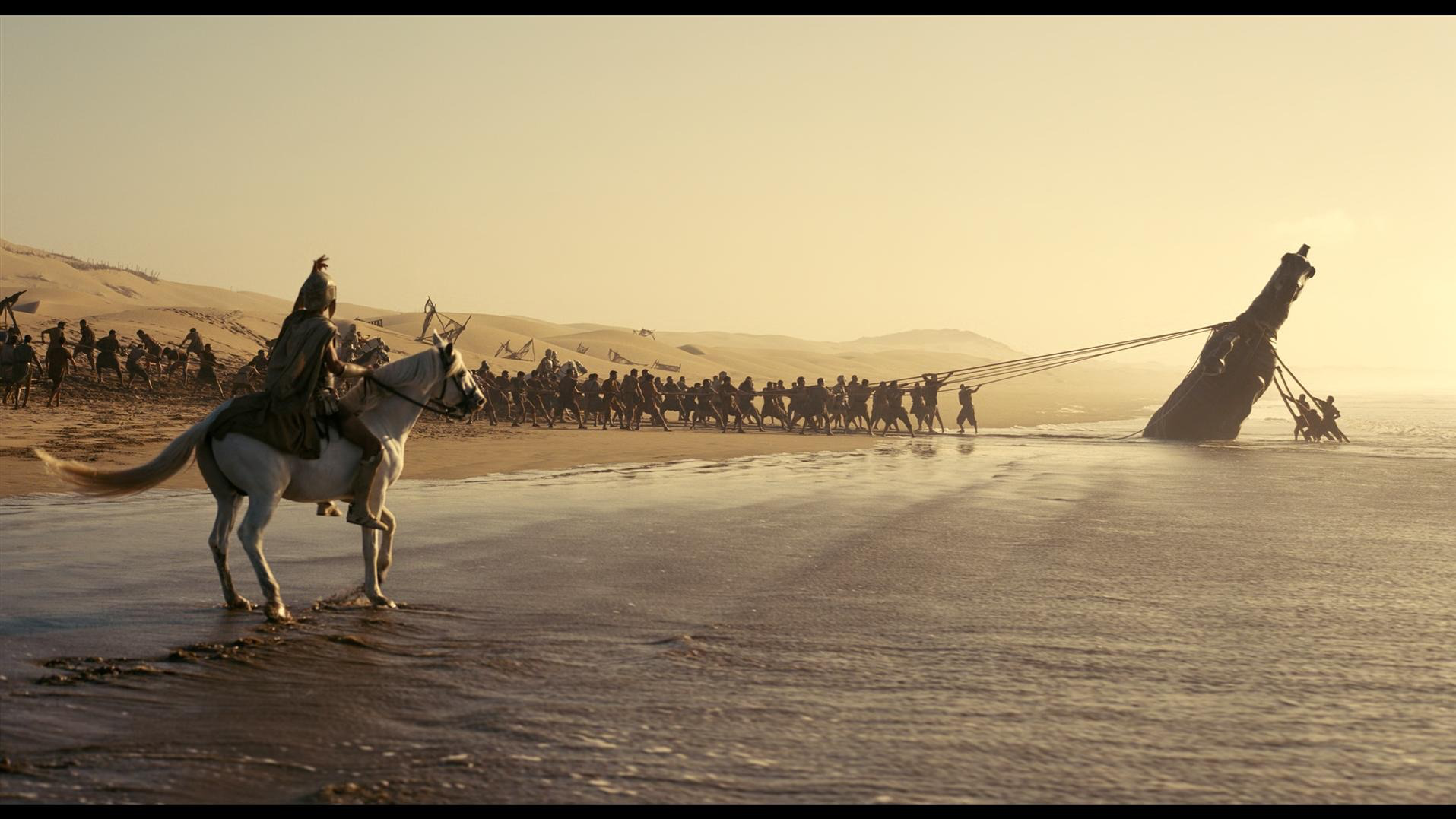 Nolan turns the Trojan Horse from a clever trick into the invention Odysseus cannot take back.
That is the invention Odysseus cannot take back. The victorious Greeks go on to raid other settlements and become indistinguishable from the “Sea Peoples” supposedly threatening civilization from outside. By the time Odysseus reaches Ithaca, the suitors inside his palace are behaving like domestic marauders, consuming another man’s household and treating restraint as weakness.
But Odysseus can defeat them only through the methods that created the crisis: disguise, infiltration, deception and overwhelming violence. He must repeat the rupture to repair its consequences.
Nolan makes this Odysseus recognizably modern: traumatized, guilty and uncertain whether he deserves to return. Classicist Emily Wilson objects that this replaces Homeric glory and cunning with a modern story of shame and atonement. She also asks whose pain we are invited to inhabit. The film follows the remorse of the man who devised the Horse far more closely than the people who died inside Troy.
That disagreement is important. So is the fact that millions of people have enjoyed arguing about it. This is, after all, a blockbuster in which Matt Damon fights a Cyclops, not a seminar on the moral economy of Bronze Age hospitality.
Chinese popular art is often doing the same two things at once. It gives us cavalry charges, tavern brawls and supernatural fox demons. Underneath all that noise, it asks whether order collapses because people cease to behave morally—or whether people cease to behave morally because order has already collapsed.
The empire has died. The heroes have not noticed.
The place to begin is Romance of the Three Kingdoms 《三国演义》.
Not because it is “the Chinese Game of Thrones.” That comparison is useful for roughly ten minutes. Three Kingdoms is larger, stranger and ultimately sadder: a historical epic in which almost everyone knows what virtue looks like, many people can deliver a very good speech about it, and hardly anyone can make it work.
The Han dynasty is failing. Eunuchs and aristocratic families fight over a hollow court. The Yellow Turban Rebellion tears through the countryside. Provincial commanders raise armies to save the empire and immediately discover that an army is an excellent reason not to obey it.
Then the heroes arrive.
Liu Bei claims descent from the Han house and wanders for years looking for a place where moral legitimacy might become political power. Cao Cao lies, jokes, composes poetry, murders inconvenient people and constructs the strongest state in northern China. Guan Yu is so loyal that loyalty becomes a form of pride. Zhang Fei is magnificent until he is terrifying, which is often. Zhuge Liang enters the story only after Liu Bei visits his cottage three times, then spends the rest of his life attempting the impossible: to use perfect intelligence in the service of a lost cause.
This is political philosophy, if we insist. More immediately, it is eighty-four episodes of men with extraordinary beards making decisions of continental importance.
The 1994 CCTV adaptation remains the great entry point. It has huge armies, unforgettable performances and the stately confidence of a production that appears to believe the Han dynasty has fallen specifically so Chinese television can reconstruct it. Moss Roberts’s translation is the better choice for readers, especially the abridged edition if 120 chapters feels excessive. It is excessive, of course. Excess is rather the point.
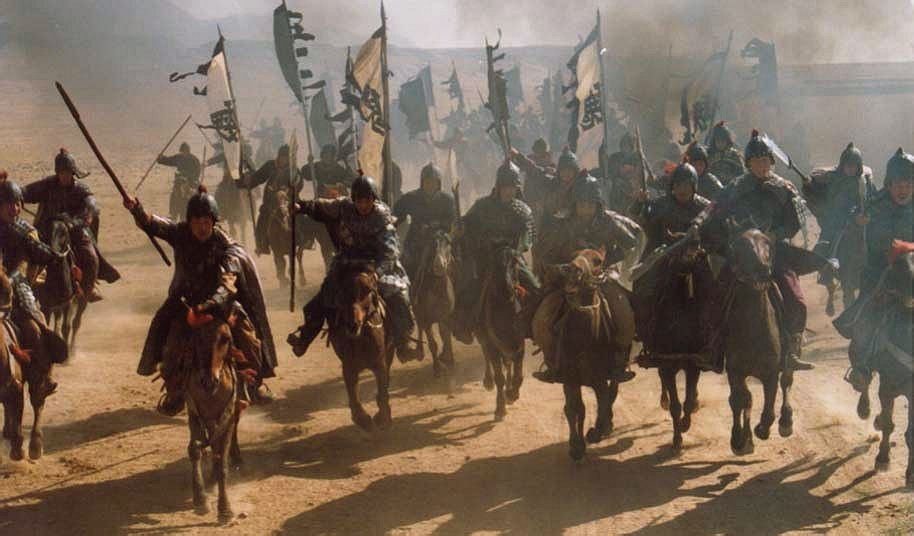 The 1994 CCTV adaptation treats the Han collapse with the scale—and the facial hair—of national mythology.
The tragedy is not that the heroes are inadequate. It is that they are enormous and still cannot reverse history. Every brilliant stratagem wins another battle and makes another battle necessary. Cao Cao can unify the north but cannot establish unquestioned legitimacy. Liu Bei can preserve a claim to righteousness but repeatedly leaves ruin behind him. Zhuge Liang can calculate everything except the possibility that Heaven, history or simple material exhaustion may not care how clever he is.
Nolan asks whether the skills that destroyed Troy can restore Ithaca. Three Kingdoms gives that problem a continent. The men created by civil war become too valuable for the war to release them.
Chinese readers have wrestled with these men for centuries because the book itself has never stopped changing. Stories about the Three Kingdoms circulated among performers long before the novel acquired its familiar form. The standard version most readers now know was edited by Mao Lun 毛纶 and Mao Zonggang 毛宗岗 during the early Qing, after the Manchu conquest had presented Chinese scholars with agonizing choices about loyalty, collaboration and survival.
Mao Lun had lived through the conquest of the lower Yangzi. People around him had died for loyalty to the fallen Ming. His edition strengthened the moral claims of Liu Bei and Shu-Han while reducing praise of Cao Cao’s camp. Was this a coded act of Ming loyalism, with Shu standing for the rightful but defeated dynasty? Or could a story about preserving legitimate succession also serve the new Qing order? Scholars still disagree—which is exactly what one would expect from a book about people who discover that loyalty is clearest only after it has become politically useless. The moral choices imposed by the Ming-Qing transition were rarely clean divisions between patriot and traitor.
Overseas Sinologists later found their own language for the same pain. Andrew Plaks emphasized the novel’s combination of grandeur and futility; Constantine Tung called its moral world one of “tragic volition,” in which the heroes’ choices matter even though the historical cycle appears foreordained. The novel opens by telling us that empires divide and reunite. It then spends 120 chapters making us care desperately about people who cannot stop the cycle anyway.
And then there is Guan Yu, who escaped the novel altogether.
Historically, he was a defeated general executed in 219. In later memory he became a terrifying ghost, a Buddhist monastic protector, a Daoist god, a Confucian model of loyalty and an imperial saint. The Qing promoted his worship among Mongol communities. Chinese migrants carried him into Southeast Asia, Australia and California. In Hong Kong, he guards police stations and triad altars alike—each side apparently confident that the god of righteousness is on its side.
The Dutch Sinologist Barend ter Haar calls this the “religious afterlife of a failed hero.” That is exactly right. Guan Yu lost his province, lost his head and won immortality.
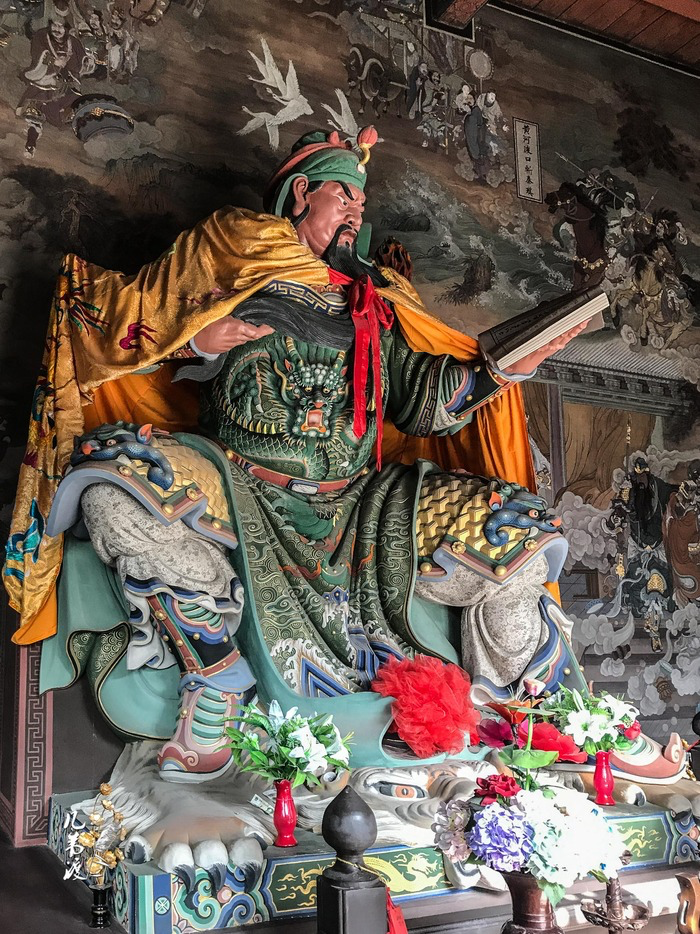 Executed as a defeated general in 219, Guan Yu later became a Buddhist protector, Daoist god, Confucian exemplar and imperial saint.
No ancient Greek hero would find this especially surprising.
Chang’an, eleven years before the end of the world
If Three Kingdoms gives us the long collapse of an empire, The Longest Day in Chang’an 《长安十二时辰》 traps us inside one magnificent day before anyone admits collapse has begun.
Chang’an in 744 is almost indecently alive. Persian and Sogdian merchants crowd the markets. Foreign clothes, music and religions circulate beside imperial officials, criminals, soldiers and aristocrats. Watchtowers pass messages across the city. Records are collected, cross-checked and turned into something resembling an eighth-century surveillance database. Lanterns cover the streets for the festival, which is visually delightful and, in a thriller about people planning explosions, not entirely reassuring.
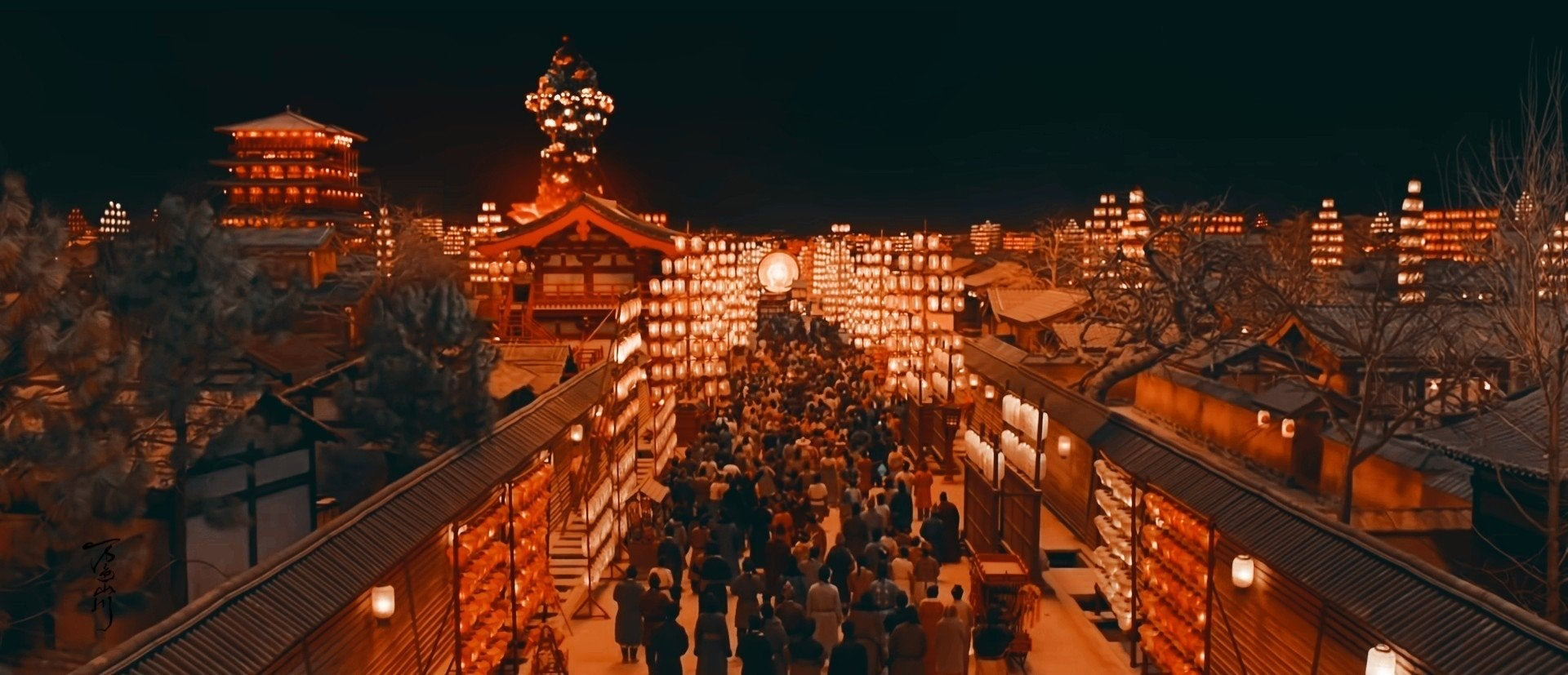 The Longest Day in Chang’an lets viewers enjoy the High Tang dream while knowing exactly what is coming for it.
A condemned former frontier soldier, Zhang Xiaojing, is released for twenty-four hours to stop an attack. He is filthy, violent, exhausted and much better company than most of the clean officials. The young administrator directing him, Li Bi, believes in systems: maps, records, chains of command and the possibility that sufficient intelligence can save the state.
The series lets both men be right and then punishes them for it.
Zhang can save Chang’an because he understands the violence the empire uses at its frontiers. The attackers understand it too. They are not an alien force descending upon an innocent city; they are the surviving products of imperial wars, abandoned soldiers and promises broken by the state.
Chinese audiences watched the series with knowledge of the date. The An Lushan Rebellion will begin eleven years later and devastate the Tang world. Every lantern therefore glows with dramatic irony. This is 盛唐, the High Tang, reconstructed at its most confident by viewers who know what happens next.
International promotion often sold the series as Tang-dynasty 24, which is fair. It is enormously bingeable. But “cosmopolitan Chang’an” carries its own modern baggage. Chinese nationalists can see the Tang as proof that a strong China can afford openness. Liberals have imagined it as a lost age of pluralism. Western Sinologists have often turned it into a Silk Road dream city. Historian Shao-yun Yang has warned that all these groups can romanticize Tang “cosmopolitanism,” forgetting that diverse empires remain empires and that incorporation is not the same as equality.
The series’ great achievement is that it lets you enjoy the dream and see the bill arriving.
Three brothers walk into the Taiping Civil War
By comparison, The Warlords 《投名状》 does not give us an empire glowing before the fall. It begins with Jet Li crawling out from beneath a pile of corpses.
This is China in the 1860s, during the Taiping Civil War, one of the deadliest conflicts in human history. The rebellion fused Christian revelation, social revolution, anti-Qing politics and apocalyptic certainty. The ruling house was Manchu; the Taiping leader Hong Xiuquan was Hakka and believed himself the younger brother of Jesus. Provincial armies, rather than the old Qing military alone, eventually crushed the rebellion. Civilians were massacred by both sides.
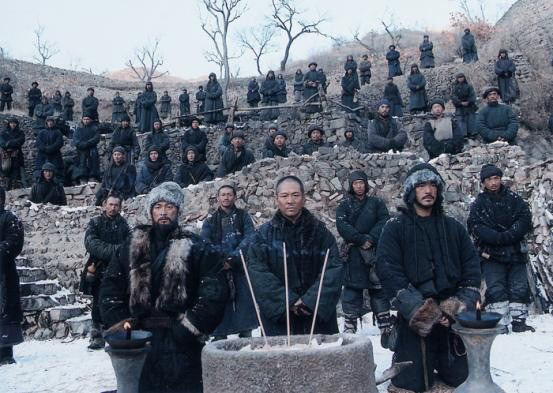 The Taiping Civil War fractured Qing China on a scale that The Warlords largely leaves outside the frame.
Peter Chan’s film explains surprisingly little of this. It gives us mud.
Pang Qingyun, the survivor played by Jet Li, meets the bandit leaders Zhao Erhu and Jiang Wuyang, played by Andy Lau and Jin Chengwu. They are hungry, their village is starving, and the state exists mainly as groups of armed men who arrive to confiscate food. Pang offers military organization. Zhao offers loyalty. Jiang offers the absolute faith of a younger brother desperate to believe in both.
They swear a 投名状: an oath sealed by an irreversible crime. The phrase belongs to the world of outlaw fraternities. You prove that you have joined by doing something that makes return to ordinary society impossible.
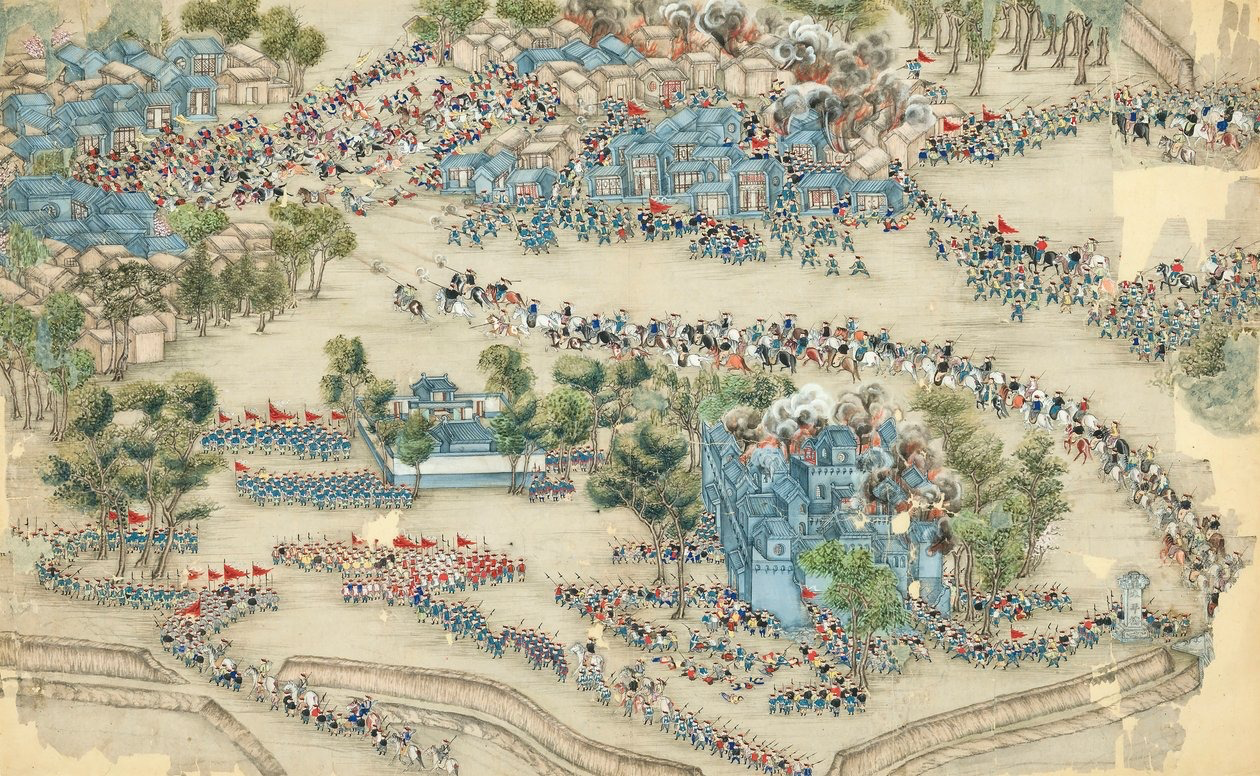 The oath works. That is the disaster: belonging begins by making a return to ordinary life impossible.
The oath works. That is the disaster.
The brothers build an army and begin to win. Every victory increases their duties to soldiers, civilians, Qing patrons and one another. Soon there is no decision that does not betray someone. Pang discovers that “military necessity” can excuse almost anything. Zhao discovers that personal honor cannot govern a mass army. Jiang discovers that perfect loyalty may require him to murder the people he loves.
Chan, a Hong Kong filmmaker remaking a story previously filmed by Chang Cheh, stripped the stars of glamour. He covered them in mud and ash and forbade the action director from using wirework. Nobody floats elegantly over a bamboo forest. Men run into spears and remain attached to them.
Nolan’s Odysseus fears that he has brought war home. The brothers in The Warlords no longer possess a home outside war. Their promise of belonging has destroyed the possibility of escape.
It is a crushing film. It is also an excellent Friday night.
The rowdiest moral disaster in Chinese literature
Then we come to Water Margin 《水浒传》, where moral disaster drinks eighteen bowls of wine, fights a tiger and becomes extremely popular.
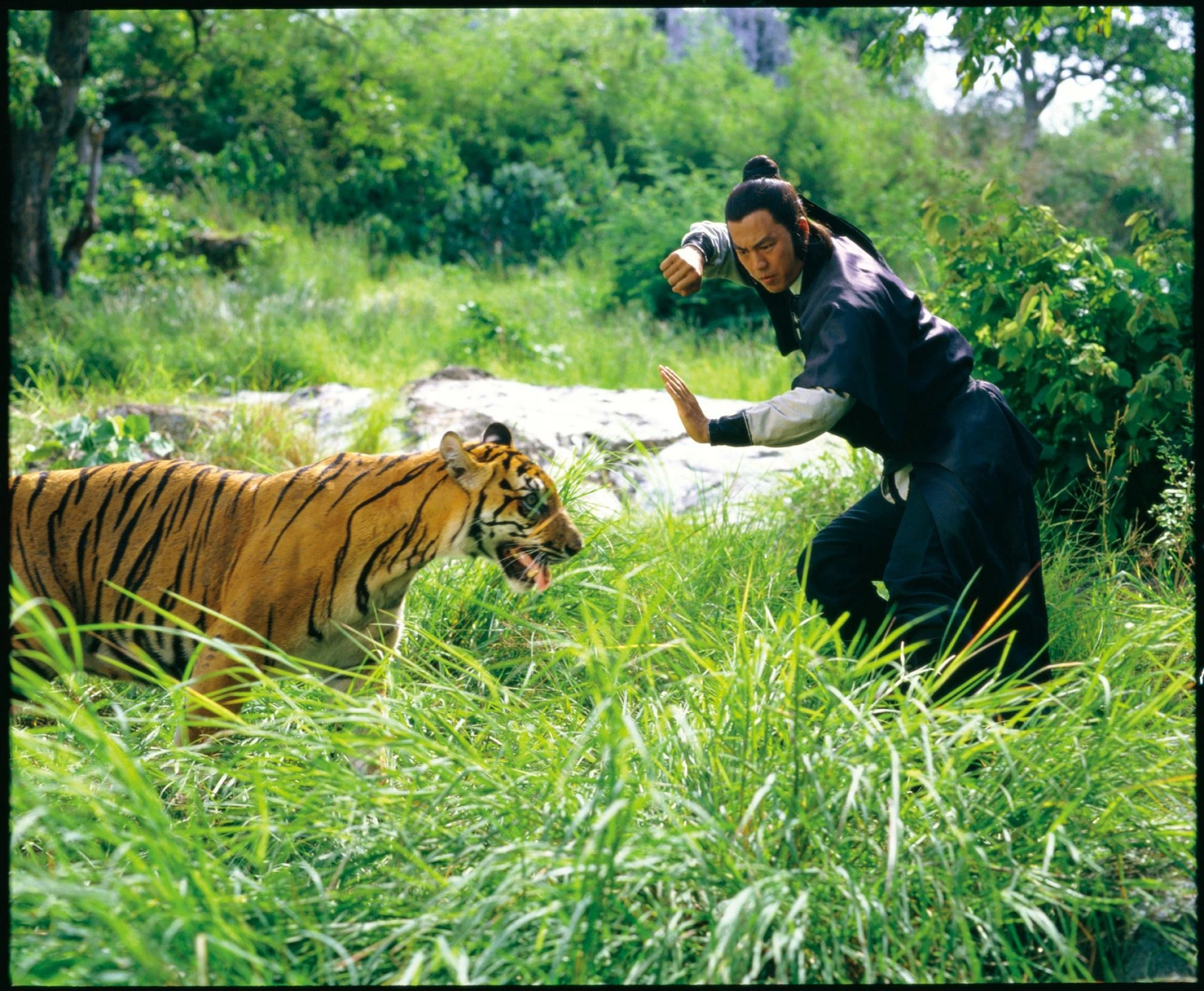 Wu Song’s walk up Jingyang Ridge has survived centuries of retelling because the tiger still appears—and the scene is still tremendous fun.
The novel follows 108 outlaws driven toward Liangshan by corrupt officials, local tyrants, personal catastrophes and, in several cases, their own impressive inability to walk away from a fight. Its world is crowded with prison guards, monks, tavern owners, judges, soldiers, boatmen, murderers and men with wonderfully specific nicknames.
Lu Zhishen, the “Flowery Monk,” uproots a willow tree. Lin Chong, an honorable military instructor, is persecuted until his patience finally catches fire—along with a temple. Wu Song kills the tiger, avenges his brother and goes on to perform acts that make the tiger episode look like the restrained part of his career. Li Kui is loyal, hilarious, childlike and terrifying. Song Jiang, the leader, writes seditious poetry while drunk and spends much of the novel insisting that he is not really a rebel.
It is difficult not to love these men. It is sometimes difficult to survive loving them.
The emotional bargain is familiar. The state has ceased to protect decent people, so decent people make justice for themselves. Liangshan offers brotherhood to men expelled from respectable society. Their 义 (yi) is immediate and embodied: rescue a friend, avenge a wrong, share food, face death together.
But the same code that creates solidarity within the group licenses horrifying violence outside it. Innocents are killed. Potential recruits are trapped into outlawry by destroying their existing lives. Women are treated with deep suspicion or spectacular cruelty. Revenge becomes a social event.
The novel never stops to define 义. It is far too busy attacking another tavern. Instead, generations of readers have fought over what they just enjoyed.
A commentary published under the name of the heterodox Ming thinker Li Zhi 李贽 defended the outlaws as the products of righteous anger, although scholars doubt that Li himself wrote it. The attribution mattered because the historical Li Zhi had attacked moral hypocrisy, been imprisoned as a dangerous heretic and killed himself in custody. Placing his name on the novel told readers how to approach it: distrust respectable morality; listen to the people it condemns.
Then came Jin Shengtan 金圣叹, perhaps the most brilliant and infuriating editor in Chinese literary history. Writing as the Ming collapsed, Jin declared Water Margin a work of genius and then cut away its final thirty chapters. In longer versions, the outlaws accept imperial amnesty and fight for the state. Jin ends with a vision of their capture. He admired their literary life while refusing them a political future. His edition does not solve the contradiction; it sharpens the knife.
Jin’s own ending was worse. In 1661, under the new Qing dynasty, he joined scholars protesting a corrupt official in Suzhou. The demonstration became the 哭庙案, the “Lamenting at the Temple” case. Eighteen participants were executed as the Qing consolidated control over the Jiangnan gentry. One famous story claims that Jin’s final message to his family contained not a political declaration but a culinary discovery: salted vegetables and soybeans, eaten together, taste remarkably like walnuts. The anecdote may be apocryphal. One hopes it is not. It would be an appropriately Water Margin exit—defiance, appetite and absurdity at the edge of the execution ground.
The argument continued across the Pacific. Pearl Buck’s 1933 translation called the novel All Men Are Brothers and presented it to American readers as a vast pageant of China: priests and prostitutes, jailers and emperors, murderers and monks all marching across the same enormous stage. American reviewers compared the outlaws to Robin Hood’s merry men. It was an inviting comparison, and not entirely wrong. It also made Liangshan sound rather nicer than it is.
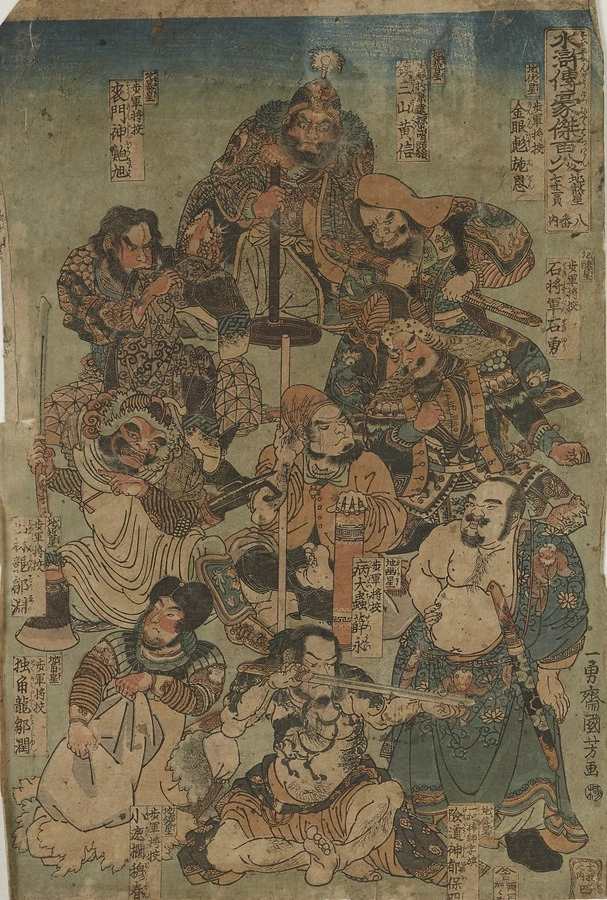 Water Margin travelled long before Pearl Buck: its unruly heroes helped ignite a nineteenth-century Japanese craze for tattooed outlaws.
The sharper Chinese argument concerns Song Jiang’s decision to accept imperial amnesty. Is he rescuing his brothers from permanent outlawry, or surrendering the only moral community the novel has managed to build? In 1975, this became a matter of national politics. Mao Zedong held up Song Jiang as a negative example: a rebel who opposed corrupt officials but not the emperor, and therefore a “capitulationist.” The ensuing campaign was directed less at a fictional outlaw than at living political enemies. A Ming adventure story had become a weapon in a late Cultural Revolution purge.
This is why Water Margin remains so gloriously difficult. Conservatives could condemn its bandits. Revolutionaries could condemn their surrender. Jin Shengtan could admire them as characters while denying them a future. Pearl Buck could offer them as universal brothers. Feminist readers can point out, correctly and uncomfortably, that brotherhood in this novel is often purchased with women’s bodies.
And still Wu Song walks up the mountain. Still the tiger appears. The book’s argument survives because its excitement survives. Begin with the 1998 CCTV series if you want the sweep and the faces; try Sidney Shapiro’s Outlaws of the Marsh if you want the longer novel in English. Either way, you will eventually be forced to decide whether Liangshan is a refuge from a corrupt world or merely that world with better nicknames.
Heaven opens a personnel department
Creation of the Gods I: Kingdom of Storms 《封神第一部:朝歌风云》 begins near the other end of Chinese imperial time: not with a dynasty dying after centuries of bureaucracy, but with the mythic transfer of power from Shang to Zhou around the eleventh century BCE.
It also begins with a man who enjoys being king far too much.
Yin Shou, played by Fei Xiang with enormous physical charm and just enough warmth to make the danger worse, leads an army of hostage-princes whose fathers sent them to court as guarantees of obedience. He teaches these young men to treat him as a truer father than their own. When rebellion comes, filial loyalty and political loyalty become the same trap: prove devotion to the king by killing the man who raised you; prove devotion to your father by becoming a traitor.
There are also a murderous fox spirit, a magical scroll, immortals descending from Kunlun, thunder weapons, battlefield monsters and an extremely busy celestial administration. I mention these because this remains a film recommendation, and the fox is magnificent.
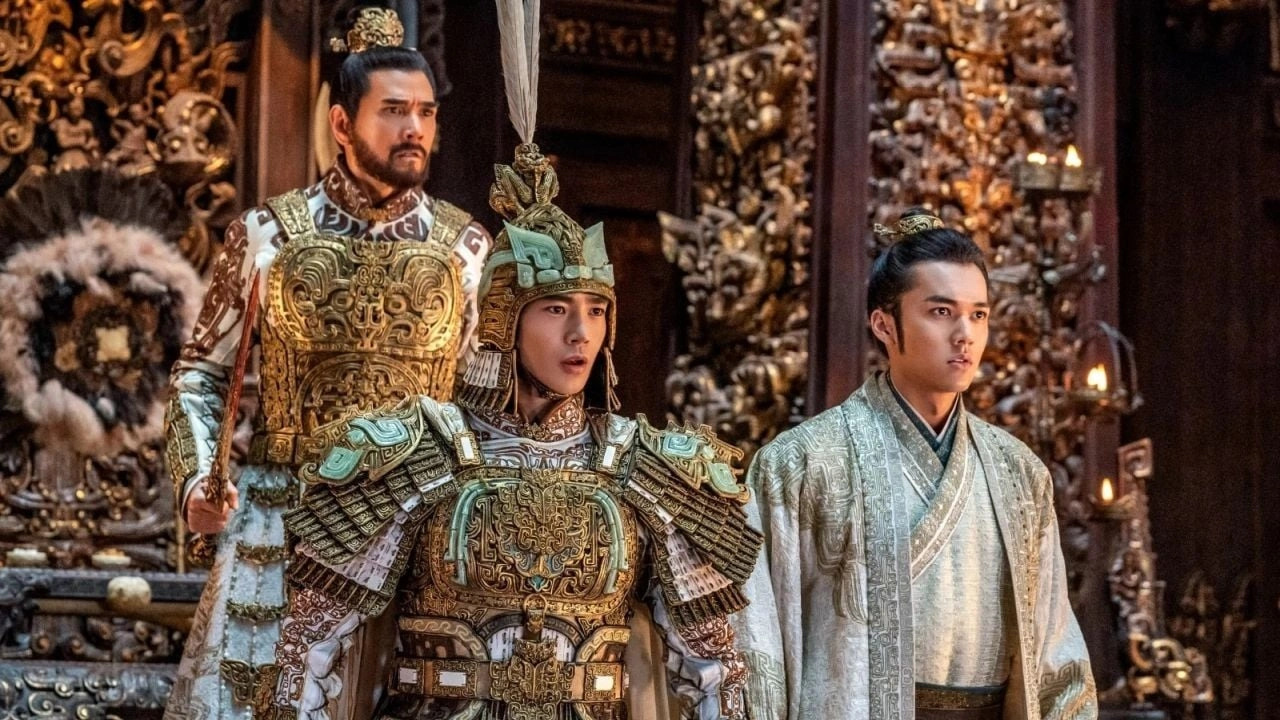 Creation of the Gods turns the Shang-Zhou transition into family tragedy, military spectacle and a very crowded supernatural bureaucracy.
The source is the Ming novel Investiture of the Gods 《封神演义》, assembled from older tales about the Shang-Zhou transition and saturated with Daoist, Buddhist, Confucian and popular religious materials. Lu Xun classified such works as “novels of gods and demons.” Modern scholar Mark Meulenbeld pushes against the idea that the supernatural machinery is merely decorative fantasy: the novel’s gods and battles also reflect living ritual networks, local cults and Daoist ways of organizing sacred territory.
That makes its politics wonderfully peculiar. The dead do not simply vanish. After the war, many are appointed to divine offices. Enemies may receive posts beside allies. Heaven does not abolish the violence of dynastic change; it absorbs the casualties, assigns them titles and turns catastrophe into an organization chart.
It is tempting to call this a straightforward story of the Mandate of Heaven, but that would collapse too many centuries into one slogan. The Zhou language of 天命 that justified the defeat of Shang was not identical to later Confucian moral history, still less to the Cheng-Zhu metaphysics of heavenly principle. The Ming novel adds still other religious worlds. Director Wuershan then adds a modern father-son drama, in which tyranny reproduces itself by teaching children that obedience is love.
Wuershan, who is ethnically Mongolian, has called the story a Chinese “national myth.” That description is revealing precisely because the Chinese nation is not ethnically simple. His film builds a shared antiquity from a Zhou conquest story, a Ming popular novel, Hong Kong-influenced screen spectacle and a cast whose bodies were trained for months to look like bronze-age warriors. Overseas reviewers naturally reached for The Lord of the Rings. Chinese viewers were more likely to arrive already knowing Nezha, Jiang Ziya and the fox spirit from childhood television, temple culture, comics and New Year cartoons.
Nolan largely makes divinity psychological: thunder may be Zeus, Athena may be a presence, but the drama belongs to Odysseus’s conscience. Creation of the Gods refuses that safety. Its gods are outside you, interested in government and liable to recruit you after death. Here the question is not simply whether a guilty warrior can go home. It is whether “home,” “father,” “king” and “Heaven” have been fused so tightly that resistance to one feels like sacrilege against all four.
This is a surprisingly painful question for a film containing an infant thunder-demon rescued by a kindly duke.
The assassin parts the curtain
Hou Hsiao-hsien’s The Assassin 《刺客聂隐娘》 offers a different kind of epic. It is so quiet that, after watching Creation of the Gods, you may briefly wonder whether the sound system has failed.
It has not. Listen for wind, insects, cloth, distant music and the faint movement of a woman who can enter a room without disturbing the curtains.
Nie Yinniang was taken from her family, trained to kill corrupt officials and taught that hesitation is failure. Her master sends her to assassinate Tian Ji’an, the military governor of Weibo and the cousin to whom she was once promised. Late Tang politics has turned kinship into strategy: marriages stabilize provinces, children become guarantees and private affection is a crack through which armies may enter.
Yinniang reaches her target. She sees him with his child. She does not strike.
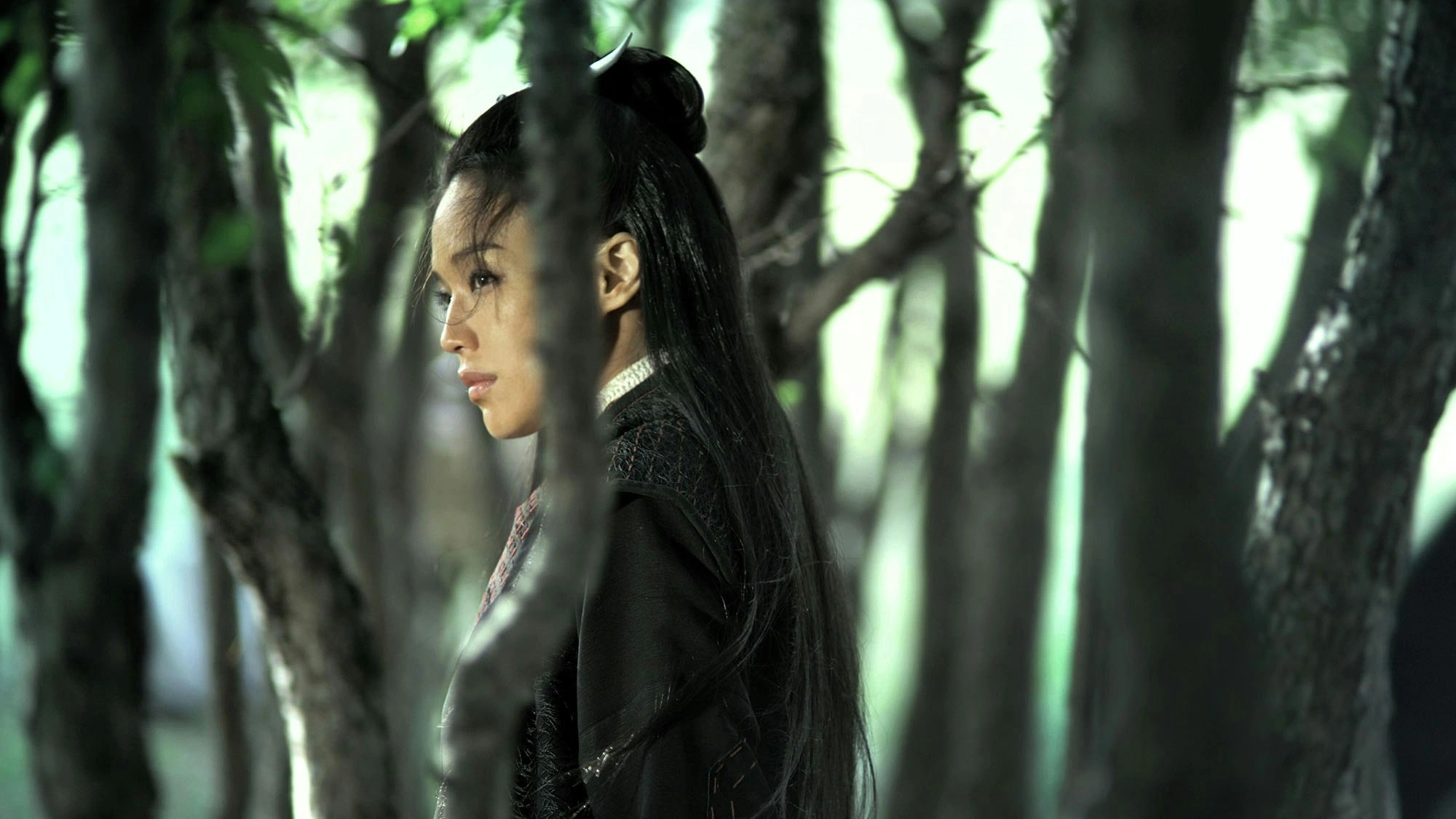 Hou Hsiao-hsien makes refusal an action: Nie Yinniang watches, understands and declines to produce the corpse her institutions demand.
In a conventional heroic story, this would be weakness to overcome before the final duel. Hou makes it the achievement. Yinniang understands every obligation competing for her body—to teacher, family, former betrothed and political order—and refuses to let any of them determine whom she must kill. Where Odysseus restores his household through a massacre, she protects what remains of hers by leaving the machinery of restoration altogether.
It is easy to label this Daoist wuwei, action through non-coercion, and move briskly on. The film resists the label as stubbornly as it resists plot explanation.
Yinniang does act: she watches, intervenes, wounds, rescues and finally chooses her companions. Her refusal is not passivity. It is control reclaimed from institutions that recognize moral seriousness only when it produces a corpse.
The reception tells its own story. International critics celebrated the film’s stillness and visual precision; Hou won Best Director at Cannes, and Sight and Sound named it the best film of 2015. Mainland audiences split dramatically between viewers who found it a masterpiece and viewers who found it an excellent opportunity for sleep. Some cinemas even had to explain that the square frame and black-and-white opening were intentional.
Both reactions make sense. Nolan translates an ancient epic into modern psychology so that the audience can enter it. Hou withholds explanation so that the audience must feel its distance. Nolan risks making the past too much like us. Hou risks making it so strange that only the truly-devoted remains. If Emily Wilson’s criticism of The Odyssey is that ancient divinity, appetite and social relations have been thinned into one man’s trauma, The Assassin shows the opposite wager: trust the old world to remain partly illegible.
It is demanding. It is also one of the most beautiful films ever made.
One last assassin, and the argument over unity
If you want to end with something louder, watch Zhang Yimou’s Hero 《英雄》.
An assassin called Nameless comes within ten paces of the King of Qin. He tells the king how he defeated three legendary killers. The story changes color as it is retold: red for passion and falsehood, blue for speculation, white for something closer to truth. Armies let loose arrows like weather. Two swordsmen fight across a lake without seeming to touch it. Maggie Cheung walks through yellow leaves and makes vengeance look like the most elegant mistake in human history.
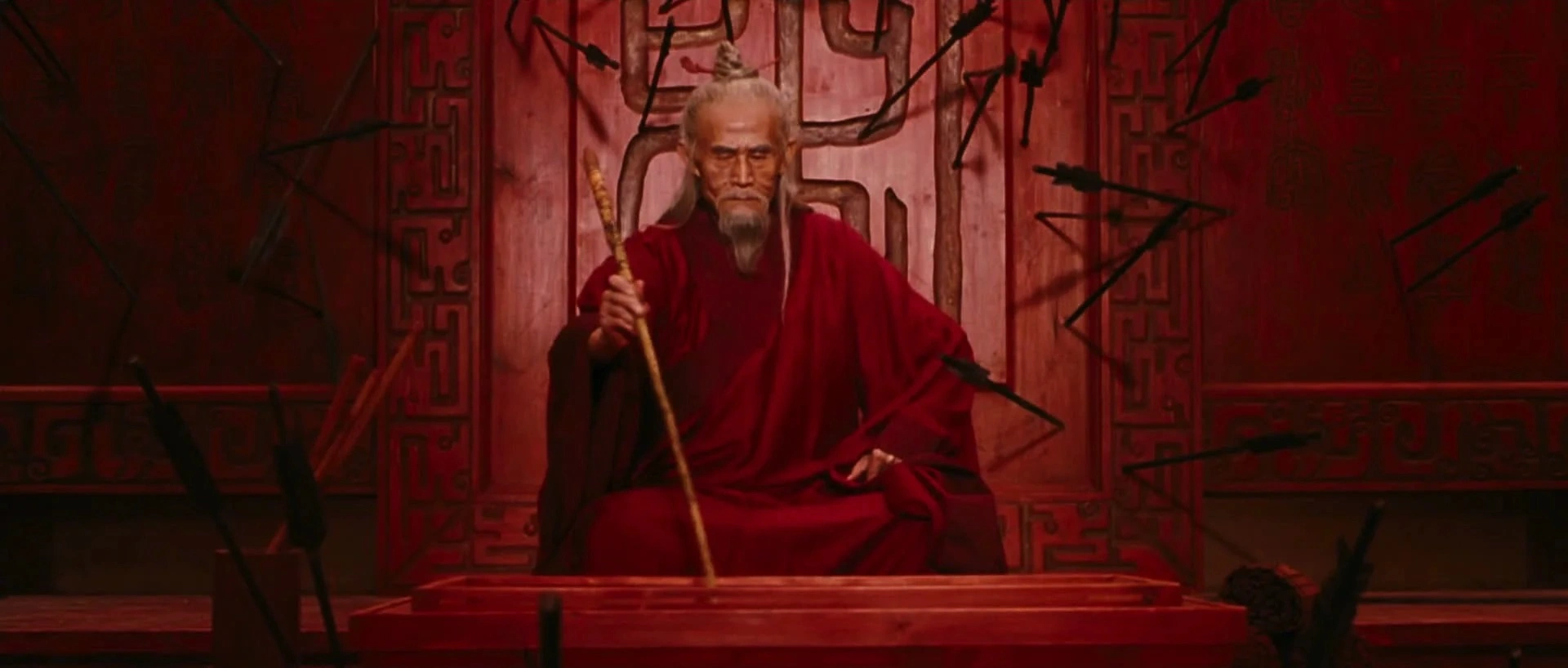 In Hero, history changes color as it is retold; beauty does not settle the argument over truth or power.
The final question is brutally simple. Should the assassin kill the ruler whose conquests have destroyed his homeland, or spare the one man capable of ending the wars and unifying 天下, “all under Heaven”?
When Hero opened in China in 2002, many Chinese critics saw an apology for despotism: an assassin sacrifices justice, the future First Emperor survives, and political unity receives the last word. The shadow of both Qin tyranny and modern state violence was impossible to ignore. When the film reached the United States two years later, much of the response concentrated on color, choreography and sublime spectacle. The same ending that made some Chinese viewers angry made many overseas viewers misty-eyed.
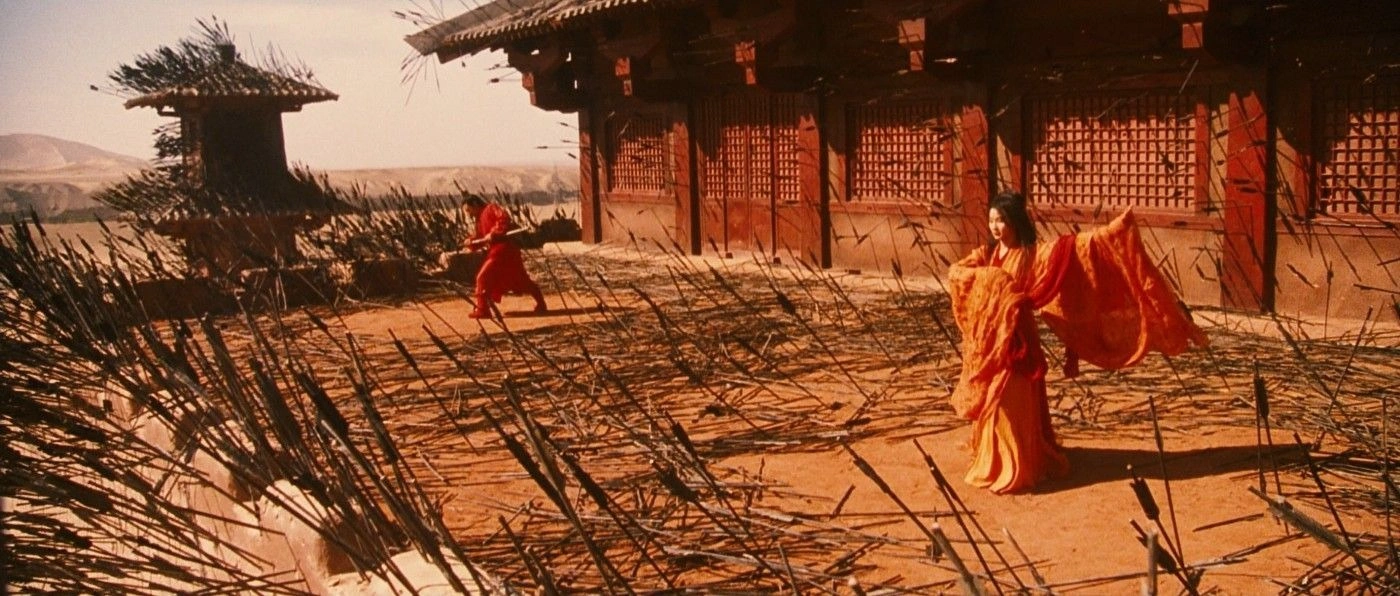 Hero makes imperial violence look like weather—which is precisely why its argument over unity remains so unsettling.
Neither response exhausts the film. Critics such as Wendy Larson have read its standardizing Qin empire beside globalization, while others find contradictions within its competing visions of 天下. The king understands that the highest swordsmanship means not killing, then orders Nameless executed. Unity ends one kind of violence by giving another kind a monopoly. Peace arrives wearing the face of an army.
That is why Hero belongs here even if one rejects its apparent conclusion. It stages, with almost indecent beauty, the temptation Nolan gives Odysseus: perhaps one more act of violence will make violence unnecessary. Perhaps the terrible man is terrible only because history requires him. Perhaps civilization survives by asking the victim to admire the scale of the victor’s plan.
Or perhaps that is what every empire says just before the arrows fly.
After the hero comes home
These works do not offer a single Chinese answer to Nolan’s Odyssey. They quarrel too much for that.
Three Kingdoms says that virtue may remain real even when it cannot change the outcome. The Longest Day in Chang’an shows an imperial system producing the people who will attack it. The Warlords turns brotherhood from salvation into a machine with no exit. Water Margin builds justice outside the state and discovers how quickly it begins to resemble the thing it hates. Creation of the Gods makes dynastic violence part of the cosmos. The Assassin imagines refusal as the one heroic skill war cannot use. Hero asks whether unity is peace or merely victory with a better publicist.
They are also, let us not lose sight of this, tremendous entertainment. There are stratagems involving empty cities and borrowed arrows, exploding lantern towers, starving armies, drunk monks, fox demons, invisible assassins and Tony Leung writing calligraphy while an army attempts to shoot him through the roof. The ideas endure because the characters do. People have worshipped Guan Yu, censored Song Jiang, defended Cao Cao, wept for Zhuge Liang and argued over the King of Qin across languages and political regimes.
Nolan’s Odysseus fears that the man who wins the war may be unfit for peace. Chinese epic adds a nastier possibility that might be closer to the Homeric original: that is precisely why history will call him a hero.
Editor: Yunpeng Zhang