




The Trump administration’s recent easing of chip export controls to China has sparked speculation that a “grand tech bargain” between the U.S. and China might be in the works.
A Bloomberg report on July 17 analyzed the situation, noting that although Trump led a hardline wave against China during his first term, he is fundamentally a “deal-making” president who prioritizes practical interests. As diplomatic and economic exchanges between China and the U.S. pick up pace, Trump may seek to conditionally relax tech restrictions in exchange for Chinese cooperation on rare earth supplies, market access, and combating fentanyl. The two sides may be slowly moving toward a series of agreements.
Analysts believe that a wide range of bargaining chips are now on the table, raising the possibility of a U.S.-China tech “grand bargain.” If Trump sees a policy that could serve as leverage to extract concessions from China—on rare earths or other issues—he is likely to use it.
The report notes that just a few years ago, the Biden administration viewed export controls as a “new strategic asset” aimed at maintaining the greatest possible U.S. lead over China in advanced technologies. But now, Trump is upending that approach. This week, tech companies like NVIDIA were granted permission to resume exports of certain chip products to China.
This strategic shift has angered China hawks in Washington and raised a key question: as Trump paves the way for a meeting with Chinese leaders later this year, to what extent will the U.S. roll back the array of restrictions it previously imposed on U.S.-China trade and technology exchanges in the name of “national security”?
“The easing of export controls on the H20 chip is a clear signal and may indicate the direction things are heading,” said Kevin Xu, a tech investor and founder of Interconnected Capital who served in the Obama administration. “There are now a lot of chips on the table, and the conditions are ripe for a tech grand bargain between China and the U.S.—one that could involve semiconductor manufacturing equipment, rare earths, battery technology, AI chips, and even mutual market access.”
Although the U.S. remains far from fully lifting its export controls, investment restrictions, and sanctions targeting China, Trump’s recent moves have opened the door to redefining relations between the world’s two largest economies.
Just a few months ago, Trump pushed the two countries to the brink of “decoupling” by slapping 145% tariffs on Chinese goods. But subsequent negotiations in Geneva and London led to an agreement to pause new tariffs. The U.S. agreed to reduce tariffs and ease export controls in exchange for China’s export of rare-earth magnets used in smartphones, electric vehicles, and high-tech weapons manufacturing.
The report noted that although Trump’s first term reshaped the dominant tone of Washington’s China strategy—with an emphasis on the so-called “China threat”—Trump himself has always been a deal-oriented president, not one to be bound by traditional national security concerns. He downplayed privacy concerns around TikTok and even welcomed Chinese automakers setting up factories in the U.S. during his campaign.
“He’s not obsessed with controlling everything,” said Dominic Chiu, a senior analyst at the Eurasia Group. “If he sees a policy as a bargaining chip that can win concessions from China on rare earths or other issues, he’ll use it.”
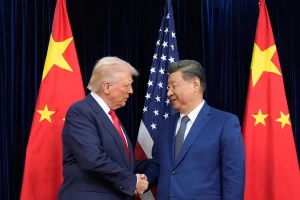
Recently, U.S. and Chinese foreign ministers held a cordial meeting in Malaysia, and a meeting between the countries’ finance ministers may also take place “in the coming weeks.” U.S. media outlets say the easing of chip restrictions has built further goodwill to support a wave of diplomatic engagement.
For the Trump administration, the goal is likely similar to that of his first term: to push China to make large-scale purchases of American goods, helping to address the long-standing U.S. trade deficit. Trump may also demand more action from China to curb fentanyl production—on July 16, he praised the two countries for taking a “major step forward.”
The Trump administration is also seeking to resolve the question of TikTok’s operations in the U.S. and wants assurances from Beijing that export controls on rare earths will not be “weaponized.”
The report noted that on the other side, China also has its own wish list. This includes: the complete removal of tariffs (including the 20% tariff related to fentanyl and the legacy Trump-era tariffs extended by Biden), the easing of investment restrictions, and—most importantly—further concessions from the U.S. on export controls.
Kurt Tong, former U.S. Consul General in Hong Kong and Managing Partner at The Asia Group, said the Biden administration has pursued a “small yard, high fence” strategy for technology restrictions and has treated it as “non-negotiable.” Trump, however, has a different focus—he wants to showcase that his deal-making strategy can deliver results for the American people.
“He cares about trade, deficits, investment in the U.S., and having a good relationship with China,” Tong said.
“In Washington, it’s practically taboo to say anything positive about Chinese investment,” said Gerard DiPippo, Deputy Director of the China Center at the RAND Corporation. “But if there’s one president who would do it, it’s Trump.”
A Bloomberg article on July 16 also observed that in an effort to secure a summit with Chinese leadership and a potential trade deal, Trump has already begun to “soften his tone on China,” dialing down the confrontational rhetoric.
Since returning to power nearly six months ago, Trump has largely stopped harping on the “massive U.S. trade deficit with China and the resulting job losses.” This softer posture stands in stark contrast to his continued use of high tariffs to pressure other trade partners. At present, Trump seems less concerned with so-called “trade imbalances” and more focused on striking a new procurement-style agreement with China—similar to those from his first term—and quickly celebrating it as a “win.” It’s worth noting that amid booming exports, China recorded a historic trade surplus in the first half of this year.
However, insiders have also expressed concern about Trump’s erratic approach to policymaking and his tendency to walk back previously promised hardline positions. This week’s developments have only deepened those concerns: red lines that the U.S. once insisted were non-negotiable with China now appear to be on the table as bargaining chips.
On July 11, Wang Yi, member of the CCP Politburo and China’s Foreign Minister, met with U.S. Secretary of State Rubio in Kuala Lumpur. The two sides exchanged views on China-U.S. relations and other issues of mutual concern.
Wang elaborated on China’s principled stance toward developing relations with the U.S., stressing the need to translate the two heads of state’s important consensus into concrete policies and actions. He expressed hope that the U.S. would approach China with objectivity, rationality, and pragmatism, adopt a policy of peaceful coexistence and win-win cooperation, and engage with China on the basis of equality, mutual respect, and reciprocity—so that the two sides can find a correct way to get along in this new era.
Both sides agreed that the meeting was positive, pragmatic, and constructive. They committed to strengthening diplomatic channels and communication at all levels and across various fields, giving full play to the role of diplomacy in managing bilateral ties. While continuing to manage differences, both countries also pledged to explore expanding areas of cooperation.
Editor: Zhiyu Wang
方腾波
The USA should come with much, much more concessions than allowing NVIDEA to export downgraded H20 chips to China. China is not really waiting for these chips.
Do they really hope to get access to China’s rare earts in this way ? To announce the export permission as a “bargaining chip” is ridiculous and pathetic, showing the dire state of the american economy. We, in China, first of all want to see some real, concrete movements. We’re sick and tired of words and empty promises.
And don’t think Trump doesn’t know this. The whole show is for the american public.
Stop the theatre. Act in a cooperative way.
[email protected]
These US officials say one thing and then insult China the next, showing China respect is the first prerequisite for a trade deal. I don’t see China selling rare earth minerals to Lockheed Martin so they can build weapons that can be used against China. I also don’t think China is as interested in Nvidia H20 chips as they once were, they wont’t to make their own and be self sufficient. Self sufficiency seems to be the main theme in China right now, not depending on the US, because the US simply can not be trusted to keep its word.