

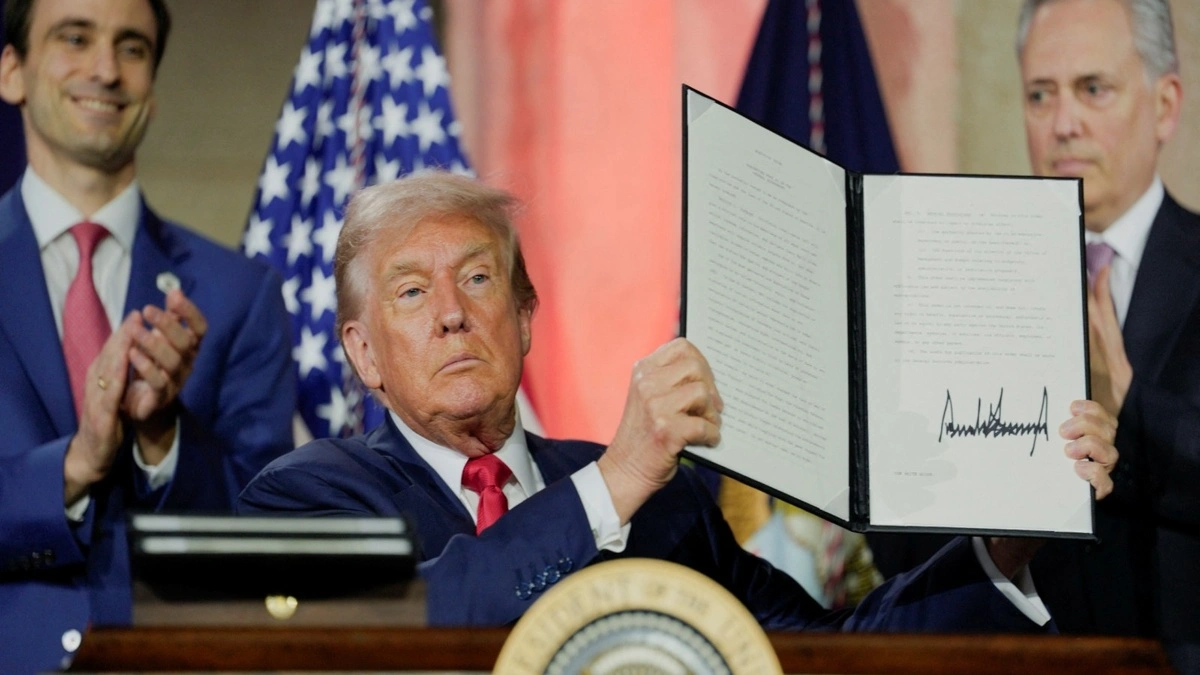
On November 24th, Donald Trump signed the executive order launching the Genesis Mission to achieve “global technology dominance in the development of artificial intelligence (AI).” This is the latest in Washington’s flurry of AI-related initiatives. Since Trump took office, Washington has promised nothing less than an AI-powered national revival: a rebuilt industrial base, modernized infrastructure, upgraded national laboratories, and a reimagined energy system. “Stargate,” the “America’s AI Action Plan,” and the latest “Genesis Mission”—just to name a few, sound like the grand pronouncements of another great national effort in American history, echoing past glories such as the Manhattan Project and Apollo Mission.
On paper, these plans appear to constitute a serious effort to dominate the “commanding heights” of AI. The Stargate sets out ambitious goal of building world leading data centers with computational capabilities to train the best AI models. The AI Action Plan defines what the United States wants to do with the best AI system. And the Genesis Mission tells every federal agency exactly what to do, and by when, to bring this grand design to life. The result looks like a coherent, almost technocratic scheme, locked together in a single state project. Yet, upon closer inspection, these initiatives produce more questions than they answer.
Lets begin with the Stargate. The project plan to build a new generation of artificial intelligence infrastructure centered on massive data centers. Backed by major U.S companies like OpenAI, SoftBank and Oracle, Stargate aims to deploy up to ten gigawatts of AI compute capacity by 2029, with total investment commitments reaching 500 billion dollars. It does have a technically correct observation: modern AI is constrained not by algorithmic cleverness but by the computational power of microchips, which require enormous amounts of electricity. As U.S.–China competition intensifies, training and serving frontier models requires dense GPU clusters and massive data centers.
However, upon closer examination, it increasingly resembles the“reshore manufacturing”mantra preached by past U.S. presidents since Obama, and which delivered little, for obvious reasons. First, electricity. These AI campuses require power on a scale historically reserved for heavy industry, often exceeding the total load of the surrounding region. Moreover, unlike earlier data-center booms that clustered around coastal tech hubs, Stargate facilities are intentionally placed in America’s interior, in states like Texas, Michigan, and New Mexico, where land is cheaper and local governments are more receptive. This also means the AI facilities will put huge strain on rural grids that were never built for this level of demand, made worse by decades of underinvestment that undercut the efficiency of transmission lines. Even when capacity exists somewhere in these regions, delivering it to a single site can take many years due to permitting delays, land disputes, and regulatory fragmentation that have long plagued U.S. power grids.
Beyond infrastructure, there is also a strategic risk of overbuilding. Stargate assumes AI demand will keep rising fast enough to justify unprecedented expansion in computational power, but the investors may have second thoughts soon. There is no guarantee that future advances in AI models will be driven primarily by increasing computational power, the so called “Scaling Law”, especially given the current intellectual direction in the United States places ever greater emphasis on algorithmic design. Thus, the inevitable emergence of more efficient algorithms that require less computational powers from data centers could therefore undercut the entire rationale of Stargate. In addition, the project bases its long-term forecasts on ever more capable AI models delivering greater marginal efficiency across the economy, without considering the possibility that the AI industry, built around replacing tangible, physical assets and subverting human understanding of existing applications, may not continue along the same model-driven trajectory seen since the 2020s.
Financially, it relies on long-term confidence in the industry, and should a downturn in the AI sector occur, even a cyclical adjustment similar to the dot-com bubble, it would dent corporate enthusiasm for years. This is compounded by the fact that the 500 billion dollar commitments are based on layered financing that relies on borrowing and mortgaging the assets being built to finance itself. Such a scheme could easily unravel if there is an interest-rate adjustment or a downturn in the valuation of AI assets.
Then comes the AI Action Plan, the United States must use AI to drive economic growth, enhance national security, modernize public services, and cement leadership in international standards-setting. It promises funding for foundational research to build “trustworthy AI,” new workforce programs to produce AI talent, and incentives for private investment in high-impact applications. Most importantly, it lays out a “whole-of-government approach” to harmonize regulations across sectors and prevent the “patchwork” of inconsistent rules that might stifle innovation. In particular, the Plan proposes: a Federal Chief Data Officer Council to standardize data governance across agencies; a Chief AI Officer Council to coordinate deployment and risk management; and a Special Advisor for AI and Crypto positioned somewhere near the apex of this structure.
Creating new government agencies to manage AI is indeed necessary. Government effort should be directed specifically toward understanding how AI is being used responsibly across the economy and society. However, the plan assumes that simply naming councils and announcing funding mechanisms is enough to make them work. There is a shocking lack of detail—almost guaranteeing bureaucratic confusion or worse.
The plan advertises “funding opportunities across agencies” and competitive grant programs for AI projects in health, transportation, energy, and beyond, without articulating a hierarchy of priorities or defining what precisely constitutes “AI industries.” In other words, any department, laboratory, or state can compete for resources by proposing projects as long as they are vaguely related to “AI.” This all but guarantees a feast of corporate welfare that increasingly characterizes American capitalism. Over the last 20 years, Washington has repeatedly announced grand initiatives from “energy independence,” to “securing the border.” Yet these goals remain as elusive as ever because policymakers consistently ignore a terrible trend: corporate concentration in America.
Since 2008, across all sectors, America’s once-dynamic market, once capable of constant renewal through startups, has given way to increasing consolidation by incumbent firms. Nowhere is this truer than in the tech sector, the darling of capital markets, where new companies face overwhelming barriers: lawsuits, threats of buyouts, acquisitions, and regulatory pressures. One only need to look at what has happened to TikTok to see how American companies, from Google to Facebook, have become de facto oligarchs. The outcome is predictable: industries dominated by such giants have little incentive to provide services efficiently, especially when dealing with government contracts. This is perhaps why Build Back Better, the Biden administration’s signature infrastructure initiative, spent $1 billion but produced virtually nothing. Nothing suggests that similar AI policy efforts will fare any better.
This tendency will be worsened by the Plan’s sudden embrace of “governance experimentation.” It praises a “try-first culture,” calls for regulatory sandboxes, and encourages agencies to pilot AI applications before formal rules are in place. For a country that spent much of the last decade warning about the dangers of “state-led experimentation” in China—from environmental risks to digital infrastructure—this sudden enthusiasm for state led governance is striking and suspicious. Policy experimentation works in Beijing because China’s centralized governmental structure allows the central administration to impose experimental conditions on localities, study successful cases, and contain the damage from failures. This is also why China has decreed that the AI industry is unsuitable for many provinces until further breakthroughs permit wider deployment.
For America, this is impossible. The federal government has far less power to compel state governments to implement—or refrain from implementing, its policies. Moreover, America’s AI industrial clusters are concentrated in coastal cities dominated by Democrats, many of whom are eager to frustrate a Republican administration’s agenda. This means that what should be scientific policy experimentation will inevitably be subcontracted to corporations that can satisfy interests across political lines, just as Tesla is leading the RoboTaxi pilot programs. But this approach is deeply counterproductive: corporations driven by profit will inevitably generate biased results that justify greater subsidies, warping policy into a vehicle for further rent-seeking.
The most revealing of the three initiatives is the Genesis Mission. While Stargate and the AI Action Plan speak in abstractions, Genesis indulges in detail, translating lofty rhetoric into deadlines: 90 days, 120 days, 240 days.
Within 90 days, every major department must inventory where AI can be applied: what data assets it holds, what processes could be automated, which “critical functions” might benefit from machine learning. Within 120 days, agencies must deliver implementation roadmaps identifying priority systems, required investments, and potential risks. Within 240 days, they are to propose concrete plans for AI-enabled automation in “critical manufacturing, logistics, and infrastructure,” including pathways toward highly automated, and implicitly, sparsely staffed—facilities.
As of today, the U.S. Department of Energy has committed $320 million to support the Genesis Mission. The focus is to reinvigorate America’s national labs—once at the center of nuclear and space research, as the core nodes of an AI-industrial complex. They are to pool compute resources, share data, and develop “foundational models” for use across government and industry.
The deeper motivation is clear. The United States has discovered the limits of its “bring manufacturing back home” agenda. Wages are high, unions are strong in key industries, permitting is slow, local opposition is organized, and supply-chain ecosystems cannot be conjured through tax credits alone. Against that reality, Genesis reads like crash-course developmentalism: if America cannot recreate the labor conditions and supply-chain density of East Asia, it will try to compensate with AI-driven automation.
But once again, the Genesis project promises more bang than buck. The Apollo program transformed America’s economy by investing more than $300 billion in technologies ranging from thermal cooling to advanced materials—advances that spread across industries, creating new businesses from household appliances to fabric manufacturing. In contrast, Genesis has devoted only $3 billion so far—funds likely to be spent covering HR costs, hiring researchers, and renovating aging labs at inflated prices.
This reveals the core problem across all the AI initiatives. While the Apollo mission had a clear objective—landing on the moon—verifiable and discrete, the so-called AI revolution is burdened with excessive flexibility. How does one define the “revolution”? Is it the adoption rate of large language models across sectors? The percentage of national electricity devoted to AI centers? The number of AI-branded corporate initiatives? Such ambiguity guarantees that the AI drive will lose focus, drawing precious talent and capital away from the genuine breakthroughs that could transform energy production or the nature of work itself.
Finally, we must address the elephant in the room. While the United States has the best AI engineers and the most proactive regulatory environment, it is China that championed open-model AI development, enabling systems like DeepSeek at a fraction of U.S. costs. Meanwhile, America’s AI ecosystem is dominated by a handful of licensed gatekeepers. Access to America’s most capable models comes through proprietary APIs, on terms dictated by corporations that themselves face growing regulatory and political pressures. Universities and smaller labs can still conduct meaningful research, but their freedom is circumscribed by compliance regimes, security reviews, and funding conditions that push them away from some collaborations and toward others.
If America is serious about competing with China for AI leadership, it should have championed an open-model approach long ago. AI sits at the intersection of three vital projects: industrial upgrading, digital infrastructure, and the provision of public goods to the Global South. Chinese policymakers see AI not only as a way to climb global value chains, but also as a tool for binding other economies into shared platforms—cloud services, payment networks, logistics systems, and now AI-enabled applications.
America’s abandonment of this approach is not due to ignorance but to the inevitabilities of a financialized economy spinning out of control. Even before the pandemic, the Federal Reserve had created more than $4 trillion in “assets”—effectively digitized money printing—flooding the economy. Such an influx takes decades to absorb, transforming the U.S. economy from one driven by real investment into one driven by speculation. Excess liquidity inevitably seeks an asset to inflate. This is why pre-pandemic America cycled through narratives—from shale oil, to big data, to Web 3—that ultimately amounted to stories supporting stock rallies. The pandemic made this worse, injecting another $3 trillion in just two years. And this is why the AI bubble, from the “metaverse,” to the deification of chip design, to AI initiatives adopting biblical language, is inevitable. These narratives must be invented, regardless of how absurd the concepts or unrealistic the implementation.
Already, industry data shows that AI adoption is plateauing at around 15%. There are limits to how far large language models can transform society, as they harvest a finite corpus of human-generated data. Even perfecting industrial robotics merely makes existing assets more productive; it does not create entirely new asset classes, as the first and second industrial revolutions did.
The great irony, and perhaps the most terrifying aspect of America’s AI obsession, is that despite its detachment from reality, its disregard for economic history, and its negation of common sense, the AI bubble is set to continue simply because it offers an effective channel through which the post-Covid money glut can be absorbed. A dot-com-style crash may occur, but recovery will be swift as the U.S. financial system pumps in more liquidity. The outcome will be greater inflation as the boom continues, greater inequality as AI-linked stocks soar to near-mythic valuations, and declining productivity as the generation’s best talent is diverted into technological concepts backed by political grandstanding rather than scientific necessity.
Editor: Charriot Zhai