


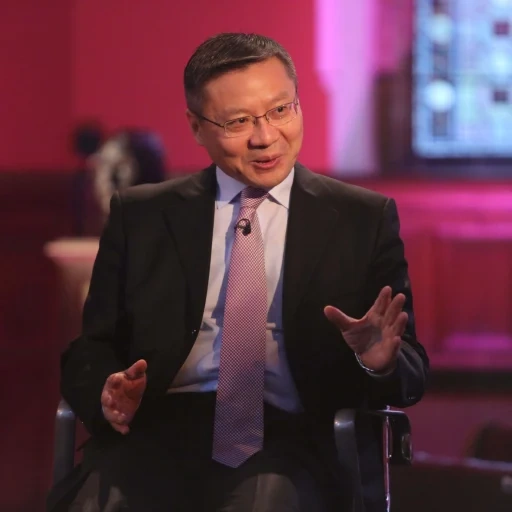
Thomas Friedman, a columnist for The New York Times, gained global fame with his 2007 book The World Is Flat. That was a time when neoliberal globalization was dominating the world, but its market fundamentalism is precisely what has led to America’s industrial hollowing-out and widening of the wealth gap today. Since 2008, Friedman has reflected extensively on America’s decline, with China’s rise serving as his primary point of comparison. Of course, he writes with frustration, hoping the U.S. will wake up, learn in one way or another from China’s experience, and revitalize itself.
Back in 2008, after attending the Beijing Olympics opening ceremony, Friedman wrote an influential commentary titled “A Biblical Seven Years” published in The New York Times on September 10, 2008. He wrote: “As I sat in my seat at the Bird’s Nest, watching thousands of Chinese dancers, drummers, singers, and acrobats on stilts perform their magic at the closing ceremony, I couldn’t help but reflect on how China and America have spent the last seven years: China has been preparing for the Olympics; we Americans have been preparing for Al Qaeda. They’ve been building better stadiums, subways, airports, roads, and parks. And we’ve been building better metal detectors, armored Humvees, and pilotless drones.”
The difference is starting to show. Just compare arriving at La Guardia’s dumpy terminal in New York City and driving through the crumbling infrastructure into Manhattan with arriving at Shanghai’s sleek airport and taking the 220-mph magnetic levitation train, which uses electromagnetic propulsion instead of steel wheels and tracks, to get to town in a blink. Then ask yourself: Who is living in the Third World country? He even lamented, “I never want to tell my girls that they have to go to China to see the future.”
Eighteen years have passed in the blink of an eye. I don’t know if Friedman’s daughters have visited China, but Friedman himself recently returned and gave a more definitive answer to his earlier musings. On April 2, he wrote in The New York Times, “I Just Saw the Future. It Was Not in America.” He described his visit to Huawei’s Lianqiu Lake R&D Center in Shanghai’s Qingpu District, saying, “It was fascinating and impressive but ultimately deeply disturbing… people came to America to see the future… now they come here.”
Not long ago, Friedman had a podcast conversation with Ezra Klein, elaborating on some of his article’s points. He said, “I’ve never seen a campus like Huawei’s. It’s basically Huawei’s response to the U.S. trying to strangle it since 2019. Despite U.S. sanctions, Huawei launched the Mate 60 series smartphone with advanced semiconductors last year. Huawei is also diving into AI technologies for everything from electric vehicles and autonomous driving to automated mining equipment. Beijing’s message to America: We’re not afraid of you. You aren’t who you think you are- and we aren’t who you think we are.”
Friedman also commented on Trump’s tariff war, noting that while he acknowledges a trade imbalance between the U.S. and China, he believes Trump is naive to think that trade barriers and tariffs alone will revive American factories. He argues that this view ignores a fundamental fact: today, nearly every sophisticated product—from cars to iPhones to vaccines—is made by global manufacturers in a vast, intricate ecosystem that cannot be built overnight.
Friedman refutes the popular U.S. narrative that China gained dominance in global manufacturing through deceit. He believes China’s manufacturing giants are so strong not just because they make products cheaper, but because they produce them faster, better, and smarter, with greater integration of AI. He suggests the U.S. learn from China’s approach, as infusing AI across industries can optimize and accelerate manufacturing from design to testing to production. However, Friedman doesn’t explain how AI can empower U.S. manufacturing when its industrial base has been hollowed out—as a Chinese saying goes, without the skin, where does the hair attach?
Friedman criticizes the widespread “China phobia” and anti-globalization sentiment in American society today. He believes that by restricting overseas investment and stifling cooperation, the U.S. is turning a blind eye to China’s latest technological advancements. This reminds me of one of Deng Xiaoping’s key considerations when promoting China’s opening-up policy: China must stay attuned to changes in the outside world in real time. Now, the U.S. is engaging in its own version of isolationism, increasingly resembling China’s late Qing Dynasty.
As for the U.S. media’s claim that “Chinese people can’t innovate and only steal technology,” Friedman counters: “If you talk to American or European businesses who operate in China, what they’ll tell you is: We first came here for the market. And now we come here to be close to innovation. And we cannot be in touch with the cutting edge of our field, unless we’re here.” He recounts the rise of Chinese new-energy vehicles, noting that China, realizing it couldn’t compete with America on internal combustion engines, leapfrog them right to electric vehicles and autonomous driving cars. Friedman vividly sums up China’s success as the “China Fitness Club model.” He explains that in this “fitness club,” China has built a complete set of proprietary facilities—from solar panels to electric vehicles—where Chinese companies fiercely compete in a brutal arena.
Friedman is deeply disappointed with Trump’s approach. He says, “Hire clowns, expect a circus.” Renowned economist and Columbia University professor Jeffrey Sachs has also pointed out in recent interviews that the U.S.-China trade conflict is not merely a bilateral issue but a microcosm of a broader global economic transformation. America’s hegemonic status has reached its end. Sachs predicts that the U.S. dollar’s role as the world’s primary reserve currency will last no more than another decade. He cites three reasons: first, the U.S.’s massive debt problem, which has rendered its economic model unsustainable; second, the weaponization of the dollar, which has sparked widespread resentment globally; and third, the rise of digital currencies, which has made traditional financial settlement methods obsolete, pushing the world toward a multi-currency era. Sachs argues that these issues do not stem from a so-called “China threat” but are a concentrated reflection of America’s internal problems.
On May 19, The New York Times published an article by Kyle Chan, a young scholar from Princeton University. He writes with frustration: “A Chinese century… may already have dawned, and when historians look back they may very well pinpoint the early months of President Trump’s second term as the watershed moment when China pulled away and left the United States behind.” In the contest between Washington and Beijing, the U.S. may win some minor battles, but it is losing the bigger war. In industries such as steel, shipbuilding, batteries, solar energy, electric vehicles, wind turbines, drones, 5G equipment, consumer electronics, active pharmaceutical ingredients, and high-speed rail, China’s output already leads the world. By 2030, China is expected to account for 45% of global manufacturing—nearly half.
He further notes that BYD, the Chinese electric carmaker once mocked by Elon Musk, overtook Tesla last year in global sales, and in March this year, reached a market value greater than Ford, GM, and Volkswagen combined. China is charging ahead in drug discoveries, especially cancer treatments, and installed more industrial robots in 2023 than the rest of the world combined. In semiconductors, the vital commodity of this century and a longtime weak point for China, it is building a self-reliant supply chain led by recent breakthroughs by Huawei.
Chen argues that if each nation’s current trajectory holds, China will likely end up completely dominating high-end manufacturing, from cars and chips to M.R.I. machines and commercial jets. The battle for A.I. supremacy will be fought not between the United States and China but between high-tech Chinese cities like Shenzhen and Hangzhou. Chinese factories around the world will reconfigure supply chains with China at the center, as the world’s pre-eminent technological and economic superpower. America, by contrast, may end up as a profoundly diminished nation.
He warns that to avoid this grim scenario, the U.S. must act now by investing in research and development, supporting academic, scientific and corporate innovation, forging economic ties with countries around the world; and creating a welcoming and attractive climate for international talent and capital. However, he believes the Trump administration is doing the opposite in each of those areas, and the time for the U.S. to change course is quickly running out.
In summary, since Trump’s return to the White House, more Western voices have been reflecting on what the U.S. has done wrong and what China has done right. Their conclusions seem to converge on one point: America’s problems seem to be intractable.
Editor: Zhiyu Wang

Wini Yu
Friedman’s evolution from marveling at China’s infrastructure to grappling with its technological resilience underscores a painful truth for America: its problems are largely self-inflicted, and tariffs alone won’t rebuild what was hollowed out by its own neglect.