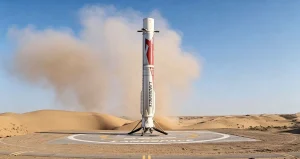




In urban rescue missions, they cut through thick smoke to scout the way for firefighters, racing against time to save lives; over farmlands, they transform into “aerial doctors,” spraying pesticides with precision and greatly boosting agricultural efficiency… Miniature drones have already taken on important roles in people’s daily life and production.
But have you ever noticed, although these drones can fly solo or perform in swarms, hardly any two drones can fly stacked like “acrobats,” one above the other?
This is because when two drones overlap in flight, strong “airflow interference” occurs, making them highly prone to “crashes,” let alone performing precise operations. This seemingly “simple” maneuver is actually a bottleneck in the development of drone technology.
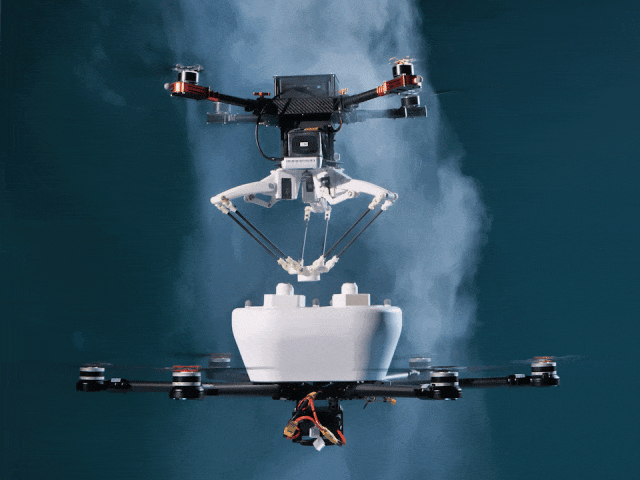
At 11 p.m. Beijing time on September 24, Nature reported a breakthrough in this field by Professor Zhao Shiyu’s lab at the School of Engineering, Westlake University. They developed an aerial cooperative manipulation system called FlyingToolbox, which for the first time internationally achieved mid-air tool exchange between multiple rotor drones. They realized high-precision collaborative operations in a stacked flight state, successfully solving the key technical challenge of balancing close-range flight and high-precision manipulation.
This is the first time that Chinese research results in the field of multi-rotor drones have been published in Nature. As drones move from “solo combat” to “group collaboration,” these aerial work robots will take on tasks beyond human reach in broader and higher application scenarios.
 Screenshot of the publication
Aerial Work Robots
Aerial work robots are a new type of robot that combines multi-rotor drones with high-degree-of-freedom robotic arms.
The drones we usually see are mostly “flying cameras,” used for aerial photography, monitoring, and similar tasks. In contrast, aerial work robots are “flying manipulators”: they can replace humans in hard-to-reach areas, performing tasks such as grasping and placing hazardous objects, cleaning high-rise buildings, conducting contact inspections, or even aerial additive manufacturing.
However, a single aerial robot has limited payload capacity and struggles to carry out complex aerial tasks on its own. Zhao Shiyu’s team envisioned: what if, just like in surgery, where the lead surgeon focuses on the operation while the nurse hands over scissors, forceps, or hemostats, aerial robots could also divide roles and exchange tools? In that way, each single-function aerial robot could instantly transform into a “multi-tasker,” completing complex operations through division of labor and cooperation.
But reality proved far harsher than the vision.
Given the layout of multi-rotor drones, if two drones want to exchange payloads, they need to fly in a “stacked” formation, with one drone hovering directly above the other to hand over tools.
However, when one drone flies directly above another, its propellers continuously blow strong downward airflow—technically called “downwash”—which severely disrupts the stability of the lower drone. Experiments showed that when the vertical distance between two drones drops to 0.6 meters, a strong downwash airflow of 13.18 m/s occurs—equivalent to a level-6 “strong wind” in meteorology (enough to make it difficult for a person to hold an umbrella).
Therefore, in existing studies on mid-air landing, suspension, and swarm flying, “stacked flying” does appear, but usually only briefly and without involving precise aerial manipulation.
Facing Level-6 Winds
How can close-range flying and high-precision manipulation achieve “the best of both worlds”? Zhao Shiyu’s team created the FlyingToolbox.
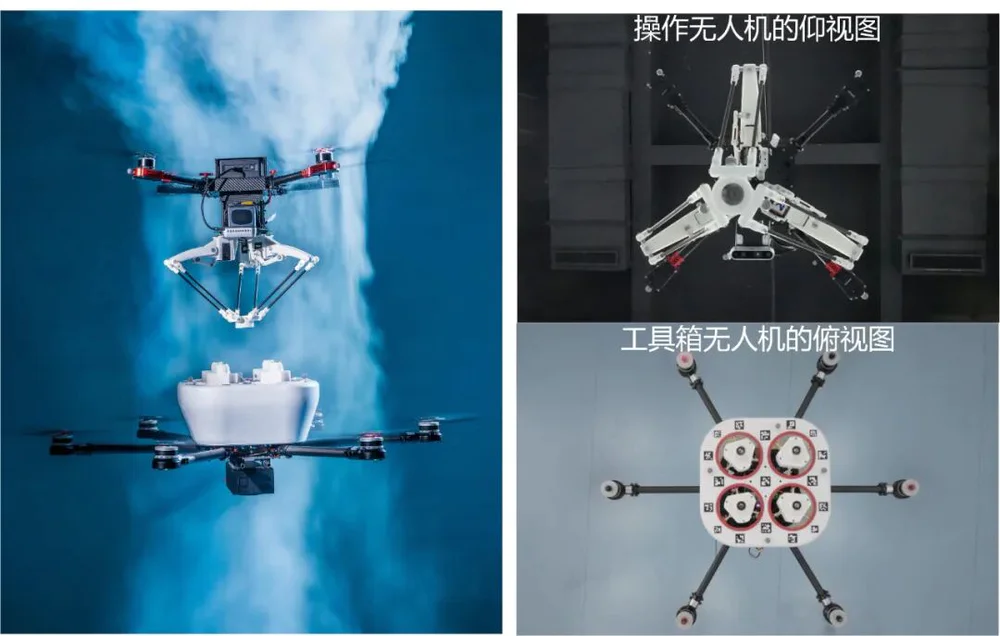 Figure 1: Components of the FlyingToolbox system.
This is an aerial cooperative manipulation system consisting of one toolbox drone and one operator drone (see Figure 1).
The toolbox drone, as the name suggests, can carry multiple different types of end-effector tools, such as claws and scissors (see Figure 2). You can think of it as the nurse’s tray full of surgical instruments.
The operator drone is the “manipulator” equipped with an extendable robotic arm—like the lead surgeon.
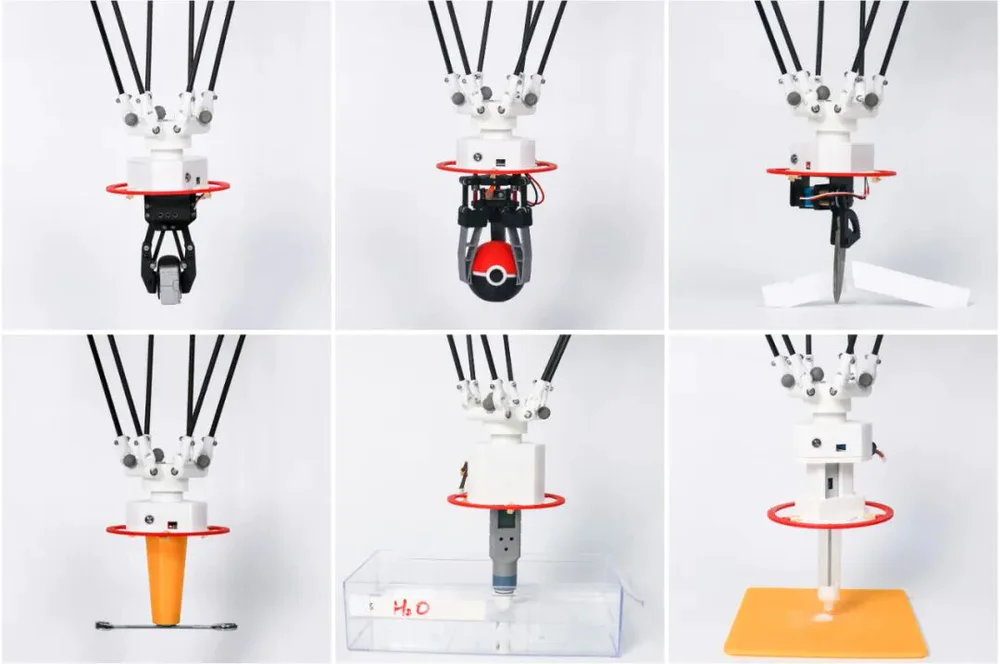 Figure 2: Various operation tools.
The goal of Zhao Shiyu’s lab: during work, the operator drone hovers above the toolbox drone and dexterously picks up tools like a surgeon, completes the task, puts the tool back, and then takes another—an entire sequence carried out seamlessly between the two drones, without human intervention.
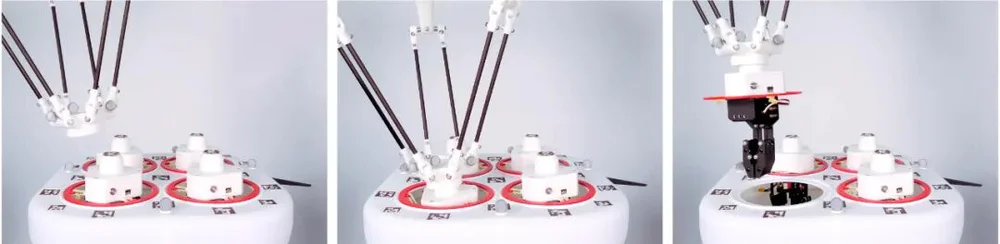 Figure 3: The docking process between robotic arm and end tool.
The greatest challenge here is overcoming the downwash airflow in stacked flight and achieving precise aerial docking under strong wind. Calculations show that to ensure successful docking, the horizontal displacement between the robotic arm’s tip and the tool’s top must be less than 1.5 cm—meaning the deviation between the upper drone’s bottom and the tool’s top must not exceed the width of a finger and a half.
The research team designed three “cutting-edge” core modules to crack this challenge:
Flexible electromagnetic docking mechanism
Airflow disturbance estimation and compensation method
High-precision docking and manipulation control technology
Flexible electromagnetic docking mechanism.This is an intelligent electromagnetic interface that automatically “snaps in” upon contact, greatly improving docking accuracy. At the end of the operator drone’s robotic arm is a cavity with an embedded iron plate; on top of the toolbox drone are four compliant conical electromagnetic docking devices, each able to mount different tools (scissors, claws, etc.) at the bottom, with electromagnet-tipped cones at the top (see Figure 4).
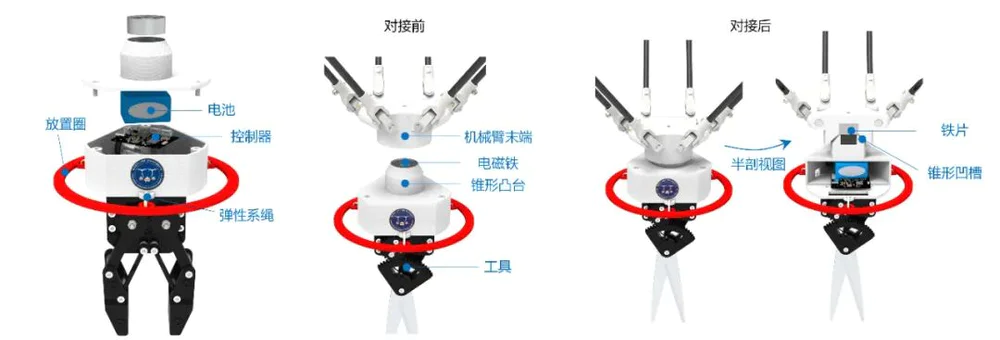 Figure 4: Structure and principle of the flexible electromagnetic docking mechanism.
When the toolbox drone receives the docking signal, its electromagnetic chip is powered on, generating magnetic force to attach to the operator drone’s cavity. Moreover, the compliant conical device is mounted on elastic cords like a miniature trampoline, ensuring successful docking even if there is slight misalignment.
Airflow disturbance estimation and compensation method. In the lower drone’s computer, a pre-embedded downwash velocity field model combines aerodynamic principles with real sensor data, predicting airflow velocity at any position beneath the operator drone. With this airflow information and the relative distance between the two drones, a neural network estimates the downwash effect and adjusts the lower drone’s flight accordingly.
High-precision docking and manipulation control technology.The operator drone carries a camera, while the toolbox drone’s top is covered with QR codes containing distinct information. When the upper drone “sees” enough QR codes, it can calculate relative distance and adjust accordingly. Meanwhile, the lower drone adjusts the rotation speed of its six rotors in real time to counteract the downwash, ensuring precise position (staying “in place”) and attitude control (not “tilting”).
Seeing Is Believing
How does the brand-new FlyingToolbox system perform? Let’s step into Zhao Shiyu’s lab and take a look.
Experiment ①
FlyingToolbox successfully achieved no fewer than 20 consecutive dockings, with an average error of 0.80 cm (standard deviation 0.33 cm). This sub-centimeter accuracy is nearly an order of magnitude better than earlier docking systems without robotic arm compensation (6–8 cm).

Experiment ②
FlyingToolbox achieved “dual-drone cooperation,” successfully completing aerial ribbon-cutting, grasping, placing, and other actions. The entire process was autonomously carried out by onboard algorithms.

Experiment ③
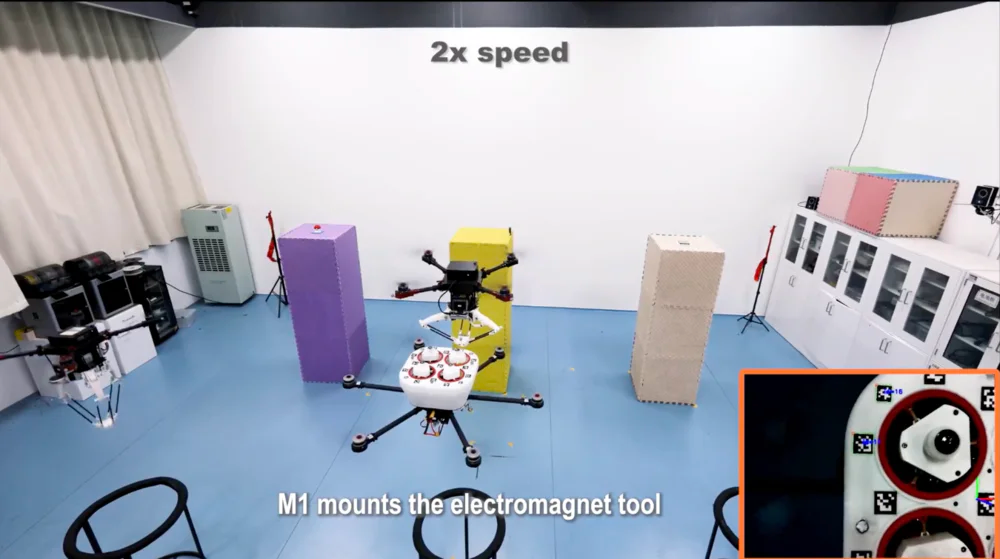
FlyingToolbox next took on the more complex task of “three-drone cooperation.” From the swaying curtains and red ribbons, one can see the dynamic airflow in the room, yet the three drones still completed the task outstandingly, demonstrating the system’s stability and versatility.
Experiment ④

FlyingToolbox also demonstrated “in-motion docking.” Unlike previous experiments where the toolbox drone hovered in place, here it moved around while the operator drone still successfully grabbed tools. This more challenging scenario expands the system’s application scope.
Thus, Zhao Shiyu’s team’s FlyingToolbox aerial cooperative manipulation system successfully solved the technical contradiction between close-range flying and high-precision manipulation.
Aerial work robots lie at the intersection of the low-altitude economy and embodied intelligence, with broad industrial prospects. FlyingToolbox is like an “aerial Lego platform”—with modular and scalable design, drones can be adapted to carry out increasingly complex tasks.
Next, the team will further enhance the system’s performance and move toward industrial application. “We want to combine high-level planning algorithms with low-level robotic control, aiming to solve real-world problems in complex, open environments…” said Zhao Shiyu.
Perhaps in the near future, advanced aerial work robots will help humans complete complex and dangerous tasks at greater heights and distances—and all of this may have started with that sub-centimeter “handshake in the air” in Zhao Shiyu’s lab at Westlake University.
Editor: Zhongxiaowen