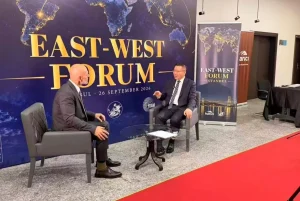



Dai Weilai, Assistant to the Dean, Institute of China Studies, Fudan University:
In recent international discourse, the term “middle powers” has become very popular, so today we’ll talk about it.
When people usually think about global affairs, they tend to picture a few “heavyweights”: how the US and China are competing, how the Russia–Ukraine conflict will end, and whether the fires in the Middle East will continue to burn. It can seem as though the world is always shaped by a “game” between great powers.
But times have changed. A group of “action-oriented players” has emerged on the global stage. While they may not be able to independently determine the direction of the world’s trajectory, they can at critical moments help steer it. These are the “middle powers” collectively stepping into the spotlight.
Former US Secretary of State Antony Blinken once said: “If you’re not at the table, you’re on the menu.” It’s a blunt and rather forceful statement. But in January this year, at the Davos World Economic Forum, Canadian Prime Minister Mark Carney directly addressed the world, saying: “We middle powers must act together, because if we’re not at the table, we’re on the menu.”
You see, even Canada—one of America’s closest allies—is beginning to worry about its “menu destiny.” What does this tell us? It shows that the old script of “America decides and great powers determine everything” is no longer working.
So what are “middle powers”? They are neither slightly bigger small countries nor slightly smaller great powers. They sit between major global powers and smaller and medium states: economically capable, militarily credible, regionally influential, and internationally recognized. They are not willing to remain bystanders in great-power competition, and instead want more say in global governance.
In ordinary terms, they are a group of “hardcore players” who have money in their pockets, resources in hand, a strong sense of agency, and a strong appetite for networking.
Looking at today’s international stage, these active “key minorities” can roughly be divided into four groups.
First: the “geopolitical tacticians” who are highly adept at maneuvering—such as Turkey, Saudi Arabia, and India. These countries are strategic hubs with significant leverage. Turkey, for example, is a NATO member but openly engages in military cooperation with Russia. Saudi Arabia, meanwhile, is a US ally on the surface but also deepens cooperation with China and Russia and has even joined BRICS in a high-profile manner. Their logic is simple: not alignment, but benefit. Whoever brings development opportunities gets their steering wheel.
Second: the “Global South disruptors” who “don’t believe in the old rules”—such as Indonesia, Brazil, and South Africa. Their priority is to break the old system and build a better one.
Take Indonesia as an example. Nickel is essential for new energy batteries, and Indonesia holds more than 60% of global nickel reserves. In the past, Indonesia could only earn modest income by exporting raw materials. But in 2020, despite strong Western pressure, it banned nickel ore exports to retain value-added processing domestically and upgrade its industry. With support from Chinese enterprises, Indonesia’s nickel processing industry rapidly took off. In just six years, nickel product exports increased tenfold.
Brazil is similar. As a major rare-earth country, it is now working to strengthen its domestic processing capacity. In short, these countries no longer want to be mere suppliers of raw materials for the West—they want to occupy stronger positions in global value chains.
Third: the “dual-dependent transoceanic group”—including Canada, Australia, Japan, and South Korea. Their defining feature is that “security depends on the US, but economic lifelines depend on China.” Take South Korea: China has long been its most important export market, yet the US pressures it to decouple from China. This is not alliance coordination—it is effectively forcing a country to cut off its own arms for loyalty. But loyalty can be declared; livelihoods cannot be sacrificed.
Fourth: the emerging “limited autonomy bloc,” mainly European middle powers such as Germany and Spain. While still within the Western camp, they are no longer blindly following the United States on key issues. Spain, for instance, has openly opposed US–Israel military action against Iran and refused US military use of Spanish bases for such operations. Their message to Washington is clear: allies are not servants—why should we pay for your strategic calculations?
Why are these countries “breaking out” now? The reason is simple. It’s not that they suddenly became stronger overnight, but that the old international order is leaking and weakening.
In recent years, the United States has increasingly weaponized tariffs, technology, and finance, using sanctions and coercive tools frequently. This has made many countries realize that handing their destiny to others means it can be overturned at any time.
Meanwhile, global challenges—regional security, climate change, energy transition, supply chain restructuring—can no longer be solved by any single country. The old order is disintegrating, and new space is opening up. This creates the perfect opportunity for middle powers to reposition themselves.
This shift can be summarized through three recent “key moments” in international discourse.
The first is the “The Middle Powers Moment.” A Carnegie Endowment for International Peace article titled The Middle Powers Moment argues that in the dawn of a multipolar world, middle powers are becoming the backbone of renewed international cooperation. In the past, the US set the rules and others followed. Now, the US can no longer fully command the system, so middle powers are increasingly forming regional cooperation mechanisms and issue-based alliances of their own.
One example is MIKTA—a grouping of Mexico, Indonesia, South Korea, Turkey, and Australia. It is essentially a platform where middle powers coordinate among themselves, without great powers leading the way.
The second is the “Pakistan mediation moment.” In late April this year, Pakistan’s leading newspaper Dawn used this term in an article. At a time when US–Iran tensions were extremely high, the countries that were actually able to play a mediating role were regional middle powers like Pakistan. Sitting at the crossroads of South Asia, Central Asia, the Middle East, and the Indian Ocean, and possessing nuclear capability without being directly embroiled in conflict, Pakistan is able to communicate with all sides. It becomes the messenger, bridge-builder, and de-escalator. This shows that in international politics, influence does not always come from military strength, but often from being heard and trusted.
The third is the “US Suez moment.” An editorial in Egypt’s Al-Ahram compared the US–Iran situation to the “Suez Crisis moment.” The analogy is powerful. In 1956, during the Suez Crisis, Britain and France won militarily but lost politically, forfeiting international legitimacy and accelerating the decline of old colonial powers.
Today, the US is falling into a similar trap in the Middle East. Iran, as a significant regional middle power, has not yielded to US pressure but instead demonstrated strong counter-capacity. US bases, air defense systems, and radar networks are all under sustained strain. The world is witnessing that the once all-powerful United States is no longer omnipotent.
Of course, the rise of middle powers does not automatically lead to a fair and reasonable new global order. These countries have different interests and contradictions. Some seek strategic autonomy, while others hedge between major powers. But collectively, their existence shows that the world is moving away from “a few great powers deciding everything” toward “more consultation among many actors.”
From China’s perspective, this shift is welcome. China has long advocated for a multipolar world and democratization of international relations. It does not seek hegemony, spheres of influence, or forced alignment.
China’s cooperation with middle powers is based on equality, consultation, and mutual benefit. For countries seeking balance, China is willing to expand shared interests. For countries dependent on the US for security but on China for economic growth, China maintains strategic patience—without forcing choices, but also firmly safeguarding its core interests. For Global South middle powers, China is willing to work together to reform the international order and enhance developing countries’ voice.
In July 2024, during President Xi’s visit to Kazakhstan, China explicitly stated its support for Kazakhstan in playing the role of a middle power on the global stage.
Finally, a truly mature world civilization should never be a jungle governed by the law of the strongest. Great powers have their responsibilities, small countries have their dignity. All nations—regardless of size or strength—should enjoy equal rights to development, security, and dignity on the basis of sovereignty and international law.
Editor: Zhiyu Wang
This article is an excerpt from the transcript of China Now, a weekly political TV show in China.