


For the past three years, Western analysts have been writing the Belt and Road Initiative’s obituary.
The diagnosis was straightforward. China’s economy was slowing — growth had moderated to around 5 percent, and a domestic property crisis was consuming political attention. In Southeast Asia, once the crown jewel of BRI activity, Chinese aid had fallen sharply. Major projects were being suspended, restructured, or canceled. Western counter initiatives like the EU’s Global Gateway and America’s PGII were supposedly offering developing countries an alternative. The conclusion seemed almost too neat: a weaker China meant a smaller BRI.
The only problem? The data says otherwise.
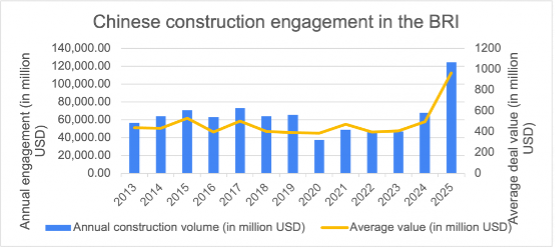
In 2025, China’s Belt and Road Initiative posted its biggest year on record — by a very wide margin. Total engagement reached $213.5 billion, a 74 percent jump from 2024. The first half of the year alone — $124 billion — already exceeded the full year total for 2024. Cumulative BRI engagement since 2013 has now passed $1.4 trillion [1].
The story of 2025 is not just about a rebound. It is about a structural transformation — of where China invests, what it builds, and who does the building. And it reveals something larger: that the BRI has become the infrastructure arm of a grander strategic project, one that aims to build a global order centered on “shared prosperity,” with the Global South as its foundation.
The West spent years assuming a shrinking China meant a shrinking BRI. In 2025, Beijing proved them wrong — not by doubling down on old models, but by quietly, methodically, building a new one.
Part I: What the West got wrong
To understand why the 2025 numbers shocked so many observers, you have to go back to the narrative that took hold around 2022 and 2023.
That narrative had three pillars. First, China’s domestic economy was struggling — real estate crisis, youth unemployment, slowing growth. The assumption was that Beijing would need to pull resources back home. Second, visible setbacks in Southeast Asia — the traditional heartland of BRI activity — seemed to signal a broader retreat. Chinese aid to the region fell from $9 billion in 2015 to $4 billion in 2023, and major projects were restructured or canceled [4]. One analysis described the shift as one of “recalibration, caution and quiet resistance” [5]. Third, external pressure — U.S. China trade wars, EU counter initiatives, the whole “de risking” vocabulary — seemed to be closing the space for Chinese overseas expansion.
All of these observations contained a kernel of truth. But they led to a categorical error: mistaking a geographic and sectoral shift for an overall decline. The West looked at Southeast Asia and saw retreat. What it missed was Africa and Central Asia — where the BRI was quietly exploding.
Critics also fixated on debt. A 2025 report from an Australian think tank claimed that developing countries owed record debt repayments to China, with $35 billion due in 2025 alone. The “debt trap” narrative has long become conventional wisdom in the West [9]. Among this narrative’s many failures is this: it doesn’t capture the real shift happening beneath the surface that China was moving away from traditional loan based funding toward foreign direct investment, reducing debt burdens while maintaining influence. In 2025, private Chinese firms — not state owned enterprises — led the investment surge. That is not a retreating power. That is a retooling one.
Part II: The 2025 renaissance — by the numbers
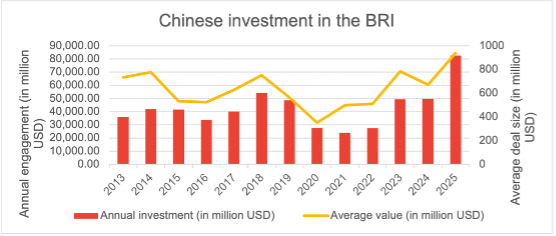
Let’s start with the headline: $213.5 billion. That is total Chinese engagement through construction contracts ($128.4 billion, up 81 percent) and investments ($85.2 billion, up 62 percent) across 150 BRI countries in 2025. It is the highest annual level since the initiative launched in 2013 [1].
But the aggregate number, as big as it is, obscures the more interesting story: what China is actually spending money on has changed dramatically.
Energy: fossil fuels and renewables
Energy was the biggest driver of BRI activity in 2025, accounting for about 43 percent of total engagement. China’s energy related deals reached $93.9 billion — more than double the previous record [1].
Here is where things get weird. In 2025, China’s overseas energy portfolio was simultaneously its most traditional and its most forward-looking. Oil and gas engagement surged to about $71.5 billion — more than triple the previous record year. A single $20 billion oil and gas processing facility in Nigeria accounted for a huge chunk of that [1].
But at the same time, green energy engagement hit new records: $18.3 billion in wind, solar, and waste to energy projects, with planned capacity of over 22 GW. The average deal size for investments larger than $100 million grew to $1.243 billion in 2025, up from $672 million in 2024 [1]. In other words, China is not choosing between fossil fuels and renewables. It is doing both — aggressively — driven largely by host country demand rather than Beijing’s industrial policy.
Metals and mining: The quiet record breaker
The metals and mining sector reached $32.6 billion in 2025, surpassing 2024 (which was itself a record year). Much of this was driven by Kazakhstan, which attracted roughly $23 billion in BRI engagement in the first half of the year alone, mostly in aluminum and copper. Copper in particular saw a significant surge in the second half of 2025, driven by demand for data centers and electrification [1][3].
This is not incidental. Mining and mineral processing now account for a huge share of BRI activity — and much of it is driven by private Chinese firms like East Hope Group and Xinfa Group, not state owned enterprises. That is a meaningful shift: the BRI is becoming more commercial, less state directed.
Technology and manufacturing: The new frontier
Technology and manufacturing reached nearly $28.7 billion in 2025, with high tech engagements in data centers, EV battery factories, semiconductor facilities, and hydrogen projects [1]. These are not the kinds of projects that fit neatly into the old “infrastructure” bucket. They are industrial. They are supply chain oriented. And they point to a BRI that is increasingly about integration into Chinese production networks, not just building ports and railways.
Where: Africa and Central Asia now take the lead
The geographic shift is perhaps the most striking change. Africa topped the rank of BRI engagement in 2025, reaching $61.2 billion — a 283 percent increase. Nigeria alone accounted for $24.6 billion in construction contracts, followed by the Republic of Congo at $23.1 billion [1]. Central Asia attracted $25 billion in the first half alone, with Kazakhstan as the single largest recipient [3]. Saudi Arabia also emerged as a major hub, receiving $19.8 billion in construction contracts and becoming the top destination for Chinese green energy engagement [2].
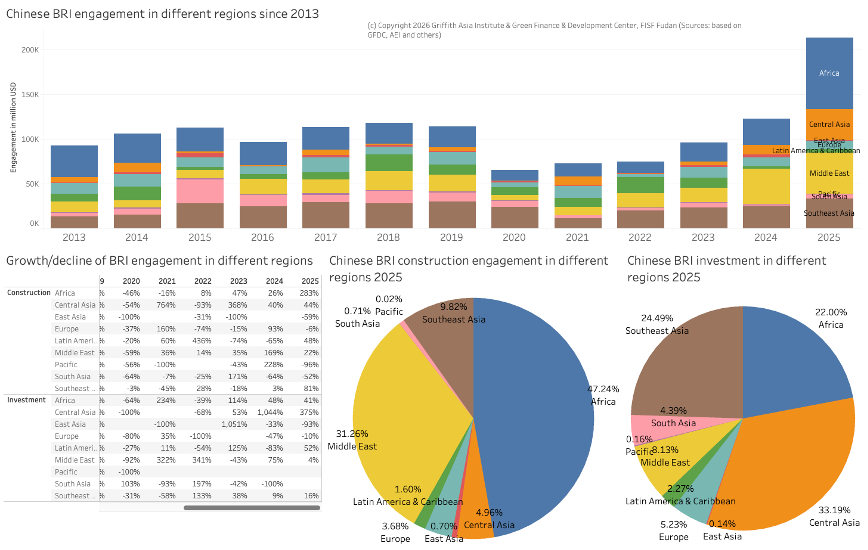
Meanwhile, engagement in Southeast Asia — once the epicenter of BRI activity — declined relatively. The Pacific fell to its lowest level in a decade [1]. The center of gravity has shifted decisively westward.
Who: Private firms.
This might be the most underreported story of 2025. BRI investments were driven by private sector companies, dominated by East Hope Group, Xinfa Group, and Longi Green Energy. State owned enterprises still dominate construction contracts — but the investment side is increasingly commercial [1]. That suggests a more sustainable, less politically driven model than the one that drew so much criticism in the early years.
As one analyst noted, China is shifting from traditional loan based funding to FDI, reducing debt burdens while maintaining influence [10]. The 2025 data bears that out.
Part III: From infrastructure to order — the global initiatives take shape
So what does a $213.5 billion surge in energy, mining, and manufacturing have to do with “shared prosperity”?
The answer is that the BRI is no longer just about infrastructure. Over the past four years, Beijing has layered four Global Initiatives on top of the BRI — the Global Development Initiative (the “GDI”) (2021), Global Security Initiative (the “GSI”) (2022), Global Civilization Initiative (the “GCI”) (2023), and Global Governance Initiative (the “GGI”) (2025) — each of which extends China’s reach into domains beyond pure infrastructure.
These are not separate projects. They are complementary. As one analysis put it, “the GDI seeks to lay the material foundation, the GSI is designed to safeguard stability, the GCI tries to foster shared understanding, and the GGI intends to provide the institutional architecture” [6]. The BRI supplies the hardware. The Global Initiatives supply the software.
Here are three concrete examples of how this works in practice.
Example 1: The China Egypt TEDA Suez Economic Zone. A flagship BRI project, the TEDA zone has created nearly 9,000 direct jobs and more than 80,000 indirect job opportunities in Egypt. It is also a textbook example of the Global Development Initiative in action — industrialization and employment generation in a Global South country, delivered without the policy conditions typical of Western development finance [7].
Example 2: Nigeria’s green hydrogen project. In 2025, Chinese firms broke ground on a major hydrogen project in Nigeria, part of the $28.7 billion technology and manufacturing surge. The project aligns directly with GDI’s emphasis on sustainable development and clean energy — while also serving China’s supply chain interests in critical minerals and energy security [1][8].
Example 3: Luban Workshops across Africa. These vocational training centers, established under BRI cooperation frameworks, provide technical skills in fields like renewable energy installation and digital manufacturing. They are explicitly framed as “small but beautiful” projects that echo the GDI’s call for people centric growth — and they operate in countries where China’s security cooperation under the GSI provides the political stability needed for long term investment [6][11].
The Global Governance Initiative, formally proposed at the Shanghai Cooperation Organization Plus meeting in September 2025, ties these threads together. It calls for “adhering to sovereign equality” and directly targets a global system in which “a few countries call the shots” [12]. Together with the other three initiatives, it embodies China’s vision of “a fair, inclusive, and multipolar international order based on equality, cooperation, and shared prosperity for all humanity” [13].
As one former Kyrgyz foreign minister put it, “Through China’s BRI and Global Governance Initiative, Global South countries are strengthening their role in tackling global issues such as development, climate change, infrastructure and the digital divide” [8]. He added that these platforms “focus on pragmatic solutions, infrastructure connectivity, and economic growth without political conditions” — offering an alternative to Western development models.
Conclusion: The BRI is not shrinking. It is being retooled.
The 2025 data is not ambiguous. The Belt and Road Initiative posted its biggest year ever, in a period when Western observers were confidently predicting its decline. But the more important story is structural. The BRI is shifting away from Southeast Asia toward Africa and Central Asia. It is shifting from pure infrastructure toward energy, mining, and manufacturing. It is shifting from state directed lending to private sector investment.
And it is increasingly integrated with a broader strategic framework — the Global Initiatives — that aims to build not just ports and pipelines, but a new global order. One centered on the Global South. One built around the language of “shared prosperity.” One that is, quietly and methodically, being constructed deal by deal, megaproject by megaproject.
The West spent years assuming that a weaker China would mean a smaller BRI. In 2025, China showed that it has no intention of retreating — only of rebuilding, in a different shape, for a different era.
Bibliography
[1] Green Finance & Development Center. “China Belt and Road Initiative (BRI) Investment Report 2025.” January 2026. https://greenfdc.org/china-belt-and-road-initiative-bri-investment-report-2025/
[2] Zawya. “Middle East emerges as key hub in China‘s record $213bln Belt and Road surge.” February 17, 2026. https://www.zawya.com/en/projects/construction/middle-east-emerges-as-key-hub-in-chinas-record-213bln-belt-and-road-surge-lpc2dfzv
[3] The Astana Times. “Central Asia Attracts $25 Billion, as China’s Belt and Road Investment Hits Half-Year Record.” July 19, 2025. https://astanatimes.com/2025/07/central-asia-attracts-25-billion-as-chinas-belt-and-road-investment-hits-half-year-record/
[4] Lowy Institute. “How will South-east Asia fill the China gap as development funds dry up?” May 30, 2025. https://www.lowyinstitute.org/publications/how-will-south-east-asia-fill-china-gap-development-funds-dry
[5] ORF Online. “The BRI‘s 2025 Push: A Strategic Regression.” August 8, 2025. https://www.orfonline.org/english/expert-speak/the-bri-s-2025-push-a-strategic-regression
[6] China.org.cn (Xinhua). “Column: Global Governance Initiative — global significance of building more stable, just world.” October 21, 2025. http://www.china.org.cn/world/Off_the_Wire/2025-10/21/content_118135048.shtml
[7] China Daily HK. “Egypt, China sign deal for flagship industrial zone expansion.” July 17, 2025. https://www.chinadailyhk.com/hk/article/616116
[8] China.org.cn (Xinhua). “Interview: Chinese initiatives empower Global South in addressing global challenges, says former Kyrgyz FM.” December 16, 2025. http://www.china.org.cn/world/Off_the_Wire/2025-12/16/content_118231028.shtml
[9] Asia Society Policy Institute. “Development as Strategy: The U.S., China, and the Global South.” April 28, 2025. https://asiasociety.org/policy-institute/new-report-development-strategy-us-china-and-global-south
[10] Center for Global Development. “The Belt and Road Trilemma: The Future of China’s Role in International Development Finance.” June 11, 2025. https://www.cgdev.org/publication/belt-and-road-trilemma-future-chinas-role-international-development-finance
[11] Embassy of China in Lesotho. “Speech by H.E. Yang Xiaokun on the Press Briefing.” September 16, 2025. https://ls.china-embassy.gov.cn/eng/dshd/202509/t20250916_11708937.htm
[12] Qiushi (English). “Global Governance Initiative — global significance of building more stable, just world.” October 22, 2025. https://en.qstheory.cn/2025-10/22/c_1134200.htm
[13] People’s Daily Online. “GGI meets global expectations: former executive director of IMF.” November 5, 2025. http://en.people.cn/n3/2025/1105/c90000-20386638.html
Editor: Yunpeng Zhang