



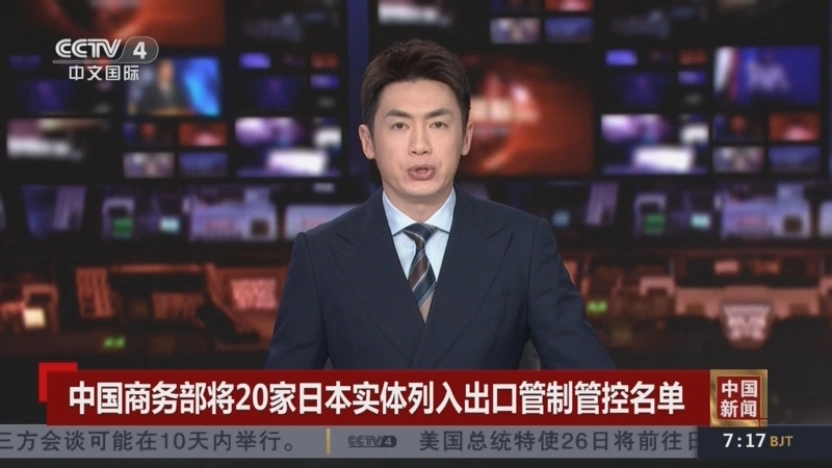
On February 24, the official website of the Ministry of Commerce of the People’s Republic of China quietly released two announcements—No. 11 and No. 12—placing a total of 40 Japanese companies and institutions within the scope of export controls. More than half a century has passed since the normalization of China–Japan diplomatic relations. Reviewing each entity on this list suggests that this was not an impulsive move, nor merely an extension of trade friction, but a carefully considered strategic signal.
Why now, and why Japan?
These 40 entities span key sectors including shipbuilding, aero engines, defense electronics, semiconductor materials, and optical films. They include multiple subsidiaries of Mitsubishi Heavy Industries, as well as Kawasaki Heavy Industries, IHI Corporation, NEC, and Fujitsu’s defense division. Even the National Defense Academy of Japan and the Japan Aerospace Exploration Agency (JAXA) are included. Clearly, China is targeting Japan’s entire military-civil dual-use industrial system.
Over the past three years, China–Japan relations in the security domain have indeed undergone notable shifts. At the end of 2022, Japan substantially revised its National Security Strategy, explicitly stating its intent to possess “counter-strike capabilities,” doubling its defense budget to 2% of GDP within five years, and deepening security cooperation with the United States. In 2023, Japan joined coordinated semiconductor export controls, restricting exports to China of 23 categories of chip-manufacturing equipment. Since 2024, Japan’s statements regarding the South China Sea and Taiwan issues have also become increasingly direct, with phrases such as “a Taiwan contingency” appearing frequently.
From Beijing’s strategic perspective, these developments indicate a substantive shift in Japan’s China policy—from a model of “economics first, security second” toward “security first, proactive prevention.” The new lists can be seen as an institutionalized response to this shift.
The date of release—February 24, 2026—was also carefully chosen. Late February marks the end of Japan’s fiscal year cycle (which ends March 31), when companies finalize procurement and contracts for the coming year. Policy changes at this moment maximize impact. It also comes just before China’s annual “Two Sessions,” when strategically significant policies often align with broader diplomatic messaging.
Another backdrop is the maturation of China’s export control legal framework in recent years. The Export Control Law came into effect in 2020, and the Regulations on Export Control of Dual-Use Items were implemented in 2024. Together, they form a comprehensive system including entity lists, end-user management, and full-chain control of dual-use items.
Compared with the U.S. Commerce Department’s BIS entity list mechanism, China’s approach is structurally similar: citing national security and non-proliferation obligations to place foreign entities under control and restrict their access to Chinese-origin dual-use items. This signals that China has shifted from being a party subject to controls to an active regulator with a full policy toolkit.
Who made the list, and why?
The 20 Japanese entities in Announcement No. 11 clearly belong to the defense sector.
The Mitsubishi Heavy Industries group forms the core: Mitsubishi Shipbuilding, Mitsubishi Heavy Industries Aero Engines, Mitsubishi Heavy Industries Marine Machinery, Mitsubishi Heavy Industries Maritime Systems, and Mitsubishi Heavy Industries Engine & Turbocharger collectively support major vessels, submarines, and propulsion systems of Japan’s Maritime Self-Defense Force.
Kawasaki Heavy Industries’ Aerospace Systems Company and Gifu Works are key subcontractors in the F-2 fighter and next-generation F-X fighter programs. Several IHI subsidiaries are deeply involved in aircraft engine R&D and production.
Two non-manufacturing institutions also stand out: the National Defense Academy of Japan and JAXA. The former trains Self-Defense Force officers; the latter is heavily engaged in dual-use technologies such as rocket propulsion and satellite remote sensing. Their inclusion indicates that China’s controls now extend beyond physical products to “people and knowledge”—any knowledge flows that enhance Japan’s military capabilities.
The 20 entities in Announcement No. 12 have a different profile. Subaru Corporation produces automobiles but also participates in Japanese defense helicopter and light aircraft programs. ENEOS Holdings is Japan’s largest refiner, supplying specialized fuels linked to military logistics. TDK Corporation and Nitto Denko Corporation are global leaders in electronic materials and functional films widely used in military electronics, precision guidance, and sensors.
JAXA-affiliated research institutions and Tokyo University of Science are included for similar knowledge-control reasons. Sumitomo Heavy Industries appears due to its role in precision transmission and hydraulic systems supporting defense manufacturing.
Their shared feature: strong dual-use characteristics. They may not be overt defense contractors, but their technologies clearly enhance Japan’s defense capabilities.
Two lists, two levels of restriction
The “control list” (Announcement No. 11) functions as a veto. Exports of dual-use items to listed entities are prohibited. Overseas transfers of Chinese-origin dual-use items to them are also banned. Transactions in transit must halt immediately. Special exemptions require difficult-to-obtain approval.
The “watch list” (Announcement No. 12) raises barriers without fully cutting off trade. Exports cannot use general licenses or simplified reporting; individual license applications require risk assessments and written commitments; review timelines have no fixed limit. Any military-related end use is automatically denied.
This dual structure—hard blockade plus soft restriction—offers flexibility, limiting diplomatic backlash while preserving leverage.
Nitto Denko as a window into Japan’s industrial depth
Among the watch-list companies, Nitto Denko is particularly illustrative. Founded in 1918, with annual revenue of roughly ¥900 billion and nearly 30,000 employees, it is one of the world’s three major giants in tapes and functional films, alongside 3M and Tesa SE.
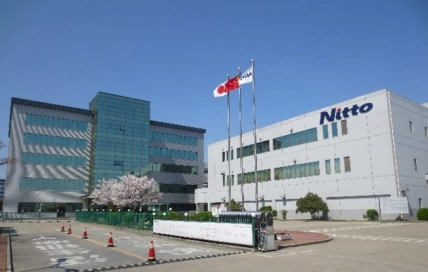
In semiconductor process materials—such as wafer thinning films, dicing films, and DAF films—Nitto Denko operates in an oligopoly, alongside Lintec Corporation and others like Mitsui Chemicals, Sekisui Chemical, and Furukawa Electric.
Even in “mature” semiconductor processes above 28nm, Chinese chipmakers still rely heavily on these materials. Hardware localization does not equal full manufacturing autonomy.
In optical functional films, Nitto Denko leads in circular polarizers, retardation films, and AR/VR optical films. Core raw materials—PVA and TAC films—remain overwhelmingly Japanese. High-end OLED flexible displays, foldable screens, and VR/AR optics remain difficult to replace.
Other niche but critical fields—breathable waterproof membranes and reverse-osmosis membranes—are also Nitto strengths, widely used in military equipment protection and naval water systems.
Japan’s strategic industrial value lies not in single flagship products but in hundreds of specialized materials and process components forming layered technological barriers—what might be called “distributed choke points.”
Controls do not mean substitution is complete
If China and Japan remain deeply interdependent, why impose controls now? Does it mean China has completed domestic substitution?
Not exactly. The control list targets areas where China has stronger supply leverage, such as certain materials and metals used in military manufacturing. The watch list, however, includes firms that remain key suppliers to China’s semiconductor, electronics, and precision industries—indicating deterrence rather than full decoupling.
Domestic substitution progress varies widely. China has largely replaced lower-end tapes, standard polarizers, some sensors, and consumer telecom electronics. But major gaps remain in semiconductor process materials, advanced optical films, AR/VR core optics, specialty chemicals, and high-purity materials.
Thus, the policy functions more as pressure transmission—raising compliance costs for Japanese firms while accelerating domestic R&D.
Mutual pressure and structural adjustment
Japanese firms such as Mitsubishi Heavy Industries, Kawasaki Heavy Industries, and IHI face supply-chain review pressures in civilian business areas. Watch-list firms like Nitto Denko and TDK face higher compliance burdens but are not banned.
There is also risk of blowback: if companies scale back China operations, supply of high-end materials to China’s semiconductor, display, and energy sectors could be affected. Hence the flexible design of the watch list.
Long term, China and Japan may move toward “managed decoupling.” China will invest more heavily in semiconductor materials and optical films; Japanese firms may accelerate “China+1” diversification into Southeast Asia and India.
A new normal in great-power competition
China’s 2026 Announcements No. 11 and 12 reflect the institutionalization of technological rivalry. They respond systematically to Japan’s security policy shift while showcasing China’s growing export-control capabilities.
The listing of 40 Japanese entities is not an endpoint but a signal. Governments, companies, and investors will now recalibrate strategies within this new framework.
One thing is certain: export controls are becoming a standard instrument of great-power competition. In an era of control for control and restriction for restriction, no supply chain is truly insulated from geopolitics.
Editor: Zhongxiaowen

Spcogg
Great analysis, thanks for explaining chinese/Japanese interdependence