



This year marks the 250th anniversary of the founding of the United States, celebrated with great pomp and circumstance across the nation. On Independence Day, a “Semiquincentennial Time Capsule” was buried near Independence Hall in Philadelphia, mandated by law to be opened 250 years from now, in the year 2276.
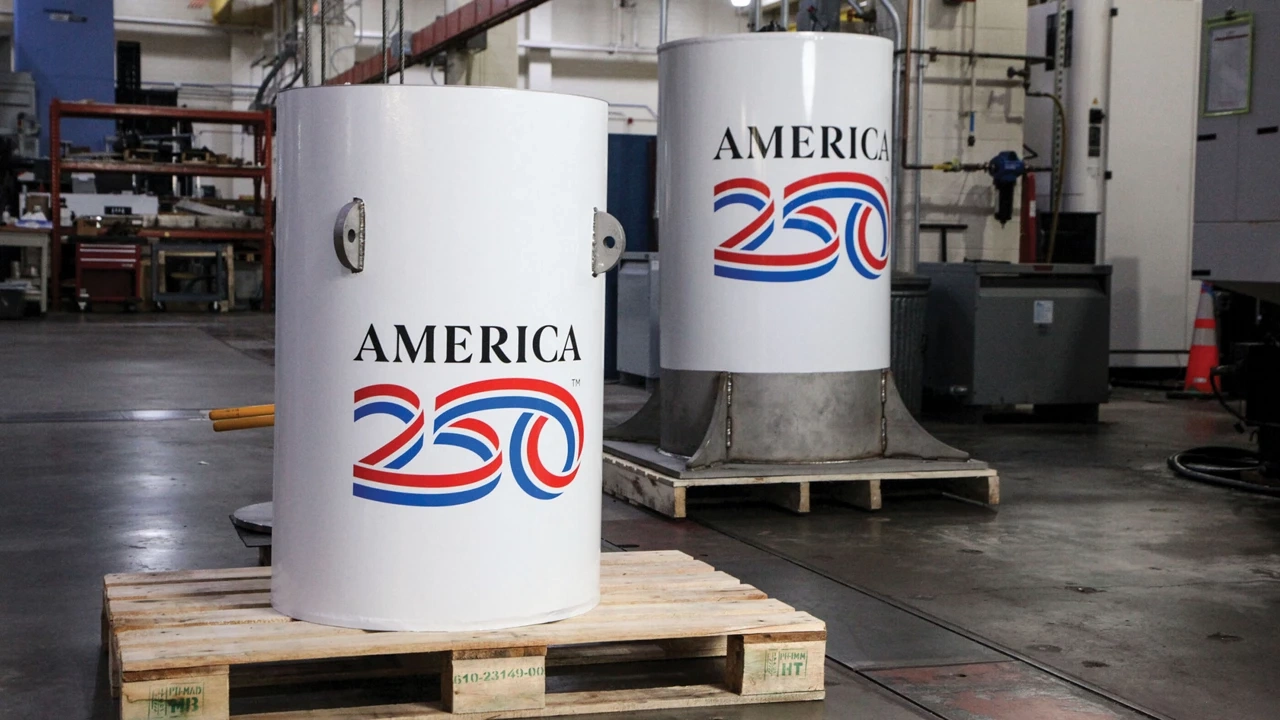 The Time Capsule| Photograph: Rich Press/NIST
But a question looms: Will the United States still exist in 250 years? Or at the very least, can the U.S. as we know it today—a global hegemony—survive until then? According to American polls, two-fifths of the population do not believe the U.S. will survive another 250 years.
As early as seven years ago, and particularly five years ago, I raised this question in a series of media programs and articles. At the time, I posited that U.S. hegemony would likely not survive the 250-year limit, suggesting we had a few years of observation ahead of us to wait and see. Now, five years later, I believe my prediction has been largely validated. The U.S. military actions regarding Iran can be seen as the death knell of its hegemony.
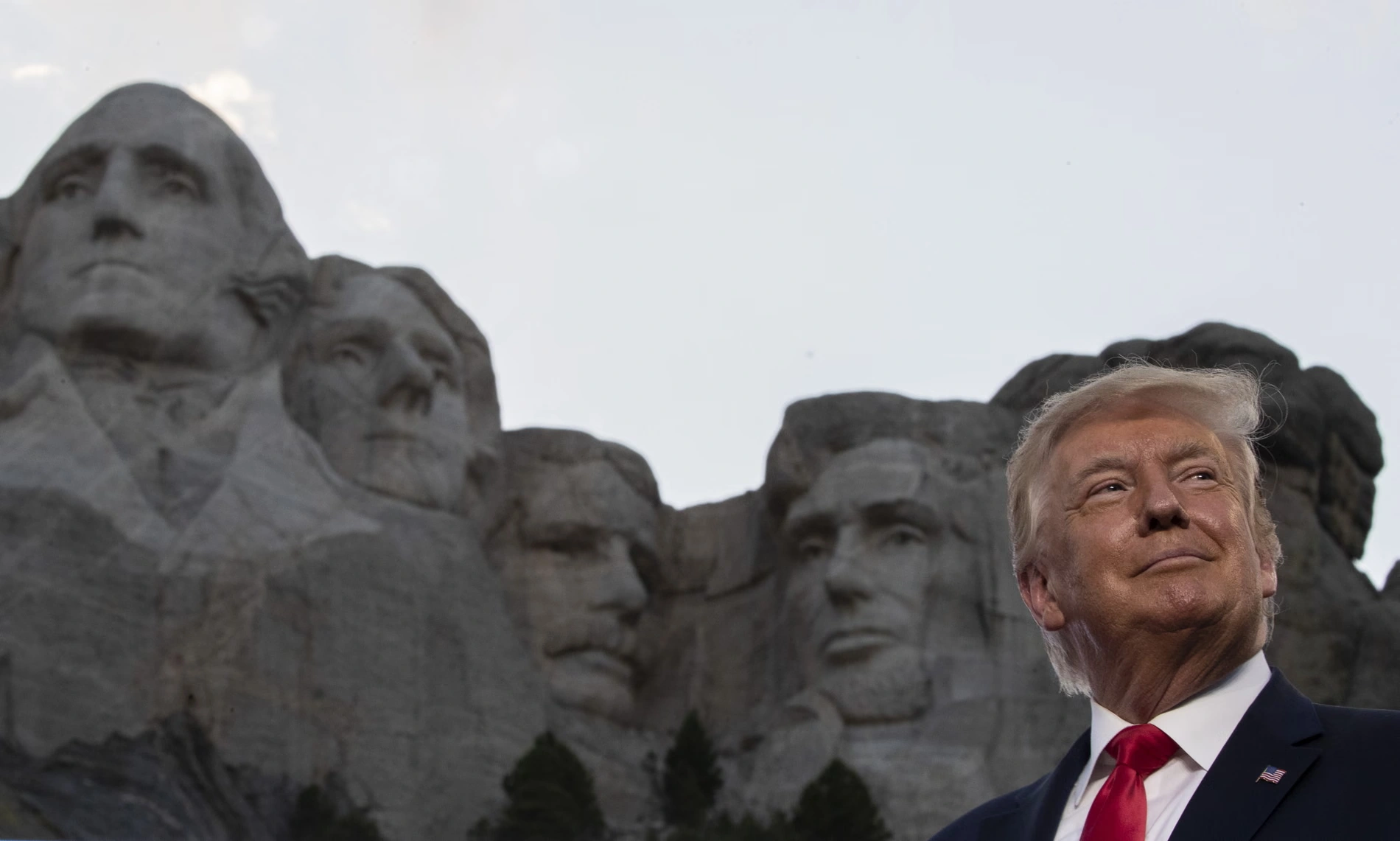 Donald Trump at Mount Rushmore in Keystone, South Dakota, in July 2020. | Photograph: AP
Of course, opinions still differ on whether U.S. hegemony has truly come to an end.
For instance, media reports this year revealed that Jim Rogers—the legendary American investor on par with George Soros and Warren Buffett—completely liquidated his holdings in U.S. stocks, leaving not a single share. He admitted that he began reducing his positions gradually in 2025, and by February of this year, he had cleared everything. In his view, a U.S. market collapse is inevitable; only the timing remains uncertain.
Tucker Carlson, widely regarded as the spiritual leader of American conservatives, remarked during a live broadcast in June that he had mentally accepted the demise of the American Empire. However, he imagined that the death of an empire should at least be spectacular. What infuriated him most was that the U.S. did not fall in a decisive battle against major powers like China or Russia, but was instead defeated by Iran—the world’s 34th largest economy, a nation sanctioned by the U.S. for decades. To him, this was an ignominious and unacceptable end.
On June 15, Vice President J.D. Vance addressed the nation, stating that Iran would receive $300 billion in reconstruction funds. Although he emphasized that this money would primarily come from investments and credits from Gulf countries, any discerning observer knows this is effectively U.S. war reparations. This marks the first time in its 250-year history that the U.S. has paid reparations for an external military defeat, and it is the only permanent member of the UN Security Council (P5) to pay such reparations since the founding of the United Nations.
America’s allies have also taken note. During the conflict with Iran, Spain stood firm against the U.S., refusing the use of its airfields. At the G7 summit, even Japan and Italy dared to show their displeasure to Donald Trump.
Scholars have also been discussing this trend in recent years. International relations theorist John Mearsheimer has consistently pointed to America’s internal decay and its loss of global hegemony. Economist Jeffrey Sachs argues that a cabal within the U.S. government is driving the complete collapse of both domestic and foreign policy. Paul Krugman has similarly noted that the U.S. is no longer the dominant economic and military power.
Dr. Hatem Bazian, a scholar at UC Berkeley, remarked that reading The Muqaddimah by the 14th-century Arab historian Ibn Khaldun today brings a bizarre sense of familiarity, as it reads like a diagnostic report for today’s global empire. He noted that while every U.S. president has claimed America is the “indispensable nation” and the guarantor of global order, Ibn Khaldun would point out that every declining empire has said the exact same thing. The Romans believed it, the Arabs believed it, and the British believed it. Yet, all of these empires eventually vanished.
Of course, some insist that U.S. hegemony will not perish, and the most fervent among them are, ironically, pro-American apologists outside the U.S. For example, some Singaporean media outlets have shown great anxiety. Lianhe Zaobao published an article claiming the U.S. is not a hegemony but a “shanba” (literally “kind hegemony”), placing its hopes on the U.S. to effectively lead global progress in the 21st century. Many financial media outlets in China are equally anxious. At the end of June, when U.S. Treasury Secretary Scott Bessent discussed the U.S.-Iran 14-point memorandum regarding the unfreezing of Iranian funds and assets, he claimed that Iran and Venezuela were returning to the dollar system, arguing that the U.S.’s aggressive maneuvering was designed to maintain the petrodollar hegemony. Domestically, financial media quickly hyped this up as a “win” for the U.S. in the war against Iran, claiming it strengthened the petrodollar and would boost U.S. economic growth to 3%. The irony is: wasn’t it the U.S. that kicked them out of the dollar system in the first place? Kicking someone out and then calling them back is now spun as a victory—truly capturing the essence of Trump-style “winning.”
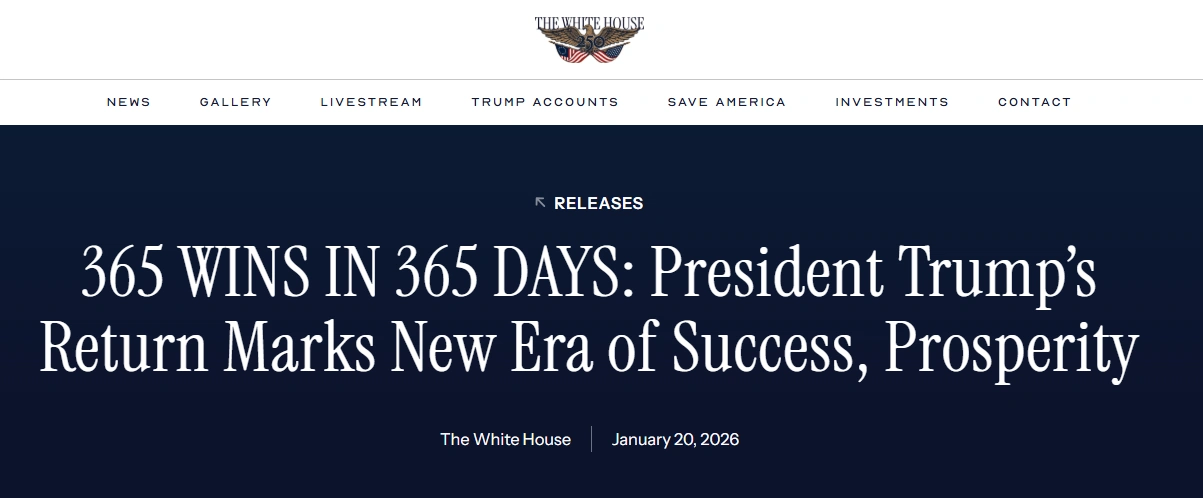 Screenshot of the White House’s press release on January 20, 2026
These individuals seem more anxious about the survival of U.S. hegemony than Americans themselves. A recent post on the social media platform X put it well: “The Romans didn’t know their empire collapsed; they just noticed one day that the roads were no longer being repaired.” Indeed, the collapse of an empire is rarely a sudden explosion; it is more often a slow deflation. Consequently, at the exact moment of an empire’s demise, many fail to realize it. Only decades later, looking back, do people realize the empire was already long gone.
My contemplation of the 250-year cycle of hegemony was inspired years ago by Sir John Glubb, a retired British lieutenant-general who managed the British Empire’s sphere of influence in the Middle East. Following the 1956 Suez Crisis, where the British Empire was publicly humiliated by the U.S. and the Soviet Union, marking the end of its imperial status, Glubb was dismissed and returned to Britain. In 1976, he published The Fate of Empires. After reviewing over a dozen empires across three millennia, he discovered that their lifespans consistently hit a wall at around 250 years. The Ottoman, Spanish, and British Empires all lasted roughly 250 years. This was corroborated by scholar Samuel Arbesman in a 2011 study, which confirmed that the average lifespan of empires converges around the 250-year mark.
When Glubb wrote his booklet in 1976, it was the bicentennial of the United States, before the country reached its post-Cold War zenith. Just fifty years later, the U.S. has arrived at its own 250-year threshold.
Of course, the 250-year thesis is not strictly scientific, and its start and end dates lack standardized metrics, making it more of an idealistic historical commentary. If we only count the period of actual U.S. hegemony, it has only been about 80 years. My belief that U.S. hegemony might end around its 250th anniversary was not because of this arbitrary number, but because I observed the alignment of underlying causes (yinyuan) and timely opportunities (jihui).
If 2026 represents the opportunity, what are the underlying causes?
First is the fundamental contradiction of capitalism. Chinese people are intimately familiar with Karl Marx’s Das Kapital and its thesis on the fundamental contradiction between socialized production and the private ownership of the means of production. As the world’s premier capitalist empire, every conflict the U.S. faces is rooted in this fundamental contradiction and its modern mutations—such as financialization, ecological limits, globalization, and governance failures. In particular, financialization and the hollowing out of industry, which are inevitable outcomes of capitalist development, are widely recognized by Western scholars as the root of American decline. For instance, the renowned French historian Fernand Braudel spoke of the “financial autumn” of empires, and the Italian scholar Giovanni Arrighi argued that financial expansion represents the terminal phase of hegemony.
Second is the empire’s ledger. Investor Jim Rogers bases his judgment on debt: “The U.S. is the largest debtor nation in human history, and this bill will have to be paid sooner or later.” While the exact timing of a crash is hard to predict, he fears his children’s generation will not escape it. British economic historian Niall Ferguson proposed “Ferguson’s Law”: when an empire’s debt interest payments exceed its defense budget, it marks the beginning of its decline. This year, U.S. national debt interest payments surpassed its defense spending, triggering widespread alarms. Ray Dalio, founder of the world’s largest hedge fund, warned that the U.S. is brewing an “economic heart attack.”
Third is that the world has long suffered under the United States. As early as 2005, Johan Galtung, the Norwegian scholar and founder of peace studies, noted that the American Empire had caused 13 to 20 million deaths since World War II. He argued that an empire guilty of so many transgressions must inevitably collapse, predicting its demise by 2025. He called on the peoples of the world to dismantle the American Empire and return the American Republic to the American people. While this may sound like a moralistic aspiration, Chinese historical experience teaches us that “an unjust cause finds little support” (shidao guazhu) is indeed an objective law of history.
Fourth is geopolitics. Some scholars deduce the end of U.S. hegemony from classic sea power and land power theories. From the perspective of sea power, for a maritime empire, losing control of key maritime chokepoints signifies imperial death. Historically, when Portugal lost the Strait of Malacca, Spain lost Gibraltar, and Britain and France lost the Suez Canal, they all invariably declined into third-rate powers. Today, the U.S. has lost control of the Strait of Hormuz—the script is remarkably similar. From the perspective of land power, losing control of the Middle East means the U.S. will be expelled from the Afro-Eurasian landmass. In 2013, Singaporean historian Wang Gungwu noted that while British and American hegemonies were built around oceans and islands, the fates of Britain and Japan show that maritime power alone, without a continental foundation, is insufficient. The U.S. was the first power in history to dominate both a massive continent and the oceans. In past hegemonic rivalries, Britain and the U.S. defeated France and the Soviet Union by locking them within the continent. The West wanted to use the same strategy against China, but China’s Belt and Road Initiative proactively wove sea and land power into a single system, while railways, high-speed rail, and power grids compressed the physical distances of the Eurasian continent. Given that China’s shipbuilding capacity is now more than 200 times that of the U.S., the U.S. cannot defeat China on either sea or land. At this critical juncture, the U.S. lost its own maritime strategic choke points, making the outcome self-evident.
 Train X8103 departed from the China-Europe Railway Express (Shenyang) Assembly Center. | Photograph: Xinhua News Agency
Of course, my assessment of the end of U.S. hegemony is an objective judgment of fact—dispassionate and analytical. Whether U.S. hegemony survives past 250 years does not affect our construction of socialism with Chinese characteristics.
The purpose of raising this question is to calibrate our view of world affairs and our responses to future challenges based on objective assessments.
Therefore, regardless of whether U.S. hegemony is ending, we must never underestimate our adversary; we must always err on the side of caution when evaluating the enemy.
For instance, regarding financialization and deindustrialization, there are forces within the U.S. seeking change. Donald Trump’s “MAGA” agenda, global tariff war, and the bipartisan push for “reindustrialization” are all aimed at resolving, or at least mitigating, this issue. Although they cannot fully succeed under the current institutional and political power structures, we must not underestimate the potential of the United States. Paradoxically, the U.S. is currently “drinking poison to quench thirst” by aggressively inflating stock market bubbles in AI and high-tech. This stock market frenzy does not help revive manufacturing or boost employment; it only benefits big capital. When this bubble eventually bursts, the damage to the imperial economy will be fatal.
Regarding setbacks in sea and land power, the U.S. might attempt a “dimensional upgrade” by dominating the heights of artificial intelligence. In the AI field, the U.S. still holds a lead, while China is stronger in applications. The future world will highly likely be a duopoly of competition between the U.S. and China. However, from a systemic viewpoint, China is more likely to emerge victorious because an AI “brain” detached from a robust industrial system will suffer from lack of circulation, whereas AI driven by actual productivity and an industrial ecosystem will continuously innovate and iterate.
As for the fiscal crisis, the U.S. may still temporarily alleviate it through dollar hegemony, as the greenback remains the dominant international currency. While the Renminbi (RMB) is rising, China does not wish for the RMB to fully replace the dollar as the sole global reserve currency, because if the RMB replaces the dollar, the fatal structural flaws of the dollar system would be transferred to us. For a foreseeable period, the financial sector may remain dollar-dominated, while the real economy becomes increasingly RMB-denominated; goods and currency may not completely overlap. Furthermore, technological breakthroughs might alleviate the fiscal crisis. Niall Ferguson suggested that the U.S. could return to the safe boundaries of “Ferguson’s Law” through a leap in productivity, a view echoed by Fed chairman Kevin Warsh and Elon Musk, who have both advocated using technological innovation to solve fiscal woes.
However, we can draw a lesson from Chinese history: the end of any dynasty is invariably marked by fiscal collapse. This manifests in two ways: first, tax inequity and a shrinking tax base. The wealthy and privileged classes pay almost no taxes, forcing the state to squeeze the middle and lower classes. This degrades the middle class into the lower class, and pushes the lower class to become dependents of powerful local landlords, further shrinking the tax base. Trump’s tax cuts for the wealthy and the “One Big Beautiful Bill Act” have precisely this effect. Second, money becomes increasingly scarce while every government initiative requires astronomical sums, yet once allocated, the funds vanish into thin air. U.S. infrastructure is a classic example. Any reform aimed at cutting expenditures is blocked by interest groups. Even Elon Musk’s drastic budget-slashing efforts will ultimately find it difficult to cut through the institutional red tape. Although the underlying logic differs in the era of fiat currency, all these phenomena have surfaced in the U.S. over recent decades. China’s historical “book of past mistakes” tells us that the U.S. is highly likely to mismanage this crisis.
Finally, even if U.S. hegemony ends, the U.S. will remain a major power, and a nuclear one at that, continuing to play a pivotal role in the global order. For the global initiatives proposed by China and the pursuit of a Community with a Shared Future for Mankind, the U.S. remains important and deserves a place. As an empowering major power, China must not only empower the international system and the Global South, but also empower former hegemons, enabling them to reintegrate into the new world order in a benign manner. After all, the chaotic collapse of a hegemony can be far more dangerous than the hegemony itself.
When I studied American history at university, almost every textbook asserted that the U.S. was an exceptional nation. “American Exceptionalism” is an unavoidable concept for understanding the country. Because of this exceptionalist ideology, there seems to be a sense of “timelessness” in the American psyche, as if historical laws do not apply to them. Throughout its development, the U.S. has always relied on spatial expansion—first across North America, then globally—to alleviate temporal crises.
The German historian Leopold von Ranke wrote in his History of the Latin and Teutonic Nations that the shared historical experience of these peoples could be summarized in three “deep breaths.” The first was the Great Migration, where Germanic tribes moved into Rome. The second was the Crusades, two centuries of religious wars that brought back immense wealth, allowing European nations to upgrade their capabilities. The third was modern colonial expansion. This illustrates the fundamental difference I often discuss between settled peoples and mobile/nomadic peoples. Once the latter can no longer move, they stagnate and lose their vitality.
When Ranke discussed this “third deep breath,” it sounded as though Europe had already become strong enough for global expansion. In reality, this phase can be divided into two stages. In the first stage, Western Europe remained one of the most backward regions in the world. The entire Eurasian continent was dependent on Eastern—particularly Chinese—goods. Andre Gunder Frank noted that while various regions of Eurasia could trade their own goods with the East, Western Europe had virtually nothing of value to offer and could only pay in precious metals. Many studies of world trade history show that until the late Qing Dynasty and even the early Republic of China, Western Europe and the U.S. could not find any major manufactured commodities to export to China. Today, it is hard to imagine that countries like Britain, the U.S., and France once had to sell agricultural products to exchange for Chinese industrial goods, silk, tea, ceramics, textiles, and even Chinese medicinal herbs like rhubarb. To offset its trade deficit with China, the U.S. had to hunt wild animals on a massive scale to export furs, or cultivate ginseng specifically to sell to China. It was only after colonizing India, stealing and transplanting tea plants, and cultivating cotton and opium, that Britain gradually offset a portion of its deficit.
Europe relied on precious metals to purchase Chinese goods, but Western Europe did not produce large quantities of gold and silver. This problem was solved only through the sudden expansion of physical space. The Age of Discovery led to the Americas, where Spain plundered vast amounts of gold and silver, finally giving Western Europeans the capital to enter the Chinese trade network.
The second stage began after Western Europe industrialized. It quickly ran into internal crises, characterized by demographic pressure and intense class struggles, bringing it to the brink of collapse. It ultimately escaped this through spatial expansion: first, by acquiring wealth and markets through colonies, and second, by exporting its surplus population to relieve internal pressures. In other words, through accidental factors, they managed to escape the curse of the cyclical law of history. However, this expansion was inherently self-defeating. As Friedrich Engels prophetically wrote in 1894: “Capitalist production has only China left to conquer, and when it has finally conquered it, it will make its own existence impossible in its home country.”
The United States is the fluke of all flukes in this process.
When European white immigrants arrived in North America and established their state, faced with almost boundless land and inexhaustible resources, they forgot about scarcity and crisis. This naturally fostered an illusion of eternal, non-temporal existence. Looking back at their old European homeland, where modernization was bringing social conflict and class struggle, Americans looked around at their own seemingly infinite resources waiting to be cultivated. They believed they could remain untainted by the troubles of the old world—this was a key origin of exceptionalism. This “breath” did not end until the 1890s, when the U.S. government officially declared the closing of the frontier. While ancient civilizations like China encountered land and resource constraints in antiquity, the U.S. only faced this problem at the threshold of the 20th century.
German sociologist Werner Sombart noted this, arguing it was the reason why there was no socialism in the United States. Every time social pressure built up, it was easily dissolved by the continuous opening of new frontiers and the discovery of new resources. In other words, they traded space for time, using spatial expansion to dissolve the crises that time inevitably brings.
U.S. spatial expansion was not limited to the Westward Expansion; Canada to the north and Mexico to the south also served as vital buffers. After American independence, a seat was even reserved for Canada in the Union. When Engels visited the U.S. in 1888, he still believed Canada would eventually be annexed by the U.S. Texas, New Mexico, and California were all seized from Mexico. After World War II, the U.S. used global hegemony to extract wealth from the world, shifting its domestic crises outward.
Consequently, Americans came to view themselves as an exception, even viewing their nation through a religious lens as an eternal, millenarian kingdom—a heaven on earth ruled by Christ himself. For a millenarian kingdom, history is unnecessary, and time is meaningless.
American thought and academia are built on this concept of timelessness. Even the social sciences themselves carry this timeless gene, believing that human society can operate indefinitely based on a set of universal laws, much like the natural world, and that humanity can solve all problems through institutional design and management science. Economists believe in the self-regulating power of the market; political scientists believe representative democracy is the “end of history”; sociologists focus on structure, function, and process. The entire society believes that by adhering to a set of legalistic principles, they can escape the judgment of history and time, allowing the U.S. to exist eternally.
However, space is finite, while time is infinite. Relying on space can only briefly delay the judgment of time. America’s geographic expansion has reached its limit, and the exploitation of the world by U.S. hegemony will inevitably meet global resistance. The expansion of U.S. tech and capital elites into space, online platforms, and AI has, under the logic of financial capital, turned into a carnival and autocracy for the few. Far from easing internal contradictions as historical expansion did, it will further exacerbate class polarization and political division. Today, the U.S. has little room left for spatial expansion. Once space stops expanding, the boomerang of time arrives. Of course, one cannot say the U.S. has absolutely no space left to expand. The Arctic, Canada, and Greenland present opportunities, and there is tacit coordination between the U.S. and Russia. The Arctic will likely form a “new Mediterranean.” But ultimately, it comes down to productive forces. The South China Sea was once practically China’s “Mediterranean,” yet it was still colonized by the West. China must not overlook the Arctic issue.
As early as 1909, the British playwright George Bernard Shaw, in his play Misalliance, spoke through the mouth of a socialist character: “Rome fell. Babylon fell. Hindhead’s turn will come.” Hindhead was a small English village in the play, symbolizing that the British Empire could not escape the rise and fall of empires. And in the famous book The Rise and Fall of the Great Powers, American historian Paul Kennedy adapted this phrase: “Rome fell. Babylon fell. Scarsdale’s turn will come.” Scarsdale is an affluent suburb north of New York City. Sir John Glubb also noted in The Fate of Empires: “The Assyrians marched on foot and fought with spears and bow and arrows. The British used artillery, railways and ocean-going ships. Yet the two empires lasted for approximately the same periods. ” He also observed that the symptoms of decline in all historical empires include internal political hatred, massive influxes of foreign immigrants, and demographic diversification. Looking at the United States today, the similarities are striking. Over these 250 years, the United States, once the exceptional youth, has ultimately returned to the track of history’s iron laws.
This transition of the United States—from an exception back to the iron laws of history—serves as the finest historical mirror for China.
Editor: Chang Zhangjin


Nathan Gant
Thanks for that thought-provoking article. However I think our unique period in history is foreshadowed by the carbon question.
Predicting future events based on the past, that’s not limited to historical studies. It’s something science does very well. Just as carbon is buried in our past, it is also in our the skies above us for future events. Carbon-14 dating is used to estimate datelines no more than 60kya (thousand years ago), ice cores can push the dates to 800kya, I think it’s only relevant in historical terms for us in the 5kya or 10kya ranges. For looking into the near future, we can use the accumulation of atmospheric carbon, (ie C-13/C-14 ratios) as real time indicators of future events and I wouldn’t bother going 500 years into the future.
Under Trump, the US has chosen to ignore global warming as one of the most severe existential threats to humanity. Stephen Hawking believed that Earth could soon reach a tipping point where climate change becomes irreversible, potentially making our planet uninhabitable. He criticized political decisions that ignored this evidence, such as the U.S. withdrawal from the Paris Climate Agreement. Trump seems to be unaware of the reality that we will have less land for farming, less water for irrigation, and there will be existential conflicts over these resources. Mass migrations of people, and we are worrying about a few thousand people coming into our country from Central America? What happens when it’s millions fleeing the equatorial areas for the north?
The United Nations IPCC lowballs unrestricted fossil fuel burning, stating atmospheric CO2 concentrations of 800 ppm by 2100. I believe it will be more like 1255 ppm, the carbon curve will reach 875 ppm somewhat earlier, likely as soon as 2080, which is about fifty years from now. The scientific equation for this prediction is:
Carbon = 280 x (1 + e^(0.023 x year – 2052))
For example, the year 2030 predicts 448.81ppm.
We are in the Holocene if not the Anthropocene era, a repeat of the Paleocene-Eocene Thermal Maximum (PETM) seems to be in the near term future. That was 56mya (million years ago) when a massive, rapid injection of carbon into the atmosphere spiked global temperatures by 5°C to 8°C. Trump ignores the flooding, instead he wants to buy Greenland. Forget that, it’s a fool’s investment when so much of that real estate will be melting into the Atlantic in a century.
NotChasing
Thanks, your analysis is interesting.
AI is looking like America’s big gamble. If it works, maybe it can advise them on how to save their empire. Some reports say it was used to plan the kidnapping of Maduro, which was very outside-the-box thinking. But it’s also potentially a bubble.
It’s humbling to me that empires often manage to pull rabbits out of hats. They go off the gold standard, fabricate statistics, confiscate wealth, in short they can break all the rules when backed into a corner. And sometimes that works to buy more time.
Diana Sáfady Maffei
Agradeço poder ler esse artigo! Mas, não entendi o que seria a “construção do socialismo com características chinesas.” Quais seriam as características chinesas? Entendo que a classe trabalhadora é universal em acordo com a teoria marxista. Além disso, o que mais poderia ser construído?
方腾波
It’s a pity that you made the comparison with the end of the Roman Empire, but not with the Chinese Qing Dynasty.
China has a solution, a plan, to overcome the 250 year cycle: Read: The historical cycle of rise and fall of civilizations.
https://yellowlion.org/the-historical-cycle-of-rise-and-fall-of-civilizations/
Nathan Gant
I just read Turchin’s theories on America’s decline, based on the somewhat controversial theories of “cliodynamics”. He is involved in the Seshat Databank project (and its offshoot, CrisisDB) which builds and analyzes a massive historical database to empirically test predictions explaining why and how complex human societies evolved, and why they periodically experience political breakdown. Turchin’s most recent books are End Times: Elites, Counter-Elites, and the Path of Political Disintegration and The Great Holocene Transformation (forthcoming).
https://open.substack.com/pub/stbadhon/p/a-scientist-fed-10000-years-of-history?r=394rha&utm_campaign=post-expanded-share&utm_medium=web