



2026 marks the opening year of China’s 15th Five-Year Plan, a planning cycle that has long shaped the country’s economic and industrial trajectory.
On the afternoon of January 30, at Huairen Hall in Zhongnanhai, the Political Bureau — the top decision-making body of the Communist Party of China — held its first collective study session of the year.
Notably, China’s top leadership did not focus on macroeconomic stimulus or geopolitics. Instead, it went straight to the core: “forward-looking deployment and development of future industries.”
Historically, the first policy meeting of the year has served as a clear directional signal. This one was no exception.
Between the lines of the official readout, the message was unmistakable: China’s economic logic is undergoing a fundamental shift.
The era of “model innovation” — the Internet Plus phase — is fading into history.
The coming decade belongs to “Hard Tech Plus.”
In the speech, China’s top leadership repeatedly used a telling word: “seize.” Seize technological and industrial commanding heights. Seize the initiative in development.
Future industries are no longer optional electives — they are mandatory courses in great-power competition. Whoever secures these technologies will define the rules of the next round of the global economy.
This meeting effectively announced that over the next five years, China’s resources — capital, talent, and policy support — will tilt overwhelmingly toward these areas.
The six technologies explicitly named were: quantum technology, biomanufacturing, hydrogen energy and nuclear fusion, brain–computer interfaces, embodied intelligence, and 6G.
They may well become China’s greatest sources of wealth and strategic leverage over the next decade.
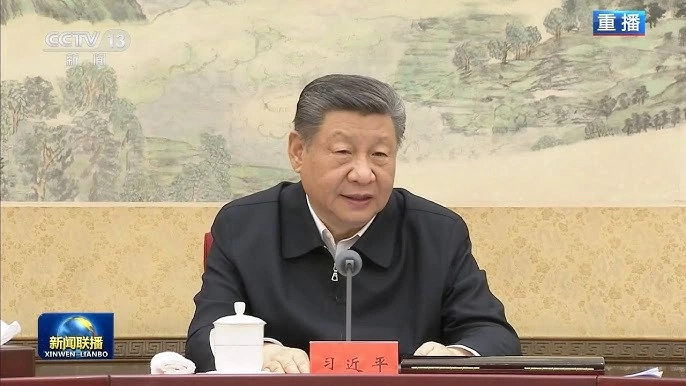 A screenshot from China Central Television’s Xinwen Lianbo (Evening News) covering this collective study session
Embodied Intelligence (Embodied AI): AI with a Body
2025 has been dubbed “the first year of humanoid robots.”
We’ve already seen robots like Tesla’s Optimus and China’s UBTECH and Zhiyuan moving boxes on factory floors.
The real breakthrough lies in the perfect integration of the “brain” and the “cerebellum.”
Think of a robot as a human being:
The “brain” (large AI models) decides what to do — understanding commands like “go pour me a glass of water,” recognizing cups and water dispensers.
The “cerebellum” (motion control) decides how to do it — gripping a cup without crushing it, walking around obstacles without falling.
Traditional robots could only repeat fixed actions on assembly lines and would fail once conditions changed.
Embodied intelligence, combining “brain + cerebellum,” can adapt to complex, unstructured environments, understand human language, perform delicate tasks, and respond to unexpected situations.
This is the decisive moment when robots evolve from automated machines into intelligent partners.
Policy documents clearly emphasize leveraging China’s “new nationwide system,” using real-world application scenarios — such as hazardous operations, elderly care, and precision manufacturing — to accelerate technological maturity.
This is a smartphone-level opportunity for the next decade.
Brain–Computer Interfaces (BCI): From Treatment to Human Enhancement
By 2025, the global BCI market had reached nearly US$3 billion, with China’s potential driven by massive clinical demand.
Following breakthroughs by Neuralink and Chinese research teams in 2025, BCIs have begun moving from laboratories into clinical practice, particularly in paralysis rehabilitation.
The policy logic is clear: medical first, consumer later.
Phase One (now):
Treatment of Parkinson’s disease, epilepsy, and paralysis — areas of rigid demand strongly supported by public insurance and policy.
The official statement emphasized “improving quality of life,” making medical rehabilitation and memory enhancement the current focus of policy backing and capital investment.
Phase Two (next 3–5 years):
Sleep management, attention enhancement, and VR interaction.
At this stage, non-invasive technologies will scale commercially, triggering a fundamental revolution in human–machine interaction.
Companies working on flexible electrodes and neural decoding algorithms are worth watching. Whoever can replace open-brain surgery with minimally invasive — or even non-invasive — solutions will capture the largest share of the market.
6G: An Integrated “Neural Network” of Earth and Space
If you believe in the low-altitude economy, autonomous driving, or embodied intelligence, 6G is unavoidable.
Ground-based stations cannot fully cover the skies or oceans. Satellite internet is essential — and forms the strategic foundation of national security.
While 5G solved speed, 6G addresses coverage and latency.
In early 2026, China launched its second phase of 6G technical trials. The future inflection point lies in the integration of satellite networks and terrestrial base stations.
Direct satellite connectivity for smartphones will become standard.
Nuclear Fusion and Hydrogen: The Ultimate Energy Forms
China’s “artificial sun” projects continue to set new records for sustained fusion reactions.
The next major milestone is the construction of commercially viable controlled fusion demonstration reactors. While grid-scale power remains distant, hydrogen energy will serve as a transitional solution, first taking off in heavy trucks and shipping.
This is the only viable path away from fossil fuel dependence.
Quantum Technology: A Dimensionality Reduction Strike
Conventional computing is like an ox pulling a cart.
Quantum technology represents a dimensionality reduction strike against the laws of physics.
Traditional computing explores paths one by one — like navigating a maze serially. Quantum computing operates from a “god’s-eye view,” exploring all paths simultaneously and instantly identifying optimal solutions.
Drug discovery that would take classical supercomputers thousands of years becomes solvable.
Quantum communication, leveraging entanglement, creates theoretically unhackable shields for finance and defense.
Quantum sensing pushes detection to atomic precision, making underground resources and deep-sea submarines effectively transparent.
China’s focus in the 15th Five-Year Plan reflects a turning point: quantum technology is shifting from laboratory demonstrations to real-world, domain-specific deployment.
Whoever controls quantum technology will possess the next era’s computational nuclear weapons and information security dominance.
Biomanufacturing: A Quiet Revolution of Creation.
This may be the most underestimated of the six sectors.
Traditional materials like nylon and plastics require oil extraction and cracking — energy-intensive and polluting.
Biomanufacturing, using synthetic biology, turns microbes into factories that directly produce desired materials.
Some Chinese firms can already produce petroleum-equivalent nylon through corn fermentation — at lower cost.
This is not just an economic calculation; it is an energy security equation.
If biomanufacturing replaces even 20% of fossil-based raw materials, China’s reliance on imported oil would drop dramatically.
At the national level, this is another dimensionality reduction strike.
Editor: Zhongxiaowen
https://www.huxiu.com/article/4832256.html
The original article in Chinese was edited and translated for better readability.