



I. Opening: A Visible Contradiction
Let me show you something strange.
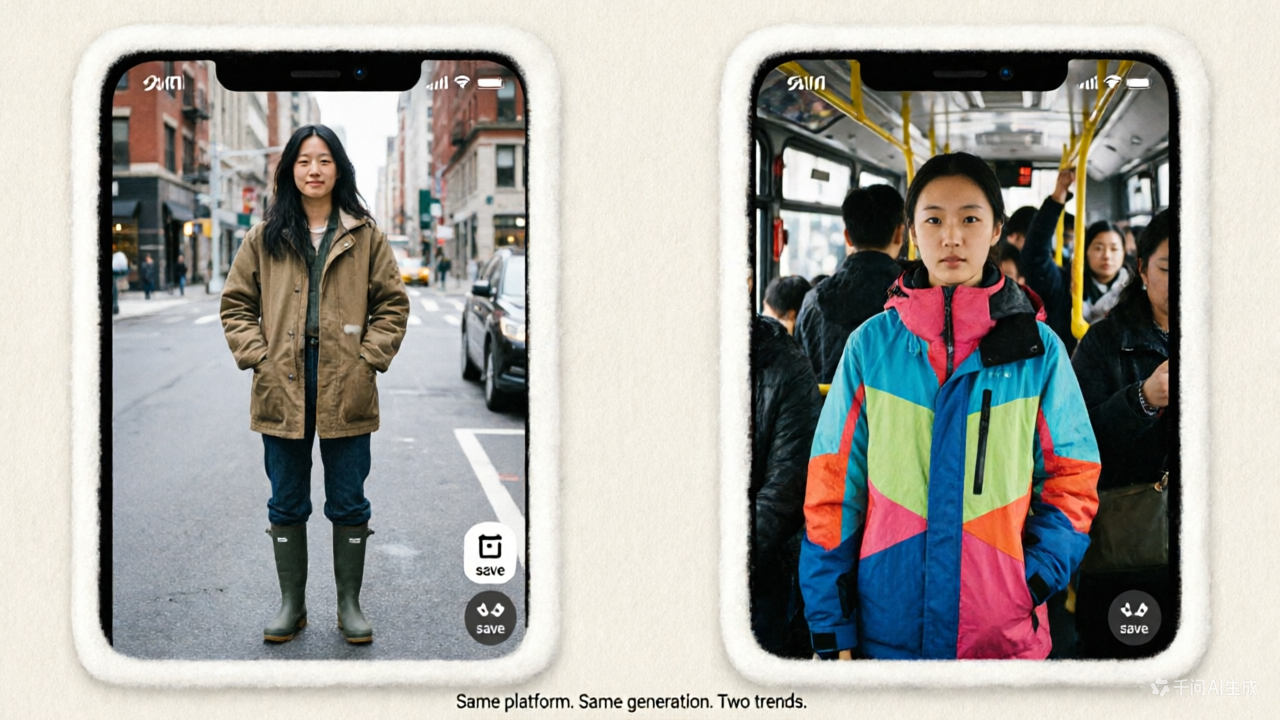
Open Xiaohongshu, and you will see a generation of young Chinese users doing something that looks contradictory. They follow trends obsessively. And yet no two people dress the same.
I spend a lot of time scrolling through Xiaohongshu, and the patterns are unmistakable. A Barbour barn jacket appears again and again, tagged under “barnfit.” Ski jackets show up not on mountains but on buses, in offices, at coffee shops. The same silhouettes circulate widely, recognizable at a glance. And yet each instance feels slightly different—remixed, localized, made personal.
Ok… but isn’t this just Instagram?
At first glance, this looks familiar. Instagram works the same way, doesn’t it? People follow trends, then try to make them their own. But the similarity is surface-level. Instagram has hashtags, of course, but they are secondary. Most users discover style by following people—friends, influencers, celebrities. Xiaohongshu works the other way around. Discovery starts with search. You follow labels—“barnfit,” “clean girl,” “old money”—and build from there. The difference is subtle, but it changes how trends form and how individuality is expressed within them.
To be clear: not all Chinese Gen Z participate in this process. I am talking about a specific slice: digitally fluent, style-conscious young people in major cities who are highly visible on Xiaohongshu. They are not representative—but they are influential. [2] Trends often appear here first, then migrate outward, shaping how fashion circulates across China. [1]
What looks like contradiction—trend-driven yet self-stylizing—is better understood as a patterned response to a highly algorithmic environment. Platforms like Xiaohongshu reward visibility, but only certain kinds of visibility—I call it “legibility.” Meanwhile, the social context makes style one of the most portable and immediately legible signals of identity you have [3].
The result is not confusion. It is adaptation. This generation is fluent in shared aesthetic vocabularies, yet constantly recombining them to produce distinction.
Here is what I keep coming back to: on Xiaohongshu, sameness is the price of entry—but difference is the point.
II. Observation: Two Case Studies in Persistence and Adaptation
Before I explain how the system works, let me show you what it produces. I picked barnfit and ski jackets not at random. They reveal specific dynamics that distinguish Xiaohongshu-driven trends from the viral spikes we are used to on American platforms [1].
Barnfit: Slow Accumulation
Barnfit is countryside-inspired dressing. Think barn jackets, muted natural tones, what users call “Western retro vibes.” My law school friends from Texas mock them; my college classmates from suburban Connecticut practically live in them. Here is what fascinated me: it had been circulating on Xiaohongshu for a long time before anyone gave it a Chinese label. As one influencer put it, “This way of dressing has been around for a while… it’s a style in China that’s been sort-of trending for ages, yet has just now been labelled” [1]. I personally have seen them around since at least 2021.
The trend existed in a loose, diffuse way before the name. People wore barn jackets. But without a shared label, there was no easy way to search for them, no hashtag to follow, no accumulating archive of posts.
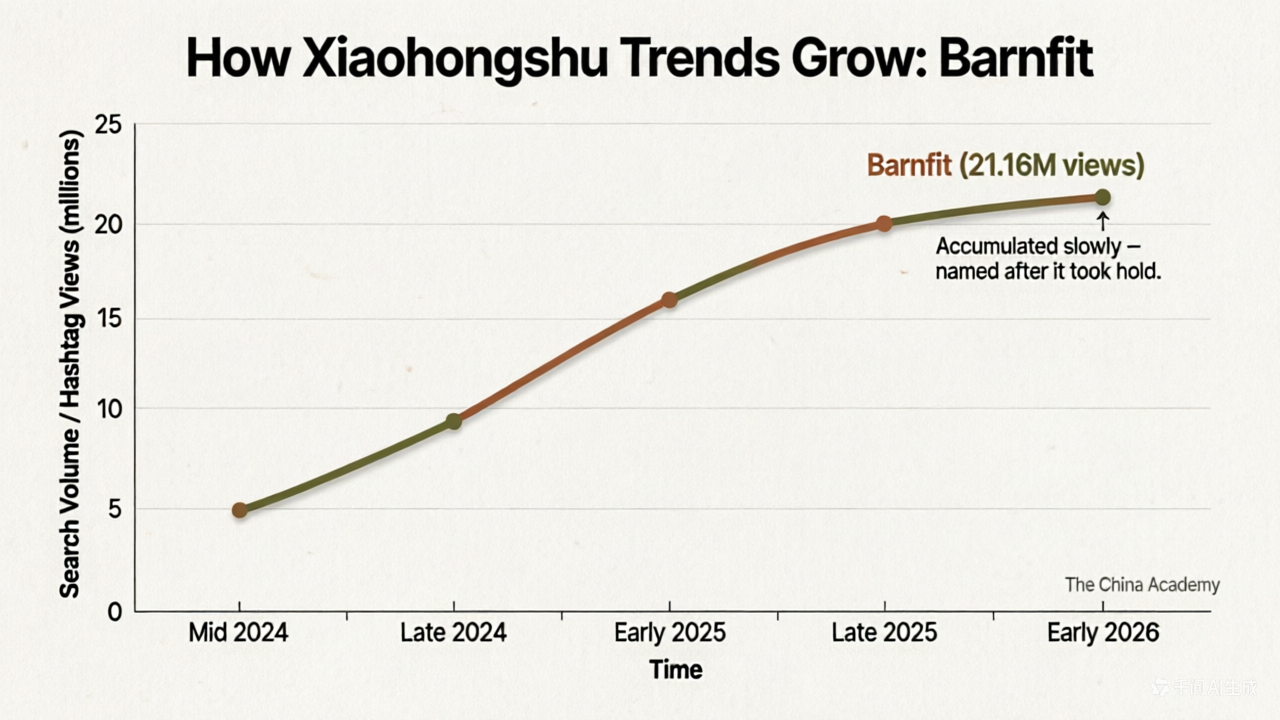
The name changed that. It turned a scattered aesthetic into something searchable. Since late 2024, the barnfit hashtag has accumulated over 21 million reads on Xiaohongshu. Whether the name caused this growth or simply captured it, the trend now has a center of gravity it lacked before. [1].
This is not a 24-hour viral moment. It is a sustained aesthetic movement that accumulated slowly and was named only after it had already taken hold. The trend persisted across months, not days.
Here is another thing worth noting: the trend did not start with commercial intent. It seems to have started with people just… posting. Some users identified an existing aesthetic—barn jackets were already circulating in fashion circles—gave it a Chinese name (‘巴恩风’), and actively promoted it as a hashtag through platform channels [4]. People started discovering it, creating thousands of outfit posts. Commercial impact followed—Barbour saw nearly 20 percent year-over-year revenue growth in China, and Lyst reported global searches for barn jackets were up 410 percent [1][2]. The trend’s platform-driven acceleration—giving a name to something that already existed—is what distinguishes it from traditional top-down fashion cycles.
Ski Jackets: Functional Migration
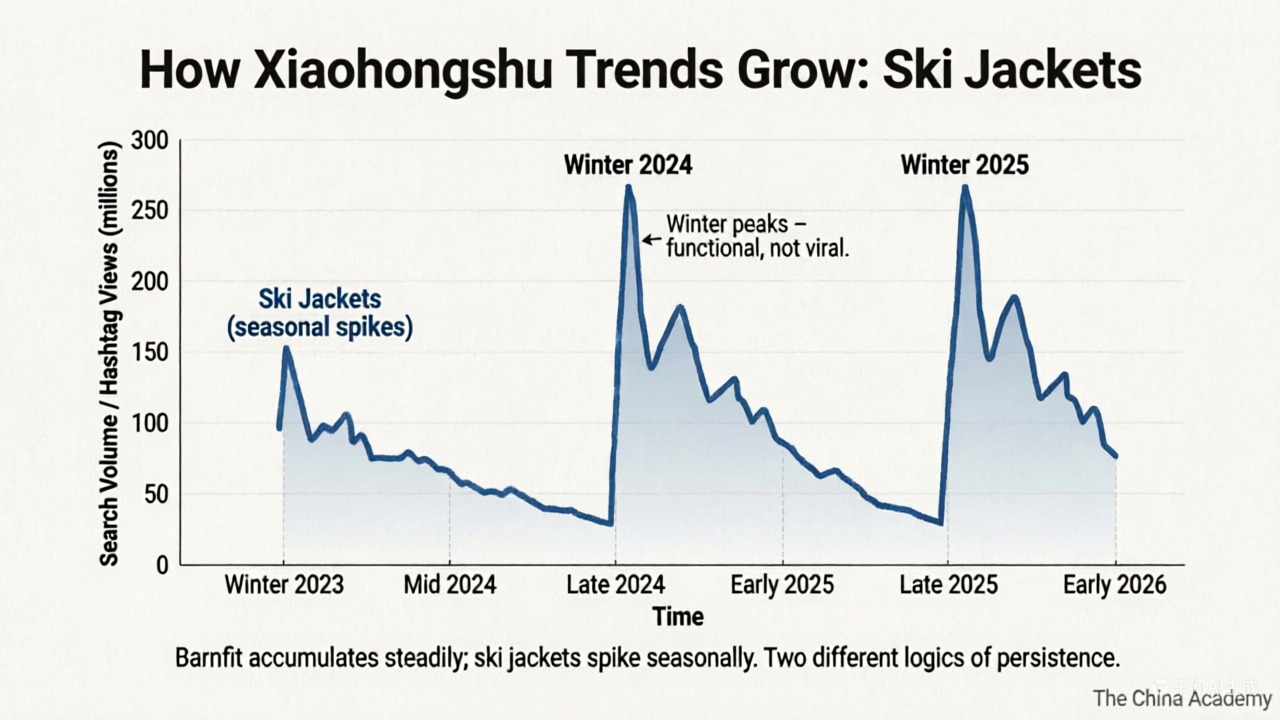
Ski jackets tell a parallel story. Originally designed for alpine sports, they have migrated into daily life—on buses, in offices, at coffee shops. As one observer put it, “The ski jackets have escaped. They’re in offices. On buses. In conference rooms. At Monday standups” [5].
The scale is striking. The hashtag for ski outfits on Xiaohongshu has accumulated hundreds of millions of views. Decathlon sells full ski jackets for 299 RMB (approximately 41 USD), so this is not a luxury trend. It is accessible [6].
What drew me to this trend is the dual appeal. The jacket solves a real problem—warmth during urban commuting: a down jacket creates a cold-air tunnel on a bike, whereas a ski jacket seals like a spaceship; an overcoat is too cumbersome on the tightly-packed Beijing subway, but a ski jacket fits right in. Most urban commuters in Chinese cities have to either ride a bike or subway, if not both, daily. But it also carries a fantasy of escape. A life elsewhere, even if only imagined [5]. It is a bit bleak when I put it this way, but let us face it: are not all aesthetic choices to some degree a bit of a fantasy? In a way, the ski jacket’s utility is not only the appeal, but also a disguise—it allows people to wear that fantasy without shouting, “hey, look, this is the ideal way of life I desire!”
And again, the trend did not begin with brands. According to reporting from Sixth Tone, users discovered its utility first. Platforms later amplified what users were already doing through campaigns like “Stylish Sports Proposals” on Xiaohongshu and “Enter Winter in Skiing Mode” on Douyin [5]. The seed was ordinary user behavior. That, to me, feels like the opposite of top-down trend manufacturing.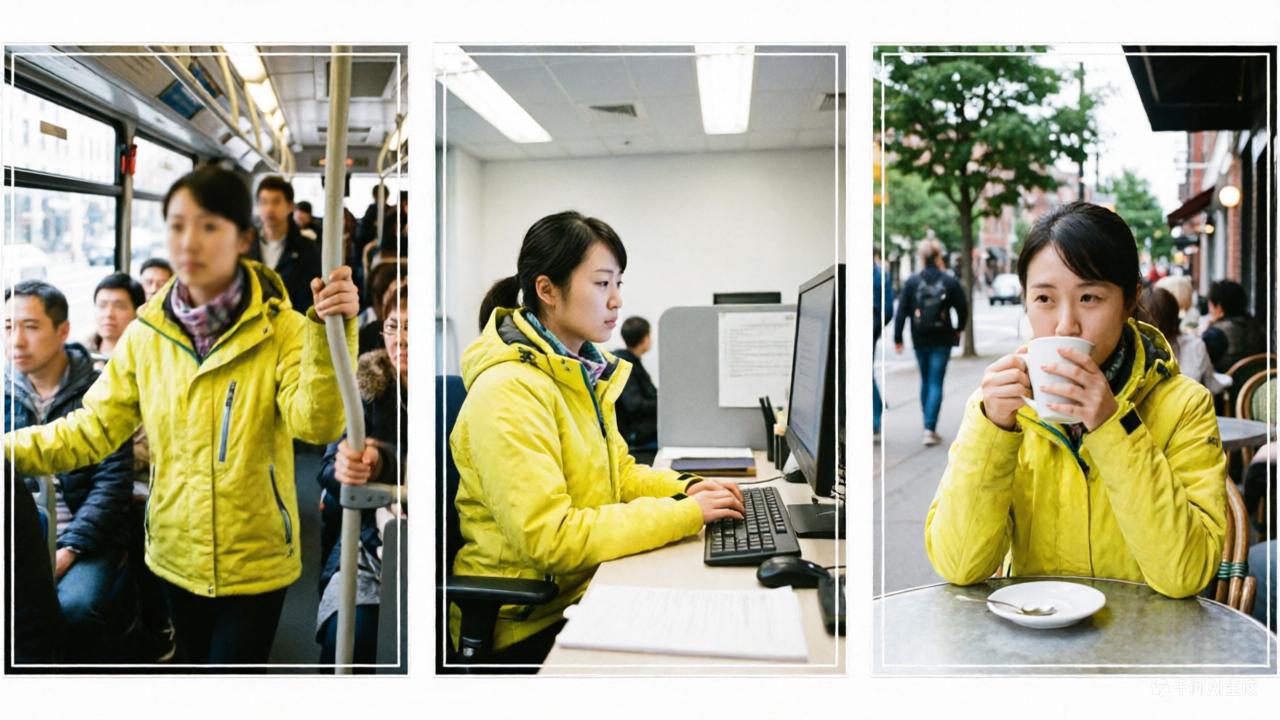
What They Share
Both barnfit and ski jackets share key characteristics that distinguish them from typical Instagram or TikTok virality [1][5]. They originated with ordinary users, not celebrities or brands. They demonstrate persistence across months or multiple seasons, not hours or days. Commercial follow-up occurred, but the trends did not start with commercial intent. And both have been adapted and reinterpreted by individual users rather than copied uniformly.
These are not trends that explode—they are trends that settle in.
III. Platform Mechanism: Why Xiaohongshu Works Differently
None of this is an accident. Xiaohongshu is built this way [3][7]. Researchers have already done the heavy lifting, so let me walk you through the key features here. And as you’re going through them, just remember that all of this can be reduced to one principle: the platform rewards what is legible.
Search-First Discovery
First, discovery is search-driven. Unlike feed-driven platforms where content is pushed to you passively, nearly 60 percent of Xiaohongshu users initiate their journey via the search bar. The platform processes over 1 billion search queries monthly [8].
Think about what this means. Trends must be nameable and indexable. An aesthetic does not spread unless it can be turned into a term. The moment users start searching for a new label—”barnfit,” “Garbagecore,” “Softcore”—the algorithm notices and prioritizes content around that query [7].
Weighted Engagement
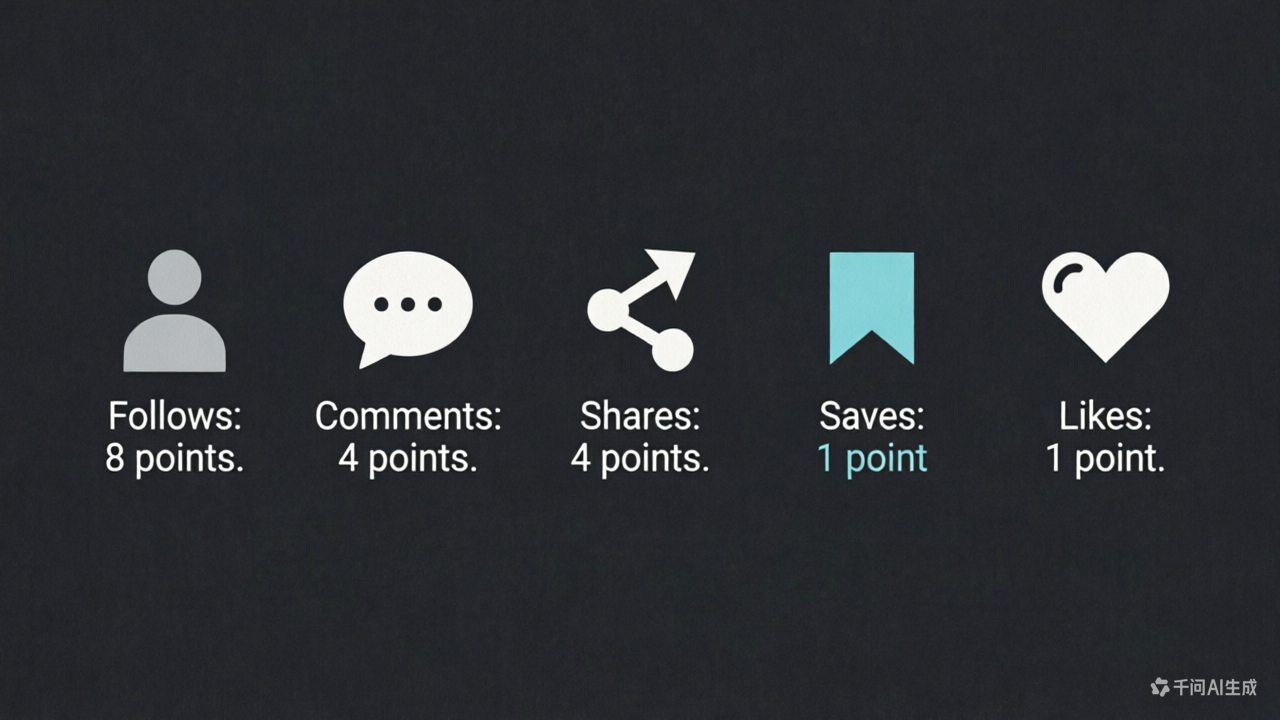
Second, the platform rewards usefulness. Xiaohongshu scores every action you take using a CES (Community Engagement Score). Follows are weighted highest at 8 points. Comments and shares are weighted at 4 points each. Saves and likes are both weighted at 1 point [3][8].
But numerical weight is not the full story. What matters is what each action signals to the algorithm. A like is low-effort—a tap, a scroll, gone. A save means the user found the content useful enough to return to. The algorithm’s prediction models have learned that saves correlate with long-term user retention and satisfaction [2][3].
This is the crucial difference. On Instagram and TikTok, likes are the primary engagement signal. On Xiaohongshu, they are almost meaningless. A post with 10,000 likes but zero saves is considered a failure. A post with 500 saves and 200 likes is a success [2].
In other words, content is valued not just for attention, but for utility.
Evergreen Distribution
Third, distribution is evergreen. When a post is published, it enters an initial traffic pool of 100 to 500 users. If engagement metrics—especially saves and comments—exceed thresholds, the post graduates to larger pools and can remain in circulation for weeks or even months [3]. According to platform analysts, content has a 3-6 month lifespan on Xiaohongshu, continuing to appear in search results and recommended feeds long after publication [1].
Contrast this with Instagram. On Instagram, a post’s useful life is 24 to 48 hours. After that, the algorithm buries it. [8] 90% or more of an Instagram post’s total reach happens within the first two days. [1] On Xiaohongshu, top-performing posts generate 60-80% of their total impressions after the first week. [1]
This is the difference between recency-driven and utility-driven distribution. Instagram rewards what is new. Xiaohongshu rewards what is useful. Content accumulates visibility over time rather than disappearing after a spike. A well-optimized post from six months ago can still generate thousands of views if it ranks well for search terms. [3] Trends grow gradually and persist longer.
Decentralized Visibility
Fourth, visibility is decentralized. High follower counts do not guarantee visibility. A Key Opinion Consumer with 500 followers can theoretically out-earn a celebrity in engagement if their content provides superior utility. 85% of product discussions come from user-generated content, not brand accounts [10]. Smaller creators can outperform larger ones if their content is more useful or more legible, at least theoretically.
Legibility as Core Logic
Across these features, a single logic emerges: legibility. A successful post is one that can be clearly seen, categorized, searched, and saved [3]. On Instagram, a blurry, moody photo can blow up because it makes people feel something. On Xiaohongshu, that same photo would sink. No one would search for it. No one would save it.
An influencer friend said this to me about virality on Xiaohongshu: what cannot be named cannot travel; what cannot be saved cannot last.
Users do not need to understand the system explicitly. They learn it through feedback—what circulates, what disappears—and adapt accordingly.
User Adaptation
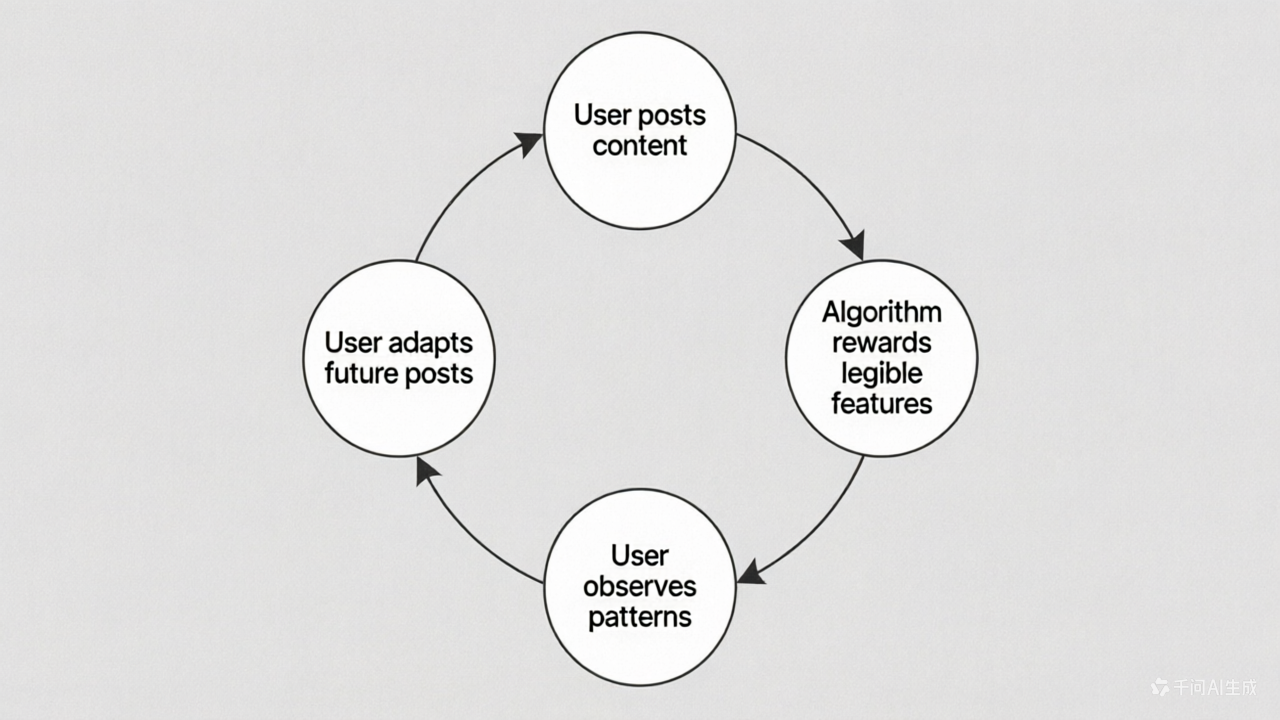
Here is what adaptation looks like in practice. You post. Some of your posts take off. Others die. You start to notice patterns. Over time, patterns emerge. Clarity beats ambiguity. Distinct silhouettes outperform subtle variations. What can be indexed circulates; what resists categorization fades [3].
This is not simple conformity. It is strategic expression under constraint.
Here is what I really think: creativity does not disappear under the algorithm—it learns to speak the algorithm’s language. I do not think people in China find this strange at all, because this kind of constraint-based creativity is not unfamiliar in Chinese education, from writing structured essays to reciting poems. All of these were (or eventually became) a form of creative expression under a stiff framework. I am not saying this is good or bad. I am saying it feels familiar. And in some way—not to sound like a culture-determinist—this is how Xiaohongshu’s model works as well.
IV. Identity Formation Under Legibility Constraints
When a system consistently rewards certain forms of visibility, those forms start to shape not just posts—but how people present themselves.
Style is not the only identity marker that matters. But on visual platforms, it is one of the most legible. It can be seen, searched, and categorized in ways that other signals cannot [3].
Other markers—hometown, family background—are less directly encoded into the feed. Hometown is rarely displayed prominently. China is a country of massive internal migration; where you are “from” is often complicated. Although there have been countless great literary pieces about that composite migrant identity—like an Anhuinese farmer’s kid growing up in cosmopolitan Shanghai—to translate that to fashion, well, that would be the stuff of genius that we are still waiting to happen.
Family and class background is not something young people advertise. On one hand, in a society where exposing and punishing corruption are routine, both in the corporate world and officialdom, displaying wealth or connections is risky [11]. On the other hand, China went through such dramatic economic, cultural and societal changes in the past five decades that any deeply rooted identity around familial background and its associated symbols have been so thoroughly transformed. We are all still figuring out the new, collectively-agreed iconography.
As a result, style becomes one of the most portable ways to express difference.
Identity as Itemization
Scroll through Xiaohongshu and you will notice something else: the captions rarely explain who the person is. They explain the outfit. A typical post reads like a list—”barn jacket + wide-leg pants + loafers”—sometimes with brand tags, sometimes with mood descriptors like “clean girl” or “old money.” Identity is not narrated. It is itemized.
Bios and captions are often just a string of keywords and emojis—”daily outfit,” “sharing,” a few mood indicators. They read less like personal statements and more like search tags.
Contrast this with Instagram. On Instagram, a caption might tell a story: “Third coffee of the day, feeling grateful, swipe for the outfit details.” The person comes first. The outfit is secondary. The tone is narrative, not inventory. On Xiaohongshu, the order is reversed. The algorithm does not care who you are. It cares what you are wearing, and whether that can be named, saved, and found again.
This is legibility in action. Instagram rewards personality. Xiaohongshu rewards precision.
Remix as Differentiation
Remix becomes the primary mechanism of differentiation. Not invention from nothing, but recombination of existing elements.
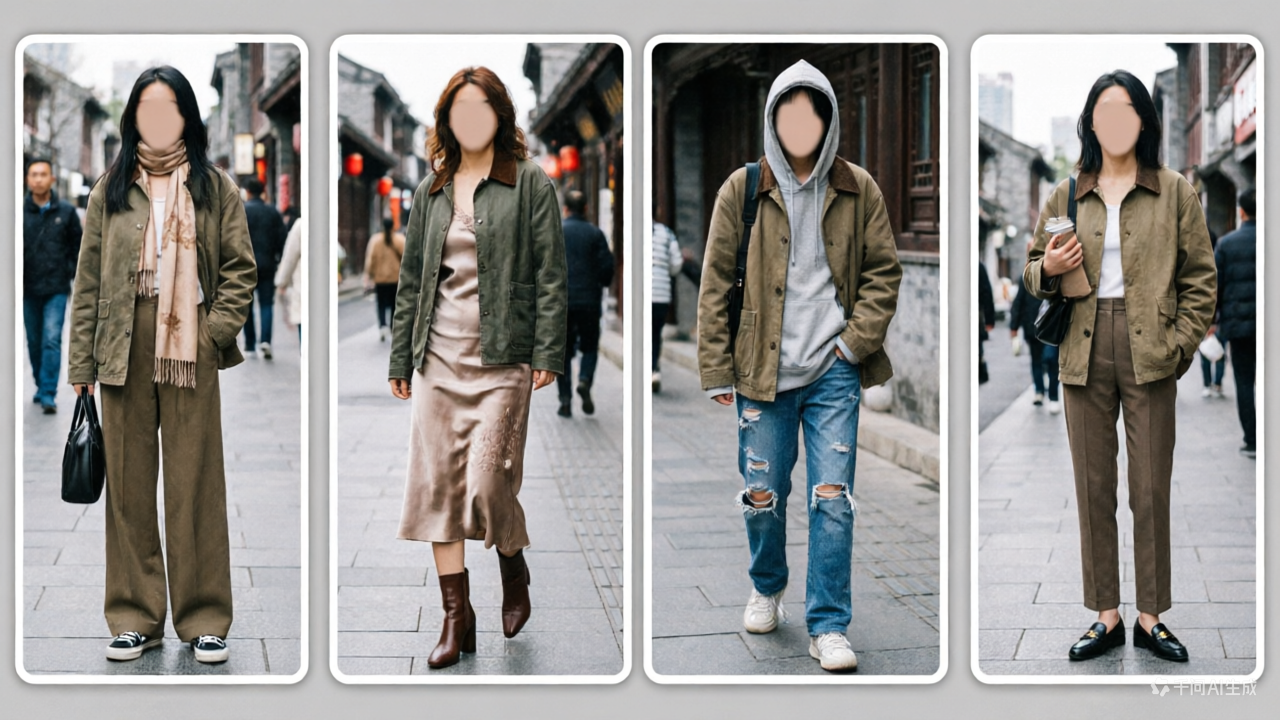
Look at how the same barn jacket appears across users, but styled differently. One user pairs it with wide-leg trousers and platform sneakers. Another pairs it with a silk dress and heeled boots. A third wears it over a hoodie with ripped jeans. The jacket is the same. The trend is recognizable. But each user has made it their own.
The same ski jacket carries different meanings depending on context. On a bus, it is commuter armor. At an office, it is a statement about practicality and fantasy coexisting. At a coffee shop, it is casual wear with a story [5].
This is what “self-stylizing” actually means. It does not mean rejecting trends. It means using trends as raw material, not as recipes. The barn jacket is not the destination. What you do with it—how you style it, what you pair it with, what it says about you—that is the point.
This is not unique to Xiaohongshu. On Instagram, users also remix trends. But the mechanism is different. On Instagram, remix is driven by influencer culture and feed-based discovery. On Xiaohongshu, it is driven by searchability and save-worthiness. The raw material is the same. The logic of circulation is not.
This is not individualism in the Western sense. It is differentiation within constraints. You cannot change your hukou (household registration) easily. You cannot change your family background. You cannot control the job market. But you can control your outfit. And you can change it tomorrow [11].
I have come to think of it this way: identity is no longer declared—it is assembled, post by post.
V. The Reference Library Question
Now let me address something that often comes up in conversations about Chinese fashion. People like to say China lacks fashion history. I think that is too crude, and honestly, it is not quite right.
China has plenty of fashion history. Think qipao, socialist dress, Hong Kong cinema, Taiwanese pop culture, Japanese and Korean influence, 1980s reform-era style, and 1990s aspirational urban fashion. All of these left marks [12].
The difference lies in how these references are organized and shared.
In Western fashion media, references function as shorthand—immediately recognizable and widely shared. “1990s supermodel streetwear” evokes a specific silhouette, attitude, and cultural moment. “Early 80s Armani” does the same. This shared canon is the product of decades of fashion magazines, runway shows, celebrity photography, and advertising campaigns that have been consistently documented, archived, and taught [13].
If you zoom out, China’s mass consumer fashion culture is still relatively recent. It does not have an equivalent unified commercial shorthand. Its references are multiple and unevenly distributed. A qipao means something different to a Shanghainese grandmother than to a Gen Z influencer in Chengdu. “1980s reform-era style” is not a fixed reference—it varies by region, by family memory, by access to archives [12].
Part of the reason is fragmentation. China’s media ecosystem is not a single stream but a collection of fast-moving, often disconnected channels—WeChat, Douyin, Bilibili, Kuaishou, and Xiaohongshu itself. A reference that lands on one platform may never reach another. Regional variation compounds the issue. A style memory from 1990s Guangzhou means little to someone who grew up in a small town in Gansu. And then there are the ruptures: the Cultural Revolution, the rapid dismantling of state-owned enterprises, the mass migration from countryside to city. Each break created a before and after, and what was lost in between was not just objects but the informal transmission of taste—mother to daughter, tailor to customer, magazine reader to friend. These discontinuities make it hard for any single canon to take root.
This is not a value judgment. It is a historical observation. The consumer fashion industry in China is roughly thirty years old, dating from the post-Reform and Opening Up period. That is simply not enough time to generate the kind of deep, widely shared, commercially codified reference library that Western fashion writing assumes [14].
As a result, fluency is measured differently. Where a shared archive exists, status can be signaled through historical knowledge—hence the detailed breakdown of a grandma or grandpa’s outfit at an Upper East Side street corner by Esquire or Popeye. Where it does not, fluency shifts toward speed—identifying, adopting, and recombining emerging trends. Being fashionable means being able to recognize and remix a trend that emerged last week. It does not mean being able to place that trend in a seventy-year lineage of well-documented cultural history, magazine covers and runway shows.
Maybe it comes down to this: where there is no shared archive, speed becomes the substitute for memory.
VI. Conclusion: Adaptation, Not Contradiction
Let’s pull this together.
Users are trend-fluent because platforms reward legibility. Search-first architecture, weighted scoring, evergreen distribution, and decentralized visibility all make trend awareness a requirement for visibility. Legibility favors certain kinds of aesthetics over others. Users adapt.
Users are self-stylizing because style remains one of the most flexible ways to express difference within those constraints. Traditional identity markers are less visible online. The available reference library for mass consumer fashion is not organized as a unified commercial shorthand. In the absence of other signals, remix becomes the primary language of differentiation.
This is not contradiction. It is adaptation.
The barn jacket on a Shanghai street. The ski jacket on a morning bus commute. These are not just fashion choices. They are small acts of agency—ways of saying “I am here, I am current, I am mine” within systems—both digital and social—that do not always offer obvious ways to stand out.
The system explains how trends move and how individuality is expressed through them. But here is what I realized as I was writing this: the system explains the circulation of style—not yet its source.
Barnfit is Western retro. Ski jackets are Western sportswear. The cores that dominate Xiaohongshu—Kidcore, Garbagecore, Softcore—are named in English, imported from global trend vocabularies. Chinese Gen Z is fluent in Western aesthetics. They remix them brilliantly. They make them their own.
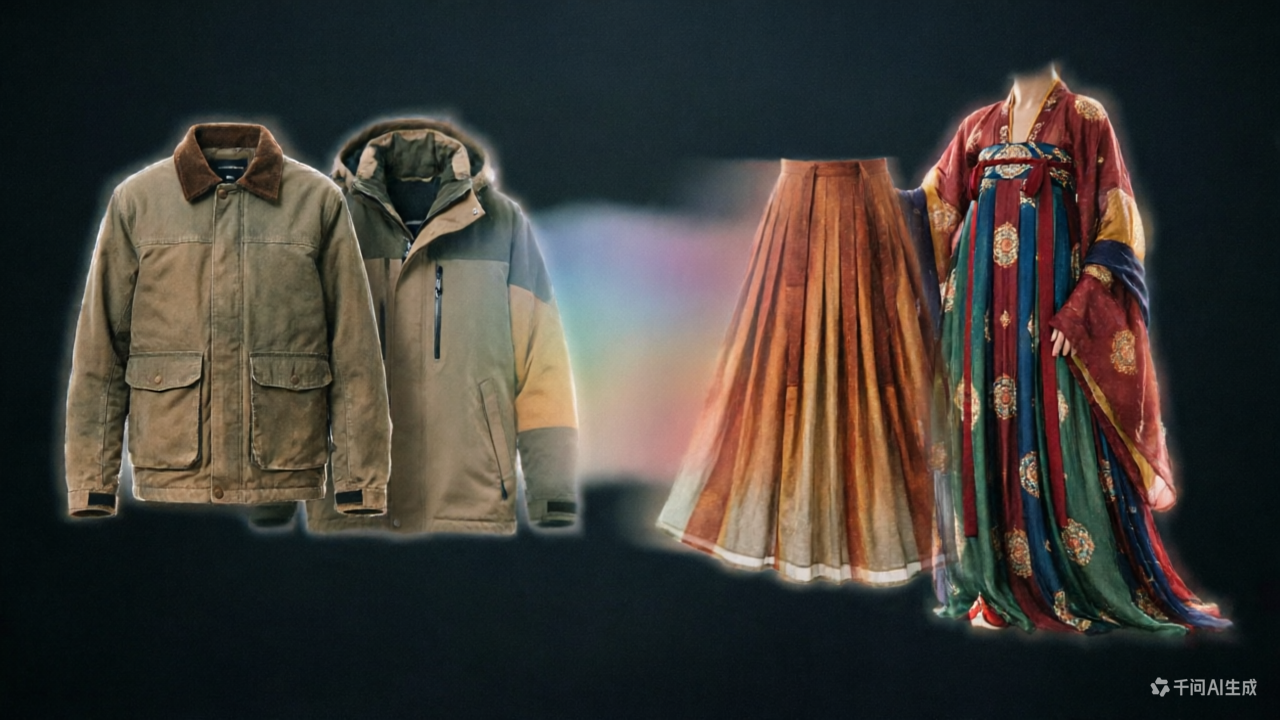
But what happens when the same system turns toward a different archive—one rooted in Chinese history? Tang dynasty silhouettes. Song dynasty color palettes. Ming dynasty textiles. The horse-face skirt. New Chinese Style.
If legibility shapes visibility, what happens when the material is deeper, more complex, less reducible to a hashtag?
That question leads to Part II.
Appendix: Bibliography
[1] Jing Daily. “From Toteme’s trending country jacket, to Hunter’s Shanghai retail debut: ‘Barnfit’ bolsters brand positioning.” December 18, 2024. Available at: https://jingdaily.com/barnfit-china-gen-z-fashion-trend/
[2] RADII. “RADII’s A-Z of Chinese Trends That Defined the Lunar Year.” February 6, 2026. Available at: https://radii.co/article/radii-a-z-of-chinese-trends-that-defined-the-lunar-year
[3] Halo Tech Media. “Deep Dive into Xiaohongshu’s Algorithm: How to Make Your Post Go Viral.” 2025. Available at: https://halotechmedia.sg/blog/xiaohongshu-how-to-make-your-post-go-viral/
[4] Lyst. “Lyst Index Q3 2025.” October 2025. Available at: https://www.lyst.co.uk/the-lyst-index/the-lyst-index-q3-25/
[5] Sixth Tone. “China’s Ski Jacket Trend: When Sportswear Became Daily Uniform.” February 2026. Available at: https://www.sixthtone.com/news/1012345
[6] Decathlon China. Product pricing data. 2025-2026. Available at: https://www.decathlon.cn/
[7] WSD Social. “Xiaohongshu Search Engine Optimization: The Ultimate Guide.” 2025. Available at: https://www.wsdsocial.com/
[8] Meetsocial. “The Rise of Xiaohongshu: Why Brands are Turning to the Platform in Southeast Asia.” July 30, 2025. Available at: https://en.meetsocial.com/blog/why-brands-are-turning-to-xiaohongshu
[9] [reserved]
[10] Hashmeta. “KOL vs KOC on Xiaohongshu: Which is Better for Singapore Brands?” March 19, 2026. Available at: https://hashmeta.com/blog/kol-vs-koc-on-xiaohongshu-which-is-better-for-singapore-brands/
[11] Southern Weekly. “争当’老式人类’:当代年轻人的反潮流生活.” January 2026. Available at: https://www.infzm.com/
[12] Ling, W. (2019). Chinese Fashion: From Mao to Now. Berg. ISBN: 978-1350138861
[13] Clark, H. (2018). The Cheongsam. Oxford University Press. ISBN: 978-0190861203
[14] Kawamura, Y. (2018). Fashion-ology: An Introduction to Fashion Studies. Bloomsbury Academic. ISBN: 978-1350071595
Editor: Yunpeng Zhang