

Editor’s Note:
For many Chinese people, today marks what many regard as the genuine Teachers’ Day, a day on which numerous people commemorate Mao Zedong. This article is excerpted from the special feature “Overseas China Studies” in Open Times, Issue 1, 2010. It offers a historical dialectical discussion of Chairman Mao’s theory of the “Three Worlds”. It points out that the lesson contained in the poetic line “I would cleave you into three segments” derives from the practice of “Arise, millions upon millions of workers and peasants, united in our cause”.
The article argues that the core of the “Three Worlds” theory consists in transposing the domestic logic of “defeating the strong from a weak position” onto the global stage. Chairman Mao taught that for weak nations to defeat hegemonies, what matters above all is not material might, but unity between officers and soldiers, the mass line, and the enhancement of “intangible strength” (organizational capacity and willpower). It is this active, defiant resolve that distinguishes the concept of the “Third World” from that of the “Global South”. The latter evokes an image of peoples waiting to be rescued from a perilous plight, whereas the Third World stands as a collective of countless oppressed and exploited peoples across distant lands, a collective risen in resistance, like Jingwei filling the sea or Xingtian fighting on undaunted.
Should weaker parties ape the institutions of dominant powers, they are bound to become dependencies. For the Third World to achieve self reliance, it must first “guard against and oppose revisionism”. Only by preserving a high degree of popular participation and domestic unity can states muster the strength to counter hegemonism. In essence, this means applying class analysis to international relations, treating external success or failure as an extension of domestic governance lines.
I. The Practical Character and Managerial Dimensions of Mao Zedong Thought
Unlike theorists such as Karl Marx and Friedrich Engels, Mao Zedong began to reflect after taking action. It was after he led a depleted small force to establish a base on Jinggang Mountain that he embarked on the most crucial reflections of his life. His most important ideas (and writings) emerged in response to problems encountered in practice. Faced with the far, stronger Kuomintang regime and its military, the weak Red Army had to figure out how to survive, grow stronger, and attain its revolutionary goals. Out of this context arose two core sets of concerns within Mao Zedong Thought: first, how to marshal human and material resources from the peasantry in service of revolutionary objectives, a classic managerial challenge; and second, the problem of defeating a stronger adversary from a position of weakness, that is, questions of competitive strategy. Drawing on management studies and organizational sociology, this essay examines the balance of competitive forces, focusing especially on Mao’s distinctive thinking on competition.
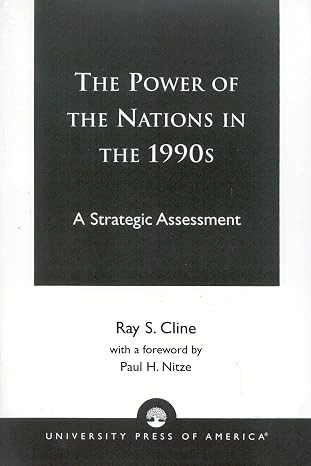
The “national power equation” formulated by the American scholar Ray S. Cline divides a nation’s power into two components. The first component comprises three items: basic entity (territory and population); economic capacity (economic and industrial structures); and military capacity (technology and power, projection capability). The second component includes two variables: strategic purpose and national will. Each of these two variables is scored on a scale from 0 to 1. The first component corresponds largely to economic and technological factors, here termed “tangible strength”. The second component captures the subjective dimension of power deployment, termed “intangible strength”. Thus competitive national power equals the product of tangible strength multiplied by intangible strength.
National Power = (Basic Entity + Economic Capacity + Military Capacity) × (Strategic Purpose + National Will)
Mao Zedong offered a concise formulation for enhancing intangible strength: “Unite to strive for still greater victories”. He never held that weaker competitors should simply accept defeat from the outset; rather, he believed victory remained attainable, provided efforts were made to boost intangible strength. On July 9, 1964, he observed: “Some say weapons come first, people second. We put it the other way around: people first, weapons second. Weapons are much like machines, extensions of the human hand.” This view continues the reasoning in On Protracted War: “The decisive factor is people, not things. The balance of forces is not merely a comparison of military and economic power; it is also a comparison of human resources and popular will.” Building on the practical experience of revolutionary base areas, one may revise the latter part of Cline’s equation: intangible strength consists of the sum of “competitive will” and “level of organization”.
Competitive Power = (Basic Entity + Economic Capacity + Military Capacity) × (Competitive Will + Level of Organization)
During the Chinese revolution, the people’s revolution led by the Communist Party of China was consistently the weaker side. To defeat an enemy equipped with “airplanes and tanks” while relying on “millet plus rifles”, it had to develop intangible strength. This constrained available competitive strategies: weaker actors must surpass their adversaries in organization and administration. Deficiencies in tangible strength ought to be offset by superior intangible strength, higher competitive will and a higher level of organization, so that the product of tangible and intangible strength would exceed that of Kuomintang forces. This holds the key to the Communist Party’s victory over powerful foes. Sun Tzu’s maxim “Superiors and subordinates sharing one desire will win” articulates precisely this insight about intangible strength determining outcomes. Raising intangible strength depended on fostering the “unity between officers and soldiers” that creates such shared purpose. The American journalist Mark Selden identified “five forms of disunity” within Kuomintang troops: disunity between military commanders and civil administration; between the military and civilians; among different military units; between officers and rank and file soldiers; and among ordinary soldiers themselves, major sources of eroded intangible strength. By contrast, the Eighth Route Army under the Communist Party emphasized “unity between officers and soldiers, unity between the military and civilians, and disintegrating enemy troops”.
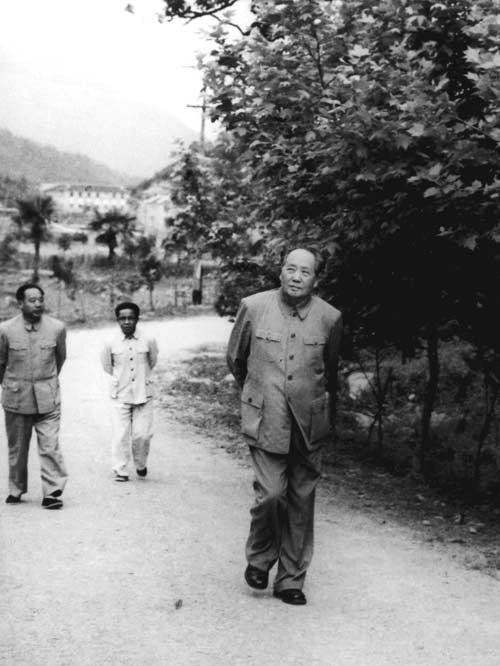 In 1965, Mao Zedong returned to Jinggangshan
Consider how Mao Zedong pursued “shared purpose” to boost intangible strength after arriving on Jinggang Mountain. The first measure was to institute a supply system. As General Huang Kecheng recalled, many officers initially resisted it. In Kuomintang forces, officers enjoyed privileges such as four dishes and one soup at meals, and majors received 180 silver dollars per month. But given Jinggang Mountain’s small territory and acute supply shortages, acceptance became unavoidable. From a managerial perspective, this removed key levers through which superiors could coerce or manipulate subordinates. What the Cultural Revolution often condemned as “material incentives” had already been set aside in the Jinggang Mountain period. Next, establishing soldier committees introduced political, economic, and military democracy. Decision, making authority was redistributed, drastically narrowing gaps between managers and the managed, amounting to political egalitarianism.
Beyond equalizing power and material distribution, while en route to Jinggang Mountain Mao Zedong chanced to observe that companies with larger numbers of Communist Party members exhibited high morale, very low desertion rates, and effective oversight of superiors by subordinates. He began to systematize the role of activist cadres alongside formal managers. The Sanwan Reorganization institutionalized this by establishing “battle fortresses” within each company. This yielded Mao’s distinctive managerial approach: raise organizational capacity while reducing reliance on coercive measures.
II. Sublating Formal Administrative Models and the Origins of Anti-Revisionist Thought
Within the Red Army, formal professional managers possessed reduced authority, coercive tools over subordinates diminished, and material privileges shrank under the supply system producing what sociologists term “relative deprivation”. Relative deprivation tends to foster right, wing radicalism among managerial strata. In the Cultural Revolution, Mao framed Party history largely as a “history of line struggles”. This core concern had already taken shape in the Jinggang Mountain era: minimizing managerial power and interests generated persistent discontent among cadres. Mao interpreted all efforts to contain such discontent as line struggle. He came to view recurrent intra-Party disagreements structurally: tendencies toward restoring managerial power and privilege would resurface even after being checked, much like class contradictions. External pressure was therefore required to counteract the managerial stratum’s impulse to revert to old patterns–a binary “one divides into two” analytical lens.
During the base-area period, right-wing radicalism within the Communist Party was contained by external threats from Chiang Kai-shek and Japanese occupying forces. When survival was at stake, managerial grievances could not be pursued too far. For instance, at the Seventh Congress of the Fourth Red Army in 1929, several officers resented Mao’s flat administrative model, which curtailed their power and benefits. They removed Mao from his post as candidate for Secretary of the Front Committee, an appointment made by the Central Committee. Yet subsequent campaigns into central Fujian and Meizhou ended in catastrophic defeat, with the Red Army losing one-third of its manpower. The dissidents’ influence waned, compelling reflection–creating conditions for the Gutian Congress Resolution, a foundational document shaping military administration and superior-subordinate relations within the Communist Party.
Following the Long March, the Yan’an Rectification Movement used small-group criticism and self-criticism to press cadres to reflect on their misperceptions. Mao’s flat administrative model was re-christened the “mass line” and gained broad acceptance. Competitive strategies suited to weakness also won consensus. Two major sets of ideas–departing from formal administration and conventional warfare–spread widely. By the close of the Yan’an Rectification Movement, the mass-line-oriented flat administration reached its historical high-water mark.
Mao’s late-career concern with “guarding against and opposing revisionism” grew out of the Jinggang-era break with formal bureaucratic administration. These insights deepened through intra-Party debates and were summarized as the “history of line struggles”. The profound disagreements with the Soviet Union paralleled enduring intra-Party disputes: how to position superior-subordinate relations in administration, and the degree to which the governed ought to participate in governance. Mutual misgivings between Chinese and Soviet Party cadres in Dalian embodied the substance of “opposing and guarding against revisionism”. The intellectual divergence between Mao Zedong Thought and “Soviet revisionism” turned on the contrast between flat administration and formal bureaucratic administration. For Mao, moving beyond formal administration was not merely a rejection of ruling-class bureaucratic norms. Critically, it held the key to mobilizing peasant human and material resources and raising intangible strength.
Before 1949, the Communist Party and its military occupied a weak position. Close ties between officers and soldiers, and between troops and civilians, could be sustained under external threat, fostering intense internal cooperation. After the founding of the People’s Republic, the Party became the governing power. With acute external peril receding, rifts widened between officers and soldiers, between officials and ordinary people. Hierarchical social distances re-emerged in line with prevailing patterns of social stratification. Mao viewed this development with deep alarm and repeatedly sought to prevent cadres from becoming divorced from the masses. War constitutes the sternest test of political systems and administrative performance. Having been validated by revolutionary wars fought from weakness, Mao remained convinced of flat administration’s efficacy. He resisted monopolization of power by specialized bureaucratic management and insisted on popular participation. When many comrades within the Party shifted their stance, he held fast to his original convictions–widening ideological rifts. As divergences intensified, he connected these policy disagreements upward and downward into a holistic interpretive framework: “two classes, two roads, two lines”. He read class conflict through the prism of line struggle, used outcomes of line-struggle analysis to forecast institutional evolution, and linked these to social differentiation and class antagonism within a socialist public ownership system. He offered a sociological reading of Nikita Khrushchev’s “turn toward revisionism”, arguing Khrushchev represented a high salary privileged stratum within the Soviet Union. Downward-looking analysis traced post-1949 policy failures and cadres’ policy swings to pursuit of separate class interests distinct from those of workers and peasants.
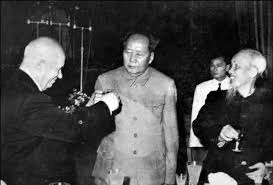 Mao Zedong, Nikita Khrushchev, and Ho Chi Minh at the Ten-Year Anniversary Banquet of the Founding of the People’s Republic of China
Japanese scholar Kondo Yasukuni described Mao’s consistency as revolutionary and state-builder: “Externally resisting aggression, internally breaking fetters–‘bursting through nets and snares’–he unleashed the people’s own forces to unite national independence with revolution. This fundamental outlook remained constant, centered on ‘the people, contradiction, great harmony’, and uncompromising critique of imperialism from the outside.” “During the revolutionary period, he wove popular idealism together with hard-headed realism. In the construction era, his fundamental attitude persisted. He achieved considerable success combining these two dimensions in military and diplomatic spheres, yet encountered setbacks in economic and cultural domains, and poured his energies into restoring that synthesis.” Kondo further argues that by the 1970s, the United States’ containment ring around China had been broken–and China’s modern-era mission of “national survival” was at last accomplished.
Ideas elaborated by Mao during the Cultural Revolution, later repudiated and treated as errors of his later years, represent logical extensions and deepening of concerns first articulated at Jinggang Mountain. How to mobilize popular energies for economic construction; how a technologically backward nation could survive within a competitive global order–these goals could not be attained by copying institutions from the First World. This constitutes a deepened formulation of Mao’s observation: “The teacher strikes the student.”
III. Another Divergence between Mao Zedong Thought and United States Institutional Practice
Beyond its split with Soviet thinking on formal bureaucratic administration, Mao Zedong Thought diverged from United States institutional practice what liberal discourse today calls universal values or mainstream civilization. Mao’s era opposed both imperialism and revisionism. Beyond clashes over political and national interests, fundamental epistemological divides separated the sides. At its core, “opposing revisionism” rejected formal bureaucratic administration as unworkable in agrarian contexts. Mao also never believed private property based institutions could marshal China’s human and material resources to complete industrialization, or guarantee social stability. During his 1965 revisit to Jinggang Mountain, he remarked: “Capitalist systems have developed for centuries and are far more mature than socialism. But capitalism cannot work in China. We have a huge, multi ethnic population, a long feudal past, stark regional disparities. Imperialist predation left our people destitute and the country effectively fragmented. Under our conditions, capitalism would reduce us to dependency. Imperialist powers enjoy advantages in energy and capital. The United States both cooperates with and constrains Western European capitalist states. Why would it permit a backward China to develop independently and catch up? Capitalism failed China in the past; it will fail China today. To pursue that path would demand sacrificing working people’s fundamental interests betraying the founding purposes of the Communist Party and the Jinggang Mountain vision. Domestic class and national contradictions would sharpen, easily exploited by foreign enemies. Fragmentation would loom large.” This reasoning adheres to the core premise of “distinct competitive strategies for weak versus strong actors”, now elevated to the level of fundamental institutions. Not only in wartime, when tangible strength is deficient, but also in peacetime economic construction, late developing nations cannot simply copy institutions pioneered by dominant powers.
In his report to the Second Plenary Session of the Seventh Central Committee in 1949, Mao noted that China’s revolutionary victory “shattered the imperialist Eastern front”, with far reaching consequences for global configurations. Assessing global forces in 1946, he characterized US imperialism as a “paper tiger”, premised on the assumption of internal disunity within the United States: only a tiny capitalist minority favored war, while most Americans opposed it. He transposed domestic civil war binaries onto international analysis. Not only was US society internally divided, but the global landscape after 1949 mirrored domestic Chinese class antagonism: alongside one camp of imperialist oppression and exploitation stood an opposing anti oppression camp, locked in binary conflict.
Professor Liu Xiaofeng has written about the Korean War, which brought fundamental shifts in Mao’s thinking on global configurations. US military leaders held China’s military capacity in contempt. General Douglas MacArthur claimed “Chinese Communist forces are not a formidable enemy”; his intelligence chief Charles Willoughby argued the CCP army had originated in guerrilla warfare, had never fought a major industrial power directly, and suffered from inconsistent equipment and logistical weakness–and moreover that China’s optimal window for intervention had already closed. From a political standpoint, however, Mao calculated differently: he sought to build China’s deterrent credibility through military confrontation with the United States. From this perspective, allowing US troops to advance to the Yalu River before pushing them back to the 38th Parallel represented the preferable course. Mao employed cost-benefit calculations wholly different from field commanders.
Mao once observed: After the Opium War, China fought imperialist powers large and small for more than a century. Apart from the Japanese surrender at the end of the War of Resistance against Japanese Aggression brought about by multiple domestic and international factors–every conflict ended in defeat and humiliating treaties. For a nation long subjected to invasion, establishing credible deterrence to put an end to imperialist predation constituted an invaluable intangible asset, capable of drastically reducing loss of life and property in future conflicts.
After the Korean War, Mao’s confidence grew. In 1953, he argued that victory in the War to Resist U.S. Aggression and Aid Korea might deter further US military adventures and possibly postpone a third world war. He noted pointedly: “The Chinese people love peace, but we are ready for war as well. The Chinese people have been organized do not provoke us; to rouse our anger is unwise.” China’s century long vulnerability to foreign incursions began to reverse. Building credible deterrence through combat against a superpower entailed heavy costs, yet Mao judged the gains greater than the losses. To earn globally recognized deterrent credibility, in his view, China had to fight the United States allow US forces to approach China Korea borders and push them back. Only after US military advantages were fully deployed yet victory remained elusive would that intangible asset of deterrent credibility take global effect, securing China’s peace for decades. In the wake of the Korean Armistice, Mao oversaw domestic economic and technological planning, personally pushing for the Twelve Year Science and Technology Plan and the Twelve Year National Agricultural Programme. He came to believe prolonged peace was possible.
In 1954, China assisted Vietnam in expelling French forces from northern Indochina. Premier Zhou Enlai attended the Geneva Conference marking New China’s major debut on the international stage. From the perspective of European balance of power diplomacy, China had emerged as a guarantor of the Vietnamese settlement. When the United States escalated its war in Vietnam in the 1960s, China issued stern warnings against violations of the Geneva Accords. Marshal Chen Yi famously quipped that he had waited sixteen years for US ground troops to enter Indochina waiting so long his hair had turned white.
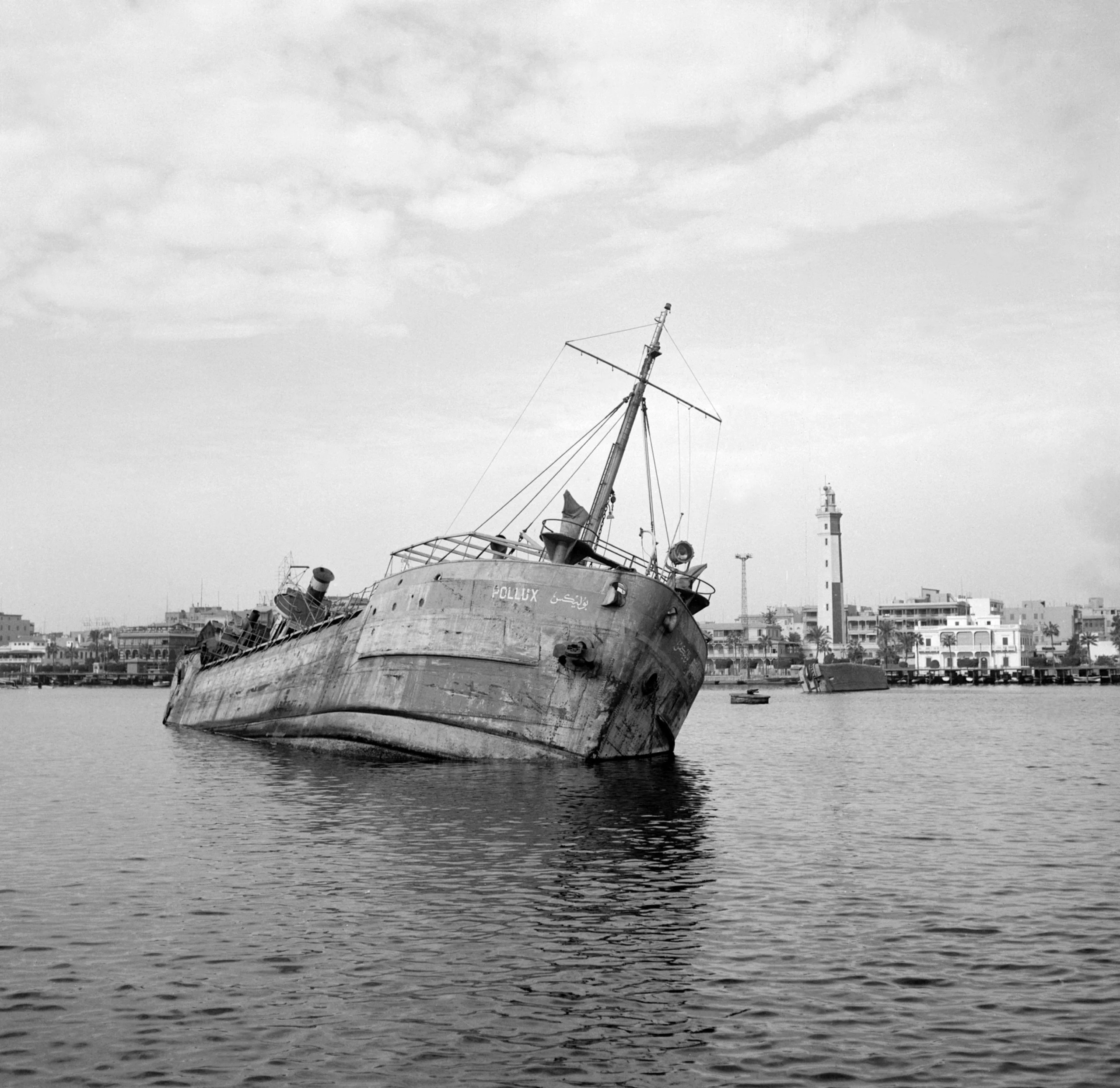 The ships sunk by Egypt during the 1956 Suez Canal incident
The 1956 Suez Crisis, in which the United States undermined British French objectives, pleased Mao. He observed disunity within the Western bloc and judged old style gunboat colonialism to be in decline. His 1957 remark in Moscow that “the east wind prevails over the west wind” reflected this confidence. In the 1958 Jinmen Artillery Bombardment, he internally advocated meeting John Foster Dulles’ “brink of war policy” with a policy of one’s own brinkmanship. Thirty six formal protests were lodged before US forces reluctantly respected China’s twelve nautical mile territorial sea claim. After this episode, Mao downplayed external military threats and refocused attention inward. In 1959 he raised the danger of “peaceful evolution” as articulated by Dulles, and condemned Khrushchev’s conduct in the United States as revisionist stating: “The domestic source of revisionism is survivals of capitalism; its foreign source is subservience to imperialist pressure.” This formed the intellectual origin of 1970s press critiques of both class capitulation and national capitulation, treated as inherently interconnected phenomena.
Having fought and defeated US forces, China secured deterrent credibility, which the Jinmen crisis subsequently tested. Mao came to discount direct US military peril. Internal speeches described US troops scattered across global bases like “ox tails tied to stakes”, not poised for offensive action. External threats, he believed, could be managed through China’s own strengths. The critical question became whether Chinese society could organize its domestic forces, whether elites would sustain the will to resist foreign powers–rather than follow Khrushchev’s path, representing privileged strata through domestic class capitulation and external national capitulation. Improvements in China’s security environment reinforced lessons from Jinggang era intra Party disputes. Security now hinged on whether managerial strata would develop separate power-interest pursuits and drift away from the masses, reverting to old ruling class patterns. This constituted the precondition for uniting popular energies and bridging domestic class rifts to stand united externally. Modern-history figures such as Empress Dowager Cixi and Chiang Kai shek ruling class representatives who prioritized internal repression over national resistance were held up as negative examples. Their conduct was interpreted as resulting from domestic class contradictions overriding national contradictions. For Mao, China’s national security problem thus turned on whether the Communist Party might degenerate into a new ruling class. Should that happen, sharp contradictions with the popular masses would ensue, bringing national capitulation abroad and destroying national security.
In sum, after the Korean War Mao concluded that although China’s tangible national power remained limited, it could be offset by intangible strength. Experience from base area governance showed enhancing intangible strength required popular participation by managerial strata. Yet managers often resisted popular oriented policies to pursue their own power and interests generating the narrative framework of “history of line struggles” prominent in the Cultural Revolution. The United States becoming bogged down in the Vietnam War reinforced the thesis that “paper tiger” adversaries were not to be feared and that internal factors proved decisive. Ultimately, Mao universalized competitive lessons drawn from China’s civil war and applied them to international relations analysis. Resistance to foreign powers came to hinge on whether domestic managerial strata would accept flat, mass oriented revolutionary lines. Domestic success in “opposing and guarding against revisionism” would in turn settle questions of external competitive outcomes. It was from this vantage point that he formulated the “Three Worlds” theory, transcending analytical frameworks centered purely on social systems or geopolitics. It was not merely that “Soviet social imperialism” committed aggression and exploitation abroad; rather, the Soviet revisionist model demonstrated how privileged strata within weak competitors prevented them from building effective intangible strength to confront dominant powers. For Mao, solving China’s place within the global order ultimately boiled down to domestic obstacles within managerial strata. In this sense, interpretations that cast the “Three Worlds” theory as a break from ultra leftism or as a move beyond ideological disputes are inaccurate. Instead, it represents a deepening of his late career anti revisionist thinking: framing weak nation external competition fundamentally as a question of whether domestic managerial elites would embrace flat, mass oriented revolutionary lines.
IV. Concluding Reflections: What Mao Zedong Perceived
Mao’s administrative model implemented at Jinggang Mountain here termed “flat administration” exhibited three features: economic egalitarianism, political egalitarianism, and mobilization of large numbers of activist cadres to assist formal administrators. Managerial power and privileges were minimized. Within Communist base areas, this produced a social landscape with sharply narrowed three major distinctions. Should this model be sustained under a governing Communist Party, societal flattening would follow. Intangible strength could rise to levels sufficient to defeat powerful adversaries without heavy reliance on coercive bureaucratic rules. Higher organizational capacity within the Red Army rested not on top down coercion, but on awakening grassroots initiative just as competitive will (then termed class consciousness) grew through bringing managerial strata into contact with the masses.
Read through Marx’s theory of alienation, Mao’s administrative vision sought to minimize alienation. The goal was not maximizing superiors’ control over subordinates, but combining grassroots initiative with guidance from above. As Mao summarized it, the aim was to realize unity between officers soldiers and between military civilians, rather than governing through bureaucracy and commandism. After 1949, Mao resurrected domestic war competitive insights to analyze global level competition. By the late 1950s, he tended to treat weaknesses within domestic managerial strata as the primary source of potential foreign policy failure the birth of his preoccupation with “turning revisionist”. Rewriting Party history as a “history of line struggles” during the Cultural Revolution amplified this conviction. When the “Three Worlds” theory was formally articulated in the early 1970s, external competitive outcomes were treated as inevitable consequences of domestic managerial degeneration. Khrushchev’s foreign capitulation stood as the emblematic symptom of a Soviet high salary privileged stratum developing independent class interests.
Surveying Mao’s lifetime: from mass line rectification in the Jiangxi base areas, to small group criticism self criticism in Yan’an; from the 1957 call for “open door rectification” granting citizens rights to “big character posters, open debate, airing views freely, and contending freely”, to Cultural Revolution era calls for popular mobilization to criticize and constrain elites he persistently sought institutional mechanisms to hold managerial strata accountable to the masses. His reasoning formed a cycle: effective external resistance demanded high domestic unity, which required reluctant managerial elites to abandon conventional ruling class administrative approaches in favour of mass oriented lines. Scholars of Mao’s political thought consistently note his enduring commitment to analyzing contradictions through the lens of “one divides into two”. Contrary to later narratives decrying “egalitarianism breeding indolence”, Mao never treated passivity among the governed as his primary concern. He consistently located administrative failures first and foremost in shortcomings among managers a conviction that hardened in his final years. In a 1964 philosophical conversation with Gong Yuzhi and others, he elevated this outlook to a world view modestly calling it “peasant born philosophy”. He argued that among Marxism’s three components, the foundation lay in sociology and class struggle.
For Mao, large Third World nations such as China faced conditions analogous to fighting strong foes from weakness. High level domestic integration was essential; chasms between elites and the populace must not grow too wide. His abiding concern: to effectively “oppose imperialism” abroad, one must resolve the task of “opposing revisionism” at home. Class analysis thereby crossed national borders. Domestic ruling class collaborators functioned as agents of imperial exploitation, while transnational alliances among global ruling classes underpinned the oppression of Third World peoples. This constitutes the core logic of Mao’s late career thought. Certain aspects of his diagnoses of global power configurations and the vulnerabilities of managerial strata in peripheral states have been partially vindicated by history. Yet valid problem awareness does not mean all practical dilemmas were thereby solved.
Editor: zhangyixincq