


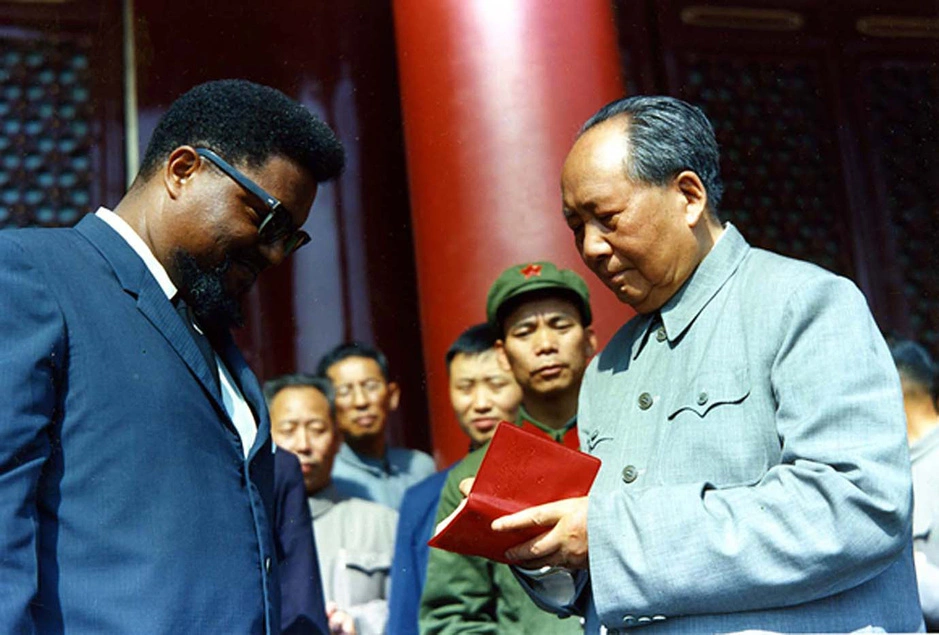
 Mao and Robert Williams
On September 9, 2026, fifty years after Mao Zedong’s death, we remember him. On April 16, 1968, Mao was himself speaking about a man who had just died. Twelve days earlier, Martin Luther King Jr. had been assassinated in Memphis. Mao did not write him an obituary in any conventional sense; in fact, King did not remain in the statement for very long. The dead quickly receded into the background. In the foreground appeared Black Americans, American working people, the Vietnamese people, and—as Mao so often put it—“the people of the whole world.”
The world revolution has now entered a great new era. The struggle of the Black people in the United States for emancipation is a component part of the general struggle of all the people of the world against U.S. imperialism, a component part of the contemporary world revolution.
This has always made me think. Why should a Chinese proletarian revolutionary care about the liberation of Black Americans—especially when this part of the history is so often forgotten? It is worth remembering that Mao’s support for racial liberation was not a one-off act of opportunism or political hitchhiking. In 1963, at the request of Robert F. Williams, Mao publicly issued a statement supporting the struggle of Black Americans against racial discrimination. According to Williams’s later recollection, Mao was the only major world leader to respond publicly to his appeal for international support. Earlier still, W. E. B. Du Bois had come to China and spoken with Mao about Black people, Africa, and world liberation. In Mao’s statements and writings, the racial question inside the United States was explicitly placed within the history of world socialist revolution—within the concerns of Marxism itself.
Why?
For a Marxist like Mao, the antagonism between capital and labor, between those who possess and those who do not, was the fundamental contradiction structuring capitalist society. The dominant form of domination was capitalist.
But this does not mean that every other contradiction is an illusion. Capital did not invent skin color. It did not invent nations, nor did it invent men and women. What is distinctive about capitalism is its ability to reorganize social differences that already exist under the “general illumination” of capital, incorporating them into property relations, labor markets, colonial expansion, and social reproduction. When Mao said that “in the final analysis, a national struggle is a question of class struggle,” then, the worst possible reading would be to turn “class” into a denominator that simply cancels everything else out.
Another sentence of his makes the point more concretely: “The evil system of colonialism and imperialism arose and throve with the enslavement of Negroes and the trade in Negroes, and it will surely come to its end with the complete emancipation of the Black people.” Black liberation did not become a concern for socialists only after being renamed “class struggle.” The slave trade, colonialism, capitalism, and the modern imperial order were already entangled histories. Socialist revolution could not simply go around Black liberation.
A Marxist cannot take part only in movements that already carry the label of socialism. Politics has never been that convenient.
The same strategy applies, on another scale, to struggles for national independence.
National independence alone is not socialism. When an African country lowers the flag of its colonizer, it does not wake up the next morning having abolished its own bourgeoisie. Charles de Gaulle did not become a communist simply because he resisted American control. It is precisely for this reason that Mao’s conception of world revolution moved from the “intermediate zone” to the “two intermediate zones,” and eventually to the “Three Worlds.”
National liberation movements in Asia, Africa, and Latin America could weaken the colonial system. France’s pursuit of strategic autonomy could pry open the U.S.-led Western bloc. Capitalist Japan and Europe had real contradictions with the United States. And after the Sino-Soviet split, a Soviet Union that still called itself socialist could itself become a hegemonic power China needed to oppose. By 1974, in conversation with Zambian President Kenneth Kaunda, Mao had compressed these judgments into an extraordinarily simple division: the United States and the Soviet Union constituted the First World; Japan, Europe, and Canada the Second; the countries of Asia, Africa, and Latin America the Third. China, too, belonged to the Third World.
The Three Worlds was first of all a political strategy, not a social theory; above all, it was a map of the battlefield. It answered the questions of a particular historical moment: Who is the principal enemy? Who can be united with? Which contradiction must be dealt with first? Socialist Soviet Union and capitalist America could therefore temporarily occupy the same strategic category; capitalist France could become a partner in China’s effort to break through its isolation. Whether every one of these judgments was correct is open to debate. But the theory put an unavoidable question squarely on the agenda: if world revolution is to become politics, it must deal with real forces that refuse to arrange themselves along the clean lines of theory.
Because to act on a world scale, a Marxist must know how to find his allies, identify his enemies, and enter wars that work to his advantage. More importantly, he must never lose himself in the victory of one war, or in the embrace of his own allies. He knows where he is going.
Of course, that last sentence is the difficult one. I have long thought that a good deal of Left politics over the past two decades has become trapped precisely here. We have become increasingly skilled at deciding which side to “stand with” in a particular conflict, while asking less and less often: what happens after we stand there? The opposite problem exists as well. Faced with the fragmentation of politics into identity and piecemeal reform, part of the Left has retreated into an answer that is almost too comfortable, as though simply pronouncing the word “class” could make the complexity of the world fall back into place.
Again, this is not easy. But allow me to borrow Mao’s favorite mythological figure: Sun Wukong, the Monkey King. His seventy-two transformations were his great talent. Different demons required different tactics. Sometimes he fought them head-on; sometimes he crawled inside their stomachs; sometimes he borrowed a magical fan; sometimes he even had to ask for help from gods he might not have particularly liked the day before. A revolutionary who truly enters world politics probably cannot afford to have only one posture. But the seventy-two transformations were never Sun Wukong’s destination. No matter what he turned himself into, he still had to keep heading west.
What does “the West” look like?
In my view, it certainly does not look like a gray world in which every difference has finally been erased. Color would differ, but it wouldn’t matter that much. Nationality would differ, but it wouldn’t matter that much. Class would matter in a different way: after a long march, the antagonistic opposition between classes would disappear together with the bourgeoisie as a class.
Editor: Yida