


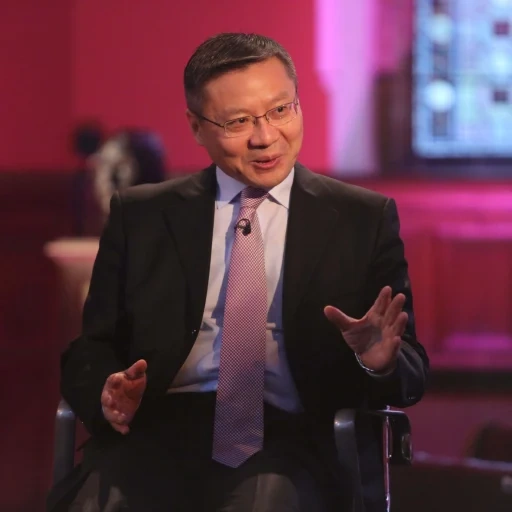
TASS: What are China’s former president Jiang Zemin’s contribution to China?
Zhang Weiwei: Jiang Zemin became General Secretary of the Communist Party of China (CPC) when the entire global socialist cause was going through a low point.
He was identified as the core of what we call the leadership of the “third generation.”The core of the first generation was Mao Zedong, the core of the second generation was Deng Xiaoping, and the core of the third generation was Jiang Zemin. From 1989 onward, during the period when he served as the top leadership figure of the CPC, up through the time he served as General Secretary and as Chairman of the Central Military Commission, and so on, he made outstanding contributions to China’s reform and development and to the rise of China.
Let me give a few examples. One is the “Three Represents” he proposed. This is our official way of articulating the Party’s ideology: the Communist Party of China should represent the fundamental interests of the Chinese people; the orientation of our advanced culture; and third, the development trend of China’s advanced productive forces.
This last point is extremely important. What does it actually mean to represent the development trend of advanced productive forces? For example, today we have AI technology, many countries are hesitant to embrace it, but China has no such hesitation. Because we define AI as an advanced productive force, we believe we must represent it. We view its development as an irresistible historical trend, so we accept it openly and confidently. At the same time, our AI development is guided by a “people first” principle, this is a Chinese philosophy that ensures the benefits reach the majority of the population. If you are committed to representing the people’s overall interests, you will inevitably encounter challenges along the way, and we will resolve them as they some. Thus, while this is an ideology at its core, it is also eminently practical; it can be put into practice and translate into tangible, concrete results that people can genuinely feel.
I understand that Russia’s constitution does not establish any state ideology, and that is Russia’s internal affair, so we do not interfere. However, the Chinese people remember a famous saying by Chairman Mao Zedong: if ideology is a battleground, and you fail to hold it, your enemy will seize it. Social development does not take place in a vacuum. That is why we openly put forward the “Three Represents.” As history has now shown, the “Three Represents” have stood the test of time.
Another key point is that during Jiang’s tenure as both General Secretary and State President, China established the socialist market economy system. This was a landmark achievement, because it explicitly recognized the role of the market. Previously, under socialism, many people were skeptical of markets, often dismissing them as inherently “capitalist.” But in 1992, that changed, Deng Xiaoping made it clear that the market is a neutral tool. Socialism can harness it, and so can capitalism. Then in 1992, China formally adopted the socialist market economy as its economic system. Under this framework, the market and the government each perform their functions in close coordination, forming a highly complementary relationship that has been a key driver of China’s economic rise to this day.
Take internet applications as an example. In China, the infrastructure is mainly built and operated by state-owned enterprises, while applications like e-commerce are driven by private companies. The effective integration of these two sectors has enabled what we call “one phone can take care of everything.” Behind this is the socialist market economy, a mixed model that has demonstrated remarkable success.
Also, during Jiang’s tenure, NATO bombed the Chinese embassy in Belgrade, Yugoslavia.
Prior to that, China’s emphasis had been on developing the national economy and building military strength, and we said that national defense should serve the development of the national economy: first the economy, then defense, with overall priority on the economy. But the NATO’s bombing of Yugoslavia was a wake-up call for the entire country, and especially for our leadership. It made clear that we needed to act quickly and strengthen our defense capabilities. In the comments on the final document issued by the Central Committee of the CPC about him, they specifically refer to Jiang’s ideas on national defense and military building. In particular, in the high-tech arena and the defense industry, he proposed many important ideas and concrete measures. Looking back now, it’s hard to overstate their significance in any assessment.
Today we are building a strong national defense force. We’ve just passed the 99th anniversary of the founding of the People’s Liberation Army. One important aspect of that is to showcase the achievements of our national defense construction. U.S. Secretary of Defense Hegseth said in an interview last year that China’s hypersonic missiles can, within 20 minutes, destroy all U.S. aircraft carriers. I think he also understands the important achievements that China’s national defense technology has made. This gives us full confidence to say “no” to imperialism and US hegemony.
TASS: What about Jiang’s work in terms of China Russia relations?
Zhang Weiwei: Jiang Zemin had a real talent for languages, he could speak many foreign languages: English, French, Russian, Romanian, and others, at least to a greater or lesser extent. So he also had great enthusiasm for Russia.
When looking at China Russia relations, during the time he served as the Chinese leader, one very important thing was that the relationship shifted from the China–Soviet to China–Russia. After the Soviet Union fell apart, Russia was influenced by the West and identified with Western ideology. We believe Russia made a mistake then, but at that time Russia genuinely hoped to become a member of the West.
During Jiang Zemin’s period, the approach was very clear: regardless of what ideology Russia had, we would develop normal friendly and neighborly relations. Now, looking back, there were a few milestone events during Jiang Zemin’s time. One was the signing of the China–Russia Treaty of Good-Neighborliness and Friendly Cooperation, very clearly stated that these two great powers, China and Russia, would not be enemies, and would remain forever friendly. Within this treaty it is also explicitly stated that the two countries would not form alliances, would not engage in confrontation, and would not target a third party. This kind of development provides the foundation for comprehensive and friendly cooperation between China and Russia.
Another very important aspect is that during his term, China and Russia resolved, once and for all, our boundary disputes. For a long time, the boundary disputes between China and Russia had affected relations between the two countries. But in the end, through negotiations between both sides, especially through the decision of the highest leaders on both sides, including Jiang Zemin personally approving the deal, we signed the boundary negotiation agreement. From then on, the 4,300 kilometer long China Russia border became a border friendly to the people of both countries, and neighborly friendship and cooperation between the two countries were developed along that border.
So, looking back, the achievement of the boundary agreement and the signing of the Treaty of Good-Neighborliness and Friendly Cooperation are likely Jiang Zemin’s most valuable contributions to China–Russia relations.
Editor: Zhiyu Wang