

Lucas Velidakis: You famously debated Francis Fukuyama in 2011, at a moment when liberal democracy still appeared to many to be the inevitable destination of political development. Fifteen years later, do you believe you won that argument — and, if so, what exactly has history proved you right about?
Zhang Weiwei: Indeed, I debated Francis Fukuyama on the China model in Shanghai fifteen years ago in July 2011. This debate has resurfaced as a hot topic in Chinese social media this year. Some commentators have summed up the debate by referencing five political forecasts I made then. Let me share them with you:
First, on the “Arab Spring”. When Fukuyama suggested that China might experience its own “Arab Spring” which was sweeping across the Arab world then, I said “no chance” and predicted that the Arab Spring would soon become “Arab Winter”.
Second, on populism. When he argued that a mature democracy like the United States could handle the challenge of populism, I said that low-minded populism would eventually destroy Western democracy.
Third, on leadership selection. When Fukuyama raised what he called China’s “bad emperor problem,” I explained how China had resolved the issue through its institutional reforms,and I cautioned him that the U.S. political system is a product of the pre-industrial era, and if it fails to reform itself, it might well elect leaders worse than George W. Bush.
Fourth, on cultural convergence. When he expressed his belief that globalization would lead to cultural convergence, I argued that on the contrary, globalization would make different peoples more aware of their own cultural uniqueness, and a civilizational state holds many inherent wisdoms, which American politics lacks.
Fifth, on the “end of history” itself. My overarching conclusion was that it’s not the end of history, but it’s the end of the “end of history.”
Looking back, most observers would agree that my views have better stood the test of time.
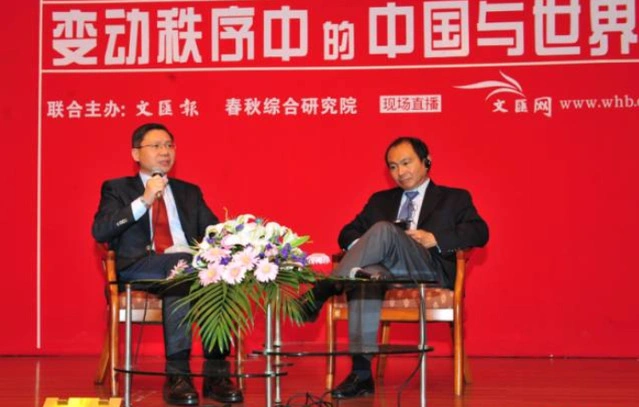 On June 27, 2011, Professor Francis Fukuyama of Stanford University was invited to deliver a speech in China and engage in a debate with Professor Zhang Weiwei regarding the “China Model.”
Lucas Velidakis: You argue that China represents a “civilizational state” rather than simply another nation-state. But why should thousands of years of civilization confer political legitimacy on the government that happens to rule China today?
Zhang Weiwei: True, China is not a typical nation-state but a civilizational state—an amalgam of the world’s longest continuous civilization with a massive modern state. An imperfect yet illustrative analogy would be a Roman Empire that evolved into the 21st century: a centralized entity governing a vast continent with a super-modern economy and a population three times that of the EU. Its people, though speaking thousands of dialects, are united by a single written script spanning millennia. Such a state, forged over millennia from hundreds of polities, would risk disintegration under a Western adversarial model. China’s 1911 Republican Revolution proved this tragically: transplanting the American system resulted in warlordism and the loss of millions of lives, a lesson most Chinese will never forget.
As a civilizational state, China’s legitimacy is deeply anchored in its historical continuum. Since its first unification under Emperor Qin in 221 BC, the Chinese polity has evolved through distinct historical epochs. While China’s contemporary one-party governance may appear illegitimate through the lens of Western liberal democracy, to most Chinese, it is a familiar and historically resonant norm.
For the better part of the last two millennia, China has effectively practiced a form of one-party rule, i.e. governance by a unified Confucian ruling elite. Selected through rigorous public examinations (the Keju system, etc.), this meritocratic bureaucracy claimed to represent—and in many instances, genuinely served—the interests of “all under heaven.” Furthermore, during much of this era, China was, by many metrics, a better-governed, more peaceful, and more prosperous state than its European counterparts. It was a governance model that drew the envy of European Enlightenment giants like Voltaire and Leibniz. It was only when China missed the wave of the Industrial Revolution in the 18th century that it began to lag behind the West. Now China is catching up fast, even surpassing the West in more and more critical domains.
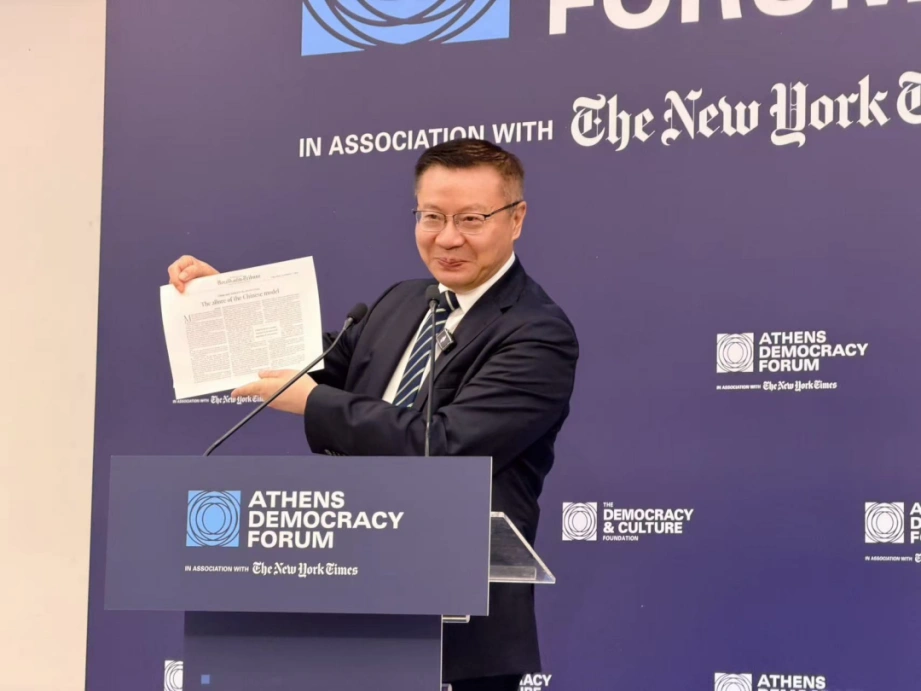 Professor Zhang Weiwei attended the Athens Democracy Forum and, during his speech, displayed his article “The allure of the Chinese model,” published in New York Times on November 2, 2006.
Lucas Velidakis: One of your central criticisms of Western democracy is that elections alone do not guarantee good government. But in a system where citizens cannot vote the ruling party out of office, what is the ultimate mechanism for holding political power accountable when it fails?
Zhang Weiwei: From the Chinese perspective, elections represent merely a form of procedural democracy, rather than the essence of substantial democracy. As a civilizational state, China draws upon the age-old wisdom of distinguishing between Dao (the overarching purpose or the Way) and Shu (the specific procedures or techniques). In this philosophical framework, Dao determines Shu. Consequently, every nation should cultivate its own procedural democracy in light of its national conditions, guided by its unique Dao—which, in the case of China, is the pursuit of good governance. From this vantage point, it is far more constructive to replace the outdated paradigm of “democracy vs. autocracy” with that of “good governance vs. bad governance.”
Without such a paradigm shift, the phenomenon of “elect and regret” risks becoming the norm for most Western democracies. Today, their electoral politics are increasingly distorted by the entanglement of money and power, the rise of social media echo chambers, populist rhetoric, and AI manipulation. One may ask: is the US today a democracy, or has it morphed into a plutocracy? And what of the UK’s Westminster model—is it still a functioning democracy given its revolving door of Prime Ministers? Can one realistically expect their next elections to yield better outcomes?
In contrast, China’s meritocratic system today is essentially a mechanism of “selection + election,” with the former originating from China’s own tradition and the latter from the West. Pioneered by China’s late leader Deng Xiaoping, this institutional arrangement has succeeded in ensuring an orderly transition of power for this vast country over the past five decades. However imperfect, this institutional arrangement has delivered unprecedented improvements in people’s livelihoods, proving itself not only viable but capable of outperforming the Western model in delivering tangible results for the people.
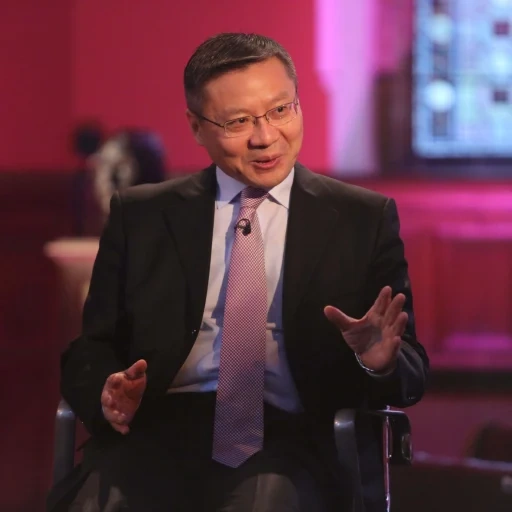
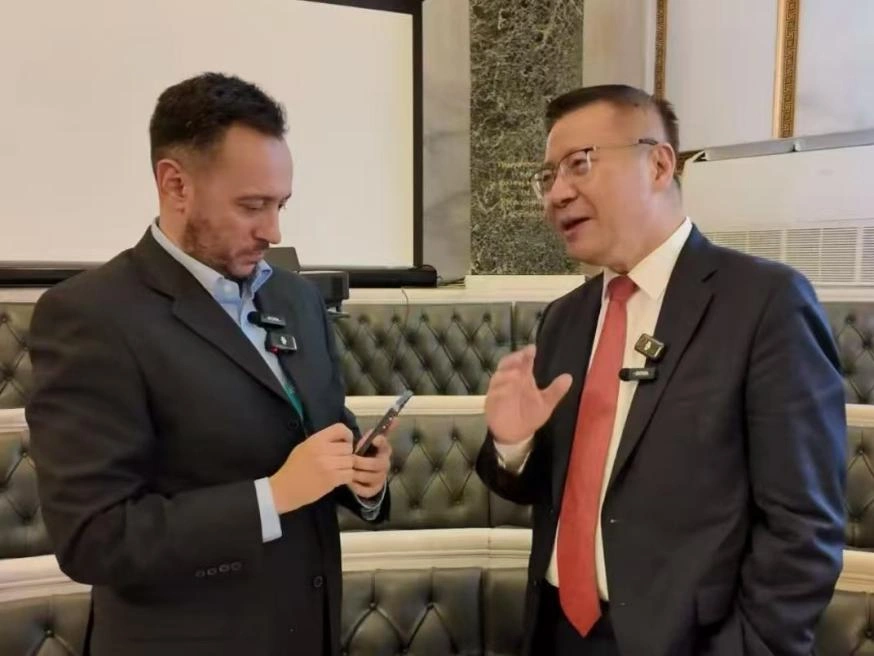 During the forum, Professor Zhang Weiwei gave an exclusive interview to Lucas Velidakis, a senior journalist from Athens Voice.
Lucas Velidakis: The Chinese system places enormous emphasis on competence, meritocracy and long-term planning. But every political system eventually produces bad leaders and bad decisions. What is China’s safeguard against a serious mistake made at the very top?
Zhang Weiwei: Your question brings to mind Winston Churchill’s famous dictum: “Democracy is the worst form of government, except for all those other forms that have been tried.” While this may hold true within the Western cultural context, the Chinese perspective offers a different view. I paraphrase Churchill’s sentiment through the lens of Sun Tzu’s concept of xiaxiace—the “least bad option” which prioritizes the mechanism for the exit of bad leaders. However, in China’s Confucian tradition of meritocracy, the state must always strive for what is termed shangshangce—the “best of the best” option—by selecting leaders of the highest caliber. It is by no means easy, yet this pursuit of excellence must never cease.
China’s political and institutional innovations have thus far produced a system that synthesizes these two imperatives: it combines the “best option” of selecting well-tested leaders with the ‘least bad option’ of facilitating the departure of bad or incompetent leaders through institutionalized democratic centralism as well as a regular retirement system. China’s orderly succession since 1978 stands as a testament to this system’s efficacy.
Lucas Velidakis: You have argued that Western democracies increasingly suffer from populism, short-termism and political paralysis. Donald Trump’s return, the rise of anti-establishment movements across Europe and declining trust in institutions would seem to strengthen your case. But is the crisis of liberal democracy evidence that liberal democracy is wrong — or simply that democracies sometimes govern badly?
Zhang Weiwei: I have long argued that liberal democracy, as practiced today, suffers from three “genetic flaws.”
First, the assumption of the rational human being. In reality, humans are often irrational, a tendency exacerbated in the age of the internet, social media, money politics and AI. Politicians exploit this irrationality to gain votes, as evidenced by the Brexit vote and the rise of Donald Trump.
Second, the assumption of absolute rights. It views individual rights as absolute, leading to the fragmentation of society. The Chinese view, conversely, holds that rights and responsibilities must always be balanced; otherwise, a 21st-century modern society will become ungovernable.
Third, the assumption of the omnipotence of procedures. This posits that as long as the electoral procedure is followed, the outcome is automatically legitimate, regardless of the quality of leadership, and flawed procedures are usually entrenched and unreformable. Consequently, democracy devolves into a “game” of procedural exploitation, where political marketing and cynical maneuvering take precedence over good governance and public interests.
As I mentioned earlier, the Chinese tradition balances Dao (the overarching purpose) and Shu (the procedures). Procedures are the Shu, and they are subject to reform when the Dao dictates the overall interests of the people. This is why China is known for its continuous reform, striving to improve with each passing year, or even passing month. Indeed, it remains my view that unless these “genetic defects” are remedied, Western democracy may well be a mere interlude in the long course of human history. This is my candid view.
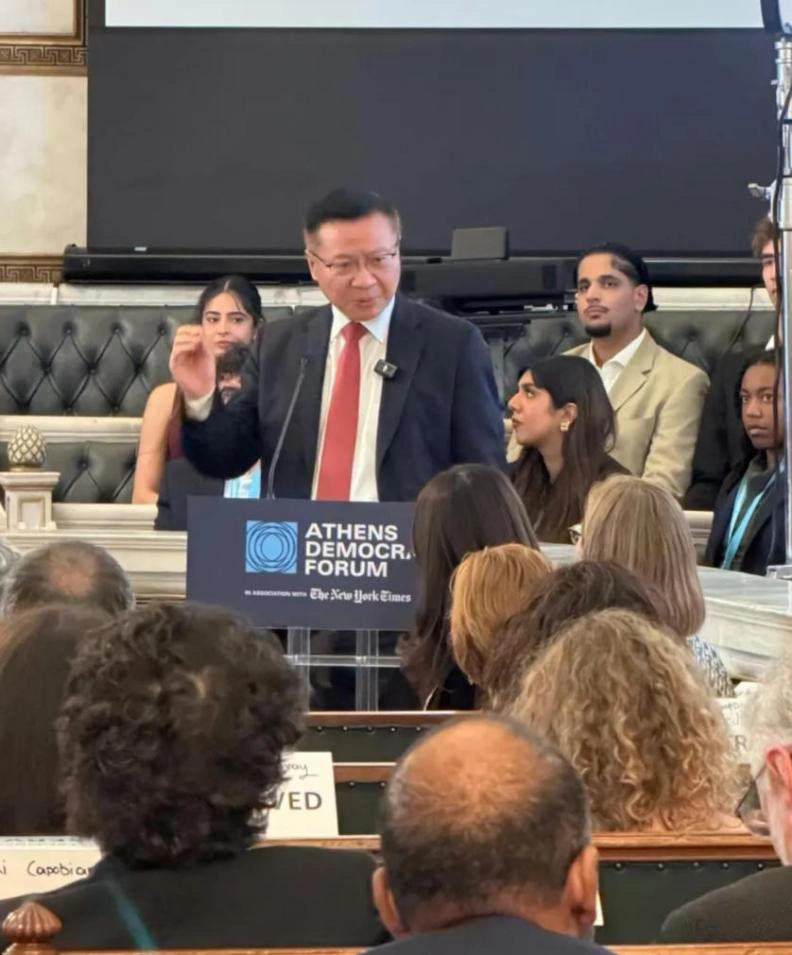 Professor Zhang Weiwei participated in the opening debate of the Athens Democracy Forum held at the Academy of Athens.
Lucas Velidakis: China describes its system as a form of democracy, while critics point to restrictions on opposition, independent media and political dissent. What would you say is the single most important political freedom that a Chinese citizen possesses which Western observers consistently fail to understand?
Zhang Weiwei: Perhaps these critics might first address the rising restrictions targeting opposition voices, independent media and political dissent across much of Europe and the United States today. This is also a major reason why there will be a debate on democracy’s identity crisis in the forthcoming Athens Democracy Forum. Freedom for the Chinese can be understood on two levels: collective rights and individual rights. With regard to collective rights, Chinese people enjoy the precious freedom to say ‘No’ to the United States or any outside power seeking to impose its will on China. One hopes that Europe too can cultivate this freedom to safeguard its autonomy and defend its core interests. Even French President Macron has openly spoken of Europe’s vassal status vis-à-vis the United States. As for individual political freedoms, Chinese citizens deeply value the protection of public order, private property and collective assets, equality before the law, as well as equal pay for equal work — a goal that many Western countries have yet to realize.
Lucas Velidakis: You have suggested that Taiwan may not have another election before reunification. Taiwan today is a pluralist democracy whose citizens repeatedly elect governments that reject Beijing’s political system. If the people of Taiwan do not want unification, by what democratic principle can China impose it upon them?
China insists that peaceful reunification remains its preference, but it also refuses to renounce the use of force. Is there any conceivable circumstance in which you would regard a Chinese military operation against Taiwan as illegitimate?
Zhang Weiwei: First, Taiwan is part of China. This is a fact recognised by nearly all countries and the United Nations. It is also written into Taiwan’s own “constitution”. Elections held in Taiwan are local elections within one region of China, not elections for a separate sovereign state.
Second, the democratic principle at stake here concerns national sovereignty and the will of the entire Chinese nation — not merely the will of residents in one regional part of the country.
Third, no sovereign democratic state permits secession via a unilateral regional referendum. Canada blocks Quebec’s secession attempt; Spain bans the Catalan independence referendum; the United States fought a civil war to stop the southern states from seceding.
Fourth, China’s Anti-Secession Law explicitly reserves the option of employing non-peaceful means and other necessary measures under three conditions: should Taiwan independence separatists bring about a fait accompli of Taiwan’s secession from China, should major incidents of secession occur, or should all possibilities for peaceful reunification be completely exhausted. At present, there is a grave risk that Taiwan’s separatist forces may cross one of these red lines, and the consequences of such a transgression would be decisive and far-reaching.
Lucas Velidakis: Beijing presents itself increasingly as a defender of sovereignty and non-interference. How, then, do you reconcile that principle with China’s close strategic relationship with Russia after its invasion of Ukraine? If territorial sovereignty is fundamental, shouldn’t Ukraine’s territorial integrity be treated as unambiguous?
Zhang Weiwei: Russia’s special military operation remains controversial even within China. Many Chinese observers regard NATO’s five rounds of eastward expansion as the root cause of this crisis. China will not accept any NATO’s expansion into Asia — not even once. China sees both Russia and Ukraine as friends. This conflict resembles two brothers drawn into fighting by external provocation. China supports a negotiated, peaceful settlement of the war and all associated territorial and sovereignty disputes.
Lucas Velidakis: If a young person today asked you to choose between liberal democracy and the Chinese model, what is the strongest argument you could make for China — and what is the strongest argument you would concede to liberal democracy
Zhang Weiwei: Personally, I would not ask any young person to make such a binary choice, precisely because these two models stem from two distinct civilizational logics and governance philosophies.
The Chinese model posits that a government’s legitimacy derives primarily from its performance and tangible outcomes for its people, rather than merely the procedural formalities of the ballot box. It is known for its capacity to deliver substantive freedoms and concrete benefits such as safe streets, world-class infrastructure, easy access to modern amenities, and the rapid, decisive green transition that China has more or less achieved through high-efficiency governance and long-term strategic planning and implementation, all deeply rooted in the logic of a civilizational state.
Under this framework, the state exists to serve the broader public good, resisting capture by narrow interest groups. Leaders undergo rigorous, decades-long governance experience across multiple tiers before assuming top office. Democracy is a whole process, not confined to a single, fleeting moment of voting; instead, it means democratic consultation, deliberation, decision-making, and oversight into the very fabric of day-to-day governance.
Chinese culture is inherently a culture of learning. As Confucius famously observed, “Among three travellers, there is always one who can be my teacher.” We have learned a great deal from the West and remain open to further learning. As I mentioned earlier, China’s political model can be described as “selection plus election”, in which “selection” draws from deep-rooted Chinese tradition, while “election” adapts Western practices. Frankly speaking, I believe the West stands to gain much by learning from the China model for its own good. That said, China does not have messianic tradition of exporting its values or imposing its model on others. That in itself is a democratic spirit: respecting each nation’s own choice, wouldn’t you agree?
Lucas Velidakis: Thank you very much for the interview.
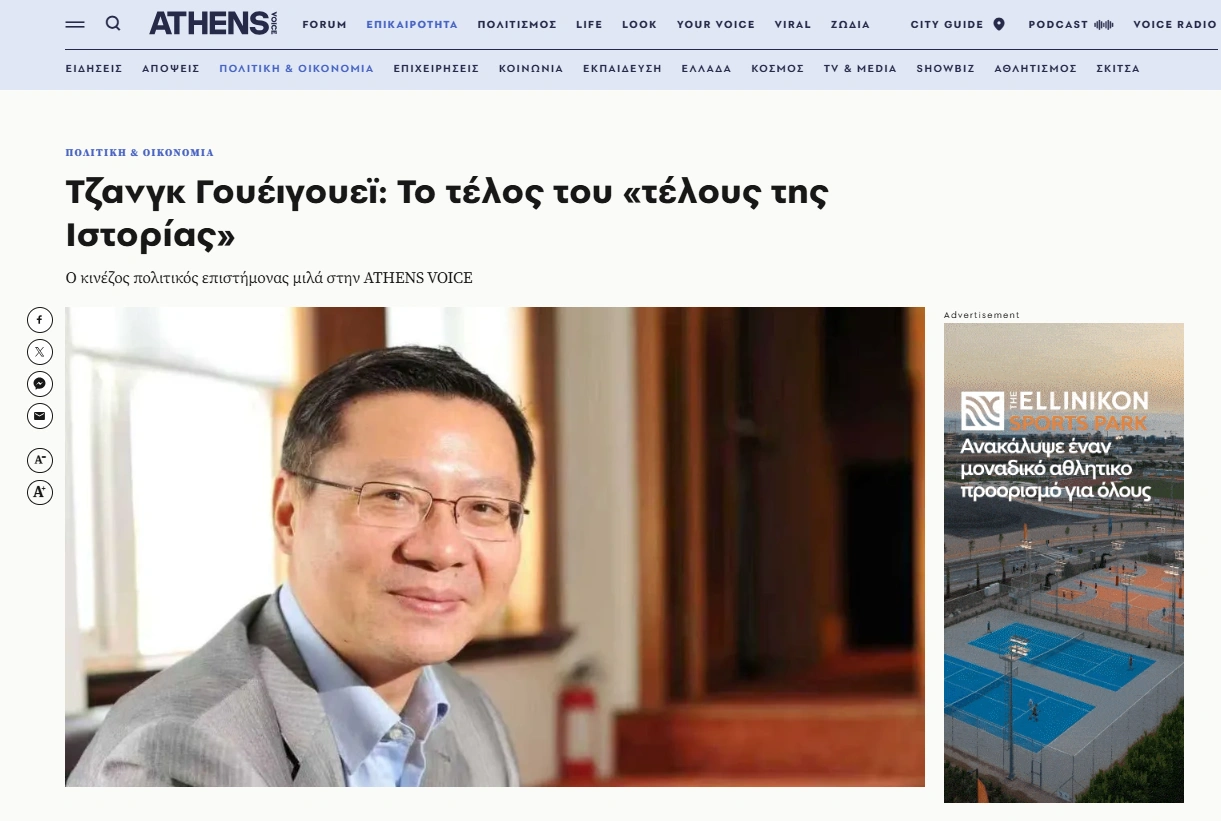 Athens Voice’s coverage of the interview with Professor Zhang Weiwei
Editor: Chang Zhangjin