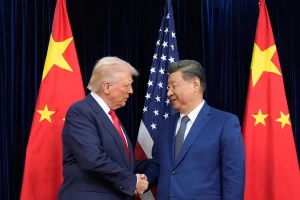



The China Academy: The phone call between Xi and Trump. I’d like to compare notes very briefly: statements from both sides now leading the headlines, the agreement that Trump is going to visit China in April. And now that is the same on both sides, and also positive sentiment is also the same on both sides’ releases.
But the White House stressed that the core focused on trade, but Chinese state media emphasized Trump’s acknowledgement of China’s important contribution towards the world’s fight against fascism and a recognition that Taiwan is of great importance to China.
And another anecdote, Western media stresses that in an unusual — and I quote, they say in an unusual move — it is President Xi who initiated the call to President Trump.
Let’s hear your take on this, Professor Shen.
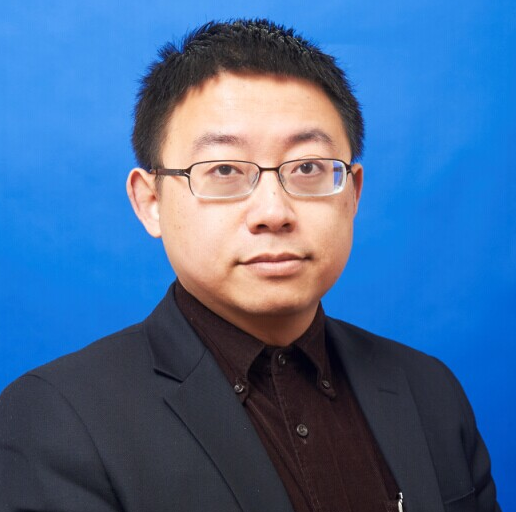
Shen Yi: Say that the information comes from the FMPRC, that in the press conference they confirmed it’s President Trump, not President Xi Jinping, that initiated the call. Mao Ning made this announcement in this afternoon’s press conference of FMPRC.
But I noted that in the Chinese version of this statement, there are two Chinese terms that are neglected from the statement.
As usual, if Trump makes the call we will say that President Xi Jinping “应邀,” as he was invited. But this time this “应邀” has been removed; they didn’t mention so.
I think that maybe Trump made the call, but both sides had the intention to call each other.
I have something to say to you and you have something to say to me and we can dialogue.
It’s not politically correct, but just some sounds like G2 models.
These two great powers, they sit down and dialogue with each other. How to deal with those things is a virtue, which is very sensitive, which is very important to stabilize their bilateral relationships and then stabilize the regional and world situations in a more general way. The first.
And second, it’s the second time that when the release of the readout between Xi Jinping and President Trump from the FM PRC, they said 中美相互成就,共同繁荣, US and China make each other successful or contribute to each other’s success and then bring to a common prosperity. It’s the first time in the Chinese statement saying that the United States and China can contribute to each other’s success.
So this is very interesting because today from China’s side, frankly speaking, when talking about the success of China that the United States can make contribution to, the number one thing is Taiwan issues.
While at the same time, what the United States needs from China’s side and help or contribution to the success of the United States, or in their terms, MAGA, is economy, the soybeans, import and export trade deficit, trade balance, and so on.
So I find that’s very interesting. From the Chinese side, focusing on Taiwan issues; from the United States, they are focusing on these trade issues.
Just like that, these two guys, they dialogue with each other and then they get everything they need from the other side. And they express the part that they need; they take what the part that the deal among these two guys and then both guys get the best part of the deals and express it to other countries. I think that’s maybe a kind of the real face of great power diplomacy because diplomacy means compromise.
Maybe the most important — if my memory is clear — it will be my first time to learn that it’s a US presidency that fully understands the importance of the Taiwan question to China.
And we know that for quite a long time, if you go back to the Joe Biden administration or go back to even Obama or Junior Bush or even Clinton, the United States has a quite framed narrative structure when talking about the Taiwan issues. It’s just like these things from China’s side trying to say that, hey, you US guys need to insist on the One China policy, or One China principle.
And the United States says we will insist on One China policies with the guide of the US Taiwan Relations Act. There are three joint communiqués and the “Six Assurances” provided by the Reagan administration to Taiwan. They use this kind of very long sentence to very precisely describe the United States’ strategic blur policies toward Taiwan issues.
But this time Trump said that first China made a great contribution to the victory of the Second World War. And then he said that the United States fully understands the importance of Taiwan to China. That’s providing another narrative.
It’s just like saying that, okay. From China’s side, President Xi Jinping said that Taiwan belongs to China as part of the arrangement of the so-called post–Second World War international order. This order is jointly produced by the victors of the Allied camps of the Second World War, which means the United States and China joined together fighting against fascism, fighting against Japanese militarism, and then they built this post–Second World War international order.
And even China says that it’s a proper time again today that the United States and China stand shoulder to shoulder to fight against or to help safeguard this order, and the United States acknowledges or says yes; he did not see any de facto opposing voice on that new narrative. That’s providing a huge space for imagination.
And in that direction, you can imagine any potential constructive possible cooperation patterns between China and the United States to solve this Taiwan question.
The China Academy: What must be happening in the imagination of Takaichi right now?
ShenYi:She can just keeps silence.
Japanese media reported that after his call with Xi Jinping, Trump also called Takaichi. However, Takaichi’s summary of the call was “no comment.”
In the Second World War — and we have a joke to laugh at those stupid Japanese military generals — they say that they put some small victories “往水里掺战果,” that in normal ways people say “往战果里掺水,” which means you’re adding one or two percent of water into the real victory result. But he just does the opposite way; it’s pure water. It means they gained nothing.
And then they put very small fragmented piece of so-called victory and add it into those waters and say we make sense, we make huge victories. That tradition, that’s a kind of culture embedded in their DNA for those people like today’s Japanese prime ministers.
But for just such kind of guys, she can say nothing. She has nothing to prove her victory from the call from the United States.
She can say nothing. When people ask what precisely US President Trump talked to you about in this Sino–Japanese relationship — the United States and Japan military allies, to which extent the United States will back up your voice on these Taiwan issues or on this so-called US–Japanese military cooperation — you can see “no comment” because it’s diplomatic, classified issues.
“No comment” means first, nothing constructive. And second, Trump made this call just a few hours after he finished dialogue with President Xi Jinping. And there’s a report from the Japanese side: the call lasted for no more than 20 minutes. According to Japan–US relationships, it’s just like the US side speaks about 15 minutes and the Japanese have 5 minutes. This 15 minutes and 5 minutes will be separated into two parts: one is the original voice and the second is the translation.
So it means the Japanese prime minister had no more than 3 minutes to express her voice — just like はぁい (“yes”) and はぁい, no more than はぁい. And you can imagine how funny this scenario is.
That Trump got the dialogue with his very good friend Xi Jinping and Xi Jinping told him something. And just as Trump finished the call, there are three ships coming from the United States to China, carrying soybeans, exporting from the United States to China.
Best salesman Trump made the good deals. So I think he just provided some information like my relationship with Xi Jinping is perfectly good. Please be smart enough to stand by, or maybe it means you should shut up, keep your voice low, or don’t annoy Xi Jinping anymore till everything Xi Jinping tells you to do, like withdraw your stupid voice.
The most interesting part is if you read the US–Japanese Security Compact, which means the treaty about the US–Japan military cooperation, you will find that the United Nations has been mentioned seven times in that joint agreement between Japan and the United States, also called the military cooperation. Especially in Article Five and Article Seven,.
It’s very interesting: in this Article Five — never mentioned the term “use of force.” It just says the attack on one side will be recognized as a kind of attack on both parties of the treaty, and they will take action according to their constitutional procedures.

Which means constitutional procedures. It means you can take a kind of political reaction, economic reaction, diplomatic reaction, or military reaction. It’s just dependent on your decision.
And the second, it says that when this situation happens, you need to report this situation to the United Nations Security Council. And after UN Security Council makes a kind of decision and takes an action, all those parties, your reactions toward this situation, must be stopped.
So this is not a kind of military treaty just like people imagine that the United States provides military protection to Japan. It’s a very special pattern of relationship in the Cold War framework, just like the United States needs a kind of assistance, a kind of help from the Japanese side, and then the Japanese side can get some freedom to act under that direction or condition.
Without that direction or condition, the Japanese-made so-called Self-Defense Force — they are not allowed to take any so-called collective defense actions in that treaty.
And also, the most important part is Article Seven of that treaty, which insists that any delegation in that treaty framework should not confront or challenge the duties and the delegations of each party which they got in the framework of UN Charters, which means the UN Charter is a kind of advanced law institution to this US–Japan military treaty. The 敌国条款, the Enemy State Clauses of the UN Charter, will be extremely important.(Editor’s Note:the Enemy State Clauses of the UN Charter))

That means that if China acts according to these UN Charters, the United States has the freedom and the right, or even kind of obligations, to not do anything to protect Japan if Japan violates the duties or delegations under the framework of UN Charters. That’s the most interesting part of the latest development of these things.
You will find that Japanese Prime Minister Takaichi made a huge or horrible mistake with a very minor step. She just moved one step forward, but this minor step just violated the whole arrangement set up as the result of the Second World War.
And it provided China and the world society a golden opportunity to reset these enemy-state articles in the UN Charters. In quite a long time people have had a kind of very beautiful imagination — since the Second World War has already finished for longer than half a century — that maybe all these stupid minds or stupid actions have been removed from the state. It will be improper to treat these countries like Axis members according to their horrible war criminal actions in the Second World War.
But nowadays, the Japanese prime minister uses her voice and her actions to prove yes, these articles still have their values. It’s a very, very correct decision that they had not been removed from the UN Charters.
It’s time to trigger them. It’s time to re-empower these articles so that we can have a very powerful international law institution to deter and fight against any potential aggressor, any potential threat to regional orders, which is one of the most important parts of those international orders after the Second World War.
Just like she said “Japan is back,” this Japanese empire wants to be back, and we need to be reminded. It’s a wake-up call. We need to do everything to stop the return of this Japanese military empire.
Editor: Zhongxiaowen