

For the past several years, a convenient but intellectually lazy story has taken hold in the corridors of power in Brussels, Paris and Berlin. It goes like this: Europe’s proud auto and industrial sectors are facing an existential “China Shock” — a tidal wave of state-subsidized Chinese EVs and clean-energy hardware threatening to bankrupt Western manufacturers. The prescribed cure is a fortress of anti-subsidy tariffs, regulatory tripwires and hard-edged protectionism to shield European industry.
That story isn’t just wrong — it’s dangerous. Europe isn’t suffering an external trade shock. It’s suffering a self-inflicted economic illness. What Brussels calls “unfair Chinese competition” is really the predictable final act of financially driven deindustrialization. For four decades, European industrial capital has been systematically sacrificed on the altar of short-term shareholder returns, buybacks and dividends. Now that Chinese private firms have outpaced the old Western brands on both innovation and scale, Europe’s elites are running to the state for protection.
Protectionism won’t save Europe — it will only turn the continent into an industrial museum. The other fashionable idea making the rounds — that Europe should “force” Chinese companies into mandatory joint ventures and technology transfers — is even further removed from reality. It overestimates Europe’s leverage. Anyone who actually weighs the catastrophic cost of a trade war will find that Brussels has almost no cards left to play against Beijing.
Europe cannot coerce Chinese capital. It has to attract it. The way forward runs through reviving the stalled EU-China Comprehensive Agreement on Investment (CAI) and using it to make Europe the most attractive destination on earth for Chinese capital — turning China’s trade surplus into European factories, equipment and jobs.

Two Eras: From Student to Teacher
To understand why Europe’s leverage has evaporated, you have to go back through 41 years of history between Western automakers and China. The story begins in October 1984, when Volkswagen signed the landmark joint-venture agreement that created Shanghai Volkswagen. At the time, the global industry was deeply skeptical: China was poor, lacked infrastructure, and had no private car market to speak of.
For the first three decades of that relationship, the arrangement was essentially colonial. Under China’s mandated 50:50 joint-venture rule, Europe’s legacy brands pulled billions of euros in profit out of a booming Chinese domestic market. Western executives comfortably assumed they would permanently monopolize the high-margin intellectual property — design, engineering, brand premium — while China stayed the low-cost assembly line forever. In Western capitals, this was celebrated as a win-win globalization story. Western governments rarely complained about Chinese state subsidies in those years, because it was their own multinationals reaping the benefit.
Then, around 2015, the structural picture flipped. Having concluded they would never out-engineer Europe on complex internal combustion technology, Chinese planners rolled out the “Made in China 2025” blueprint and redirected the entire industrial system toward new-energy vehicles — the battery-electrics, plug-in hybrids and clean-energy supply chains that now define modern transportation.
That marked a shift from a foreign-led export model to one led by homegrown giants. Before 2015, multinationals operating joint ventures or wholly owned subsidiaries in China accounted for nearly 60% of China’s total manufacturing exports. By 2026, that picture has completely reversed: Chinese private enterprises now generate roughly 65% of China’s total export value, while the foreign-owned share has collapsed to just 22%.
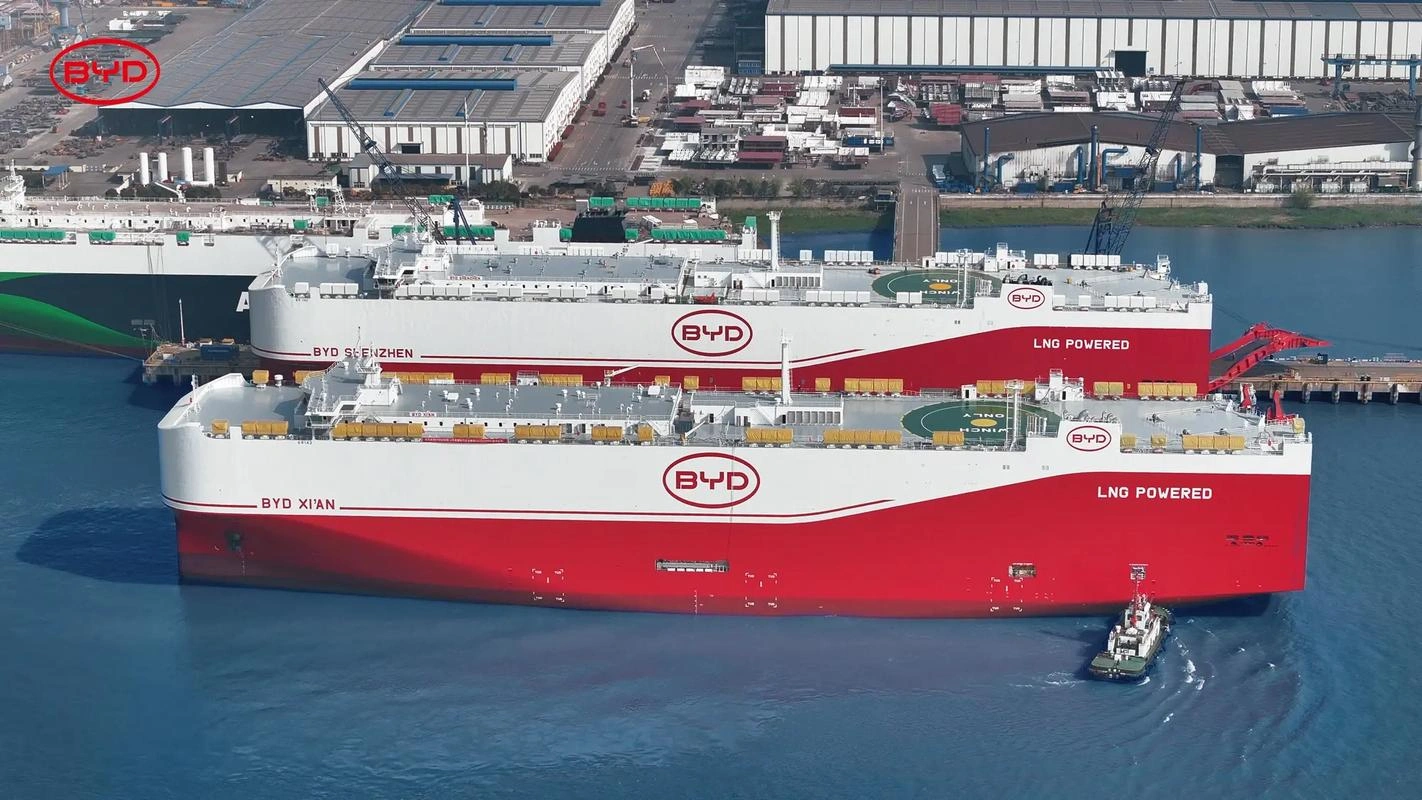
Nowhere is that reversal more visible than in Europe’s own plug-in hybrid market. Chinese brands — BYD, Chery, SAIC — now dominate the fleets of vehicles pouring into European ports, threading their way strategically through the tariff landscape to capture more than a third of all European plug-in hybrid sales. The Chinese “student” has fully absorbed Western manufacturing know-how, paired it with global dominance in battery technology and supply chains, and is now exporting advanced cars back into the very European market that once taught it how to build them.
The Microeconomics of Decline
The West’s sudden moral outrage over Chinese state subsidies conveniently obscures the real culprit behind Europe’s industrial decline: the financialization of European industrial capital. While Chinese firms have relentlessly plowed every yuan of cash flow — backed by state-directed bank credit — back into vertical integration, lithium supply and automated production lines, Europe’s industrial giants have been hollowed out by financial rentiers chasing short-term returns.
To trace the deeper pathology of this decline, it’s worth revisiting the foundational microeconomic critique that Karel Williams and his co-authors laid out in their landmark study of the auto industry, Cars: Analysis, History, Cases. Examining the postwar decline of British and European carmaking against the rapid rise of Japanese mass production, Williams and his colleagues argued that industrial competitiveness comes down to three structural factors: process design, market volume, and market fit. Update that thesis for the post-2010 era, and the parallels between Europe’s historical defeat by Japan and its current rout at the hands of China are startling.
Start with process design. China’s auto industry moved toward deep vertical integration; Europe’s, Williams argued, remained fragmented — undermining high capacity utilization, flexible lean production, and pushing up the structural break-even point. After 2010, rather than fix that historic flaw, Europe’s legacy automakers doubled down on it, outsourcing key components and production steps to a vast, brittle network of global suppliers in pursuit of short-term return on capital employed. That only deepened supply-chain fragmentation and structural inefficiency.
China’s private automakers went the opposite direction. Over the past decade, while European firms poured capital into share buybacks, companies like BYD accelerated vertical integration, designing products from the outset around high-throughput, automated production and bringing batteries, power electronics and chips in-house. By reintegrating vehicle design, factory logistics and component manufacturing, Chinese firms cut out layers of external markup and the efficiency losses of a fragmented supply chain — breaking through the “process design” bottleneck that has long plagued Western automaking.
Second, consider what post-2008 austerity did to Europe’s domestic market. Williams stressed that for capital-intensive, highly automated manufacturing, a stable mass market is what keeps utilization — and margins — high. Without one, both collapse fast.
After the 2008 financial crisis, Europe endured years of harsh fiscal austerity, wage stagnation and crumbling public infrastructure, all of which suppressed domestic purchasing power and shrank the mass market needed to sustain large-scale production. China, meanwhile, used macroeconomic stimulus and state-directed bank lending to aggressively cultivate a mass domestic market for new-energy vehicles, giving its industry the demand it needed to scale.
Against that backdrop, European automakers leaned harder on high-margin luxury exports to markets like China just to keep their sprawling corporate structures afloat — further neglecting the health of their own home market. The result was a vicious cycle: European manufacturers lost the base demand needed to spread fixed costs, while relying on a handful of expensive models to preserve margins, driving utilization down, unit costs up, and the domestic market into further decline.
Third, on market fit and brand trust, Europe’s failures run just as deep. Williams defined “market fit” as the manufacturing discipline of delivering the right car, at the right price, to ordinary consumers. Post-2010 European auto capital lost that discipline entirely. Chasing short-term returns and fat margins, financialized European brands developed a pronounced “premium bias,” abandoning affordable hatchbacks and small sedans in favor of bulky, expensive, higher-margin SUVs. That reliance on low-volume, high-premium models pushed European carmakers further from ordinary consumers and eroded the mass-market base an entire auto ecosystem depends on.
At the same time, European brand equity took its own hit. Volkswagen’s 2015 emissions-cheating scandal didn’t just damage one German giant’s decades of brand credibility — it shook the broader European narrative of engineering reliability and technological leadership. Declining market fit and a brand-trust crisis compounded each other, leaving a gaping hole in the European market. Chinese brands like Chery and BYD moved in right on cue, offering more competitively priced, better-equipped mass-market cars that filled the space Europe’s legacy makers had voluntarily vacated.
In short: post-2008 austerity crushed mass-market demand; rentier profit bias pushed carmakers toward overpriced luxury SUVs; and scandals like Dieselgate demolished brand trust and the technology-leadership story that went with it.
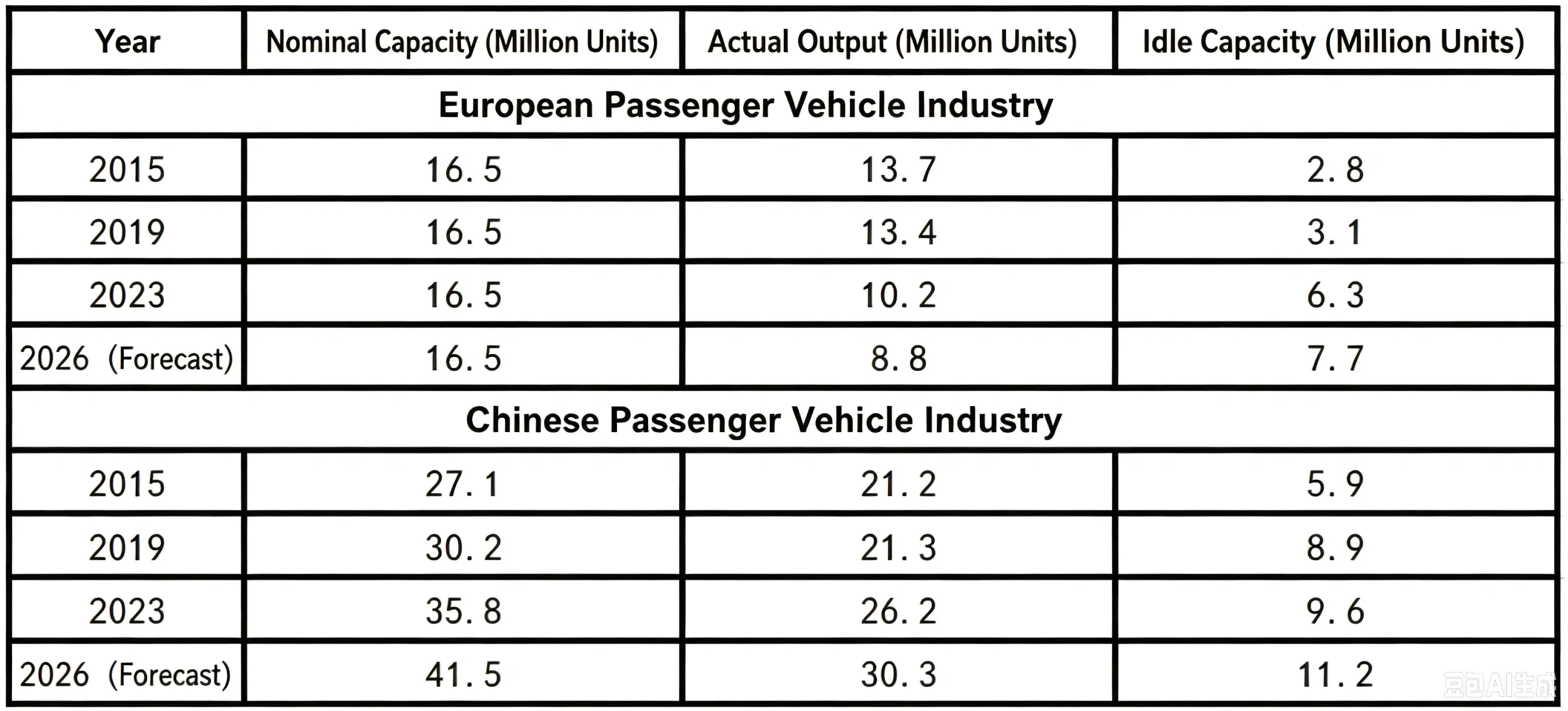
To put numbers behind the Williams thesis — and show how process design, market scale and macro policy together shape factory efficiency — it’s worth tracking capacity utilization in European and Chinese auto manufacturing since 2015. In this industry, 75–80% utilization is generally considered the structural break-even zone; fall below that, and fixed costs like depreciation, tooling and plant overhead can no longer be spread effectively, sending unit costs up and margins into rapid decline.
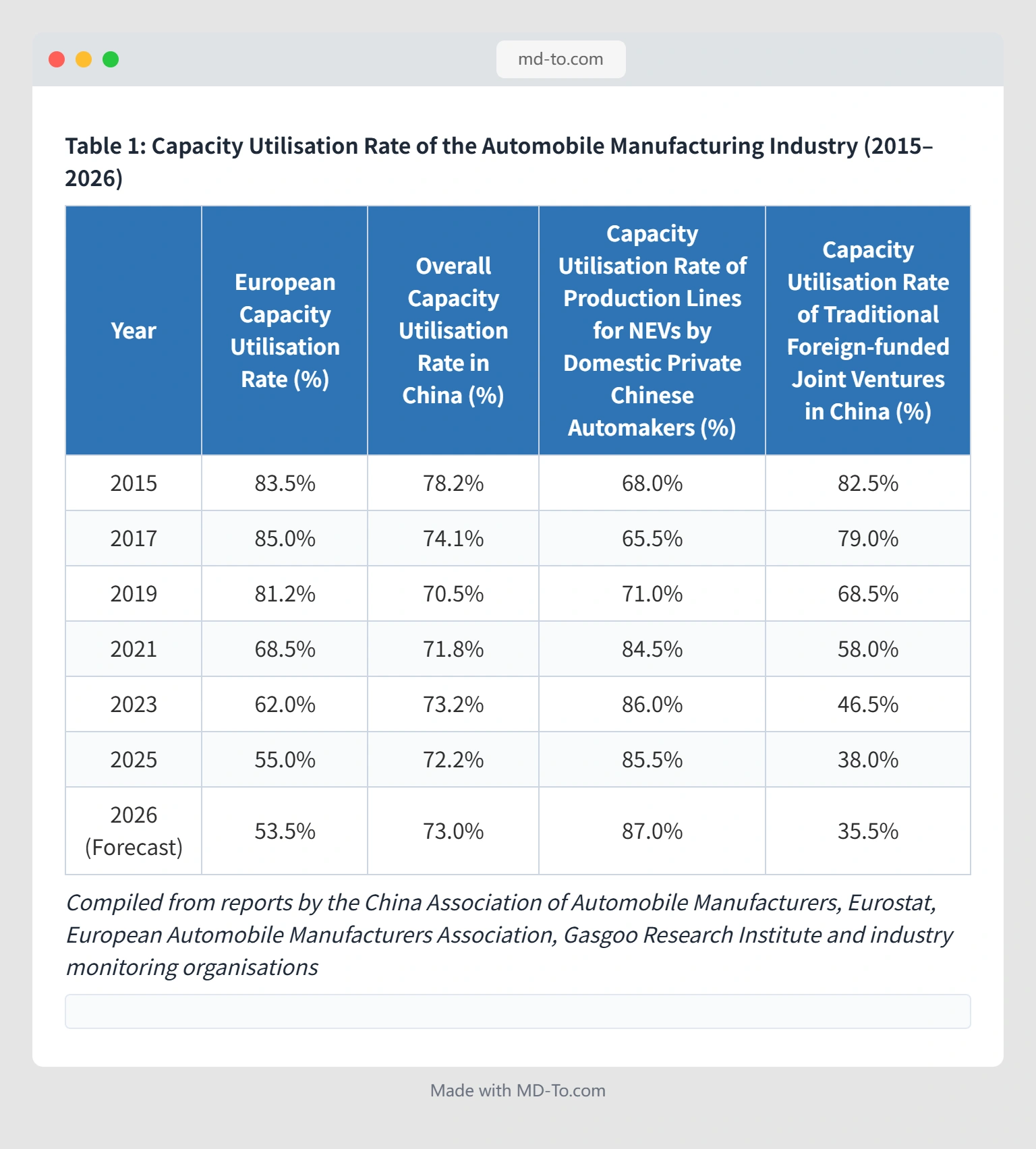
 Compiled from reports by the China Association of Automobile Manufacturers, Eurostat, European Automobile Manufacturers Association, Gasgoo Research Institute and industry monitoring organisations
A decade ago, Europe’s legacy plants were running near full capacity on the back of strong high-end exports, while China was expanding domestic auto capacity to meet explosive middle-class demand. By 2017, the two industrial strategies had begun to visibly diverge: Europe hit a cyclical production peak, while a wave of new Chinese EV entrants temporarily dragged down the national average utilization rate.
By the late 2010s, post-2008 austerity and a structural tilt toward premium models had left European domestic demand stagnant. China, meanwhile, was consolidating its industry and clearing out zombie auto plants. By 2021, Europe’s supply-chain fragility was fully exposed: its outsourcing strategy backfired during the chip shortage, forcing assembly lines to a standstill, while vertically integrated Chinese firms like BYD — with in-house chip design and production — kept running.
By 2023, as the world emerged from the pandemic, the structural divergence became undeniable. Weighed down by high, uncompetitive energy costs, European auto output never recovered to pre-pandemic levels, while China’s homegrown EV makers scaled up fast enough to offset declining output at foreign joint ventures.
By 2025, the picture had fully flipped: Europe fell into structural crisis, with plant closures piling up one after another, while China’s massive export volumes — combined with the retirement of outdated capacity — kept its industry-wide utilization stable.
By mid-2026, the new industrial order had solidified: more than 45% of Europe’s auto capacity now sits idle, while China’s leading private new-energy automakers run automated assembly lines near-optimal capacity — with foreign joint ventures in China left absorbing most of the pain from weak domestic utilization.
Western politicians point to China’s aggregate capacity figures and cry “dumping.” But look at the underlying microeconomics and you find a two-track system.
The legacy laggards: idle domestic capacity is concentrated among foreign joint ventures that failed to electrify in time — think SAIC-Volkswagen — and traditional state-owned automakers, running at an unsustainable 40–50% utilization.
The private-sector leaders: the homegrown firms driving the export boom — BYD, Chery, CATL — run highly automated, vertically integrated plants well above the 80% break-even threshold. They don’t need state life support; their process design alone gives them a cost advantage large enough to absorb tariff pressure with ease.
Over a decade, European auto-industry utilization collapsed from 85% to 53% — a number that captures, in hard data, the twin crises of energy costs and rentier capitalism. As the next section shows, sky-high industrial electricity prices have made life impossible for European parts suppliers, forcing plant closures and idled assembly lines one after another. Europe isn’t losing to bigger subsidies. It’s losing to a rival industrial system running at optimal scale.
That structural divergence confirms the Williams thesis — and punctures the West’s “overcapacity” narrative. With utilization down to 53.5% in 2026, Europe’s auto industry has entered a cost-penalty zone it simply cannot survive in. Legacy European automakers scattered process design across a sprawling web of tier-one and tier-two outsourced suppliers, leaving them with no ability to adjust dynamically when demand shifts.
China, by contrast, shows a genuinely two-track industry. Overall national utilization sits around 73% — dragged down heavily by legacy foreign joint ventures like SAIC-Volkswagen and Changan Ford, which run at just 35.5% as consumers abandon traditional combustion models.
Meanwhile, China’s private-sector leaders — BYD, Chery and others — run near-optimal, vertically integrated new-energy production lines, hitting 87% utilization in 2026. They don’t need artificial state life support. In-house battery cells, unified software-defined vehicle architecture and flexible automated workshops give them a superior process design that lets them keep spreading fixed costs and shrug off foreign tariffs.
The Power Bill Behind the Collapse
To understand why European industry has buckled under this pressure, look at the economics behind the power grid. Europe’s industrial electricity prices sit structurally three to four times higher than benchmark rates in China or the United States. In mainstream macro discourse, energy costs are often treated as a secondary variable — something efficiency gains can offset. That badly misreads the underlying physics of manufacturing.
Expensive electricity is a competitiveness killer, and it behaves like a progressive tax applied at every single stage of the value chain. Take the production chain for a modern electric vehicle, or an industrial machine tool: it doesn’t start on an automated assembly line. It starts in the ultra-high-temperature electric arc furnaces that smelt steel and forge structural aluminum. From there, materials move through chemical processing facilities that crack raw polymers into interior plastic components, then on to semiconductor cleanrooms, which require enormous, uninterrupted HVAC systems to filter air down to the micron level.
The most punishing constraint from high electricity prices falls on battery manufacturing. Producing lithium-ion and LFP battery cells requires energy-intensive electrochemical processing — slurry mixing, continuous roll-to-roll coating, and, critically, cell formation, which demands days of continuous, stable charge-discharge cycling to stabilize a cell’s chemistry and consumes enormous amounts of power throughout.
European manufacturers pay roughly €150 per megawatt-hour; their Chinese competitors pay around €45. That gap doesn’t hit just once — it compounds at every stage: mining, smelting, refining, component supply, final assembly. By the time a part reaches a European vehicle plant, the cost pressure has traveled and compounded through the entire supply chain. The whole surrounding supplier ecosystem gets hollowed out in the process: domestic tier-one and tier-two suppliers simply can’t survive a 300% energy-cost gap.
The bitter irony is that Europe had a chance to avoid all of this. In December 2020, after seven years of grueling negotiations, the EU and China reached agreement in principle on the Comprehensive Agreement on Investment. It was, in its way, a triumph of pragmatic European strategic autonomy — securing unprecedented access to the Chinese market, scrapping mandatory joint-venture rules in key sectors, and building a legitimate, stable channel for China’s growing trade surplus to flow back into European fixed capital investment. It was an economic framework designed to anchor Chinese capital on terms Europe itself could live with.
But just as the agreement sat before the European Parliament awaiting final approval, a geopolitical disaster struck. A moralizing “human rights” agenda was forced onto what had been a technocratic process. Almost overnight, Brussels’ elite set aside the deal’s economic and industrial value in favor of an abstract, performative geopolitical posture — sacrificing concrete industrial survival for symbolism.
Captured by that ideological turn, Western Europe had no defenses left when the 2022 strategic shock hit. Washington had little trouble exploiting Western Europe’s deep-seated fear of Russia, stirring up old survival anxieties to push Europe into a total economic break with Moscow. The first casualty wasn’t Russia — it was the foundation of German industrial power: cheap, abundant pipeline gas.
By severing its energy ties to the East and shelving its investment deal with China at the same time, European industry effectively became a hostage in Washington’s geopolitical game. Europe gave up cheap, stable Russian pipeline gas for wildly overpriced American LNG — and, by joining Washington’s trade war against China, cut off access to the low-cost solar, wind and battery components that could have actually eased its own energy crisis. European industry was caught in a double bind: forced to pay premium prices for American energy while being pushed to build an expensive, unworkable wall of protectionism against Chinese innovation.
The Art of Attraction: Hungary, Spain and the Turkish Cautionary Tale
Brussels’ hardline confrontational approach doesn’t work — and nowhere is that clearer than in the pragmatic choices being made on Europe’s geographic edges. Since Europe can’t coerce Chinese capital, real industrial revival is happening precisely in the places that have figured out how to attract it instead.
1. Hungary’s gravitational pull
Under Budapest’s realist governance, Hungary has become the leading platform in Europe for Chinese capital inflows. BYD’s decision to build its first major European passenger-car plant in Szeged wasn’t handed down by Brussels — it was the natural result of an unusually attractive business environment. Hungary’s government streamlined approvals, co-invested directly in infrastructure, and offered the promise of a stable bilateral relationship free of ideological interference.
By landing BYD, Hungary didn’t just win assembly jobs — it locked in billions of euros in fixed capital investment and pushed Chinese battery and tier-one suppliers to build out a genuine local industrial ecosystem inside the EU customs zone, delivering real economic dividends at home.
2. Spain: the economics of reviving idle industrial assets
Catalonia took a different route — repurposing existing industrial assets. When Nissan closed its historic plant in Barcelona, it left behind a skilled workforce and an idle industrial site. Rather than accept deindustrialization, Spain partnered with Chery, which formed a joint venture with local firm EV Motors to retool the old Nissan plant and start building Omoda and Jaecoo models.
Instead of erecting tariff walls against Chery, Spain treated its underused industrial assets as leverage to attract investment. The result: a revived auto ecosystem, thousands of unionized skilled workers back at work, and China’s efficient, large-scale manufacturing model taking root on Europe’s Mediterranean flank.
3. Turkey’s cautionary tale: the limits of coercion
The most instructive case may be the sharply diverging fortunes of CATL and BYD in Turkey. Although Turkey sits inside the EU customs union, CATL has been able to expand its cooperation there freely, outside Brussels’ political jurisdiction — because Ankara has focused on industrial integration, positioning Turkey as a battery-supply hub serving both European and Middle Eastern markets.
BYD, by contrast, has recently paused and scaled back its long-anticipated plans to build a plant in Turkey. Why? The Turkish government tried to shift to a coercive approach, abruptly slapping a 40% additional tariff on all Chinese car imports in an attempt to force Chinese investment onshore.
BYD’s sudden cooling should serve as a warning to trade officials across the region. It proves that China’s private-sector leaders are no longer eager supplicants chasing market access. If a country reaches for market-blocking tariffs instead of offering genuine industrial partnership, Chinese capital can simply walk away. What happened in Turkey is a preview of what awaits Brussels if it insists on a path of confrontation and coercion.
The Way Forward: Mastering the Art of Industrial Attraction
The only viable path to European industrial revival is to abandon defensive tariff walls and build genuine, hard-to-resist industrial attractiveness instead. Europe needs to stop treating Chinese capital as a threat to be managed and start treating it as the core funding source for its own reindustrialization.
That starts with Brussels immediately reviving the long-stalled Comprehensive Agreement on Investment — not as a cudgel to beat China with, but as a genuinely attractive policy instrument. The CAI, with its complete legal architecture and predictable regulatory framework, offers exactly what Chinese private companies want most as they globalize: regulatory stability, rule of law, and frictionless access to a market of 450 million high-income consumers.
Rather than threatening Chinese industry leaders, Europe should build an ecosystem that makes it the obvious commercial choice for Chinese firms to establish deeply integrated manufacturing hubs on EU soil. Hungary and Spain already show early, organic versions of this model working — companies coming to Europe not under duress, but because forward-thinking host countries offered strong infrastructure, local incentives and strategic location.
By tying an updated CAI closely to European industrial policy, Brussels could create the conditions for Chinese firms to build out complete supply chains — not just “screwdriver assembly” plants — for straightforward commercial reasons. Europe can offer world-class logistics hubs, streamlined approvals for clean-energy infrastructure, and joint investment funds to draw the world’s most efficient tier-one suppliers to set up shop on the continent. That would cut logistics costs and let struggling European legacy automakers plug into advanced supply chains right at home.
Beyond that, Europe should actively embrace Chinese clean-energy technology to repair its own broken energy system. Deploying low-cost, high-efficiency Chinese solar panels, wind turbines and grid-scale LFP storage is the fastest way to reverse Europe’s cost disadvantage. Cheap, abundant clean power is the lifeblood of modern automated manufacturing.
None of this means simply reviving the old CAI text unchanged, as if the past several years hadn’t happened. If Europe wants to become the premier destination for recycling China’s trade surplus into local investment, the updated agreement needs real mechanisms to shield European joint ventures from U.S. secondary sanctions. Washington’s growing use of export controls — invoked through the Foreign Direct Product Rule — and financial sanctions to disrupt Chinese high-tech industry globally threatens to derail any European reindustrialization plan built on cooperation with China.
To insulate EU industrial policy from U.S. geopolitical leverage, a revised agreement needs to include at least three concrete legal mechanisms:
First, corporate risk firewalls paired with independent IP licensing. To protect European manufacturing bases, the agreement should require Chinese private companies to transfer ownership of localized production facilities to EU-registered subsidiaries, with IP for battery management systems, software-defined vehicle architecture and automated manufacturing processes licensed to those subsidiaries on an independent, irrevocable, non-exclusive basis. That would make the production-side IP legally EU-owned, allowing the resulting vehicles and components to qualify as 100% EU-origin goods under international trade law — and, so long as local production lines avoid U.S.-origin software and equipment, reduce exposure to U.S. Bureau of Industry and Security entity-list restrictions.
Second, an alternative cross-border clearing and interbank settlement mechanism. The primary tool of U.S. secondary sanctions is cutting off SWIFT access and blocking Federal Reserve settlement. To hedge that risk, the agreement should establish a dedicated euro-sovereign clearing mechanism, run directly by the European Investment Bank or a regional central bank. All trade-surplus investment, capital expenditure and tier-one supplier payments between European subsidiaries and their Chinese parent companies would move through a direct clearing channel built with the People’s Bank of China, settled purely in euros or renminbi — bypassing the dollar system entirely and placing transactions outside U.S. banking jurisdiction.
Third, local-content procurement rules to safeguard strategic autonomy. Current U.S. policy claims extraterritorial jurisdiction over products containing even minimal amounts of American technology. To hedge against the Foreign Direct Product Rule, a new EU-China agreement needs strict local-sourcing standards requiring Chinese-owned plants in Europe to source machinery and equipment from European or non-U.S. suppliers, drawing on Europe’s own strengths in automation engineering, precision manufacturing and specialized equipment. By systematically substituting local solutions for American software and toolchains throughout the production chain, these plants could reduce their dependence on U.S. regulatory reach. The goal of this legal firewall is straightforward: even if Washington sanctions a Chinese parent company, its European subsidiary should be able to keep running, preserving local jobs, fixed investment and the surrounding regional supply chain.
Europe stands at an industrial crossroads. It can keep walking the road of defensive protectionism and wishful coercion, buying rentier capital another few quarters of shrinking profit at the cost of the continent’s steady marginalization as an industrial power. Or it can set aside its misplaced pride, revive and update the Comprehensive Agreement on Investment, and master the art of industrial attraction — turning China’s trade surplus into European factories, machinery and energy infrastructure, repairing an industrial ecosystem that decades of financialization tore apart.
The answer is already clear. Brussels can either build the policies that draw in Chinese capital to help rebuild Europe — or watch the future of the global economy get shaped without it.
Editor: Yangwen