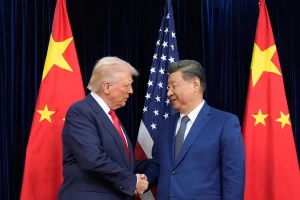



In August 2026, a draft internal letter from the U.S. State Department, leaked by Reuters, shook the global tech industry and financial markets. Though not yet formally dispatched, the letter was addressed to the 35 countries that had signed the Joint Statement on Artificial Intelligence Partnership for Opportunity* this June, including U.S. allies such as Japan, Australia, and South Korea. Its tone was uncompromising: *“To try to be in all camps is to have none. Signing the Pax Silica Declaration is not merely gaining membership—it is a commitment.” With this “AI ultimatum” as a blade, the United States is carving a “Digital Iron Curtain” across the global technological map.
Yet behind this curtain lies a United States rife with strategic contradictions and internal divisions.
I. “Pax Silica” or “Silicon Hegemony”?
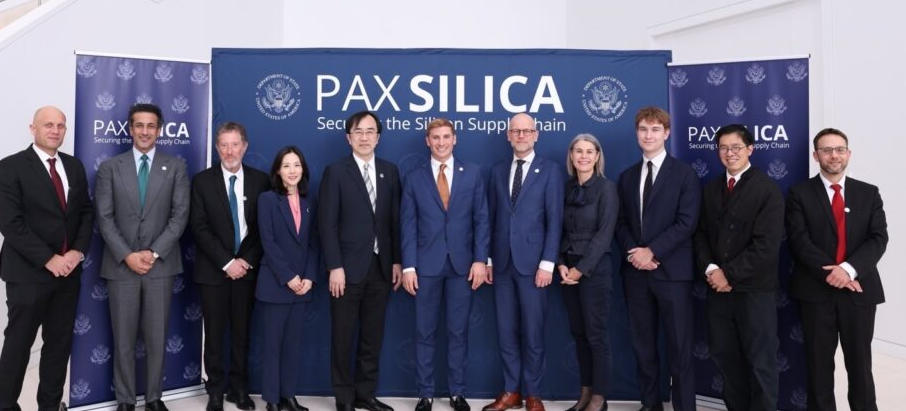
In December 2025, the U.S. State Department launched the “Pax Silica” initiative, ostensibly aimed at securing the supply chain for frontier foundation models, computing chips, and critical minerals in artificial intelligence. By August 2026, the initiative had expanded to roughly 24 signatories. In June of this year, the U.S. hosted the second Pax Silica Summit, issuing the Joint Statement on Artificial Intelligence Partnership for Opportunity, formally designating member states as “Pax Silica economies.”
But “peace” is little more than a carefully wrapped fig leaf. While touting technological security and open cooperation may serve as slogans, the core objective is to contain China’s AI development and preserve U.S. technological hegemony. Trisha Ray, a fellow at the U.S. think tank Atlantic Council, stated bluntly that the Pax Silica alliance’s central purpose is to build an economic bloc that competes with China across the entire AI value chain. Even more overtly, a U.S. official remarked that it is hard to envision a country that joins China’s AI initiatives remaining a “trusted partner” of the United States.
This is not groundless suspicion. The U.S. government’s starkly inconsistent positions have eroded its own credibility to zero. In May of this year, U.S. Deputy Secretary of State Jacob Helberg publicly stated that Pax Silica was not an exclusive club and that signatories need not choose between China and the U.S. Yet merely months later, Washington has completely reversed its earlier stance. Such backtracking has once again severely depleted U.S. national credibility, confirming that the so-called AI “opportunity partnership” is merely a political tool to preserve technological monopoly, not a genuine effort to build global cooperation platforms or provide international public goods.
II. Kazakhstan’s Dilemma
The immediate trigger for this “Digital Iron Curtain” is Kazakhstan. This largest country in Central Asia is the only known nation that simultaneously participates in both the U.S.-led Pax Silica initiative and the China-led World Artificial Intelligence Cooperation Organization (WAICO). Why place Kazakhstan in the AI competition spotlight? The answer lies in resources. Critical minerals identified by the U.S.—tungsten, copper, rare earths, etc.—are directly tied to the security of semiconductor and advanced manufacturing supply chains. One of Pax Silica’s core goals, launched in late 2025, is to build an AI industrial chain independent of China—from mineral extraction to chip manufacturing to frontier models. In June, the U.S. proudly announced Kazakhstan as the first Central Asian member of Pax Silica.

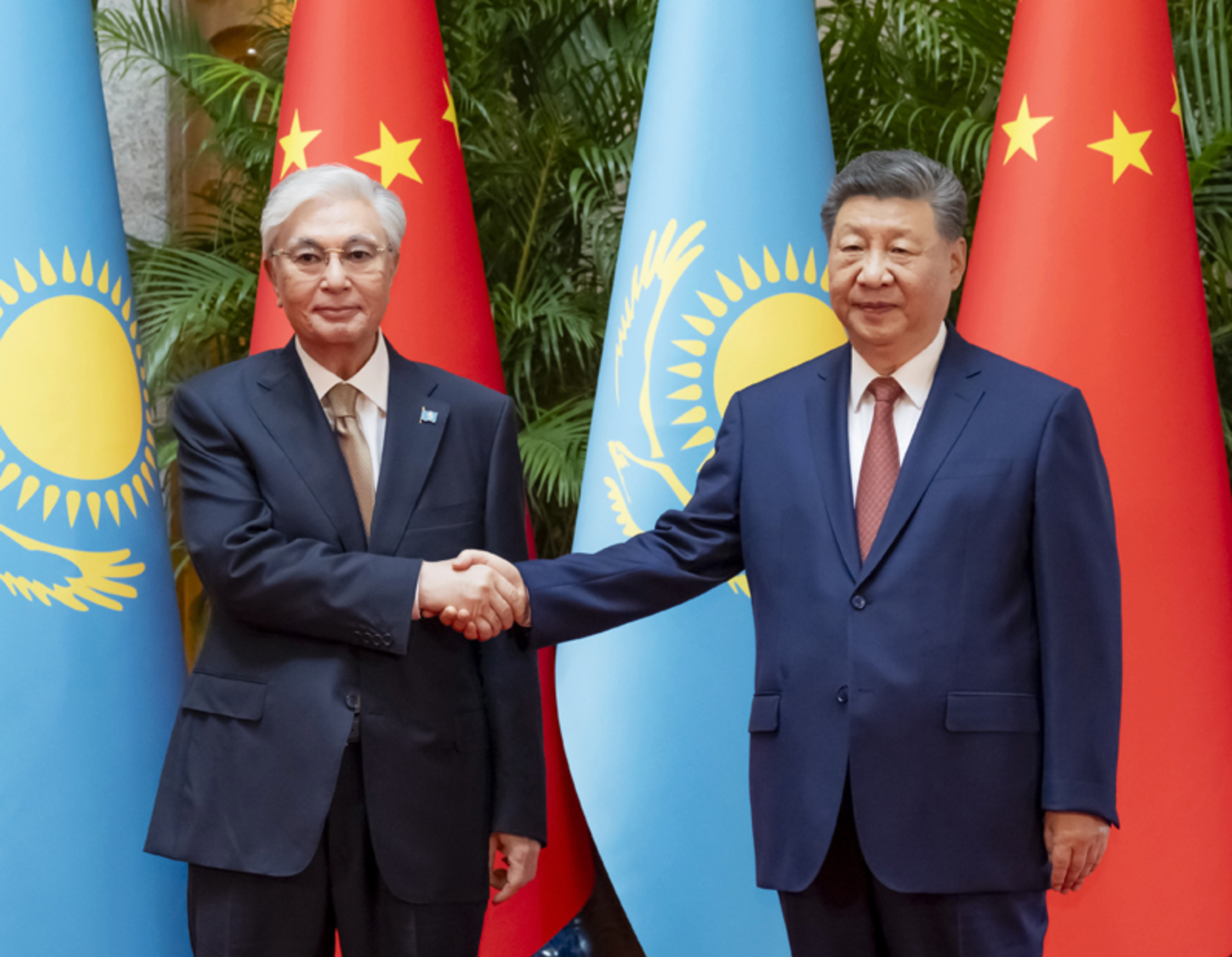
However, Kazakhstan’s economic ties with China run far deeper than with the U.S. Bilateral trade in 2025 approached $49 billion, making China its largest trading partner; cumulative Chinese investment exceeds $30 billion, with over 8,500 Chinese-funded enterprises operating in the country. In July 2026, President Tokayev attended the World Artificial Intelligence Conference in Shanghai, where both sides signed cooperation agreements worth over $15 billion. More critically, Kazakhstan is actively advancing its “Data Center Valley” and regional AI hub plans—it needs both U.S. high-end computing power from Nvidia and Chinese investment and market access.
Chen Shu, a lecturer in Politics and Public Administration at the University of Hong Kong, noted that dual membership was originally a “balancing act” that could serve as a bridge. But the U.S. “AI ultimatum” is forcing Kazakhstan to choose. Li Lifan, director of the SCO Research Center at the Shanghai Academy of Social Sciences, analyzed that if U.S. pressure escalates, Kazakhstan is more likely to adopt a “domain stratification” strategy—tilting economically toward China while hedging technologically on both sides. Kazakhstan’s predicament carries demonstrative and cautionary significance. The U.S. logic is simple: since you cannot “choose both,” you must choose me.
But if tensions escalate, how would Kazakhstan decide? Li Lifan suggests framing it as a cost-benefit calculation: which abandonment would inflict greater loss on Kazakhstan? The answer is clear. Forgoing China carries higher, more rigid, and harder-to-reverse costs. China-Kazakhstan trade is nearly ten times the size of U.S.-Kazakhstan trade; China accounts for about 27% of Kazakhstan’s mineral exports, compared to only about 5% for the U.S. The China-Kazakhstan crude oil pipeline is a crucial alternative route bypassing Russia. More importantly, Chinese investment has become deeply “embedded”—from infrastructure to digital communications, from mining to manufacturing. Interrupting these projects would mean not just economic losses, but a halt in employment, fiscal revenues, and regional development momentum.
Abandoning the U.S. entails more concentrated, more “qualitative” costs, but with a narrower impact scope. Lost would be access to high-end chips, advanced AI technology cooperation, Western capital inflows, and the indispensable strategic balancing lever in the China-U.S.-Russia triangle. Any obstruction in cooperation with U.S. companies like Nvidia would severely setback Kazakhstan’s plans for a regional AI hub; high-value-added mineral projects such as tungsten development may slow. Losing the U.S. would visibly shrink Kazakhstan’s maneuvering space between Russia and China. However, these impacts are more about long-term industrial upgrading and diplomatic flexibility; in the short term, the direct blow to the economic fundamentals is far less severe than alienating China.
Thus, purely from an interest-prioritization perspective, Kazakhstan’s preference—”keep China, retain the U.S. if possible”—is clear. But that does not mean it will readily “pick a side.” Hence, scholars predict Astana’s most likely path is: first, delay and obfuscate; if pressure persists, engage in asymmetric tilting while leveraging competition to drive up its own value.
III. Uzbekistan’s Open Diplomacy
Meanwhile, the maneuvers of Uzbekistan, a small Central Asian nation, have placed the U.S. in an awkward quandary. Within just one month, this country joined China’s WAICO, and immediately thereafter formally notified the U.S. State Department of its active application to join Washington’s Pax Silica initiative. On August 28, Uzbekistan’s ambassador to the U.S. stated openly that all domestic preparations were complete, and that the country was ready to sign the Pax Silica cooperation agreement as soon as the U.S. confirmed. The ambassador publicly articulated the core logic of international cooperation: all nations have the right to participate in various forms of global collaboration, and artificially setting thresholds and red lines will ultimately backfire and harm global industrial development.

Such a move appears to signal that Uzbekistan fully understands the U.S.’s core purpose in building Pax Silica—to erect an AI technology wall excluding China—yet it chose to respond with straightforward diplomatic engagement. If the U.S. rejects Uzbekistan’s entry, then it will definitively pivot toward China’s cooperation framework. If the U.S. accepts Uzbekistan, then Pax Silica’s exclusivity threshold effectively collapses.
What enables this landlocked Central Asian country to stand up to U.S. pressure is its strategic leverage, which major powers urgently need. Uzbekistan is rich in gold, copper, uranium, tungsten, molybdenum, and other strategic resources, with 28 types of critical minerals in its development pipeline, covering rare earths and metals essential for high-end manufacturing and AI. The biggest vulnerability in the U.S. AI supply chain today is the shortage of critical mineral resources; to reduce reliance on Chinese rare earth processing, Central Asia is the only alternative breakthrough.
China’s direct investment in Uzbekistan has reached $10.7 billion, deeply covering energy, mining, big data centers, and other core sectors. Yet the most critical advantage lies in technology deployment. U.S. AI chips and models are top-tier in performance but pricey; Chinese open-source AI models offer higher cost-performance and lower deployment barriers. For developing countries, usability, affordability, and deployability matter far more than mere technological excellence.
An assistant to Uzbekistan’s presidential administration put it candidly: national development does not require a passive binary choice. Engaging both Chinese and American technology systems simultaneously and leveraging complementary resources is the optimal path for national interests. This is not diplomatic rhetoric—it is the soberest survival logic for small and medium-sized states. Coercing partner countries to pick sides and engage in exclusive cooperation—this Cold-War-style playbook has long ceased to work in today’s multipolar world.
IV. Self-Contradiction: America’s Strategic Schism
The greatest irony of this U.S. “Digital Iron Curtain” campaign lies in its internal strategic contradictions. The “choose one” coercion disregards the realities of developing countries. Pax Silica imposes strict bloc-entry criteria but provides neither dedicated funding nor practical assistance to bridge AI infrastructure gaps. Zhou Mi, a researcher at the Chinese Academy of International Trade and Economic Cooperation, noted that U.S. AI advantages and governance models do not fit the diverse development contexts of other nations. If developing countries are forced to abandon their own suitable regulatory paths and passively pick sides, they gain no substantive development benefits while facing elevated technology and security risks. Using security as a cover to impose containment is typical AI hegemonism.
The industry backlash—Silicon Valley is not buying it—is even more ironic. While the U.S. erects “small yards and high fences,” it is mired in internal division. Nearly 200 Silicon Valley startups under the “Small Tech Association” jointly wrote to the U.S. government, urging it not to cut off American developers’ access to Chinese open-weight AI models. Twenty-five tech giants and institutions—including Nvidia, Microsoft, and Meta—also signed an open letter opposing “premature restrictions” on open models. This wave of Silicon Valley dissent sends a clear signal: no matter what banner it flies, closure is losing support; only openness serves the industry’s common interest. The opposition from U.S. industry to AI bloc-building and man-made technology segregation reveals a deepening rift between Washington and Silicon Valley. The vast majority of U.S. industrial players do not want the global AI ecosystem to be fragmented by blocs; enterprises need open global markets and the innovation vitality that technological collaboration brings.
V. The Limits of Hegemonic Logic: Technology Gaps Narrow, Coercion Fails
America’s strategic anxiety stems from an undeniable fact: technological monopoly is eroding.
Stanford University’s 2026 AI Index Report shows that the performance gap between Chinese and U.S. AI models has essentially disappeared. In February 2025, DeepSeek-R1 briefly matched top U.S. models; by March 2026, the U.S. lead had shrunk to just 2.7%. Chinese AI large models have made significant breakthroughs in coding capability, mathematical reasoning, and multimodal fusion, with some models now globally leading.
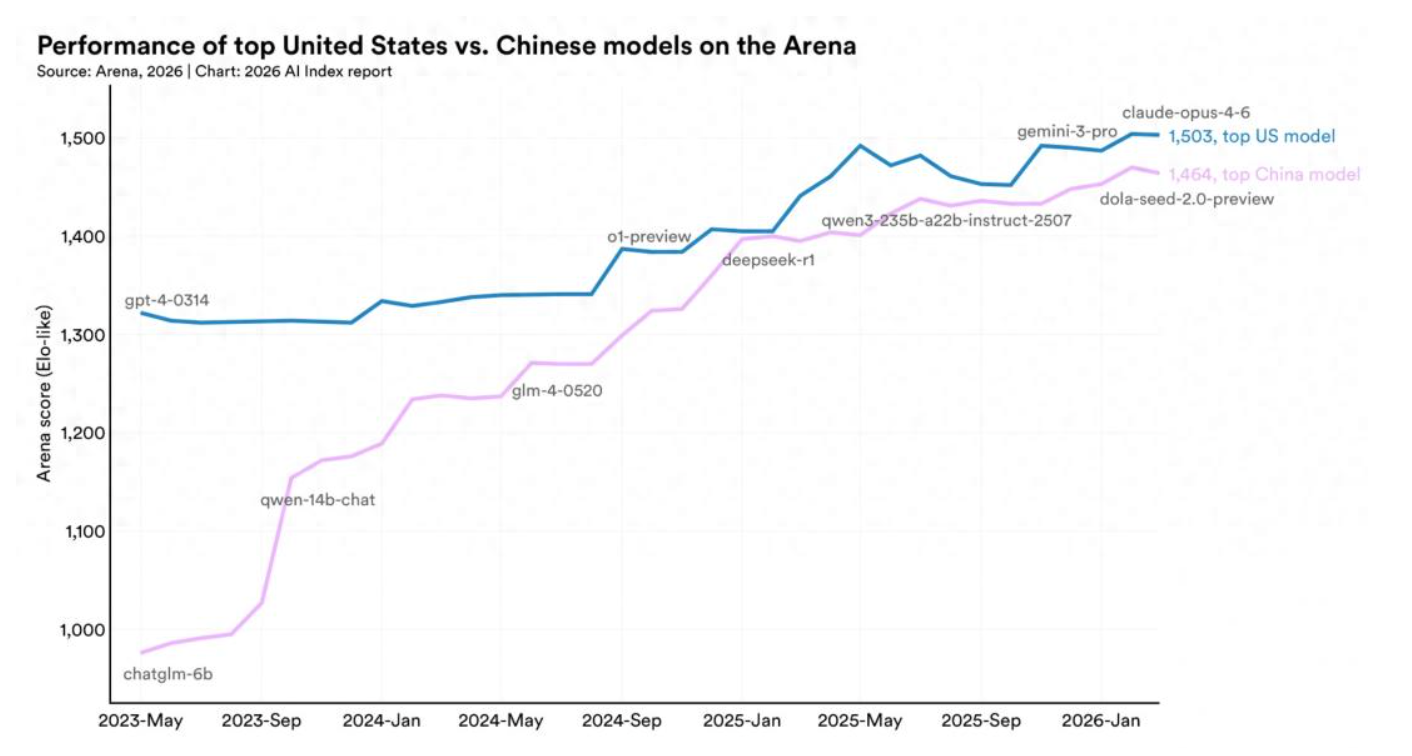
The New York Times once commented that the U.S. treats cutting-edge AI models as a hugely disruptive force that must be guarded closely, while China views it as a lower-risk technology to be shared and commercialized to win friends and expand international influence. This contrast sharply reveals the fundamental difference in AI governance philosophies between the two countries.
The U.S. attempts to sustain AI hegemony through “either-or” coercion, but AI remains an emerging field. No country—including the U.S.—can balance AI development and security governance solely on its own. By applying old zero-sum antagonism to forcibly sever cooperation and compel other nations to choose sides, Washington not only fails to achieve its strategic objectives but also risks backfiring on its own interests and exacerbating global technological fragmentation.
VI. The Iron Curtain Will Eventually Fall
Artificial intelligence represents a shared development opportunity for all of humanity. Openness and integration are the trend of the times, the general direction, and the common aspiration. The U.S. is determined to build an exclusive technological bloc, weaponizing tech cooperation and polarizing governance, relying on political power to artificially sever knowledge flows and entrench technological monopoly—this is a misguided move against the tide of history.
China’s Embassy in the U.S. has clearly stated its opposition to politicizing trade and technology issues, adding that “such practices will only hinder global AI development and serve no one’s interests.” WAICO, established in Shanghai in July 2026, as the first intergovernmental international organization on AI, already has 29 founding member states, emphasizing “open-weight” technology and a Global South orientation.
The U.S. attempt to sustain AI hegemony through “either-or” coercion will not only fail to achieve its strategic goals but will also accelerate the erosion of its own influence. This “Digital Iron Curtain” will ultimately be shattered by the tide of the times.
Editor: Zhao Yiwen
https://baijiahao.baidu.com/s?id=1873666072184315044&wfr=spider&for=pc
https://www.workercn.cn/c/2026-08-20/8874432.shtml#1#1
https://www.guancha.cn/internation/2026_08_21_828072_1.shtml#1
https://www.qstheory.net/20260819/aa0704d4382b4e58b4d823ae1940f076/c.html
https://cn.chinadaily.com.cn/a/202608/20/WS6a868fb0a3105d3d7a27bf11.html
https://m.thepaper.cn/newsDetail_forward_33805289
http://www.digital.cas.cn/dtfb/yjdt/202606/t20260625_5113346.html#1#1
https://t.cj.sina.com.cn/articles/view/7879923942/1d5ae18e602001v1iy
https://www.sohu.com/a/1069674150_122575434
https://xinwen.bjd.com.cn/content/s69b34ba1e4b0687a289276bf.html