

Between April 8 and 9, 2026, the war between the United States and Iran took a series of dramatic, hairpin turns.
On April 8, with less than two hours remaining on the countdown to Donald Trump’s threat to “bomb Iran back to the Stone Age,” Tehran put forward a “10-point proposal.” Trump called it “a workable basis on which to negotiate,” and announced his acceptance of a two-week ceasefire. Yet just one day later, on April 9, the White House reversed course, claiming that the Iranian plan discussed in the media was not the “working framework” received by US officials.
This back-and-forth has surprised many observers. But perhaps even more surprising was Trump’s statement to Agence France-Presse that he believes it was China got Iran to negotiate.
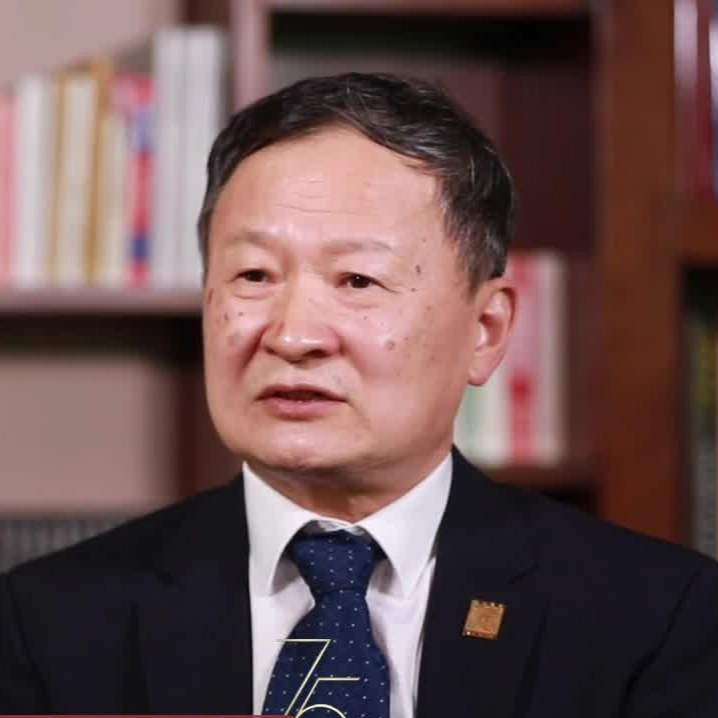
How exactly is China pushing for a ceasefire? And if, as many analysts argue, a prolonged American quagmire in the Middle East benefits Beijing strategically, why is China working to stop the fighting? According to Professor Wang Xiangsui, a leading Chinese strategist and Deputy Secretary-General of the CITIC Foundation for Reform and Development Studies, the answer lies in understanding two specific moves China has made during this conflict, and the decision-making logic behind them.
I. Action One: The Joint Peace Initiative with Pakistan
Why has this war been so hard to stop? Why is the current ceasefire so fragile? Professor Wang’s answer is blunt: The core demands of the U.S. and Iran are diametrically opposed, and there is a colossal barrier of “mutual distrust.” This distrust stems largely from the fact that during two previous rounds of nuclear talks—both showing “significant progress”—the U.S. and Israel suddenly launched attacks on Iran, even assassinating its Supreme Leader. That history has made Tehran deeply wary of any engagement with Washington.
It is therefore highly significant that the current ceasefire negotiations, which offer a glimmer of hope for peace, are set to take place in Islamabad, Pakistan.
Consider the context. The war has long since spilled over Iran’s borders into the wider Middle East. Iranian retaliatory strikes have repeatedly hit targets linked to U.S. allies, including Saudi Arabia. Pakistan, which has a mutual defense treaty with Saudi Arabia, would normally be viewed by Iran as a potential adversary. So why has Iran trusted Pakistan enough to submit the core elements of its 10-point plan through Pakistani channels and agree to negotiate there?
At the end of March, China and Pakistan jointly issued the “Five-Point Initiative for Restoring Peace and Stability in the Gulf and the Middle East.” China’s involvement lent crucial weight and credibility to this diplomatic channel. Moreover, while the U.S. and Iran remain at an impasse over uranium enrichment, the China-Pakistan initiative offered a pragmatic starting point by explicitly calling for a halt to “attacks on critical infrastructure such as energy facilities, desalination plants, power grids, and peaceful nuclear installations.” This provided a tangible foundation for talks that accounts for the interests of all sides.
Professor Wang cautions that significant gaps remain between Iran’s “10-point plan” and the U.S.’s “15-point proposal.” The current opening for peace owes much to the war of attrition—both sides need a breather. How long this ceasefire lasts and how far negotiations can go remains to be seen. However, thanks to diplomatic mediation by China and Pakistan, the U.S.-Iran conflict is now, for the first time, trending toward dialogue. That, in itself, is a valuable and constructive shift.
II. Action Two: The Veto at the United Nations
On April 7, the UN Security Council voted on a draft resolution submitted by Bahrain concerning the Strait of Hormuz. The draft “strongly encouraged” nations with an interest in commercial shipping through the strait to coordinate “defensive” operations. The vote was 11 in favor, with Pakistan and Colombia abstaining. But China and Russia, as permanent members, cast vetoes, and the resolution failed.
Why did China veto it? China’s Permanent Representative to the UN, Fu Cong, was unequivocal in his explanation to the Council: The Security Council’s actions should be aimed at de-escalation. They must not be used to provide legal cover for unauthorized military action. “The position we took in this vote,” Fu stated, “will stand the test of history.”
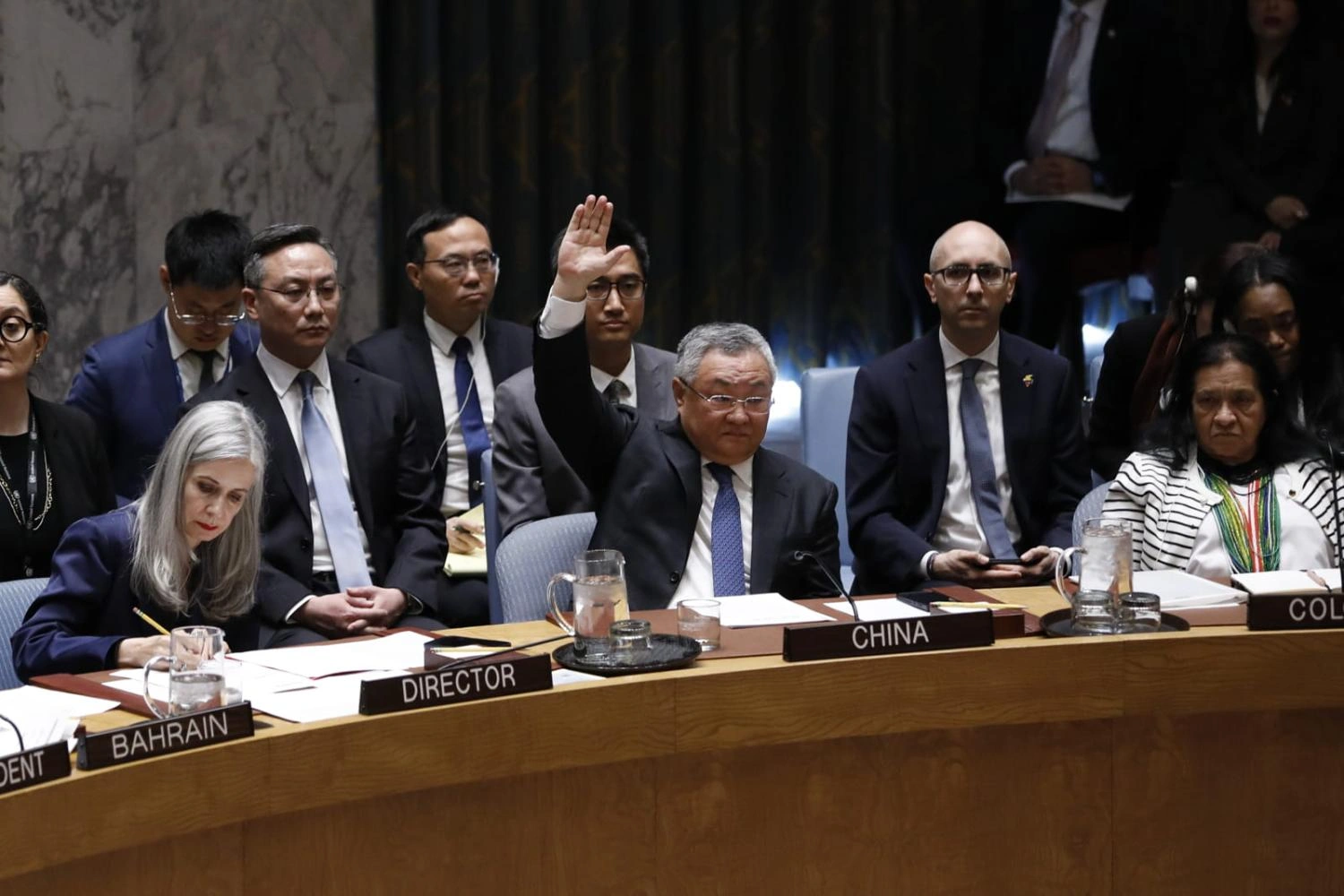
Professor Wang argues that this statement reveals the core methodology behind the effectiveness of Chinese diplomacy: First, determine the rights and wrongs of the matter. Then, formulate the strategy.
First, China’s definition of this war is clear. The military action by the U.S. and Israel against Iran violates international law; it is illegal aggression. Therefore, when some nations sought UN authorization for the use of force in the Strait of Hormuz, China’s position was firm: you cannot give a “free pass” to a war of aggression.
The strait is blocked precisely because of the war. It is a direct, defensive consequence of Iran being attacked. To try to address the consequence without addressing the root cause, the war itself, is to put the cart before the horse.
At the same time, China has explicitly stated that “the sovereignty, territorial integrity, national independence, and security of Iran and the Gulf states must be upheld.” This support does not mean providing military aid. It is a principled endorsement, within the framework of international law, of a victimized nation’s legitimate right to self-defense.
If you view China’s diplomatic maneuvers merely as “tactical skill” or “interest calculation,” you miss the complexity and consistency of the underlying logic. What truly anchors China’s position is a concept of world order that transcends the narrow interests of any single nation-state.
In the Chinese philosophical tradition, this is known as the “Tianxia” worldview, or “All-under-Heaven.”
III. The Bedrock of Chinese Diplomacy: The “Tianxia” Worldview Beyond Interest Calculation
Professor Wang observes that the current UN-based international system is, at its core, an association of sovereign states. The fundamental unit is the nation-state, and the supreme principle is sovereign equality. Yet this system runs into an inherent dilemma when the interests of two sovereign states clash: Who adjudicates? On what grounds? In the absence of a higher authority, raw power often becomes the final arbiter. This is the institutional root of America’s post-WWII propensity for frequent wars and its long-standing role as the “world’s policeman.”
China, on the other hand, accepts the basic framework of sovereign states but doesn’t stop there. The Chinese philosopher Zhao Tingyang, a member of the Chinese Academy of Social Sciences, has elaborated on the concept of the “Tianxia System.”
Zhao notes that the ancient Tianxia system had three dimensions: geographical (the world itself), psychological (the hearts and minds of the people), and political (a system that encompasses all political units). The modern Tianxia system has evolved into a “new three dimensions,” with the political dimension resting on three core concepts: the internalization of the world, relational rationality, and the “Confucian Improvement.”
The “Confucian Improvement,” put simply, is this: Do not impose on others what you yourself do not desire; and do not force on others even what you yourself desire. It’s a deceptively simple wisdom, yet it cuts to the blind spot at the heart of the current international order.
By what right does the United States unilaterally declare Iran’s potential nuclear capability a threat to its own security? Iran has repeatedly stated it does not seek nuclear weapons, and even reiterated that commitment in the current ceasefire terms. Even if doubts remain, the proper response under international norms is sanctions, negotiation, and verification—not undeclared war, targeted assassination of leaders, and threats to “destroy a civilization.”
Within the Tianxia framework, the security and developmental rights of every nation and every people must be respected. No country’s security should come at the expense of another’s. Security must be common and non-exclusive. This is the deeper meaning of what China calls a “Community with a Shared Future for Mankind.”
Zhao Tingyang further argues that true fairness and equality within the Tianxia system ultimately depend on epistemological equality. Without equality in the realm of knowledge, political or any other form of equality is impossible. This means building a new world order requires not just institutional change, but a conceptual shift—breaking the discursive hegemony of certain powers so that different civilizational traditions can participate as equals in defining what a “good order” looks like.
It is this classical wisdom, born from millennia of Chinese political practice, that has allowed China, in its joint statements with Pakistan and Russia, to find a more precise leverage point to pry open the door to a negotiated settlement. China’s constructive role in this crisis demonstrates the responsibility of a major power.
IV. How Far Can the Talks Go? Cautious Optimism Prevails
While the international community, China included, has made earnest efforts to halt the fighting, Professor Wang stresses a sobering reality: a ceasefire built on such wildly divergent terms, with major variables remaining between Israel and Iran, and with a Trump administration pathologically prone to policy whiplash, is extraordinarily fragile.
Whether this fragile truce can be transformed into a lasting peace hinges on a fundamental question: Can the international community embrace a concept of order that transcends the law of the jungle? Can it truly accept that every nation’s security deserves respect, and that every civilization has a right to endure and evolve?
China’s answer is consistent and clear: The world needs peace, and the globe needs order. If the Middle East is to move toward genuine peace, more nations must abandon zero-sum thinking and return to the spirit of international law and the UN Charter—embracing inclusion over exclusion, dialogue over coercion.
The road to getting more people to recognize and participate in building this Tianxia worldview will be long. But faced with the alternative—a civilizational slide backward—China’s pursuit of this path is not a matter of choice. It is a matter of necessity. Indeed, it is a monumental task that requires the collective effort of people across the entire globe.
Editor: Charriot Zhai