


How does a decision made by one country in the interest of its own security affect the strategic calculations of two other major powers? When the security concerns of China, Russia and the United States are so closely intertwined, no bilateral conversation alone can fully answer that question.
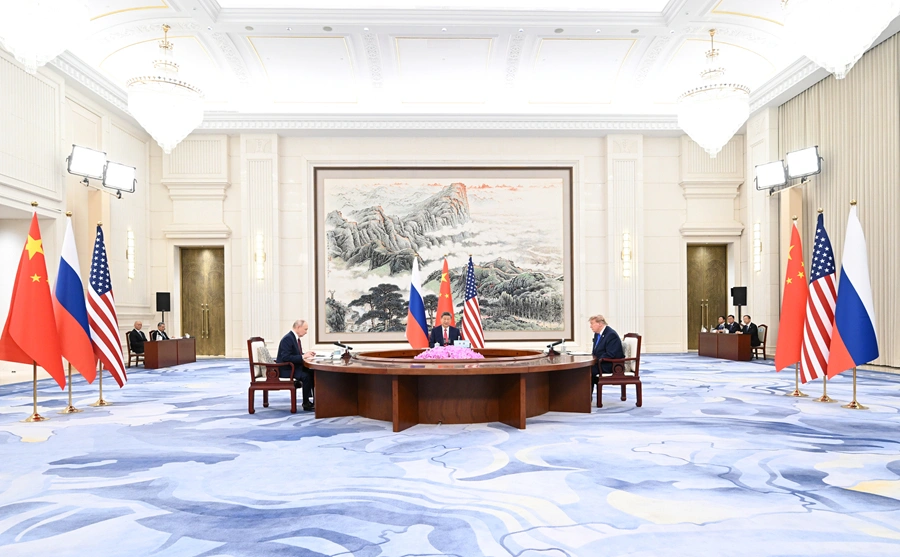
On November 19, Chinese President Xi Jinping hosted a summit between the leaders of China, Russia and the United States in Shenzhen, exchanging in-depth views with Russian President Vladimir Putin and U.S. President Donald Trump on safeguarding world peace and promoting strategic stability in major-power relations. For the first time in history, the leaders of the three countries met face-to-face around the same table to address a question of fundamental importance to the future of the world.
Two outcomes of the summit deserve to be examined together. The first was President Xi’s four-point proposal on how major powers should get along, addressing how countries with different political systems and interests can avoid confrontation and pursue cooperation. The second was the joint Declaration on Peace issued by the three leaders, which identified areas where joint action is already possible.
As the host, China assumed responsibility for bringing the three leaders together while putting forward substantive proposals for discussion. In the declaration, the Russian and U.S. presidents expressed their appreciation to China for hosting the historic meeting. An assessment of the Shenzhen summit can therefore begin with this hard-won joint document and examine how the three countries translate their responsibilities for world peace into concrete policy choices.
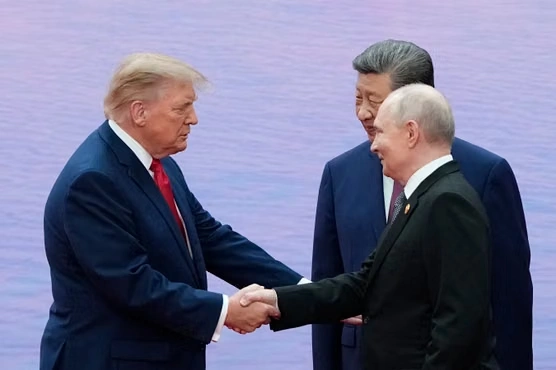 US President Donald Trump shakes hands with Russian President Vladimir Putin as China’s President Xi Jinping looks on before the welcome banquet at the Asia-Pacific Economic Cooperation (APEC) summit in Shenzhen on November 18, 2026. Source: AFP
A Historic Trilateral Meeting Brings Greater Clarity to Strategic Intentions
China, Russia and the United States are founding members of the United Nations and permanent members of the UN Security Council. More than eight decades ago, the peoples of all three countries made enormous sacrifices to defeat fascist aggression. By entrusting the Security Council with the primary responsibility for maintaining international peace and security after the war, the international community placed particular expectations on how its permanent members would exercise their power.
This history is worth revisiting today because the three countries continue to face a fundamental question: when their national interests diverge from those of others, how much diplomatic effort are major powers capable of influencing matters of war and peace willing to invest in preserving peace?
The groundbreaking nature of the Shenzhen summit must be understood in the context of three interconnected bilateral relationships. A cooperative initiative discussed between China and Russia may be interpreted differently by the United States in light of its own security concerns. When tensions arise between China and the United States, Russia will likewise assess their implications for its national interests.
Even when two countries clarify an issue through bilateral discussions, the third may still have to rely on secondhand accounts to interpret their intentions. Bringing all three leaders together allows the highest-level decision-makers of each country to articulate their priorities and concerns directly while hearing how the other two understand the same issues. Particularly when fundamental security interests are at stake, a question that can be asked and answered face-to-face is often more valuable than signals repeatedly scrutinized after a meeting.
This does not require all three bilateral relationships to develop at the same pace. China’s relationship with Russia is grounded in good-neighborliness, friendship and mutually beneficial cooperation. China’s pursuit of stable relations with the United States is equally rooted in the practical needs of both peoples and the wider international community.
Issues that can be resolved bilaterally should continue to be addressed through bilateral channels. Those that concern all three countries and have global implications deserve trilateral discussion. Nuclear risks, energy flows and the functioning of the United Nations are all issues on which the views of other parties remain important, even when two countries have reached an understanding. An additional forum for discussing such matters can benefit countries far beyond the three participants.
Some certainty comes from openly communicating intended actions. Another kind comes from reassuring others that there will still be room for consultation when unexpected developments occur.The direct exchange of views among the three leaders on peace and strategic stability primarily provided the former. Achieving the latter will require sustained engagement after the summit. While a single summit cannot predict where the next crisis will emerge, it can help the three countries better understand one another’s willingness to manage disagreements before a crisis occurs. This is precisely the distinctive value of head-of-state diplomacy in maintaining strategic stability.
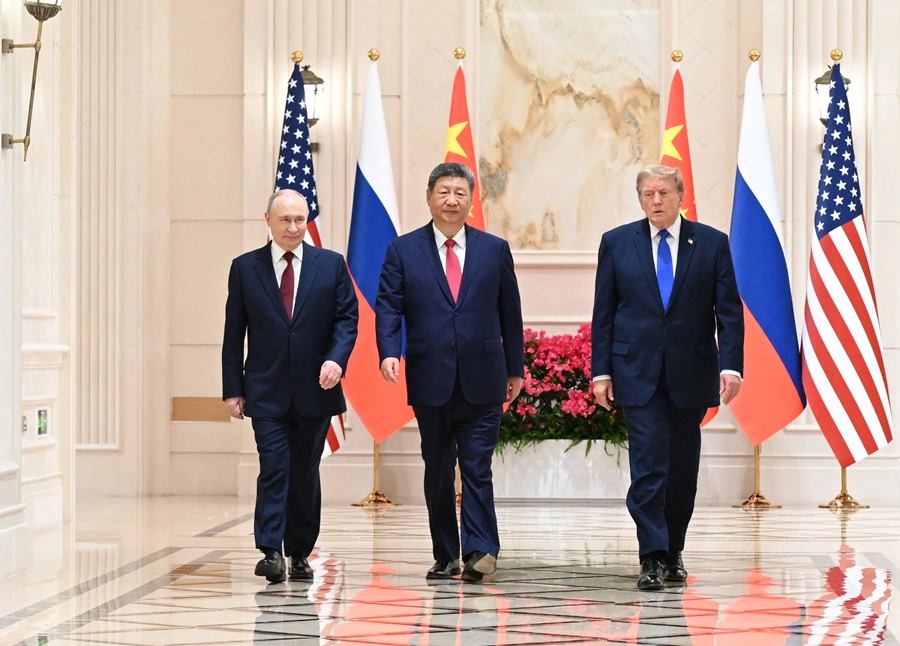 President Xi Jinping enters the meeting venue with President Vladimir Putin and President Donald Trump. Source: Ministry of Foreign Affairs of China.
Four Principles for Major-Power Relations: Setting Boundaries and Creating Opportunities
President Xi Jinping put forward four principles: mutual respect, peaceful coexistence, win-win cooperation, and dialogue and consultation. Each serves a distinct purpose while reinforcing the others. Mutual respect determines whether countries are willing to listen to one another. Peaceful coexistence establishes boundaries for competition, while win-win cooperation gives their peoples a tangible stake in stable relations. Dialogue and consultation make it possible to uphold the other three principles even during periods of significant disagreement.
The first principle is mutual respect.
China, Russia and the United States have different historical experiences, social systems and development paths. No country can decide the future of another nation’s people on their behalf. Recognizing this reality allows major powers to shift their attention from trying to change one another toward finding ways to coexist over the long term.
China emphasizes respect for sovereignty and territorial integrity, respect for each other’s core interests and major concerns, and advance communication on major sensitive issues affecting other parties. These principles are particularly important before a policy is finalized, when decision-makers still have room to assess its potential consequences for other countries.
A policy measure that appears limited in scope to those who formulate it, for example, may be perceived by another country as a fundamental change in policy direction because of its historical experience. Judging how others should react solely on the basis of one’s own intentions can easily lead to their concerns being dismissed as unwarranted hostility. Taking the time to understand what another country genuinely fears can sometimes reveal an approach that protects legitimate national interests while easing the concerns of others.
The second principle is peaceful coexistence.
History offers no shortage of examples of great-power rivalry ending in catastrophe. Yet shifts in the balance of power do not dictate the choices of political leaders. If one country interprets every aspect of another’s development as a threat and seeks to secure itself at the expense of the other’s long-term security, both may push each other into an increasingly dangerous situation, even while claiming to act in self-defense.
China’s emphasis on upholding peaceful coexistence as a fundamental principle calls on major powers to remain conscious of the strength they possess and take responsibility for the potential consequences of their actions. Particularly in times of heightened tension, powerful countries should exercise the restraint necessary to allow time for diplomatic engagement and give others room to de-escalate.
Peaceful coexistence also concerns how major powers respond to conflicts between other countries. People living in conflict zones cannot afford to wait until the major powers have settled all their differences. Even when China, Russia and the United States disagree on a particular regional issue, they can still use their respective diplomatic channels to encourage the parties involved to resume contact and create conditions for a political settlement.
Whether mediation produces lasting results depends in part on the willingness to listen to the parties directly involved and understand their practical concerns regarding security, livelihoods and postwar arrangements. For families affected by armed conflict, meaningful negotiations facilitated by major powers matter far more than distant arguments over whose position should prevail.
The third principle is win-win cooperation.
The three countries possess different strengths in resources, manufacturing and markets, yet none can independently absorb the costs of severe fluctuations in the global economy. If every form of interdependence is regarded as a vulnerability and severing economic ties is treated as a guarantee of security, businesses will struggle to make long-term production plans, while consumers will ultimately bear the cost of lost efficiency.
China advocates building on complementary strengths to identify opportunities for cooperation that benefit all parties. The practical significance of this approach is that even when agreement on certain security issues remains elusive, the three countries can still make progress in areas such as ensuring stable energy supplies.
Cooperation that delivers tangible benefits to ordinary households is also more likely to endure changes in the political climate.
The fourth principle is dialogue and consultation.
Heads of state can set the direction of international relations, but unexpected incidents will not wait for the next summit. President Xi proposed maintaining regular high-level exchanges, keeping channels of dialogue open at all levels, and establishing mechanisms for crisis communication and prevention.
Much of the groundwork for effective diplomacy must be laid during ordinary times. When a dangerous encounter occurs at sea or in the air, the parties involved may have incomplete information, yet the earliest reports are often the most influential in shaping perceptions.
Knowing whom to contact to verify information and how to communicate concerns promptly gives decision-makers greater confidence in exercising restraint until the facts have been established.
If the three countries can develop these arrangements in greater detail, the dialogue initiated by their leaders will prove valuable precisely when it is needed most.
 President Xi Jinping hosts the summit between the leaders of China, Russia and the United States in Shenzhen. Source: Ministry of Foreign Affairs of China.
A Declaration on Peace: Four Commitments That Can Be Put to the Test
The joint Declaration on Peace issued by the leaders of China, Russia and the United States is a concise document covering United Nations reform, the supply of refined petroleum products, international justice and nuclear risks.
The four provisions differ in their level of specificity, reflecting the realities of diplomatic negotiations. On some issues, the three countries are able to affirm shared principles. On others, they can formulate plans for concrete action. In certain areas, the agreement achievable at present is a commitment to further dialogue.
Only by assessing each provision on its own merits can we understand where the summit achieved substantive progress and what work remains to be done.
The first provision concerns reform of the United Nations. The three countries expressed their intention to enable the UN to respond more effectively to global challenges and fulfill its fundamental mission of maintaining international peace and security.
Although China, Russia and the United States all hold permanent seats on the Security Council, they chose to place the United Nations at the top of their trilateral declaration. That decision deserves particular attention.
The world is concerned not only with how major powers coordinate with one another, but also with what such coordination means for countries that were not represented at the meeting. Grounding their cooperation in the UN framework helps ensure that countries of different sizes and at different stages of development can participate in decisions that affect their own futures.
From the perspective of genuine multilateralism, which China has consistently advocated, reform should address institutional efficiency while also strengthening the representation and voice of developing countries.
Many countries severely affected by the spillover effects of conflicts must cope with rising energy and food prices while securing resources for their own development. Their experience gives them a direct understanding of how security and development should be prioritized.
If these perspectives are taken into account from the earliest stages of agenda-setting, arrangements made by the international community are more likely to prove viable on the ground.
The declaration establishes the direction of reform. The specific measures, however, must be discussed collectively by the broader UN membership. For the three countries, a willingness to subject their proposals to scrutiny through wider multilateral consultation is itself part of fulfilling their responsibilities as major powers.
The second provision is considerably more specific. The three countries plan to increase the production and supply of refined petroleum products and reaffirm the importance of stable energy flows.
Why would a declaration on peace issued by three heads of state specifically address refined petroleum products?
From the extraction of crude oil to its processing at refineries and subsequent shipment to markets where fuel is needed, disruption at any point in the supply chain can cause shortages in end markets.
Oil production, refining and transportation represent different stages of this chain. Only by combining the respective strengths of different parties can energy supplies reach the places where they are needed, when they are needed.
Although energy producers and consumers may have different interests regarding prices, they share an interest in predictable supplies and uninterrupted trade.
From the perspective of businesses and markets, such a commitment carries particular significance.
When a freight forwarder provides a quotation for an export shipment, the customer needs shipping rates and schedules that will still be honored several weeks later. If fuel surcharges rise unexpectedly, large companies may have sufficient resources to absorb or distribute the additional costs. For a small or medium-sized enterprise, however, a profitable order can quickly become a loss-making one.
Further down the supply chain, the cost of transporting food and everyday necessities directly affects household expenditure.
Viewed in this light, the Shenzhen declaration’s emphasis on stable energy flows addresses an issue whose consequences can be felt in ports, factories and ordinary homes alike.
Increasing production and supply remains a plan, and its effectiveness will ultimately be demonstrated through actual deliveries and transportation. By publicly expressing their willingness to act, however, the three countries have already established a clear objective for subsequent coordination.
The third provision concerns international justice. The three leaders recognized the importance of the principle of state consent and respect for the immunities enjoyed by state officials. They also agreed that the International Criminal Court and other similar institutions should not abuse their jurisdiction.
This provision should be interpreted closely in accordance with the wording of the declaration. The three countries emphasize that the exercise of jurisdiction must have a legitimate basis and clearly defined limits, and that the immunities enjoyed by state officials must be respected.
From the perspective of sovereign equality and the international rule of law, both of which China emphasizes, the credibility of rules depends heavily on their consistent application.
If different standards are applied to comparable situations depending on the parties involved, confidence in international institutions will be undermined. Disagreements that could otherwise be resolved through legal channels will also become more susceptible to escalating into political confrontation.
The fourth provision addresses a fundamental question of world peace.
The three leaders reaffirmed that “a nuclear war cannot be won and must never be fought” and made clear their intention to engage in dialogue on reducing nuclear risks and preventing nuclear proliferation.
In 2022, China, Russia and the United States joined the United Kingdom and France in issuing a joint statement on preventing nuclear war and avoiding an arms race. The latest declaration builds on a position previously affirmed by all three countries while clearly identifying the issues to be addressed in subsequent discussions.
Nuclear risk reduction and nuclear non-proliferation are closely interconnected. The former concerns reducing the dangers of miscalculation and conflict escalation, while the latter focuses on preventing the further spread of nuclear weapons. Both require a necessary degree of cooperation among major powers.
Particular caution is warranted in this area. The three countries have different nuclear capabilities, strategic environments and policy concerns. Once substantive dialogue begins, they will inevitably encounter practical difficulties that go beyond broad statements of principle.
The declaration identifies the subjects to be discussed, while specific arrangements remain to be negotiated.
On issues of such sensitivity, helping other parties develop a more accurate understanding of one’s own policies and identifying actions that could trigger dangerous miscalculations during periods of heightened tension would already constitute meaningful progress worth pursuing.
The meeting between the leaders of China, Russia and the United States. Source: Ministry of Foreign Affairs of China.
Conclusion
Examining China’s four-point proposal alongside the joint declaration offers a clearer understanding of the certainty that the Shenzhen trilateral summit has brought to the world.
Principles such as mutual respect and peaceful coexistence explain the basis on which China seeks to engage with Russia and the United States. The joint declaration, meanwhile, informs the international community of the issues on which the three countries are prepared to assume shared responsibilities despite their remaining differences.
There is considerable room for practical diplomacy to bridge these two outcomes. China’s proposal to establish crisis communication mechanisms provides a direction for future work, while the commitment to nuclear risk dialogue enshrined in the joint declaration establishes a common starting point for one of its most important components.
In Shenzhen, China undertook a task that required both patience and sound judgment. It accommodated the respective concerns of the three countries while keeping the agenda focused on challenges facing the world as a whole. China openly articulated its own principles while creating conditions for the other two parties to express their views and identify common ground.
By hosting the summit, proposing principles for major-power relations and facilitating a joint declaration, China demonstrated its sense of responsibility for safeguarding the postwar international order, as well as its strategic commitment to assuming greater responsibility amid increasingly complex relations among major powers.
Securing a place on the diplomatic agenda for issues of national concern demonstrates diplomatic competence. Bringing countries together to assume responsibility for issues that matter equally to the peoples of other nations reveals the broader vision befitting a major power.
World peace is rarely determined by a single meeting, yet a single miscalculation can exact an enormous price.
The significance of the Shenzhen summit lies in the willingness of all three countries to work toward preventing such a price from being paid before a crisis occurs.
Fostering this kind of constructive engagement is central to China’s decision to extend the invitation and host the summit. It also represents the most promising prospect for China, Russia and the United States to work together in safeguarding world peace.
Editor: Chang Zhangjin