

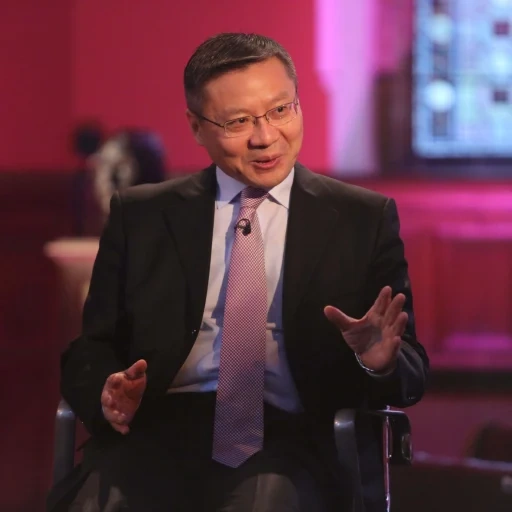
The following text is a transcript of a speech delivered by Professor Zhang Weiwei, Dean of the Institute of China Studies at Fudan University, on the popular Chinese political TV show China Now.
Zhang Weiwei: Recently, a new trend has emerged in the global “China fever,” called “Becoming Chinese,” which can be also known as “living like a Chinese person.” People are drinking hot water, goji berry tea, apple juice, and white fungus soup, and many have even learned to cook porridge, soup, and stewed eggs—all traditional Chinese dishes. They wear slippers at home, soak their feet before bed, and some even practice Chinese exercises like Baduanjin and Tai Chi. Many Western Gen Z individuals describe themselves as being in a “very Chinese stage of life.” A related trendy meme is “Chinamaxxing,” meaning “extreme Chineseization.”
In the past, Chinese cultural exports were mostly traditional symbols: kung fu, green tea, pandas, Peking Opera, Peking Opera masks, etc. But today, more and more foreigners are actively embracing Chinese culture. This bottom-up, grassroots-driven cultural dissemination is very strong. It is mainly formed spontaneously by overseas Gen Z young people, Chinese-American bloggers, and ordinary netizens, and is spreading rapidly through platforms such as TikTok, YouTube, and Xiaohongshu.
China has been demonized by Western media for far too long. As more and more foreigners visit China and follow Chinese and foreign social media content, they are discovering a China completely different from the one portrayed by Western media. Through the internet, they are sharing their observations, especially the Chinese lifestyle, with the outside world, contributing to this new wave of “Becoming Chinese.” The vibrant and diverse Chinese lifestyle, underpinned by the long and rich Chinese civilization, is captivating countless foreigners.
On February 25th, CNN published an article stating that Asian cultural waves have swept the West multiple times in recent decades, such as the Japanese and Korean cultural trends, and now it’s China’s turn. However, unlike Japan and South Korea, China is not an ally of the United States, but rather a country designated as a “strategic rival” by the US. In recent years, the trade war, technology war, and tariff war against China, along with geopolitical tensions, have deepened anti-China sentiment in Western societies. However, young people in the Western world are now embracing “extreme Sinicization,” undoubtedly a sign of a shift in the Western social atmosphere.
Our program, “China Now,” has also played a role. Not long ago, The New York Times published an article stating that “China is brimming with confidence while the US is retreating,” arguing that China’s “rising narrative” built in recent years has not only deeply resonated domestically but also garnered widespread international acclaim, lamenting the phenomenon of “China’s confidence soaring while the US is succumbing to defeatism.” The article mentioned our special program on the Huajiang Canyon Bridge in Guizhou, showcasing China’s mega-projects in video format. Many Western influencers also acknowledged that “from high-speed rail hubs to breathtaking city skylines, everything demonstrates China’s infrastructure construction capabilities.” The article also mentioned some of our programs, such as the special program “Some American Thinkers Begin to Reflect,” which argued that many prominent Americans “have begun to acknowledge China’s rise and America’s decline,” even concluding that “America…” The article states, “The problem is long-standing and deeply entrenched, difficult to reverse.” It cites a Pew Research Center survey showing that “this year, in 10 high-income countries, public opinion of the United States continued to decline, while opinion of China rose.” The article’s tone is one of disappointment and frustration, arguing that the Trump administration should not be intimidated by the rising power of China. Wired magazine also published an article last month titled “Why Every American Has Suddenly Entered a Very Sinicized Period.” The article states that “many Americans, especially the younger generation, have fallen in love with Chinese technology, Chinese brands, and Chinese cities like never before.” They are consuming more Chinese-made products than ever before. In a sense, the only logical next step is to simply “become Chinese.” Chinese. Many foreigners are captivated by the futuristic feel of Chinese modernization, from Chinese mobile phones and new energy vehicles to Chinese games and AI models. This, in turn, reflects “all the unsatisfactory aspects of American life, or rather, the decline of the ‘American Dream.’” The article points out that these Americans and foreigners who want to “become Chinese” are largely venting their extreme disappointment and dissatisfaction with their country’s decades of stagnation. They seem to have found a near-perfect mirror image in China. Today, a growing number of Generation Z are becoming… Chinese, even becoming “spiritually Chinese.”
Seven years ago, in 2019, our program “China Now” did a special episode comparing the Chinese Dream and the American Dream. We said at the time: the Chinese Dream is already more exciting than the American Dream. Today, most Americans believe that the American Dream has lost its luster. In 2012, a book called *The Betrayed American Dream* caused a stir in the US, explaining why the American Dream has lost its luster. It stated that if we take 2000 as the base year (100), then by 2011, that is, about ten years later, the median real income of American households was only 89.4. In other words, the income of most Americans not only did not increase in ten years, but decreased by 10%, a reduction of 10%. American economist Nobel laureate… Nobel laureate economist Joseph Stiglitz pointed out years ago that numerous studies have shown the United States was once a nation brimming with opportunity, a century ago. However, in the last two decades, this has changed. This, to a considerable extent, reflects the current perception of many Gen Z Americans of their country.
Faced with structural crises in the US and the West as a whole—economic inflation, social division, rampant drug use, cultural disorder, and the prevailing “survival of the fittest” law internationally—Gen Z in the West is using Chinese cultural symbols to stage a kind of spiritual rebellion. They express their stance with “I choose China,” mocking the fading “American Dream” and finding an outlet for their dissatisfaction with reality. The recent US-Israel actions regarding Iran… The foolish war launched by Lang further fueled their rebellion.
This emerging “China fever,” on the whole, is still at a relatively superficial level of understanding of Chinese culture. But I think this is also invaluable, because it means that the idols of old culture, represented by the United States, are fading on a large scale, both domestically and globally. The futuristic feel of Chinese modernization, the cultural heritage carried by Chinese lifestyle, the low-cost, high-quality life in Chinese society, and the righteous path of humanity revealed by Chinese socialism are broadening the horizons of many foreign youths and becoming a source of spiritual aspiration for many.
As we’ve discussed many times in our program, the phenomenon of “loving one’s country as soon as one goes abroad” and “loving China as soon as one comes to China” has become a highly probable and widespread pattern. Our program has consistently stated that despite the existence of this phenomenon in China… While there are various issues, China’s current level can withstand comprehensive international comparisons, including those with the United States. This is the source of our confidence in creating “China Now.”
This spectacular and vibrant wave of interest in Chinese lifestyle can also be seen as a tribute to China, such a great civilization. She is both ancient and young, both traditional and fashionable, possessing both unique Chinese character and a global perspective. As an ancient civilization spanning thousands of years, she also possesses many of the outstanding qualities of a large-scale modern nation. All of this serves as a new encouragement and inspiration for all those dedicated to promoting Chinese culture to the world and fostering global cultural exchange. We will certainly continue to strive for even greater achievements and live up to the expectations of the world for China.
Editor: Gu Shengze