


On September 1, France officially began imposing environmental fees on “ultra-fast fashion.”
Under the new rules, qualifying ultra-fast-fashion products will be subject to an additional charge per item. In 2026, the fee can reach as much as €12 per item, and it is set to increase further in the coming years. Starting in 2027, France will also introduce tighter restrictions on advertising and influencer promotions for these brands.
The French government has made its reasoning clear: the measures are intended to reduce overproduction and pollution in the textile industry.
But even before these new rules took effect, France’s conflict with Shein had already become about much more than environmental protection.
Back in November 2025, when Shein opened its first-ever physical store at Paris department store BHV, it was met with fierce protests. Large crowds gathered outside the store, chanting “Shein, shame on you” and demanding that the company leave France.
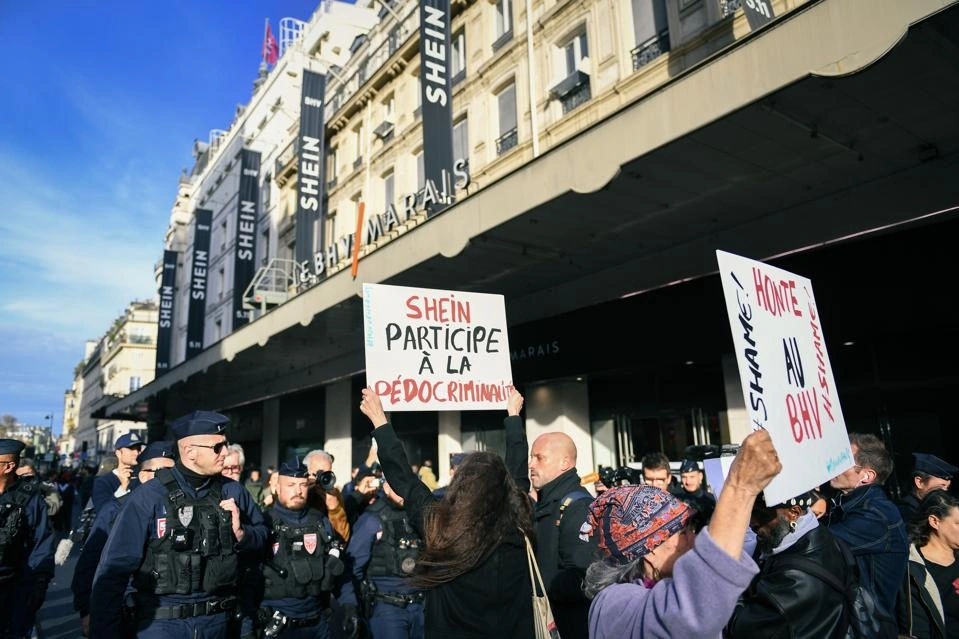
The French government, meanwhile, suddenly seemed remarkably quick to act. On the very day Shein’s physical store opened, the government announced plans to introduce legislation that would ban Shein from operating online in France. The French prime minister’s office also announced that the platform would be banned in the country until Shein could demonstrate that its operations complied with French law.
The timing was hard to miss.
“There is no love without a reason, and no hatred without a reason.”
The hostility toward Shein in France reveals something deeper: the arrogance of an old European order that has long enjoyed a privileged position, now confronting a Chinese company that represents a very different kind of new order.
In fact, the name Shein is not particularly familiar to many people in China. That is because the company was designed from the beginning primarily for overseas markets. Founded in 2012, it later moved its headquarters to Singapore and has largely stayed out of the mainland Chinese consumer market.
The industry Shein entered, meanwhile, had already been transformed by one particularly famous pioneer: Zara, the Spanish fashion retailer.
Zara did something very simple. It made fashion inspired by the latest luxury trends accessible to people who could not afford Prada.
That, in essence, is the promise of fast fashion: fast, cheap, and endlessly varied.
People who buy fast fashion are not necessarily buying the clothes themselves. They are buying the feeling that comes with keeping up with trends, looking fashionable, and getting that sense of style without paying luxury prices.
That consumer psychology posed a serious challenge to established fashion brands.
Zara’s strategy was essentially a case of speed above all else. Once the latest collections from luxury brands such as Louis Vuitton and Prada appeared on the runway, Zara could quickly take inspiration from the designs, put its own versions into production, and get them into stores.
At its fastest, the process could take only a few weeks, with the finished clothes reaching stores within days. Traditional fashion brands, by contrast, could take six months to go through the same cycle.
Zara and H&M had already pushed the fast-fashion model to its limits. So how much faster could fashion possibly become?
Then Shein appeared.
What it brought was “fast fashion 2.0,” and it made the traditional Zara model look almost outdated. Many people in the industry now argue that “fast fashion” is no longer an adequate description of Shein. A better term might be real-time retail.
So how does Shein do it?
In a world where consumers spend much of their lives on their phones, Shein can collect data directly through its app, analyzing what people like, what they click on, and how long they spend looking at particular products.
Once those signals come in, the company can move quickly into design, sometimes producing a new design within 72 hours. It then makes only a tiny initial batch, perhaps a few hundred pieces or even just a few dozen.
Why produce so little?
Because the initial batch is essentially a market test. Shein wants to see which products take off and which ones do not.
If a particular item suddenly goes viral on TikTok, production can be ramped up almost immediately. If nobody cares about it, the product can simply be dropped.
That changes the economics of fashion. From design to sale, a traditional brand may need six months. Zara can do it in around 20 days. Shein can sometimes do it in as little as five.
And because Shein operates primarily online, with very few physical stores, even after factoring in international shipping, a customer may receive a garment roughly two weeks after it was designed.
By then, Zara may still be waiting for the design to make its way through the traditional process.
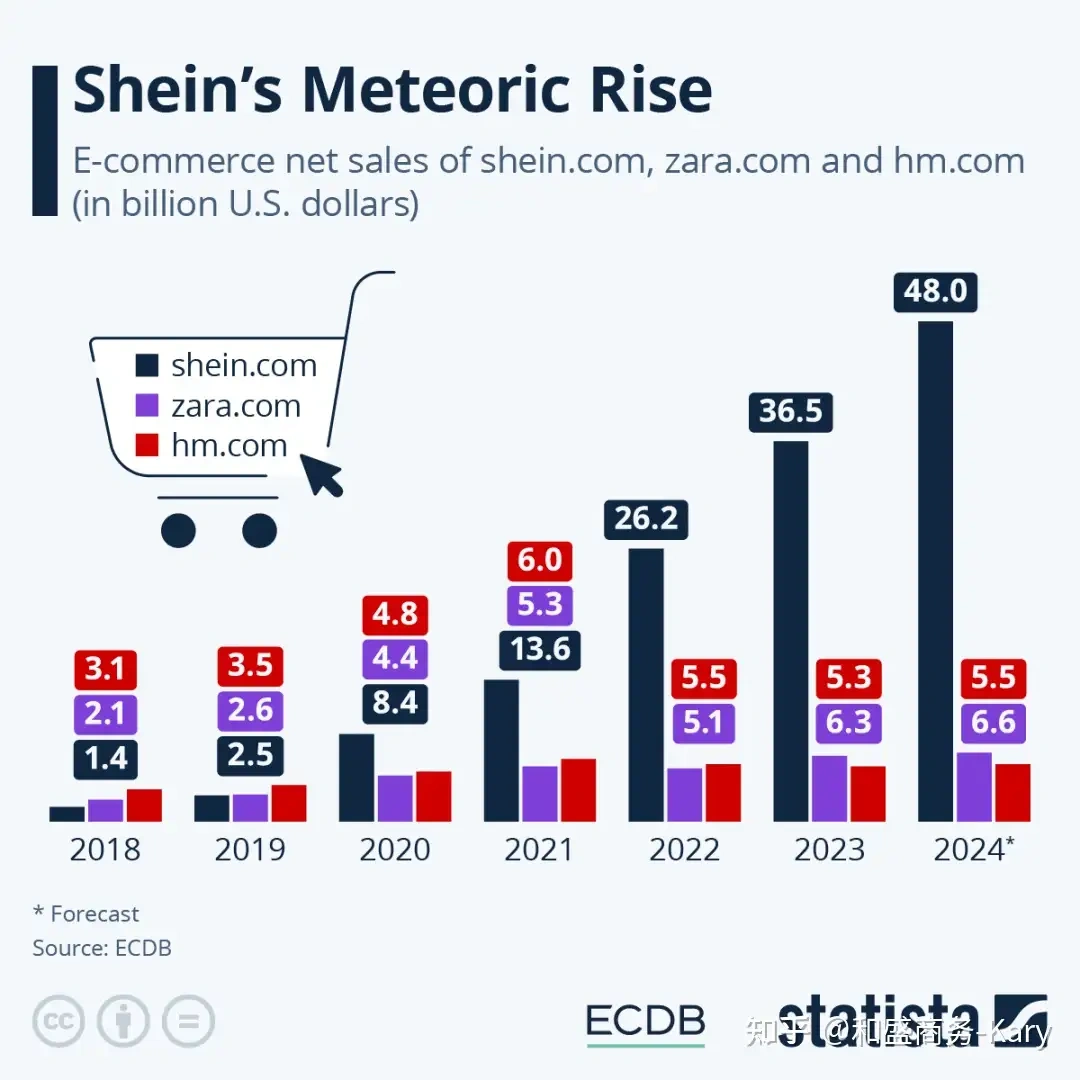
This is what “ultra-fast fashion” means.
Shein’s ability to operate this way rests largely on two things: China’s flexible manufacturing supply chain and overseas social media.
Shein works with large numbers of garment factories in the Pearl River Delta and uses its own ordering and data systems to manage production in real time.
These factories do not need to produce huge quantities of inventory in advance. Shein sends the orders, and they make what is needed.
Small batches. Fast production. Fast restocking.
The model allows Shein to keep introducing new products while keeping inventory risk relatively low.
The company then pushes those products onto TikTok and other social-media platforms through influencers, short videos, livestreams, and discount links.
When a particular item suddenly takes off, the supply chain moves with it.
Shein’s real strength, then, is not simply that its clothes are cheap. It is that the company has combined Chinese manufacturing capabilities, internet data, and social-media marketing into a single business model.
And that is precisely why France is now targeting “ultra-fast fashion.”
Because Shein is not merely challenging a handful of clothing brands. It is challenging an entire set of rules that has governed the traditional fashion industry.
France can, of course, argue that this is about environmental protection.
The French government has argued that textile production is a major source of pollution, and that advertising for the cheapest fashion products should be restricted while low-cost products should face environmental fees. The money collected can then be used to support brands that make greater efforts to protect the environment.
But how exactly do you determine whether a brand belongs to the world of cheap fast fashion?
One factor is the volume of products it sells. Another is how quickly it introduces new styles.
If this is really about environmental protection, why not assess the supply chain? Why not examine the raw materials? Why not inspect factories and monitor their emissions?
Why focus on production volume and the number of new styles?
Strip away all the rhetoric, and the uncomfortable reality is that traditional players are struggling to keep up with Shein.
Shein’s advantage is technology. By analyzing social-media trends, it can reportedly introduce thousands of new products a day, while established brands such as Zara and H&M, still relying on much of the traditional model, operate at a far slower pace.
Regulating fashion according to how quickly a company can introduce products starts to sound like regulating transportation by speed alone: declaring cars unsafe and telling everyone to go back to horses.
One of the most striking critics of Shein is Marie-Emmanuelle Demours, CEO of the French fashion brand Paul & Joe.
Her argument is difficult to miss.
“Our buttons are handmade in Paris. That is what fashion should look like.”
She also accused Shein of copying “anyone and any brand,” arguing that the company does not respect people, the planet, or creativity.
It is hard not to wonder how persuasive such an argument is in 2026. Are handmade buttons really the standard by which modern fashion should be judged?
And if Shein can launch thousands of new styles a day, who exactly is it supposed to be copying? At that speed, there are very few companies even operating on the same playing field.
Perhaps the more relevant question is how ordinary French consumers themselves see the issue.
On the day Shein opened its Paris store, one reporter asked consumers why they were buying from the company. One customer gave a remarkably straightforward answer:
“I’d like to buy French products too. But French products are too expensive, and wages aren’t going up. I just can’t afford them.”
There is also an uncomfortable irony in the criticism coming from the French fashion establishment.
Why is the CEO of Paul & Joe so hostile to Shein? Perhaps because the brand she manages can sell a basic white shirt for as much as $2,341.
Two thousand three hundred and forty-one dollars for a shirt.
And despite being presented as French fashion, that particular shirt is made in Tunisia.
Rather than simply blaming Shein, perhaps the French fashion industry should take a harder look at itself.
This is also why Shein’s decision to open its first physical store in Paris became so symbolic.
Does Shein actually need that store?
Probably not.
At its current global scale, the company does not need the additional sales generated by a single physical location.
What it really needs is an identity.
A brand that has spent years being labeled “cheap,” “low-end,” and “internet fast fashion” wants to enter one of the most important fashion cities in the world.
Paris.
And it chose BHV, a French department store with more than a century of history, located in the heart of the city.
BHV is deeply embedded in Parisian consumer culture, in a city that has long been associated with refinement, luxury, and the bourgeois lifestyle.
For Shein, establishing a presence here means much more than opening another retail outlet. It gives the brand a form of recognition and legitimacy in the very heart of the global fashion industry, potentially creating room for it to move further up the value chain.
And BHV itself had plenty of reasons to welcome Shein.
A profitable brand capable of attracting younger shoppers is hardly the kind of tenant a department store would want to turn away. SGM, the French company behind BHV, hoped that bringing in Shein would help draw a younger generation of customers.
SGM owner Frédéric Merlin even said he was proud to welcome Shein.
For Shein, then, this was not simply another store.
It was a message to the traditional fashion industry:
I am not just selling clothes online. I am entering your territory.
And that is precisely what makes the French fashion industry so uncomfortable.
On the day the store opened, protesters gathered outside chanting “Shein, shame on you” and demanding that the company leave France.
French media then focused heavily on controversial products sold through Shein’s platform, including adult products accused of being sexualized to resemble children, as well as weapons and other restricted goods.
These issues should absolutely be subject to regulation.
But they also raise a legitimate question: who actually made these products? Who put them on the platform? And how much responsibility should the platform bear for what third-party sellers offer?
For example, a controversial silicone doll that attracted attention was not manufactured by Shein itself. It was reportedly produced by a French company registered in Hong Kong.
That does not mean Shein should be exempt from responsibility for monitoring its platform.
But if a product made by a French company appears on a platform founded in China, and the entire controversy is then framed around a “Chinese company,” there is clearly a question about where responsibility begins and ends.
The same applies to allegations involving forced labor and environmental problems. These are serious issues that deserve investigation.
But they should not simply be reduced to a verdict before all the facts are established.
And when we turn our attention back to France’s own fashion industry, the picture becomes even more interesting.
France’s most famous fashion brands sell design, heritage, craftsmanship, and brand value.
That model obviously has its strengths.
But it also has one very real weakness:
It is expensive.
French consumers know that too.
And this is precisely where Shein’s real strength lies.
Shein is not trying to compete with French luxury brands over who can make the more beautiful button.
If this were simply a foreign brand taking market share, the solution would be straightforward. Beat it. Learn from it. Or build something better.
But Shein is not simply bringing another clothing brand into the market.
It is bringing a completely different business model.
And that is why France has chosen another approach:
Use regulation to reduce the advantage of that model.
From environmental fees to advertising restrictions and tighter regulation of products sold on the platform, Shein is no longer facing competition from traditional fashion brands alone.
It is facing pressure from an entire industry and regulatory system.
And when a new competitor from China comes along and completely changes the equation on price, speed, and scale, what does the old system do?
Does it learn from the new model?
Does it try to beat it?
Or does it simply change the rules?
That is the truly interesting part of the Shein-France story.
Years ago, Liu Cixin, the author of The Three-Body Problem, wrote a line that has since become famous:
“Being weak and ignorant is not an obstacle to survival. Arrogance is.”
France is a particularly interesting example.
It has world-class fashion traditions, brands, designers, and talent. If those strengths could be combined with new digital business models, France could absolutely help define the next generation of fashion.
But if the response to every new competitor is simply to tell consumers, “We are more sophisticated,” then the real question may not be why Shein has succeeded.
It may be: Why are consumers no longer willing to pay for that sophistication?
And this is not just a problem for France.
Over the past few decades, Europe has faced similar challenges from Chinese manufacturing, new energy, batteries, automobiles, and other industries.
Whenever a new competitor emerges, what determines whether an industry can remain a leader is not how glorious its past was.
It is whether it has the ability to learn the new rules.
Editor: Yangwen