


This year, a very intriguing phenomenon has emerged in the mainstream Western media: from Foreign Policy, The Wall Street Journal, Bloomberg to The New York Times, headlines from top American newspapers and policy think tanks have frequently featured eye-catching phrases like “China is Winning” or “China Emerges as the Winner.”
Whether in the fiercely competitive global technology arena or amidst the economic ripples caused by geopolitical conflicts, US media seems more eager than ever to label China a “winner.” If we carefully examine these US media reports this year, we might ask: how many times has China actually “won” under the lens and pen of the US media? What kind of changing times and Western mentality are hidden behind this frequent narrative of “victory”?
On May 7th of this year, Foreign Policy published an in-depth column titled “How China Is Winning the Global AI Race.” The author clearly points out that while policymakers in Washington and Silicon Valley executives are still locked in a fierce battle over semiconductor export controls, computing chip blockades, and metrics for top-tier large-scale models, China has already quietly won this global artificial intelligence race.
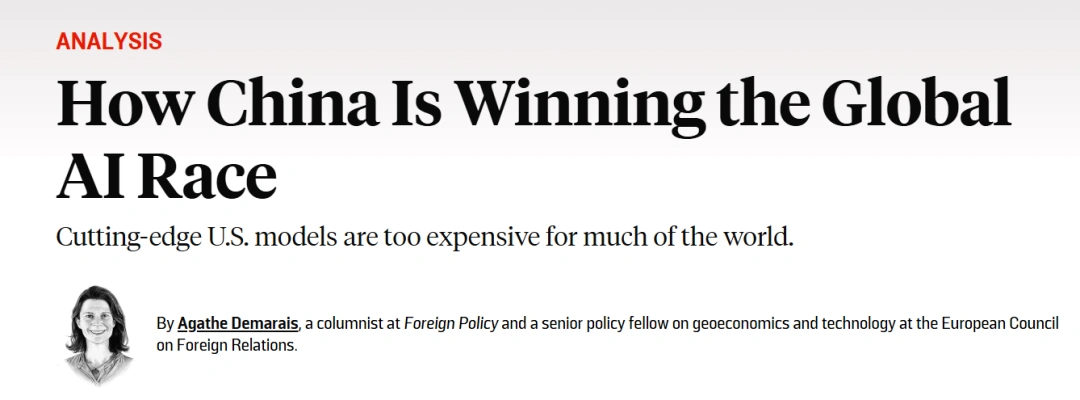
The article has taken Kimi K2.6 of Moonshot AI and Qwen of Alibaba Cloud as examples, revealing a fact that makes the West anxious: top-notch models in the United States are too expensive and heavily reliant on Western datasets, making them inaccessible to the vast majority of countries in the global South. China, on the other hand, has quickly filled this gap with its high cost-effectiveness, low-cost deployment, and open-source ecosystem. From AfriqueQwen-14B, a large model developed in 20 local languages based on Qwen in Africa, to the Singapore government’s decision to abandon Meta’s Llama and switch to Qwen to build sovereign AI, Chinese AI is repeating the successful experience of the “Belt and Road” infrastructure, using invisible, low-cost, and seamless technical infrastructure to establish the global default standard for the next generation of technological development. US media believe that even though the United States has the most advanced chips, China is winning a vast market share and rule-making power.
On April 12th this year, amidst the tensions in Iran that led to a crisis in the Strait of Hormuz and a significant impact on global oil and natural gas supplies, the Wall Street Journal reported on the explosive demand for China’s clean energy industry under the headline “An Iran War Winner: China’s Green Industrial Complex”.
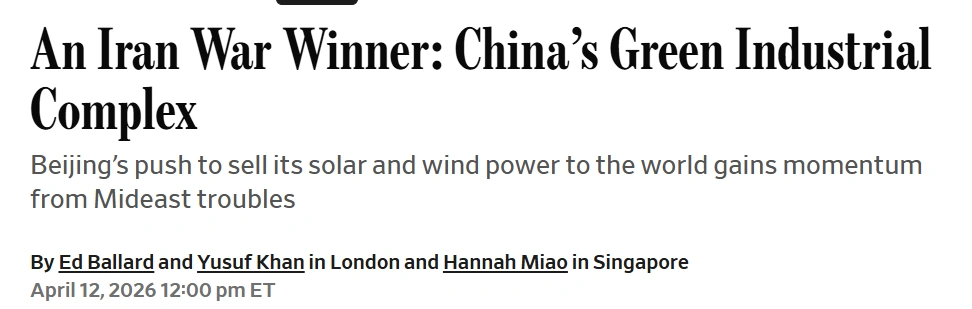
The report points out that geopolitical conflicts once again warn the world: relying on fossil energy means tying the country’s destiny to the choke points of war. From residents in Baghdad, the capital of Iraq, rushing to buy Chinese solar panels, to South Korea, Spain, and even the UK accelerating the deployment of photovoltaic and heat pumps, the whole line is flocking to Chinese manufacturing.
Immediately following on April 13th, The New York Times published a feature story titled “China’s Electrostate Is Poised to Win From War in the Middle East,” further extending the perspective to the deep-seated competition in power grids and energy storage. The report pointed out that the energy crisis triggered by the war in the Middle East not only catalyzed the demand for new energy, but also compelled countries around the world to accelerate the reconstruction and upgrading of their power systems. China, with its absolute advantage as an “Electrostate,” has already occupied the commanding heights.
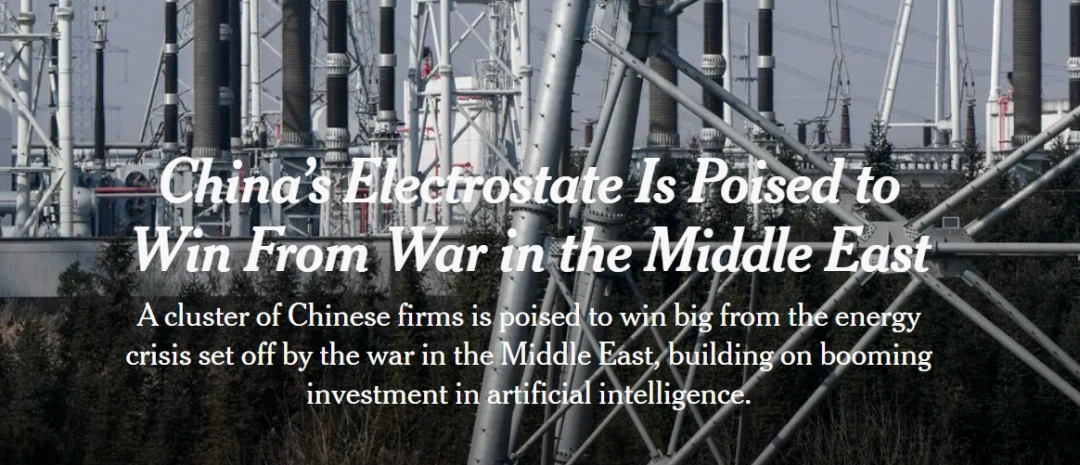
The article emphasizes that China has almost monopolized all key aspects of modern power grid construction, ranging from ultra-high voltage transmission cables and transformers to grid-level energy storage batteries (such as lithium iron phosphate batteries led by CATL and BYD), and even to software for controlling energy flow. More crucially, this wave of power grid infrastructure upgrades is deeply overlapping with the global explosion of AI. The construction of massive AI data centers is consuming enormous amounts of electricity. Whether it is for future-oriented AI computing power bases or resilient power grids to withstand geopolitical crises, countries have found that “all paths leading to the future of electric energy must pass through China.”.
The op-ed titled “The Iran War Shows China’s Energy Strategy Is Working” published by The New York Times on August 25th was even more blunt, stating that China’s long-term strategy of “reducing dependence on fossil fuels and investing heavily in photovoltaic/wind power/batteries/electric vehicles,” which was initiated three decades ago, had passed a rigorous “real-world stress test” during this crisis. China possesses the world’s largest strategic oil reserves, and its domestic power grid is highly reliant on domestically produced coal and renewable energy. This strategic resolve not only shields China from the severe impact of the inflationary storm but also allows it, as the world’s largest exporter of green equipment, to gain strategic initiative in this global energy crisis. The title of the article in the printed version was even less subtle, being “The Iran War’s Surprise Winner Is China.”.
Not only in the fields of technology and industry, but also in its geo-economic analysis, The New York Times has repeatedly labeled China as a “winner”.
In analyzing the long-term impact of the situation in the Middle East on Asian economies, on June 29th this year, The New York Times published a report titled “China Emerges as a Relative Winner From Strait of Hormuz Crisis”. Citing simulation predictions from a high-level think tank, the report pointed out that affected by the Strait of Hormuz crisis, India, Japan, and many Southeast Asian countries were deeply mired in surging energy prices, scarcity of materials, and fiscal expansion, causing some factories that had originally attempted to break away from China’s supply chain to stagnate again. On the other hand, China, relying on its abundant reserves, strong industrial chain self-sufficiency, and flexible price controls, successfully mitigated the impact, further consolidating its stable position as the global manufacturing core, and logically becoming a “relative winner”.
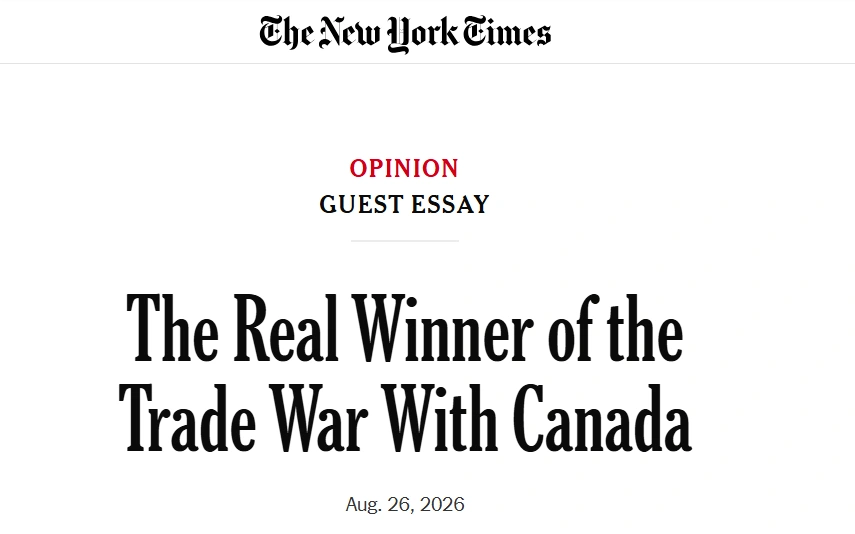
In the article titled “The Real Winner of the Trade War With Canada,” a heavyweight commentary analyzing the tariff war and trade friction between the United States and Canada on August 26th this year, Chad P. Bown, a senior researcher at The New York Times, strongly criticized the absurdity of the unilateral tariff policy of the U.S. government. Drawing a historical analogy from how Chinese automobiles quickly occupied 30% of the market after the Australian automobile manufacturing industry faltered, the article warned Washington that the U.S. tariff stick is destroying the integrated manufacturing foundation of North America, forcing its ally Canada to open its market to China (such as signing the tariff agreement on agricultural products and 49,000 electric vehicles). When the United States isolates its allies and abandons its leadership, China enjoys the institutional and market dividends brought by the trade war without even “what can I say” becoming the real winner of the North American tariff friction.
When we examine these headlines and comments from the US media together, we can discover an intriguing logical structure. What is the underlying motivation for the frequent use of the label “China wins” by mainstream Western media?
Firstly, this is a warning in the prosperous era of Western public opinion, which is “using others’ success to remind oneself of one’s own weaknesses”.
The stance of American media has never been to praise China.On the contrary, the fundamental intention behind these articles is to sound the alarm to American policymakers, members of Congress, and the public. In the context of American media, promoting the idea that “China has won in the AI open-source race” is to criticize the U.S. Department of Commerce’s chip blockade policy for being outdated; emphasizing that “China’s green industrial complex has won” is to reflect on the capriciousness and politicization tendency of U.S. subsidies for new energy; and lamenting that “China has won in the U.S.-Canada trade war” is to criticize the unilateral tariff policy for dismantling the U.S. alliance system. This “crisis-driven” writing mode is a classic public opinion tool in the internal political game in the United States.
Putting aside the cautionary and anxious motives of the US media, the numerous facts elaborated in the report are highly persuasive. The US media had to admit that China’s “victory” was by no means a fluke, but rather the realization of decades-long strategic determination.
From the perspective of the integrity of the industrial ecosystem, whether it is the absolute dominance in the fields of batteries and grid energy storage, or the complete industrial chain from high-voltage cables, transformers to photovoltaic panels, China has built manufacturing barriers that cannot be replicated by other countries around the world.
From a market perspective, in the AI field, compared to the lofty and elitist large models of Silicon Valley, Chinese enterprises have accurately captured the rigid demand for “cheap, practical, and customizable” products in the global South, promoting the inclusive implementation of technological civilization.
In terms of strategic resilience against external shocks, China’s vast strategic energy reserves and diversified supply system have demonstrated the core confidence of a super industrial power in withstanding the storm when facing the geopolitical tsunami in the Middle East and the dramatic fluctuations in global commodities.
In the face of overwhelming reports from the US media proclaiming “China has won”, we not only need to draw confidence in our own development path from these objective analyses, but also need to maintain a calm and clear-headed attitude beyond emotions. In the era of interdependent globalization, no major country can withdraw unscathed from the violent fluctuations of the global economy. We need to be wary of the narrative trap of “winning thoroughly” and have a clear understanding of the external environment.
In addition, the high-profile promotion by American media of “China’s victories in key areas” is often a prelude to a new wave of protectionism and trade barriers in the West. When Western public opinion is filled with narratives such as “China dominates new energy” and “China’s large models penetrate the global South”, it is often followed by stricter tariff barriers, investment reviews, and accusations of so-called “overcapacity”.
Since the beginning of this year, US media have repeatedly shone the spotlight on China as a “winner” across multiple tracks, including artificial intelligence, new energy, geopolitics, and international trade. These reports are not only an objective acknowledgment by the Western elite of China’s industrial resilience and strategic execution capabilities, but also a concentrated spillover of deep anxieties within the US policy circles. To understand this “anxious praise” from US media, we must not be blinded by prejudice or carried away by false praise. True victory does not depend on the headlines of the moment or the place, but on whether we have a clear long-term plan, solid industrial foundation, and a market mindset that benefits the whole world. In the face of complex external public opinion, maintaining strategic focus and taking solid steps to deepen industrial and technological innovation are the ultimate strengths to cope with all changes.
Editor: Gu Shengze