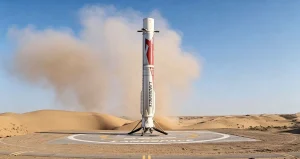



Noon,July the 10th,2026,Hainan Commercial Spacecraft Launch Site.
Long March 10B carrier rocket blasted off, with stage separation occurring six minutes later. The first stage neither fell into pre-designated sea areas,nor deployed four landing legs to settle steadily on a barge like SpaceX’s Falcon 9, nor was it ‘clamped’ by two giant mechanical arms as Starship is.
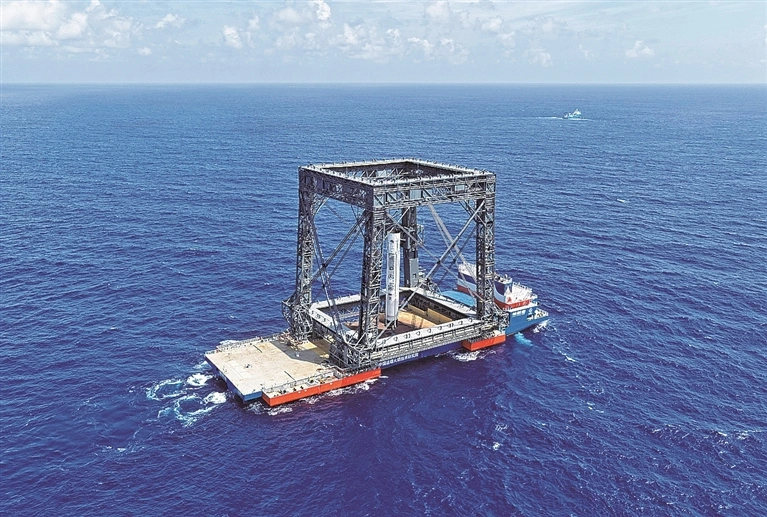 Long March 10B was softly captured by the huge net
It fell into a net.
In just dozens of seconds,the third technical route for reusable rockets has emerged worldwide.
Mnay people find live scene incredible at the first sight: the large rocket,weighing dozens of tons and descending from the edge of space ,was firmly trapped by a soft arresting net.However, what is truly noteworthy is not the net itself,but the strategic choice behind it.
Over the past decade, whenever reusable rockets were discussed,the world almost universally recognized only two technical route defined by the United States: one is landing legs vertical recovery like SpaceX’s Falcon 9,the other is mechanical arms capture verified by Starship. Today, China didn’t copy either of them, but delivered a completely different engineering solution.It means, Chinese aerospace industry’s question has shifted from ’how to catch up with the US’ to ’whether there are other technical paths besides the US’. They are two entirely different questions.
Why Must Humanity Recover the Rockets.
Many people have a question for a long time: rocket were always designed to splash down into designated sea areas, so why has the whole world suddenly become obsessed with rocket recovery?
The answer is simple.
For the past sixty years,humanity has always been doing a rather luxurious thing—- building a plane and scraping it after a single flight. None of the airline would do so, yet this is how the rocket industry operated for decades. A large carrier rocket built by billions dollars only works within hundreds seconds.Once the first-stage engines push the rocket out of the atmosphere, their mission is complete.They then plunge into the ocean ,turning into a pile of metal on the sea bed.
Lots of people consider the most expensive part in a rocket launch is the fuel, actually it’s the contrary. Liquid oxygen,kerosene and liquid oxygen-methane propellants make up a tiny share of overall launch expenses. The truly costly components are high -thrust engines, rocket frame structure, controlling system and electronic devices manufactured with ultra-precision.From machining individual parts and assembling a full high-burst engine often takes months,even over a year.It embodies the whole high-end industrial manufacturing complex, rather than hundreds of tons propellant. For decades, what humanity has effectively discarded after each launch is not fuel,but an entire precision manufacturing plant.Whoever can retrieve these systems will transform rockets from ‘disposable commodities’ into genuine industrial products.
This marks the shift in the core competition within commercial spaceflight.
Musk’s Innovation Extends Far Beyond Recoverable Rockets
On December 22, 2015, at Cape Canaveral, Florida, USA, the first stage of the Falcon 9 booster returned to a land launch site for the first time after completing its launch mission, realizing the first successful recovery of an orbital-class large rocket first stage in human history.
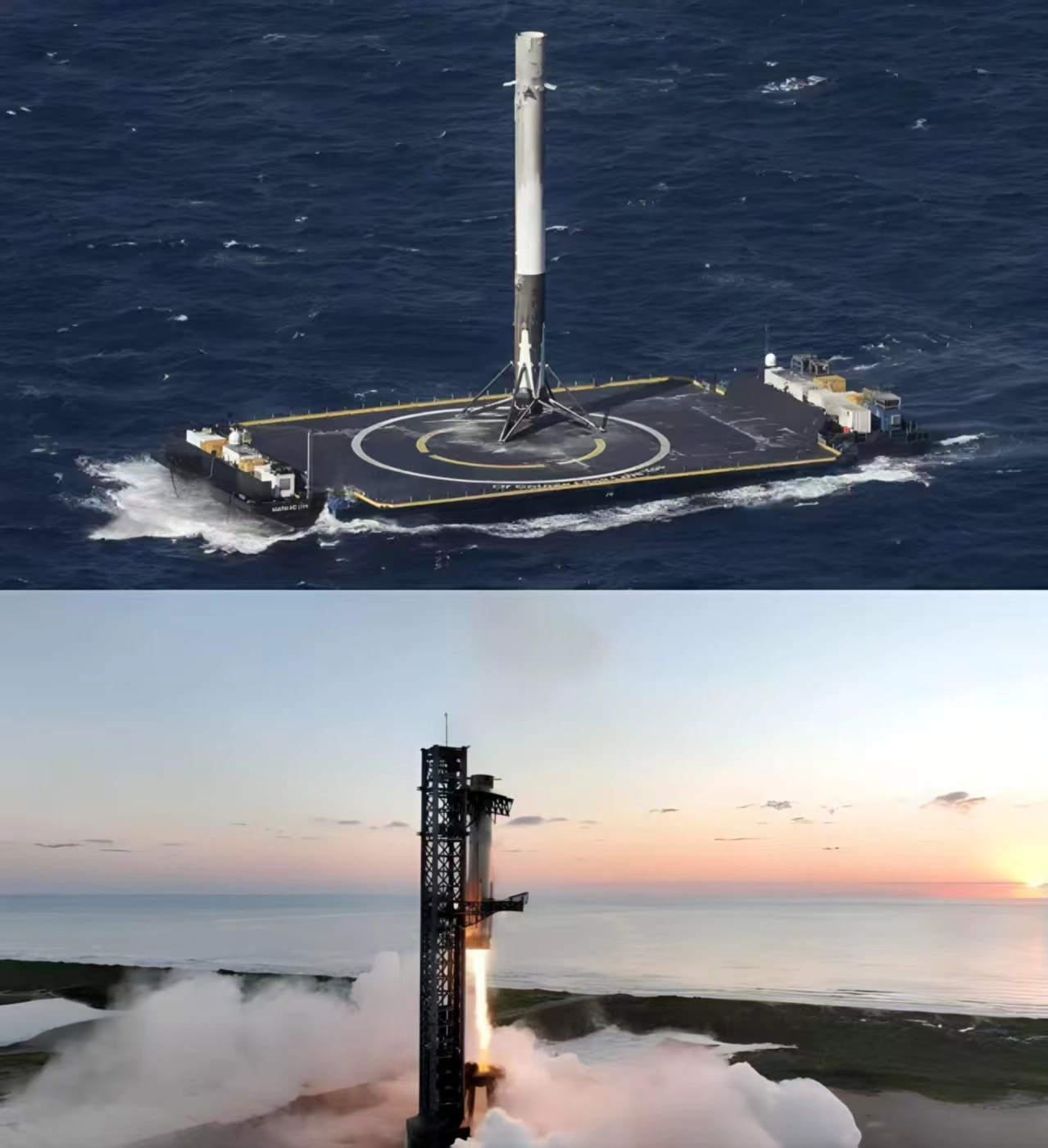 SpaceX mode:landing legs and mechanical arms
Nowadays, this achievement is widely taken for granted, yet at that time, no one could guarantee its success. Before Falcon 9, the global aerospace industry reached a near-universal consensus: large orbital rockets held no economic value for reusability ,because adding recovery system would increase vehicle mass, which in turn reduced payload capacity — a tradeoff widely deemed uneconomical.
Even SpaceX itself did not commit firmly to its current design at the beginning. Public documents reveal SpaceX thoroughly evaluated multiple recovery concepts including parachute retrieval, mid-air hoisting and helicopter capture, before discarding all complex architectures for a pragmatic reason: commercial success hinges not on theoretical sophistication, but operational reliability. Hence Falcon 9 adopted the now globally recognized solution: four landing legs, enabling the booster to settle upright on an unmanned offshore barge much like a self-landing airplane.
This breakthrough changed the entire space industry. As engines gained reusability, overhaul cycles shortened and recovery success rates raised steadily, Falcon 9 launch costs plummeted while launch cadence surged. According to SpaceX’s public data, the Falcon 9 first stage has completed hundreds of successful recoveries to date, with multiple boosters undertaking more than 20 reflights. Rockets no longer operate on a single-mission basis, instead cycling repeatedly like commercial airliners.
What actually changes the world is not merely returning boosters, but introducing economies of scale to spaceflight for the first time. Previously, rocket manufacturers could only produce dozens of vehicles annually; today, a single booster can fly dozens of times within a year. This is a key driver behind the United States’ widening lead over other nations in commercial space over the past decade. The competitive gap stems not from superior engine thrust, but cost advantages — not marginal technical edges, but a business model generations ahead of its peers.
China Did Not Copy America’s Playbooks
If the story ended here, the Long March 10B would merely be a Chinese imitator to Falcon 9. Its true significance lies in China’s rejection of direct replication.
Most viewers’ first reaction to the net arrestment recovery system is to ask: “Why not adopt SpaceX’s landing leg design?” This reasoning falls into the trap of judging past decisions based on conclusion. While Falcon 9 stands as the most successful reusable rocket today, SpaceX opted for landing legs over a decade ago not as the theoretically optimal solution, but as the lowest-risk engineering path to rapidly validate a viable commercial model. As long as the booster could land independently, SpaceX could iterate the full cycle of recovery, overhaul and reflight. Mass penalties and payload losses from landing legs could be optimized incrementally afterward. Following Falcon 9’s consistent success, an entire industrial ecosystem evolved around this architecture: recovery barges engineered for landing legs, overhaul workflows built around leg hardware, and launch schedules optimized for vertical leg landings. The mature commercial framework made evolution far more cost-effective than a full revolution
China’s development timeline stands entirely distinct. When China began developing large reusable launch vehicles in the mid-2020s, SpaceX had already borne countless developmental costs for the industry over the preceding decade. There was no need for China to retread a well-documented path with inherent limitations. Instead, Chinese engineers posed a fresh core question: if a rocket is engineered for full reusability from its first day, are landing legs an unshakable feature?
Thus,the answer is the flexible arresting net unveiled to the public today.
At first glance, the net capture system strikes many as a circus-style spectacle. In reality, it’s more like aircraft carrier operations. Carrier-based fighters do not rely on gradual braking via landing gear; arresting cables halt dozens-ton aircraft within seconds upon touchdown. The core principle is straightforward: the higher the speed during rigid contact,the more severe the strcuctural impact loads. Chinese engineers drew inspiration from this naval mechanism, with one critical adaptation: while carrier jets land horizontally, rocket boosters descend vertically, so the horizontal arresting cables of flight decks are reoriented vertically on the sea platform. The rocket eliminates heavy landing legs entirely, fitted with foldable grappling hooks on its base. Upon descending over the recovery vessel, a flexible arresting net captures the booster, and hydraulic buffer systems gradually dissipate kinetic energy, removing the need to support dozens of tons of vehicle mass solely on four rigid legs.
The greatest merit of this design is not its striking visual effect, but mass reduction. Official briefings confirm removing landing legs alone cuts vehicle structural weight by approximately two metric tons. For launch vehicles, every kilogram of mass saved translates to greater payload capacity to orbit or reduced propellant consumption. Two metric tons may seem nothing to normal people, yet for orbital rockets, this mass saving often equates to hundreds of kilograms of additional usable payload delivered to space — a prize for which rocket engineers globally will invest years refining structural designs. From an engineering perspective, the net system recovers far more than the booster itself: it salvages payload capacity previously sacrificed to accommodate landing legs.
That said, it is premature to declare net capture inherently superior to landing leg vertical recovery. Any new engineering route requires prolonged operational validation: Can consistent high recovery success rates be sustained? Does the system remain stable under severe sea states? How efficient will post-flight overhauls prove? Will maintenance costs stay economically competitive? Continuous commercial launch missions in the years ahead will answer these critical questions. Nevertheless, China has proven one definitive truth: reusable rocket technology has no singular universal solution.
What Exactly Is the Long March 10B Carrier Rocket?
The Long March 10B (CZ-10B) carrier rocket is developed under the lead of the China Academy of Launch Vehicle Technology (CALT), a subsidiary of China Aerospace Science and Technology Corporation (CASC). It adopts a two-stage tandem configuration with a 5-meter core diameter. The first stage burns liquid oxygen and kerosene propellant, while the second stage uses liquid oxygen and methane. The full vehicle generates a liftoff thrust of roughly 890 metric tons, with a total liftoff mass of approximately 760 metric tons. The maiden flight vehicle stands 63 meters in full length. In reusable configuration, it delivers a 16-ton payload capacity to Low Earth Orbit , supporting missions including low-orbit satellite internet constellation deployment and heavy commercial satellite launches.
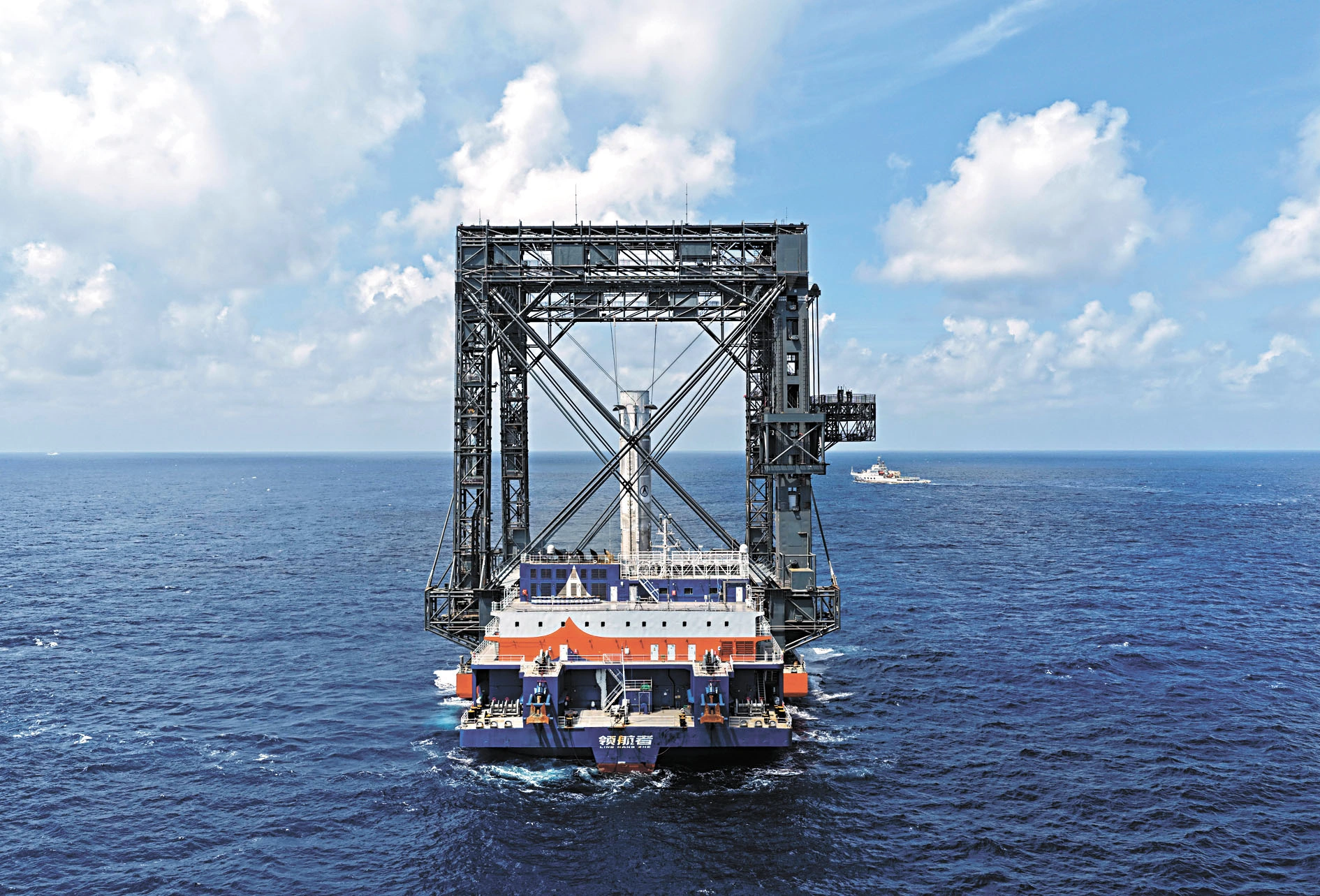 The Navigator, the Long March 10B and the net
The recovery vessel tasked with this mission, the Linghangzhe (Navigator), measures 144 meters long and 50 meters wide, with a full-load displacement of 25,000 metric tons, equipped with a 36-meter-tall arresting net truss. The platform features DP2 dynamic positioning capability, enabling stable operations in sea swells up to four meters, with an expanded capture tolerance window of ±50 meters.
This mission’s historic value can be summarized by two ‘firsts’: China’s first successful controlled recovery of a launch vehicle first stage, and the world first practical implementation of net capture recovery for launch vehicles.
The combination of these two ‘firsts’ marks a historic breakthrough for China in reusable launch vehicle technology. Prior to this flight, China had conducted multiple low-altitude demonstrations of reusable technology, yet never recovered a first stage after a full orbital launch mission. Net capture recovery represents an unprecedented engineering practice within the global aerospace sector. While SpaceX employs rigid vertical landing legs and Starship relies on giant mechanical arms to clamp descending boosters, China has pioneered a third technical route with a flexible arresting net.
This success establishes China as the world’s second nation to master a complete industrial technical system for heavy-lift reusable launch vehicles.Amid the booming global commercial space industry, reusable technology is key to slashing launch costs and ramping up launch frequency. The Long March 10B delivers drastically reduced launch expenses in reusable mode, distinguished by heavy-lift capability and outstanding cost-performance.
It is vital to note this milestone did not materialize overnight. In February 2026, the Long March 10 low-altitude demonstration flight concluded successfully, with its first stage completing controlled return flight and planned ocean splashdown. From ’returning intact’ in February to ‘precision capture’ in July,in just five months, Chinese aerospace engineers achieved a technical leap: evolving from ‘being retrievable ‘in to ‘being catchable’ .
Next Milestone: Re-flight
This mission marks the 657th launch of the Long March rocket family. For the Long March 10B, however, this is merely the starting point. The development team disclosed ongoing optimization of the rocket’s performance and accelerated iterative upgrades of reusable launch vehicle technology, targeting the first re-flight of the recovered first stage by the end of 2026.
From a successful maiden flight to operational reusability — from a ‘one-off technical breakthrough’ to ‘sustainable routine operations’,China’s reusable rocket program has only just embarked on its path.
At noon on July 10, 2026, a rocket soared into space, then descended gently to be securely caught by a flexible net. Decades from now, when people look back on this moment, they may remember far more than the arresting net itself. This flight symbolizes a profound shift: China’s commercial space sector is evolving from a technological follower to an originator of pioneering technical routes.
And this might be the true milestone of the Long March 10B’s maiden flight worthy of being etched into history.
Editor: Gu Shengze