


The idea of launching a large-scale emergency rescue mission in space – involving thousands of engineers, scientists and government personnel in a matter of days – has been the stuff of movies.
Films have dramatised such events as clock-ticking scenarios but in reality, even the most seasoned spacefaring nations have needed months to respond to in-orbit crises.
China has revealed details of its emergency involving the damaged Shenzhou-20’s return capsule in November and how it pulled off its first astronaut rescue mission in rapid fashion.
 November 14: Shenzhou-21 returns successfully, astronauts safely exit the capsule.
Within just 20 days, Chinese engineers diagnosed the threat, returned the Shenzhou-20 crew safely to Earth aboard the Shenzhou-21 spacecraft and launched the uncrewed Shenzhou-22 capsule to provide a new safe return vehicle for the remaining crew.
The emergency was triggered by a shard of space debris about the size of a grain of dust – less than 1 mm (0.04 inch) – wide that cracked a window on the capsule.
The contrast in response time to past incidents is striking.
Following the Soviet Union’s Soyuz 33 engine failure in 1979 that prevented its crew from docking with the Salyut 6 space station, the uncrewed replacement craft, Soyuz 34, was launched and docked about two months later to give the resident crew a safe return vehicle.
More recently, after a coolant leak compromised a Russian Soyuz capsule docked at the International Space Station at the end of 2022, the replacement ship was launched over two months later and the affected crew did not return until September 2023.
And in 2024, two Nasa astronauts saw their planned eight-day mission balloon into a nine-month odyssey owing to technical issues with Boeing’s Starliner, forcing them to return on a SpaceX Dragon after their lengthy unplanned delay in space.
China’s rescue unfolded as a tightly coordinated cross-system effort, with engineers, flight controllers and launch crews working day and night to assess the damage and put the emergency plan in motion, according to an interview aired by state broadcaster CCTV on Monday.
Jia Shijin, chief designer of the Shenzhou spacecraft system, said he was stunned to hear about a triangle-shaped mark on Shenzhou-20’s window, just one day before the crew’s scheduled return on November 5.
“The odds of a spacecraft getting hit are already low,” he said in the CCTV interview. “But striking the window? That felt almost impossible.”
To assess the damage, the astronauts photographed the mark from multiple angles and lighting conditions, while one of the Tiangong space station’s robotic arms captured external imagery.
On the ground, specialists from a dozen glass research institutes reviewed the evidence and concluded the mark was a crack that had penetrated the window’s outer thermal pane.
To evaluate worst-case scenarios, simulations and wind tunnel tests were carried out, including parallel trials by two leading research agencies. Results showed that if the crack expanded during atmospheric re-entry, the outer thermal pane could detach entirely.
“That could have exposed the pressure pane inside,” Jia said. “And if that failed, the cabin could have depressurised in an instant.
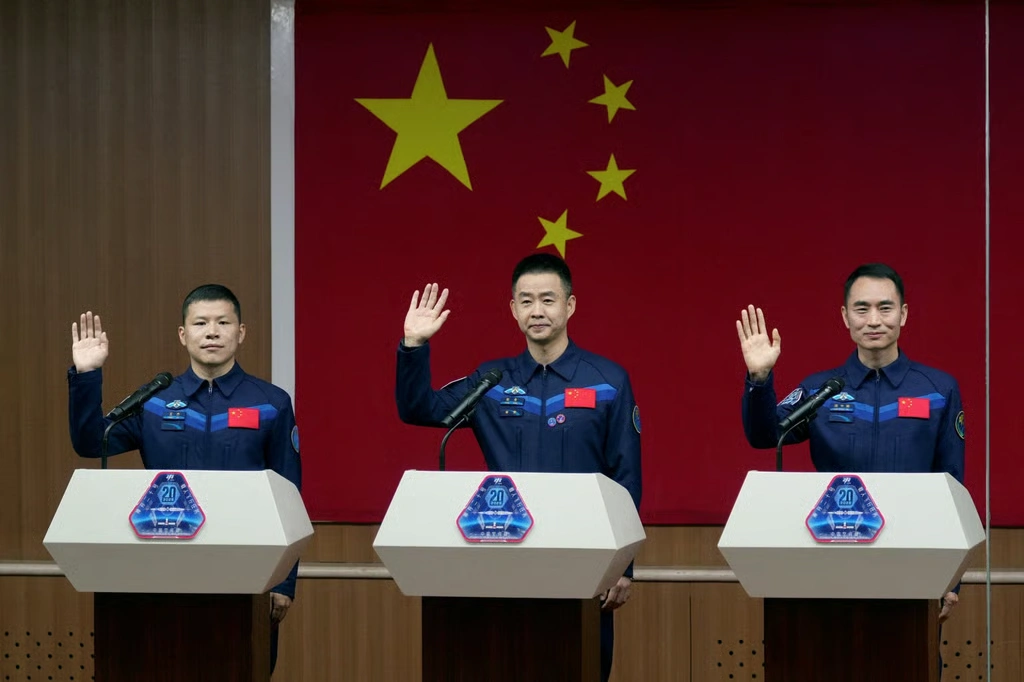 Chinese astronauts Chen Dong, Chen Zhongrui and Wang Jie flew on the Shenzhou-20 space flight mission whose return capsule was found to be damaged. Photo: China Daily via Reuters
At a high-level meeting on November 8, Chinese space officials decided that the damaged Shenzhou-20 capsule could no longer guarantee a safe ride home.
Ji Qiming, assistant director and chief spokesman for the China Manned Space Agency, said two emergency plans were considered.
One entailed launching a brand-new uncrewed capsule, Shenzhou-22, for the crew to ride back in. The other was to have the astronauts borrow the Shenzhou-21 spacecraft already docked at the Tiangong space station and send up Shenzhou-22 later as a replacement lifeboat.
The second option was chosen, Ji said, because Shenzhou-21 shared a similar configuration to Shenzhou-20, making it easier for the crew to operate. More importantly, it was the fastest way to get them home.
Wu Dawei, deputy chief designer of the astronaut system at the China Astronaut Research and Training Centre, said there were adequate supplies of food and oxygen aboard Tiangong and that the astronauts remained in good spirits as they prepared to return.
The only shortfall, Wu quipped, was food for the four mice that arrived with Shenzhou-21. “We gave them some of the astronauts’ water and soy milk,” Wu said. “They came back in very good health.”
In the CCTV interview, Ji said the Shenzhou-21 crew aboard Tiangong would inspect the cracked window on Shenzhou-20 more closely and attempt to reinforce it during their next spacewalk.
“Shenzhou-20 will eventually return to Earth without a crew,” he said. “That process will yield the most realistic test data, extremely valuable and meaningful for our future work.”
The emergency launch of the uncrewed Shenzhou-22 capsule on November 25 has also accelerated spacecraft production timelines, CCTV reported.
The Shenzhou-23 capsule, originally scheduled to roll off the line in March next year, is now expected to be ready two months earlier, with Shenzhou-24 also being fast-tracked for completion next summer, according to the broadcaster.
Since Chinese astronaut crews are typically named after the spacecraft they fly, the next crew will be known as the Shenzhou-23 crew. Jia explained that there would be no “Shenzhou-22 crew”, saying this was a reminder of the risks behind every mission.
“In human space flight, the work is never truly done,” Jia added. “We should never assume we’ve achieved perfection. Even after successes, only by staying alert can we continue succeeding.”
Editor: Zhongxiaowen