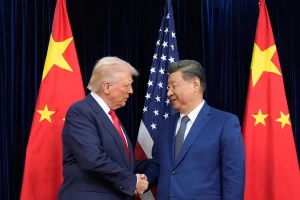



From June 9 to 10, 2025, Chinese and U.S. delegations held trade talks in London. After the meeting, both sides stated that they had, in principle, reached a “framework of measures” and would report back to their respective national leaders for further action. About two weeks later, on June 26, Trump announced that a trade agreement had been reached with China. On June 27, a spokesperson for China’s Ministry of Commerce confirmed:
“Under the guidance of the consensus reached between the Chinese and U.S. heads of state, the two countries’ trade teams held talks in London from June 9 to 10. They reached a principled agreement on a framework to implement the key understandings from the June 5 phone call between the leaders and to consolidate the outcomes of the Geneva trade talks. Recently, with approval, both sides further confirmed the details of this framework. The Chinese side will, in accordance with the law, review and approve qualified export control applications. The U.S. side will in turn lift a series of restrictive measures previously imposed on China.”
The sequence of events from Geneva to London reveals that the underlying logic of the U.S.–China trade confrontation has shifted—from a traditional tariff war to a more complex contest involving “supply chain warfare” and a “technology war,” both of which touch on the core interests of long-term great-power competition.
U.S. policy toward China comprises both consensus and non-consensus elements. The evolving dynamics of the current U.S.–China rivalry have fully confirmed this analysis: the tariff war once spearheaded by Trump, characterized by sweeping duties, falls into the “non-consensus” category and lacks broad support in the United States. In contrast, the U.S.-led push for export controls on technology reflects the real policy consensus—and it has become the central front in the ongoing contest between the two sides.
The conclusion of the London trade talks marks the end of one chapter and the beginning of another in U.S.–China trade relations under Trump’s second term—one that moves from confrontation and retaliation toward conditional cooperation.
1. Trump’s Tariff War Against China: Not a U.S. Policy Consensus
The large-scale tariff war Trump launched against China does not represent a mainstream consensus in the United States.
Trump’s understanding of tariffs has always been broad-brushed and emotional. He seeks to use a simple tool to tackle complex issues, believing that tariffs can “kill multiple birds with one stone” and achieve several goals at once. His objectives include:
Trade Balance – Reducing the U.S. trade deficit with China, which he treats as a numbers problem solvable by cutting Chinese exports or increasing Chinese purchases;
Industrial Policy – Using high tariff walls to force companies to bring supply chains back to the U.S. This would require tariffs to be maintained over the long term with policy stability, not subject to arbitrary reversals;
Revenue Generation – Using tariffs to provide fiscal revenue for the U.S. government to offset income lost from tax cuts. This, too, requires long-term consistency;
Negotiating Leverage – Using tariffs as a bargaining chip to either further open up China’s market or gain Chinese cooperation on issues like fentanyl. This implies that once a deal is reached, tariffs can be removed.
Obviously, these goals conflict with one another. They differ in terms of the scope of industries affected, the severity and timing of implementation, and how long the tariffs should remain. Coupled with Trump’s complete chaos in methodology, expectations management, and execution, it’s clear that these tariffs could not possibly meet their stated objectives. Instead, they have eroded both political support and market confidence.
Trump sees himself as dominating the American political arena: the Democratic Party appears, in his eyes, to be a hollow shell offering no meaningful resistance and largely absent from the political stage, while the Republican Party is completely under his control—from both chambers of Congress to the ideologically driven justices of the Supreme Court.
But he cannot control markets, public sentiment, or economic fundamentals. Since March and April, U.S. consumers, importers, retailers, and manufacturing firms dependent on global supply chains have voiced strong dissatisfaction with Trump’s tariff policies. Most economic elites—finance professionals, economists, think tank analysts, professors, and media commentators—oppose the tariffs and their underlying rationale, warning that the U.S. economy is headed toward a recession. Consumers want to see a revival of domestic manufacturing in critical sectors, but they do not want a sharp rise in the prices of clothes, everyday goods, toys, and electronics, which would worsen already high food and grocery prices. Furthermore, foreign governments—including U.S. allies—have not caved easily. They’ve responded with harsh rhetoric and, in many cases, their own countermeasures.
The tariff war has rapidly drained Trump’s political capital and market credibility. Ultimately, it was the capital markets that imposed the strongest constraint. The S&P 500 dropped 19% from its February high to a low on April 8, 2025—the year’s lowest point. In a hyper-financialized economy, falling stock prices quickly stoke widespread pessimism and reshape business and personal consumption behavior. But what truly forced Trump to change course was the bond market: investors dumped U.S. Treasuries, causing yields to surge. This hit Trump—whose background in real estate makes him acutely sensitive to interest rates—where it hurt. He first postponed his “reciprocal tariffs” against other countries, and then, after the Geneva talks, rolled back the irrational 145% tariff hike on Chinese goods.
Here, I offer four observations that can help forecast how the trade war may evolve going forward:
First Observation: Trump’s imposition of high tariffs lacks political consensus, economic conditions, and public support in the U.S.
Second Observation: Markets currently view Trump’s tariffs as absorbable. The average U.S. tariff rate now stands at 18.8%, the highest since the 1930s (up from just 2.4% in 2024). Markets have not yet seen a surge in inflation, possibly believing that the supply chain, logistics system, and consumers can collectively shoulder the current burden without worsening the economic outlook. Of course, if conditions deteriorate over the coming months and the economy slides into recession, this view could shift.
Third Observation: Political circles, businesses, capital markets, and the public now believe that the tariffs are achieving several strategic objectives, and are therefore broadly satisfied. These include:
A tiered structure: 30% tariffs on China (only during Trump’s second term), 10% on other countries—aligning with a strategy of targeted pressure on China;
Revenue generation: At current levels, tariffs can bring in around $400 billion annually, helping to offset the fiscal impact of tax cuts (though in practice, this represents a tax cut for the wealthy and a tax increase for the poor, exacerbating inequality);
Supply chain adjustments: Some companies are shifting production away from China to other countries (due to the 30% vs. 10% tariff spread), with some operations potentially returning to the U.S.
Taken together, markets view the current tariff regime as tolerable and believe Trump is likely to maintain it.
Fourth Observation: All sides now believe that the capital markets can restrain Trump. This is the logic of TACO (“Trump Always Caves Out”)—when Trump rolls out extreme policies, markets push back forcefully (e.g., through stock and bond sell-offs), and under pressure, Trump retreats. The back-and-forth in March and April appears to have confirmed this dynamic, and market actors now have strong confidence in it.
Based on this logic, markets see the risks of Trump resuming or escalating the tariff war as manageable. That’s why the S&P 500 hit a record high last Friday: investors don’t necessarily believe the economy is in great shape, but they do believe the worst is over. Compared to prior months, Trump’s behavior has become more predictable. In short, markets have placed their bet: Trump making a full-blown comeback with aggressive new tariffs is unlikely. People no longer take Trump’s tariff talk seriously.
Summary:
Trump’s aggressive tariffs on China lack broad political consensus in the United States because they are unsupported by a coherent policy framework, economic rationale, or public backing. As a compromise, domestic stakeholders in the U.S. are willing to accept the current level of tariffs on China—for now.
2. Export Controls on Technology: The Real U.S. Consensus on China
In stark contrast to the tariff war, export controls on technology targeting China represent the real bipartisan consensus in the United States. This policy approach has, in fact, been a central pillar of the Biden administration: while it largely maintained Trump-era tariffs against China, it strategically shifted the focus toward technology export controls—some aimed at specific industries and products, others more “surgical,” targeting particular companies. U.S. elites from both parties view the U.S.–China great power contest as fundamentally a struggle in strategically critical domains. They therefore advocate a model of “strategic decoupling” in economic and trade relations: sensitive sectors are to be delinked or significantly reduced in cooperation, whereas non-sensitive sectors remain open to normal trade.
For the United States to maintain its advantage in strategic competition with China, it must both continue advancing in critical technologies and industries, and try to block China from advancing in and catching up with those fields.
The U.S.’s specific strategies include:
Passive defense – preventing the transfer of U.S. resources to those Chinese sectors, including expertise, technology, talent, and capital.
Active offense – targeting Chinese companies/entities in strategic fields by placing them on various restricted lists and imposing export controls.
Actions taken under this consensus include severing commercial and technical ties, cutting financial and capital linkages (“finance decoupling”), and limiting academic and research exchanges (“academic decoupling”).
To U.S. policymakers, this is part of a broader “tech war” justified by national security. For example, export controls on Huawei and limiting visas for Chinese students in “critical fields” stem from this logic—not a trade-war rationale. Trade-war logic emphasizes maximizing exports and market openness; tech-war logic emphasizes restricting exports in critical sectors.
Between national security (political calculations) and trade balance (economic calculations), U.S. elites uniformly prioritize national security. Thus, even if export controls reduce U.S. exports to China and impact American companies’ profits, these measures are regarded as necessary.
This consensus transcends administrations: both the Biden and Trump governments—at least among technocrats and decision-makers—have acted in sync on this front.
Since April 2025, a systematic escalation of U.S. technology export control measures against China has emerged, including:
EDA software controls: On May 29, the U.S. Department of Commerce’s Bureau of Industry and Security (BIS) instructed EDA software firms like Synopsys and Cadence to suspend services to mainland China—blocking access to core semiconductor design tools.
Aircraft-engine technology restrictions: In late May, the U.S. paused licensing for critical aviation technology—such as LEAP‑1C engines—hindering the COMAC C919 project.
Chemical-export licensing: Since May 23, shipments of high-purity (≥ 95%) ethane and butane to China now require U.S. export licenses—leaving several U.S. ethane ships stranded along the Gulf Coast.
Tightened chip technology rules: In mid‑June, BIS warned global chipmakers (TSMC, Samsung, SK Hynix) that existing U.S. technology waivers in mainland China could be withdrawn.
These measures, conducted by BIS, fall outside the traditional “trade war” toolbox—they are part of a broader tech-security framework.
Additionally, on May 29, Secretary Rubio announced that the Trump administration would begin revoking visas for Chinese students in “critical fields” or those “associated with the Chinese Communist Party”—a State Department policy firmly rooted in “tech war” logic, not trade policy.
Some may argue that because these measures were introduced during a tariff war—as part of China countermeasures—their logic is intertwined. The connection exists tactically: bureaucrats seized “the trade-war moment” to launch these initiatives, and politicians used them as pressure mechanisms. But in substance, they are logically and structurally separate. They often remain even if trade tensions ease—and in fact, the U.S. has consistently refused to link rollback of these measures to the easing of tariff disputes.
Unlike the chaotic tariff war, the tech war is grounded in clear logic, precise objectives, a systematic and sustainable methodology, and minimal domestic economic impact. It has:
Bipartisan political support (across both elected officials and technocratic elites);
Industry and capital market approval (it curtails Chinese competition with little domestic backlash, though a few U.S. exporters like Nvidia may be exceptions);
Wide public acceptance (export controls don’t affect daily life for most Americans, so there’s little opposition).
In the wake of Trump’s provocations, Washington’s elites quietly nudged policy back on track: tariffs stabilized—30% on China, 10% on others—and the main front shifted firmly to the tech war, i.e., export controls on critical technologies.
Trump’s shift toward this direction may seem accidental, but it was, in fact, a deliberate—or at least predictable—strategy in plain sight rather than a hidden conspiracy.
3. China’s Rare Earth Countermeasure: A Precise and Effective Strategic Weapon
Having covered America’s “open strategy,” let’s turn to China. In response to the U.S.’s escalation of technology export controls, China began implementing targeted countermeasures starting April 2, 2025. These measures focused primarily on rare earths and other critical mineral resources, placing export controls on rare earth products destined for the U.S., requiring government approval for such exports. The effects were immediate: in April, China’s exports of rare earth magnets to the U.S. dropped 59% year-on-year; in May, they plummeted 93% year-on-year.
This countermeasure carries major strategic weight. China mines 70% of the world’s rare earths and handles 90% of the chemical processing, giving it absolute dominance over the supply chain. Rare earths are essential for producing wind turbines, EV batteries, military radars, precision-guided weapons, and other high-tech products—areas where the U.S. is heavily dependent on Chinese supply.
The impact was swift and expected. Many American industries faced looming supply chain disruptions that directly affected operations. Businesses large and small lobbied the U.S. government. Mounting pressure from all sides eventually led the U.S. to agree, in the latest framework agreement, to lift certain restrictions on China in exchange for the resumption of rare earth exports.
This was clearly a victory for China’s countermeasures.
The U.S. should now realize that it’s not just capable of choking China—it, too, can be choked by China. The Chinese call this tactic “strangling the neck”; Americans call it “weaponization.”
Ultimately, the contest between the two countries is about who can choke whom more effectively. One factor is quantity—who imposes more chokepoints. The other is impact—whose chokepoints actually inflict more damage and become unsustainable for the opponent.
While the U.S. restricts China’s access to key technologies, China is restricting the U.S.’s access to critical resources. And when it comes to rare earths, this truly is a chokepoint: one decisive move with powerful results.
The U.S. has long been concerned about supply chain security. But practically speaking, recreating a complete rare earth supply chain outside of China is extremely costly and time-consuming. Crucially, the U.S. only has market forces—private enterprises—but lacks state-owned enterprises (SOEs) as instruments of national industrial policy. Relying solely on price incentives and tax cuts is insufficient to build out such a strategic sector (rare earths involve a whole web of interconnected sub-industries). Having SOEs to shoulder functional responsibility is ideal; in their absence, robust industrial policy is necessary—but here too, U.S. politics are deeply divided, with half the country ideologically opposed to such policy. As a result, U.S. rare earth plans remain largely theoretical.
And rare earths are just one example. There are many such niche but critical sectors. In fact, the U.S. and China are already in an asymmetrical competition—China simply hasn’t “weaponized” these resources the way the U.S. has with technology.
The foundation for great-power competition lies in a massive manufacturing and industrial base. Technological innovation ultimately depends on real-world industrial capabilities.
4. China and the U.S.: Limited Cooperation, Ongoing Strategic Contest
Under the latest framework agreement, the U.S. and China have engaged in a transactional arrangement: China will accelerate approvals for exports of rare earths and other key materials, while the U.S. agrees to roll back certain restrictions on China. This reflects a state of mutual constraint in the supply chain contest.
From a timing standpoint, China’s rare earth export licenses to the U.S. are only valid for six months. The U.S., for its part, is unlikely to fundamentally loosen its export controls on core technologies like chip design software or jet engine tech due to this agreement. These are temporary arrangements, not long-term resolutions.
This kind of provisional agreement underscores the dawn of the “weaponized supply chain” era. The U.S.–China economic dialogue now resembles Cold War-era arms control talks: both sides aim to maintain their strategic edge, aware of each other’s supply chain leverage, while exploring ways to shift the balance of power more decisively in their own favor.
5. Trump’s “Unexpected Opportunity”: A Strategic Window Created by Personality
Trump’s return to power has undeniably introduced fresh uncertainty into U.S.–China relations. Paradoxically, however, his personal political quirks have created a rare window of strategic opportunity for China.
First, Trump’s obsession with tariffs has bought China room to negotiate. Under Biden, the U.S. concentrated on waging a tech war against China. Trump has brought the focus back to tariffs—a topic that does not enjoy broad elite consensus in the U.S. Trump is relatively isolated on this issue, squandering resources and weakening his domestic political capital. Yet out of ego, he continues to frame things around a “trade war.” The irony is that while the rhetoric is about trade, the fight remains over tech. This mismatch allowed China to press for concessions in the tech domain under the guise of trade negotiations.
Second, Trump’s highly transactional nature enables pragmatic, issue-specific deals between the two countries. He fixates on short-term, tangible gains and shows little interest—or aptitude—for long-term strategic planning. Abstract ideas like national security or ideology barely register with him. This opens up room for both governments to find overlapping interests.
Third, while Trump’s unpredictability increases volatility in U.S.–China relations, it also undermines the coherence and continuity of long-term American strategy toward China. His presence disrupts the U.S.’s ability to develop and implement a systematic anti-China strategy. In doing so, he buys China precious time and space to recalibrate its strategic posture.
VI. China’s Strategic Opportunity: A Critical Window for “Trading Time for Space”
Faced with the current complex landscape, China must craft its response based on a clear-eyed understanding of the fundamental nature of U.S. policy.
First, it is essential to make an accurate judgment about the long-term trajectory of U.S. policy toward China. Trump is an outlier—he is obsessively focused on tariffs, but largely indifferent to issues like security, ideology, systemic rivalry, and the tech war. However, Trump will exit the political stage in three and a half years. U.S. China policy will, in all likelihood, revert to its true bipartisan consensus. Since April, the U.S. has introduced systematic restrictions across multiple key technological sectors. These moves reveal that technological export controls and tech containment remain Washington’s core instruments. The underlying logic—to preserve its technological edge and delay China’s catch-up—will not change, regardless of Trump’s personal inclinations. This policy has deep-rooted bipartisan support within the U.S. and is built for the long haul.
Second, China must leverage its comparative advantages to mount countermeasures. It should establish a more robust export control system over key resources such as rare earths, ensuring that retaliation is not only efficient but also precise, minimizing collateral damage to other geopolitical or economic partners. In addition, China should explore potential countermeasures in emerging technological domains. Looking ahead, the tug-of-war over supply chains will inevitably expand into more areas.
Third, China must accelerate indigenous innovation in core technologies. The current mix of tariffs and retaliatory resource-based controls has offered valuable experience for future rounds of strategic competition. Still, resource advantages alone are insufficient. The key lies in achieving breakthroughs in core technologies to avoid being strangled by U.S. chokepoints. In fields like semiconductor manufacturing, aircraft engines, and advanced materials—areas heavily restricted by the U.S.—China must ramp up investment and strive for major breakthroughs in the coming years.
Fourth, China must recognize both the presence of a strategic window and the urgency of the moment. Trump is an extreme, highly unrepresentative figure in American politics. Paradoxically, his presence has become the biggest disruption to the United States’ systemic anti-China strategy, thereby creating a rare and temporary strategic opportunity for China. However, any window that arises due to Trump’s personal idiosyncrasies is inherently limited. China must seize this opportunity to accelerate its push for technological self-reliance and supply chain resilience, and achieve decisive progress in critical technologies as soon as possible.
History shows that great-power competition is often decided by how well a country capitalizes on strategic windows. The current global environment presents China with a rare—perhaps historic—opportunity for development. Yet even the most valuable opportunities can vanish in a flash. Only through clear-eyed analysis, sound strategy, and unwavering execution can China gain the upper hand in this long-term strategic contest—and secure a position of overwhelming advantage.
Editor: Zhiyu Wang