



On July 16, 2026, Moonshot AI released its large language model Kimi K3. That same day, it topped a widely followed coding-arena leaderboard, becoming the first open-weight model to outperform all closed-source models. Over the next two weeks, the American response was strikingly divided across three spheres. The financial sector cast its vote in the most direct way possible: US-listed AI stocks lost about $470 billion in market value in three days, while the Philadelphia Semiconductor Index fell nearly 10 percent in a week. Washington split into opposing camps. The director of the White House Office of Science and Technology Policy accused Chinese companies of “large-scale distillation” of American models; the Treasury secretary threatened financial sanctions; yet the commerce secretary publicly questioned whether export controls would work. Industry voices were more blunt. Twenty-five companies, including Microsoft, Nvidia, Dell, and IBM, jointly called for support for open-weight models, while nearly 200 Silicon Valley startups warned the White House that banning Chinese open-source models would mean that it would not be Chinese companies that died, but American entrepreneurs.
How could a single product launch provoke such sharply divergent reactions? Because what it tested was not the capability of Chinese models, but the resilience of the American narrative. When a model approaching frontier-level performance and costing less than one-tenth as much to use as US closed-source models can be downloaded for free, the foundations of the business model built on premium pricing for closed models begin to crack.
On the surface, the debate over AI appears to be a contest between technical approaches—open source or closed source, domestically developed chips or imported ones. At a deeper level, it is a debate in political economy: Who owns intelligent capabilities? How is production organized? And how are the resulting gains distributed across society? Technical questions are never merely technical. In *Capital*, Marx distinguished between “the machine” and “the capitalist application of machinery”: machinery itself can reduce labor, while its capitalist application can intensify exploitation. Today, we need the same distinction. AI is among the most highly socialized products of our age. It encodes the language, collaboration, and collective knowledge of the human species in a single model. Yet this socialization can take two forms. Marx himself observed that the joint-stock company represented a regressive form of socialization, whereas the cooperative represented a progressive one. Borrowing this distinction, this article proposes two concepts. The “feudalization of intelligence” occurs when socially produced intelligence is appropriated by a small number of private actors and converted into rent, dependency, and domination. The “socialization of intelligence,” by contrast, means returning socially produced intelligence to society and turning it into capabilities that the majority can access, use, and verify. The significance of China’s development path in the age of AI lies in the struggle between these two directions.
The Diagnosis and Limits of “Technofeudalism”
The term “feudalization of intelligence,” as used here, is not coined out of thin air. It builds on an unresolved debate in Western intellectual circles. In May 2026, Cédric Durand, a professor at the University of Geneva, and technology critic Evgeny Morozov debated in Shanghai the “technofeudalism” hypothesis that Durand had systematically advanced in 2020. Durand’s diagnosis begins with a paradox: AI investment is booming, with Amazon, Google, and Microsoft building enormous data centers, while investment by non-tech companies is declining and net capital accumulation remains near historic lows. The result is a two-speed economy: AI is burning hot on one side, while the real economy stagnates on the other. The boom is driven by financial rather than productive logic. Nvidia invests in OpenAI; OpenAI buys computing power from Microsoft; Microsoft then buys Nvidia chips. These circular transactions help sustain one another’s valuations.
On this basis, Durand identifies three features of technofeudalism: pervasive digital dependency, in which no one can do without network services; the private capture of political power, extending even to monetary authority through stablecoins; and a zero-sum logic of predation, in which people must pay to obtain essential access. This, he argues, is not profit earned through equivalent exchange, but tribute extracted through control. The rent-seeking logic of platform capitalism is laid bare.

Morozov’s rebuttal is equally forceful. Feudalism and capitalism differ in two respects: whether domination is personal or impersonal, and whether the economy is stagnant or accumulative. By these criteria, the power exercised by platform giants remains impersonal, and capital accumulation at the top has not stalled. Workers may not share in the gains, but that is precisely what one would expect under capitalism. More importantly, the technofeudalism hypothesis obscures the real story: geopolitics. Huawei has been sanctioned, and its Ascend chips cannot be exported. The UAE’s G42 was forced to terminate its contract with Huawei in order to obtain advanced American chips. This is not feudal tribute; it is imperial hegemony reshaping the global landscape of intelligent capabilities.
Which side is right? My view is that Durand is wrong in his label but right in his diagnosis, while Morozov is right to recalibrate the target but underestimates the value of the diagnosis itself. Durand does exaggerate the extent of “feudalism”: what we are seeing is a new form of capitalism, not a return to the Middle Ages. But the valid part of his diagnosis should not be discarded along with the label. Platforms’ exclusive control over key means of production is indeed creating new forms of dependency.
The real significance of this dispute over terminology lies in identifying the proper target of criticism. The technofeudalism hypothesis matters not because it accurately names a particular stage of capitalism, but because it forces us to ask: when the socialization of the means of production reaches unprecedented heights, who controls its socialized products?
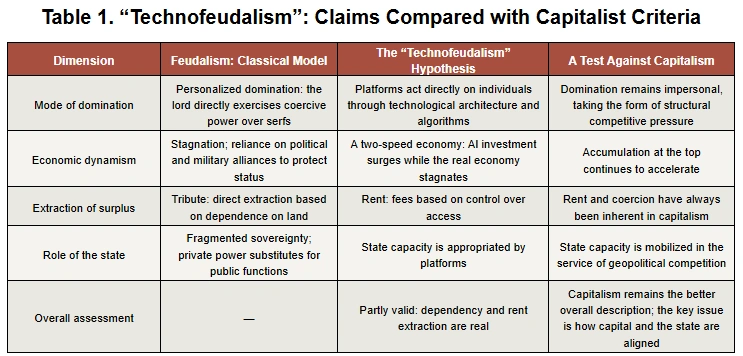
Whatever label one adopts, the deep involvement of the US government in the AI industry shows that the picture of “platforms swallowing the state” is only half right. The other half is that the state protects capital while relinquishing control over it. Feudalization and hegemony are two sides of the same coin.
Rents, Moats, and Narratives
Where, then, is the battle being fought? The answer is open source. The intense reaction in American business and political circles to Kimi K3’s release offers a natural experiment for examining the political economy of intelligent capabilities. The motives of those advocating closed models and bans fall into roughly three categories. The first is rent. Closed-source labs build their business models around locking frontier models behind application programming interfaces (APIs)—remote-access channels that charge users for each call—and charging a premium. Open models dismantle that gate. The second is the moat. Mandatory safety testing, export controls, and anti-distillation legislation all impose compliance costs that large labs can readily absorb but that small teams and open-source communities may find prohibitive. Even if, as Dario Amodei has recently suggested, safety testing is tiered according to what counts as “frontier,” with lighter requirements for those catching up, the questions remain: Who sets the threshold, and who has the resources to comply first? The answers still favor incumbents. Safety requirements therefore continue to function as barriers to entry—a phenomenon researchers call a “regulatory moat.” The third is narrative. When the technological lead has narrowed to just three to five months, the only gap left to widen is the gap in public perception. “Distillation,” “security risks,” and “ideological threats” are invoked in turn. In short, what worries these actors is not that Chinese models are unsafe, but that they are too cheap.
To understand why “too cheap” is so threatening, we need to ask where the money behind the AI boom is coming from. Since early 2024, the five largest US tech companies have spent a combined $560 billion or so on AI capital expenditure, while AI-related revenue over the same period has amounted to only about $35 billion. The enormous gap is being bridged by a long-term narrative about artificial general intelligence (AGI). As one OpenAI founder put it, the idea is to build a general-intelligence system first and “then simply ask it how to make money.” In 2024, retail investors poured nearly $30 billion into Nvidia, while Wall Street cast every model launch as a “new industrial revolution.” The histories of railways, radio, and fiber-optic networks repeatedly show that even when technological progress is real, the infrastructure may survive while investors’ money goes up in smoke. This helps explain why Kimi K3 struck such a nerve: it unsettled the entire pricing logic behind the premium charged for frontier models.
The closed-source camp has a more sophisticated accusation: open source is inherently “decelerationist,” because open-weight models depress the profits of frontier labs, reduce the capital available for reinvestment, and thereby slow the development of next-generation models. This argument conflates harm to the returns of three leading closed-source labs with harm to AI progress as a whole. Nathan Lambert, a researcher who has long tracked the open-source ecosystem, puts the rebuttal precisely: “one slows things down, the other speeds them up.” Open source slows the accumulation of rents by frontier labs, but accelerates the diffusion of intelligence throughout the economy. Macroeconomic estimates offer hard numbers: if no country invested in open source, long-run GDP would be 2.2 percent lower on average, while total enterprise software spending would rise to 3.5 times its current level. The AI inference market is reproducing the same pattern: open models deliver 90 percent of the capability at one-sixth the price of closed models, and performance gaps can close within months. In 2025 alone, unrealized consumer benefits were estimated at between $20 billion and $48 billion. In economic history, the steam engine and electricity contributed to growth less through invention itself than through their diffusion across industries. Schumpeter’s “creative destruction” has always destroyed rents and created capabilities.
The charge of “deceleration” must be set against the closed-source camp’s own selective approach to slowing things down. Anthropic CEO Dario Amodei argues that, given the intensity of US–China competition, the government should tighten chip exports, crack down on distillation, introduce tiered safety testing before release, and support a regulatory philosophy known as “Pacing the Frontier.” Amodei has recently elaborated on this position. In the testing regime he proposed to the US Center for AI Standards and Innovation and the White House, frontier models would face stricter tests and non-frontier models lighter ones. The stated aim is to regulate the pace of the most advanced models, not to restrict those trying to catch up. Under Anthropic’s preferred approach, such a system could even hurt the commercial interests of frontier labs while benefiting challengers, including open-weight models.
This revised argument deserves serious consideration, but it also reveals the heart of the problem: those who appoint themselves the pace-setters occupy the very position from which “the frontier” and its speed are defined. Who is slowed down, and by how much? The gatekeepers still hold the keys. Moreover, this defense addresses only safety testing. The same package of proposals includes chip export controls and anti-distillation legislation, whose effects still fall overwhelmingly on Chinese companies and open models. In nineteenth-century Britain, the Locomotive Acts—often associated with the “Red Flag Act”—required a person to walk ahead of a motor vehicle carrying a red flag. The rule was ostensibly about safety, but in practice it protected the carriage business. Genuine deceleration is not found in the wording of regulations; it occurs when gatekeepers narrow the supply of intelligent capabilities.
The struggle over interests is only part of the story; the institutional mechanisms still need to be explained. To understand why open source constitutes a substantive challenge to the feudalization of intelligence, we first need to clarify the concept. “Open source” is not simply a state in which information has been made public. It is an institutional arrangement for allocating control over technology. Cyberspace has no naturally unregulated state: technological architecture, like law, markets, and social norms, directly constrains what actors can do. Open source is therefore not technological freedom left behind when law withdraws, but a particular allocation of architectural control. It is also a mode of production validated by three decades of practice. Linux accounts for nearly 40 percent of server operating systems, while Apache dominated the web-server market for years. Economists have consequently recognized that open source is at once “cutting-edge technology, a commodity, and a public good.” Steven Weber offers the classic formulation: the real product of open source is not software, but a way of organizing production—“distributed innovation”—that brings together the creativity and immediate needs of people scattered across society.
AI models, however, have no single component that can straightforwardly be called “source code.” Model weights, architecture, training code, training data, and filtering rules all shape a model’s behavior; publishing only one layer is usually insufficient to reproduce the training process. Even DeepSeek, widely regarded as a benchmark for open models, has not released its complete training data. It is more accurate to understand openness as a continuum: open interfaces, open weights, open development, and an open ecosystem. Each successive level allows users greater scope to modify what they use. The decisive dividing line is the second level. Model weights can be understood as the digital files that encode a model’s learned “memory.” Open weights allow users to run a model on infrastructure they control, freeing them from ongoing permission to use a remote API, from the provider’s logging practices, and from the risk of unilateral shutdown. Once an open-weight model has been lawfully downloaded, its original provider generally cannot immediately change the rules under which it runs. The balance of control has shifted.
Of course, open source is neither romantic nor cost-free as an institution. In Elinor Ostrom’s terms, it is a form of commons governance: sustaining a shared resource requires rules governing participation, monitoring mechanisms, and graduated sanctions. Open-source licenses are a core part of this governance system. The commons is not sustained by abstract altruism alone. Empirical studies repeatedly find that developers’ leading motivation for contributing to open source is the intellectual stimulation of writing code, followed by the opportunity to learn and master new skills. In a sense, open source is the largest and least expensive voluntary training system in existence. Yet openness can disperse dependency at the application and deployment layers without automatically eliminating concentration at the infrastructure layer. Model-hosting platforms provide storage, version control, and community discussion, making them chokepoints in the open-source ecosystem. Nearly all major domestic open-source projects publish on platforms based overseas. Relying on someone else’s open-source infrastructure is like growing your crops on another person’s land. GitHub has previously restricted developers in countries including Iran and Syria. The freedom granted by a license can be nullified by control over infrastructure. This is the other half of the political economy of open source—and a question China’s development path must answer.
The Legal Limits of Private Constitution-Making
Beyond the struggle over economic interests, a quieter contest is unfolding over norms: who gets to set the boundaries of AI behavior? A series of events involving Anthropic in the first half of 2026 reads like a condensed constitutional drama. In 2022, the company, which presents itself as putting safety first, introduced “Constitutional AI,” using a set of principles written in advance by humans to replace much of the manual labeling process. In January 2026, it published an “AI constitution” of more than 80 pages. Then that constitution collided head-on with state power. In February, the US Department of Defense demanded that the company remove provisions in its usage policy prohibiting the use of its products for lethal autonomous weapons and mass surveillance. After Anthropic refused, the department designated it a “supply-chain risk”—a label never before applied to an American company. In June, the US government issued an export-control order that forced Anthropic to abruptly disable two of its latest models for all customers. A company that sought to constrain its own technology through an internal constitution discovered, in the face of national-security claims, that its carefully crafted “constitution” was little more than a technical commitment that could be revoked at any time. The other side of the story is the document’s own ideological foundation: it is rooted in the laissez-faire culture of the American West Coast and embedded in the model’s deeper grammar through reward functions—the mechanisms used during training to tell a model which behaviors score well.
From a legal perspective, the key issue is classification. What makes a constitution a constitution is not the loftiness of its principles, but three conditions governing how norms are created: due process, meaning that constituent power belongs to the people rather than a private company; public participation, meaning that fundamental values must be debated, negotiated, and continually interpreted in the public sphere; and historical durability, meaning that they must be tested across different historical circumstances. By these standards, “Constitutional AI” meets none of the conditions. Its principles are selected and revised by internal corporate teams, while users and affected parties have neither a channel for authorization nor a mechanism for objection. Once the principles are converted into training objectives, they no longer operate as norms that a model “ought to follow”; instead, they function as a probabilistic structure designed to eliminate the possibility of violations. Yet the vitality of legal norms lies precisely in preserving the possibility of violation, defense, interpretation, and revision. Anthropic’s “Constitutional AI” may be a technical standard or a product-safety policy, but it is not a constitution.
Stripped of its rhetorical packaging, “Constitutional AI” is a form of self-certifying ethical service: the provider produces the system being evaluated, unilaterally sets the evaluation criteria, and uses the findings to advance its own commercial interests. This structurally violates the principle of neutrality that must govern any normative assessment. Through code, algorithms, and terms of service, platform companies make rules, enforce them, and resolve disputes, becoming the “new governors” of cyberspace. The solution is not to ask companies to write more elegant “constitutions,” but to move the debate from “What values should a model follow?” to “Who has the authority to define and verify those values?” I advocate separating evaluation from development and implementation: ethical assessments with public consequences should be removed from companies’ internal processes and entrusted to professionally qualified institutions with no vested interest in the systems they assess. China’s 2026 *Measures for the Review and Services of Science and Technology Ethics in Artificial Intelligence (Trial)* require ethics-review service centers not to provide both review and re-review services for the same activity, pointing—albeit tentatively—in this direction. At the same time, the law must preserve an institutional means for individuals to say no to algorithmic decisions. In consequential areas such as credit, hiring, and insurance, affected people should have procedural rights to notification, explanation, appeal, and human review. Who has the power to set the rules and who gets to share in intelligent capabilities are two sides of the same question.
Orderly Innovation and the Socialization of Capability
Taken together, diagnosis, resistance, and rule-setting reveal the full shape of the feudalization of intelligence. They also show that this feudalization is not a technological fact of life, but a set of institutional arrangements that remain open to political choice. China’s response to the trend is not merely a competing narrative; it consists of concrete institutional practices. In its approach to governance, China has not waited for a single comprehensive law. Instead, it has introduced rules for specific contexts as the technology has developed: filing requirements for large models and rules governing algorithms and deep synthesis; the 2023 *Interim Measures for the Management of Generative AI Services*, which established ongoing obligations for service providers; and the 2026 ethics-review measures, which added another layer of institutionalized ethical oversight.
In the structure of innovation, leading Chinese models have chosen a largely open-source path. “Sovereign AI” projects in several Southeast and Central Asian countries are being built on Chinese open-source models. In terms of application, AI in the United States is used extensively in business and consumer markets. China, by contrast, can draw on a comprehensive manufacturing base to deploy AI widely in factories, with companies such as Huawei and SenseTime developing industrial models specifically for this purpose. This path also raises concerns: the extensive use of robots reduces some traditional manufacturing jobs. But the nature of the problem differs from that created by the hollowing-out of US manufacturing. In China, the Labor Contract Law imposes procedural requirements on large-scale layoffs carried out in the name of technological improvement. The model of replacing people with digital twins and then dismissing the people themselves may proceed with few obstacles in the United States, but in China it would encounter legal constraints. As for society’s ability to reshape platforms, the public deliberation organized around Meituan’s delivery algorithms—with academics, the media, and members of the public involved—suggests that what is happening in China is less a “platform-feudal society” than a process through which society is socializing the platform itself.
Behind these developments lies a consistent philosophy of governance that can be called “orderly innovation.” Rather than placing a ceiling on an unfinished technology through legislation, it preserves room for evolution by using rules tailored to particular processes and contexts. This differs from the EU’s precautionary principle, which can allow abstract risks to stifle concrete innovation. It also differs from the American laissez-faire model, in which the state protects capital while relinquishing control over it. Yet orderly innovation is only half the answer. The other half—and the more distinctive one—is the socialization of capability.
Development economics offers useful analytical tools here. Alexander Gerschenkron argued that late-industrializing countries achieve industrialization through institutional instruments different from those used by early industrializers. Comparative research on developmental states likewise shows that “embedded autonomy”—a bureaucracy that is embedded in society while retaining autonomy—is a key variable in latecomer catch-up. China’s distinctive approach is that the state has neither replaced the market nor underwritten capital and then relinquished control. Instead, it seeks to act as a guarantor of open capabilities, supporting infrastructure that individual firms are unlikely to provide adequately on their own: public computing capacity, public datasets, evaluation benchmarks, and mirrored archives. At the same time, it holds back from turning every download, research project, and modification into an administrative licensing process or dictating a single technological path. Polanyi’s lesson remains relevant: markets are never spontaneous natural orders; they are created and sustained by institutions. The question is whose interests those market-making institutions serve.
We must ask a further question: what, exactly, is being “ordered” by orderly innovation? AI is an extremely capital-intensive technology, and its direction is shaped from the outset by where the money comes from and why it is invested. The short-term logic of private capital naturally favors “substitution” applications that can be monetized quickly and consolidate market power, such as automated content generation, intelligent customer service, and warehouse and logistics automation. Their selling point is lower costs and greater efficiency; their direct consequence is faster job displacement. By contrast, “empowerment” applications with substantial social benefits but longer payback periods—tools that help teachers educate students or systems that improve primary-care doctors’ diagnostic capabilities—attract too little investment because they do not support a compelling story about a trillion-dollar market. As a result, AI’s employment impact is becoming polarized: demand for high-skilled jobs remains strong, low-skilled jobs persist for the time being, and a large swath of middle-skilled white-collar work is being hollowed out rapidly. This is not the inevitable result of technological capability, but a political consequence of capital allocation.
Evidence on productivity points to the same political-economic structure. To date, the most rigorous randomized controlled trial has found that, in early 2025, the most advanced coding tools increased the time senior developers needed to complete tasks by an average of 19 percent, even though the developers had predicted in advance that the tools would make them 24 percent faster. Yet positive effects are also real in structured settings such as writing, customer service, and manufacturing quality inspection. After upgrades under China’s intelligent-manufacturing pilot and demonstration program, production efficiency rose by nearly 40 percent on average. Economists describe this pattern as a “jagged technological frontier”: AI improves performance within the boundaries of its capabilities but can worsen it beyond those boundaries. The implications are political-economic. The direction of capital flows determines whether society receives empowerment within the frontier or disruption beyond it. How the shock of technological change is distributed depends on whether institutions can steer AI toward empowerment rather than substitution.
Another risk to watch is the financialization of the development path. The United States has already provided a cautionary example. Today’s AI investment boom shares the structure of earlier railway manias, radio bubbles, and fiber-optic booms: uncertain business models, companies whose value rests largely on concepts, an influx of inexperienced investors, and a narrative of inevitability that shuts out all doubt. Economic research shows that bubbles and lasting legacies can coexist. If temporarily inflated valuations generate enough capital accumulation before the narrative fades, the infrastructure may remain as a permanent legacy. If the narrative collapses first, the boom may end in sheer waste. This is where the risks of the American path are concentrated. Valuations could collapse abruptly. The circular transactions among Nvidia, Microsoft, and OpenAI make each party’s revenue and spending dependent on the others. If the private-credit chains financing the expansion of computing capacity begin to default in succession, the result could be a classic “Minsky moment.”
China’s risks take a different form. Its toolkit for managing asset bubbles—high savings, capital controls, and state control over the financial system—can stretch out and slow the adjustment process, allowing excess capacity to be absorbed administratively. But the same mechanisms can also encourage inefficient market entry driven by subsidies and lending based on policy endorsement rather than risk-adjusted returns. Risks then accumulate more slowly, appearing as distorted resource allocation and hidden debt. The answer is not to patch the system at the margins, but to bind regulation more closely to industrial policy. Eligibility for public investment and government procurement should be linked to substantive assessments of ethical impact and algorithmic audits, so that subsidies reward verifiable productivity gains rather than the number of entrants. The state should go a step further, acting not only as a guarantor of open capabilities but also as a builder of key infrastructure: public computing capacity, public data pools, evaluation benchmarks, and a lifelong skills-renewal system accessible to the whole population. Reskilling is itself one of the largest potential application areas for AI.
This balance between advancing and holding back gives practical meaning to the principle of “coordinating development and security.” Development is not an exception to security: lacking independent models, tools, and talent is itself a major security vulnerability. Nor is security an external constraint on development, because stable expectations about responsibility can lower the cost of innovation. China’s *New Generation Artificial Intelligence Development Plan* coordinates technology, industry, and governance through phased goals. The 2025 policy on the “AI Plus” initiative further calls for the cultivation of open-source ecosystems and application capabilities, while local legislation in Shanghai and Shenzhen supports innovation through public computing resources and tolerance for reasonable trial and error. These arrangements do not amount to laissez-faire. They seek to ground security in the country’s own ability to develop, deploy, and repair technology.
This path also has an international dimension. The United Nations’ *Global Digital Compact* calls for open and interoperable digital public infrastructure. In a world where export controls and sanctions are frequent, trustworthy open infrastructure is itself a scarce resource. This is what makes Chinese open-source models important to other countries. Southeast and Central Asian countries building their own “sovereign AI” on Chinese open-source models represent a cross-border extension of the socialization of capability. Of course, if openness is merely rhetoric used to expand market share, its persuasive force will eventually be exhausted. Openness must be backed by public investment if it is to carry real weight. The same answer applies to the objection that “open-source companies ultimately have to answer to their shareholders.” Precisely because markets alone cannot guarantee a sustained supply of open capabilities, the state’s role as guarantor is indispensable. Such resilience cannot be built overnight by decree; it must be sustained through long-term public investment.
Conclusion
Let us return to Marx’s distinction. AI as “machinery” is the crystallization of humanity’s collective knowledge and the highest form of socialized production in our time. Who owns AI and how it is used, however, are questions of political economy and institutional choice. The feudalization of intelligence is not technologically predetermined; it is a trend that can be resisted. Nor does the socialization of intelligent capabilities arise spontaneously from the market. It is an institutional achievement that requires sustained support from law and public investment. The ultimate judge of the open-source debate will not be a hearing in Washington, but which society enables the greatest number of people to use, modify, and scrutinize the technology. Machines have no will of their own; institutions do. The constitutional question in the age of AI is, at bottom, a contemporary expression of an ancient one: will socially produced wealth be shared by society, or carved up into fiefdoms by a privileged few? China’s answer is being written into its laws and industrial practices.
Editor: Chang Zhangjin