

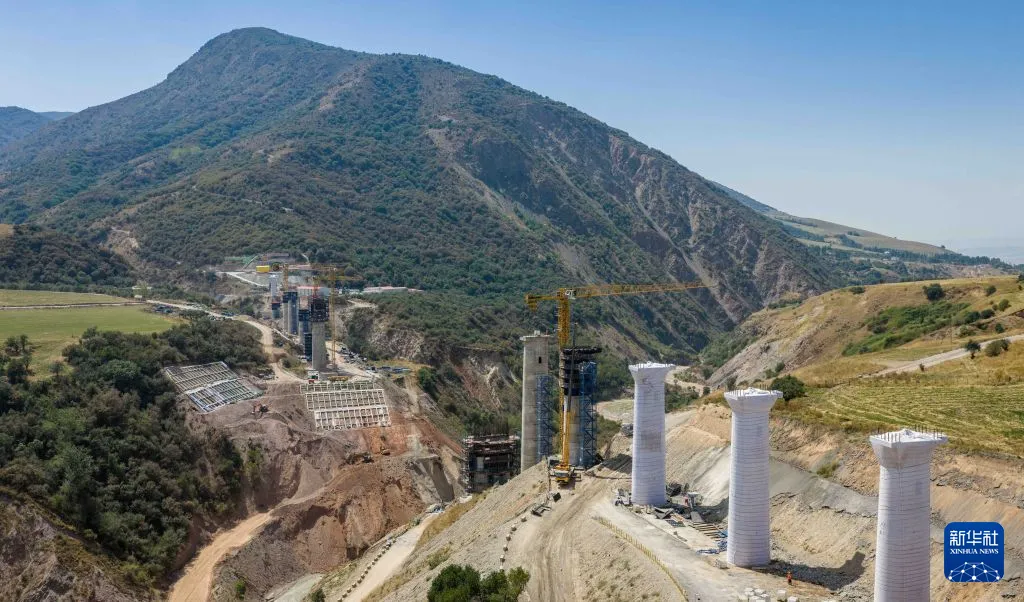
Deep in the Tien Shan mountains, the piers of the Kichi-Alket River Bridge are rising inch by inch. At 122 meters tall, equivalent to a 40-story building, the bridge sits in a Zone-8 seismic area, requiring specially formulated rebar and concrete. The main-span steel truss girders are assembled onshore and then moved across the valley using a incremental launching system—a construction method never before used in Kyrgyzstan.
This is the first detailed technical disclosure by People’s Daily on August 31, 2026.
On the same day, hundreds of kilometers away in Bishkek, Chinese and Kyrgyz leaders placed the railway at the core of their talks. The joint declaration stressed “ensuring the smooth and timely implementation of the railway project, and creating favorable and mutually beneficial conditions to secure its traffic volume and efficiency.”
From a dashed line on blueprints in 1997 to an actual bridge in the Tien Shan in 2026, the railway has taken nearly three decades.
Li Lifan, Director of the SCO Research Center at the Shanghai Academy of Social Sciences, told Guancha.cn that this railway transforms Kyrgyzstan from a “transit dead-end” into a hub linking the Fergana Valley with the Eurasian continent—”a revolutionary shift in its geographical role.”
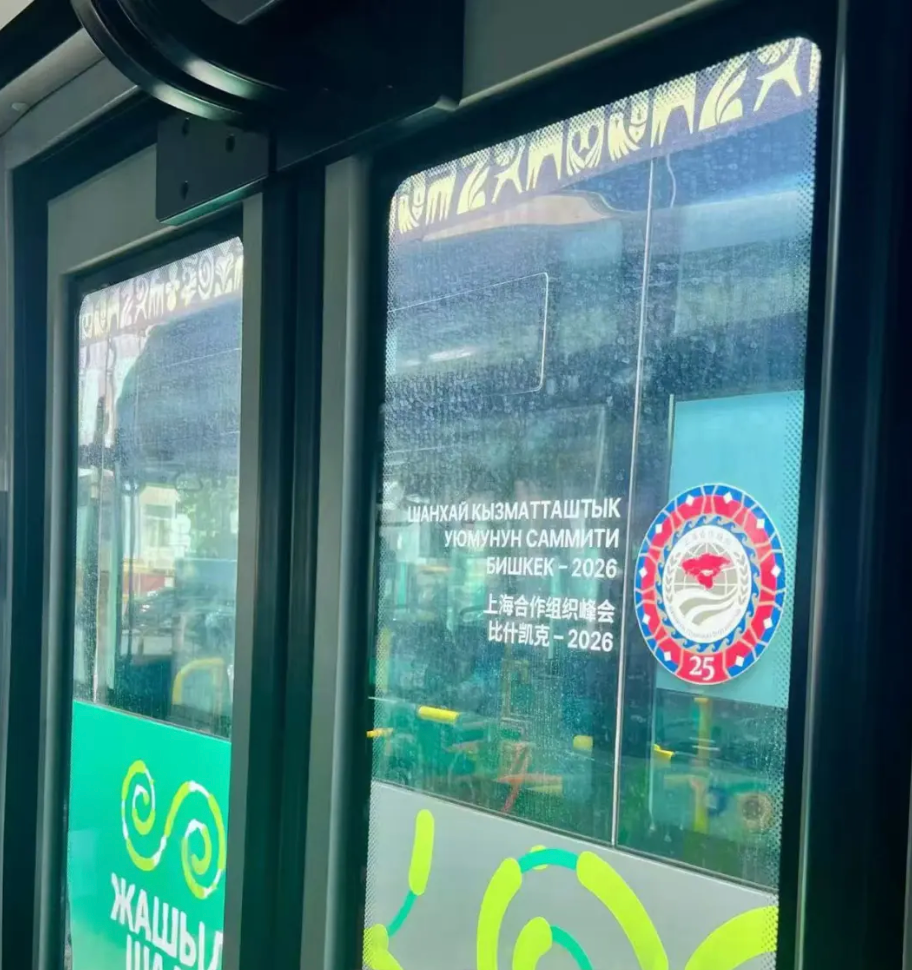
Li also noted that Russia’s stance has shifted from cautious to conditional support, that the gauge-switching solution adopts a “Lithuanian model” hybrid arrangement, and that the SCO has played a pivotal role in multilateral coordination.
The Kyrgyz Section: The Toughest Part of the Entire Line
The China-Kyrgyzstan-Uzbekistan railway starts from Kashgar in China’s Xinjiang, passes through Kyrgyzstan, goes west via Jalal-Abad, and ends at Andijan in Uzbekistan. The Kyrgyz section, at 304.84 km, accounts for nearly 60% of the total length and is a flagship Belt and Road project personally promoted by the heads of state of all three countries.
This section is the most challenging. The route crosses major mountain ranges—Moldo Too, Heylebet, and Fergana—as well as multiple river systems including the Alpa, Jamandavan, and Kichi-Alket rivers. It faces harsh environments: high altitude, severe cold, strong winds, drought, and complex geological conditions such as high seismic intensity, high in-situ stress, and permafrost. The Kyrgyz section plans to build 29 tunnels and 50 bridges, with a total bridge-tunnel length of about 120 km, accounting for nearly 40% of the line. The long tunnels through the Fergana, Naryn-1, and Koshteb areas are critical to controlling the construction schedule.
The project officially broke ground on December 27, 2024; three key tunnels began construction at end-April 2025; and the Kyrgyz section entered full-scale construction in June 2025. In December 2025, the trilateral joint-venture China-Kyrgyzstan-Uzbekistan Railway Co., Ltd. signed loan agreements with CDB and Exim Bank.
According to Chinese and Kyrgyz media, as of August 2026, the construction progress of the Kyrgyz section has for the first time presented a clear overall picture:
26 of the 29 tunnels have started, with 1 holed through; 40 of the 50 bridges are under construction; 83 of the 107 roadbed sections have entered construction. Over 10,000 construction personnel and more than 7,000 sets of machinery and equipment are on site; overall project progress is about 17%. The Koshteb North No. 2 Tunnel, 209.6 meters long, was holed through on August 5 after 87 days of work. The substructure of the Shaorbulaksai River Bridge has recently been completed.
The Kichi-Alket River Bridge best illustrates the difficulty. Kyrgyz media had previously released data on bridge length and pier height, but the Chinese report added new details: seismic-resistant design for Zone-8 intensity and the incremental launching technique. Currently, the site is still pouring remaining piers and reinforcing riverbanks; the steel truss girders have not yet been seen crossing the valley on a large scale.
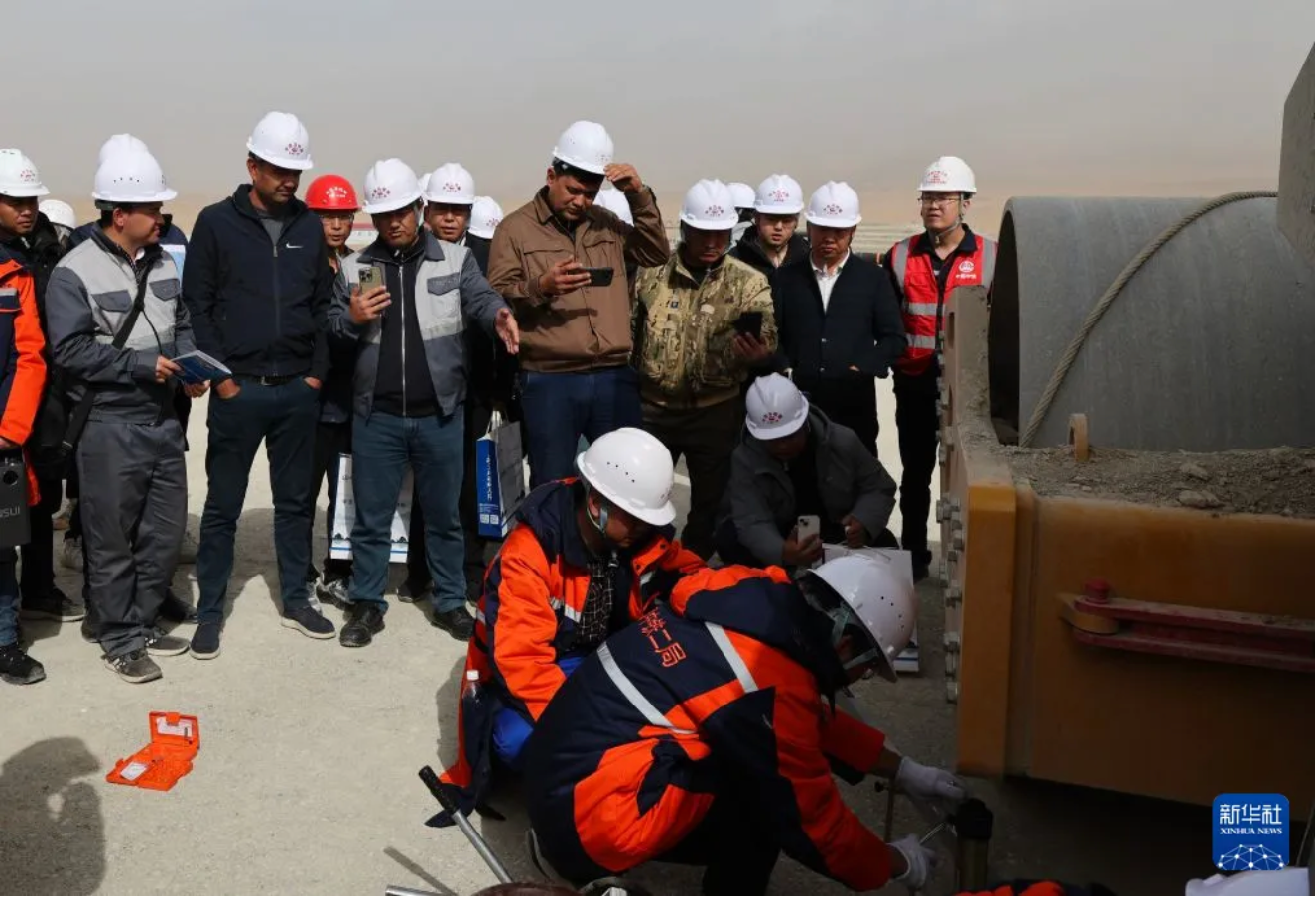
Zhuang Jiwen, head of the Infrastructure (Operations) Department of the railway company, said the project applies advanced Chinese railway construction technologies and experience, carrying out key research on high-altitude, low-temperature concrete, seismic resistance for high-intensity bridges, and snow damage prevention. Chinese railway builders operate at altitudes of 3,500 meters. More than 3,000 Kyrgyz employees have participated in construction; over 60% of main materials such as cement come from Kyrgyz domestic sources, and material and equipment leasing has exceeded 10 billion soms.
Official plans generally target commissioning between 2030 and 2031; Uzbekistan’s Deputy Minister of Transport recently expressed hope to advance it to 2028.
Kyrgyz President: Comparable to a Second “Kumtor”
Kyrgyzstan regards this railway as a game-changer for its national destiny. President Sadyr Japarov said in a national address on July 21 that the country’s railways and highways are “effectively in a transport dead end,” with imports and exports heavily dependent on external corridors. Once the railway is completed, “our country will become a transit nation” and “Kyrgyzstan will become a gateway for a major corridor between China and the world.”
He directly compared transit revenues to the Kumtor gold mine, the country’s economic icon: “Transit transport will bring Kyrgyzstan stable, long-term income comparable to what the Kumtor gold mine yields today. It can be said that this will be a second Kumtor for the country.”
In a mid-August interview, he elaborated: a gold mine will eventually be exhausted, but a railway can collect transit fees indefinitely, mentioning expected net annual revenue of about $400–500 million. On August 31, Japarov stated that China-Kyrgyz cooperation has entered a “new golden period of development,” again naming the railway as a key project to revive the ancient Silk Road and open new gateways.
“This railway will fundamentally change Kyrgyzstan—not just Kyrgyzstan, but the entire Central Asia,” said Deputy Prime Minister Edil Baisalov on August 28 to The Times of Central Asia. He believes that once completed, the railway will become part of a larger transcontinental line, cutting transport time by at least seven days compared to the northern route of the Trans-Siberian Railway or maritime shipping.
Baisalov stressed that the railway will help Kyrgyzstan increase exports of natural resources. He explained that Naryn Oblast is rich in coal, iron, aluminum, and rare earth elements, but most remain undeveloped due to the lack of efficient rail transport. “During the Soviet era, Kyrgyzstan’s mineral deposits were largely ignored, with priority given to other regions. With this railway, the country’s mountain wealth can finally be developed.”
Baisalov believes the project is not just for exporting raw materials, but will also support the construction of metallurgical plants, steel mills, aluminum plants, and other industrial facilities. “International investors are already building logistics centers and assembly facilities along the railway, using local labor. Several towns will develop along this transcontinental corridor, directly connecting European, Middle Eastern, Chinese, and Southeast Asian markets.”
Russia’s Stance Softens: Willing to Assist and Provide Support
The concept of the China-Kyrgyzstan-Uzbekistan railway dates back to 1997. Over the years, Moscow has remained cautious, particularly on the gauge standard. Central Asian rail networks have long used the 1,520 mm broad gauge inherited from the Soviet era, forming a Moscow-centered transport system. Once built, China’s 1,435 mm standard gauge will, for the first time, substantially enter the Central Asian hinterland—meaning the long-standing Russia-centric Eurasian rail network will face a structural shift.
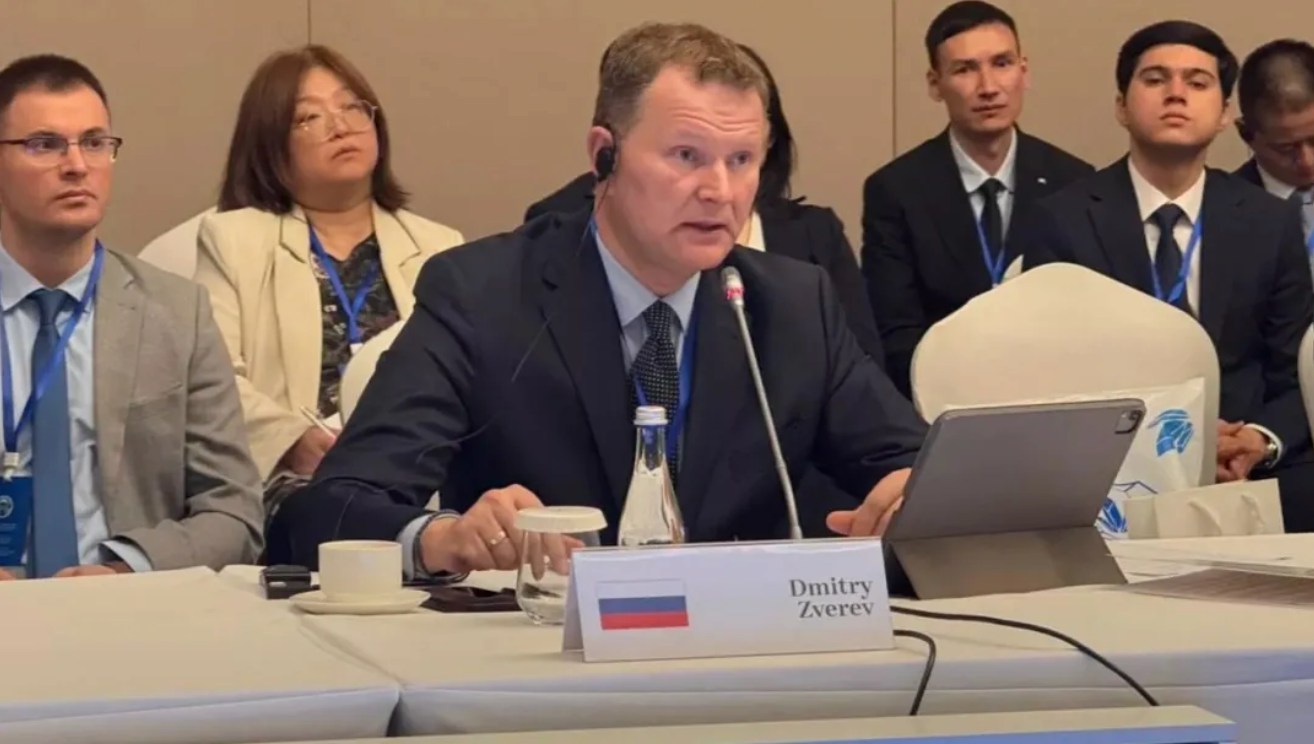
After 2022, Moscow’s strategic focus shifted, and its resource input into Central Asia was adjusted. Russia’s stance gradually opened up. In April 2026, Russian Deputy Minister of Transport Dmitry Zverev publicly stated that Russia is willing to assist in the railway’s construction, providing technical support, professional training, and rolling stock supply.
At the same time, Zverev emphasized that Kyrgyzstan, as a member of the Eurasian Economic Union, should follow the Union’s unified requirements for railway standards and technical regulations, and “would very much welcome the project choosing the 1,520 mm gauge.”
The trilateral solution is a hybrid gauge: from Kashgar via Torugart to Makmal, about 160–167 km, uses the 1,435 mm standard gauge; from Makmal to Jalal-Abad and then to Andijan uses the 1,520 mm broad gauge, with a transshipment hub at Makmal. Thus, the standard gauge extends about 160 km into Kyrgyz territory, not stopping at the border.
Li Lifan observed that Russia’s support comes with conditions: “Its core demand is to maintain influence through the gauge issue. Russia’s compromise on the gauge shows that it also needs the SCO in areas like energy and security, rather than unilaterally ‘lowering its posture’.” He summarized the Makmal transshipment as “a second practice of the Lithuanian model in Central Asia”—two gauges meet in the hinterland of a third country, rather than being cut off at the border.
Li said, “Russia’s shift highlights the SCO’s coordinating role—the SCO provides a multilateral platform acceptable to all parties.”
If Russia has “turned around,” Kazakhstan is “watching from the sidelines.” The railway bypasses Kazakhstan entirely, shortening the China-to-Middle East/Southern Europe route by about 900 km and saving 7–8 days of transit time. Kazakhstan fears that the new line will divert overland freight orders from the China-Europe rail route, weakening its transit hub status.
That anxiety has translated into action. Kazakhstan launched a domestic railway upgrade program and sought EU loans to purchase rolling stock. In April 2026, the Kazakh Prime Minister publicly noted insufficient equipment and manpower input on the Bakty–Ayagoz railway line. But the inherent shortcomings—longer distances and more transshipment steps—cannot be fixed by upgrades alone.
Li Lifan said Kazakhstan has also hinted at possible peripheral participation in the CKU railway, such as in telecommunications and infrastructure—i.e., limited involvement.
SCO Coordination and Technology Transfer
The railway’s progress has been achieved through multi-tiered institutional design within the SCO framework, covering gauge coordination, financing arrangements, and security cooperation. The SCO Transport Ministers’ Meeting on April 23, 2026, was precisely the key occasion for Russia’s public endorsement. It was also through the SCO that all parties sat at the same table on core issues such as gauge and financing.
But diplomatic dialogue is one thing; actually building and operating a railway through the high-intensity seismic mountains of the Tien Shan is another—especially the safety assurance of the tunnel complex, which requires not just political consensus but also an executable collaborative mechanism.
Can the SCO framework provide operational security collaboration for such cross-border controlling projects? Li Lifan’s judgment was blunt: “The answer is yes—the SCO provides a critical platform, but implementation relies on multilateral cooperation. A public security cooperation mechanism is the basic principle for safeguarding this railway.”
He specifically noted the power supply and communication security for trains traversing tens of kilometers of tunnels—”this also holds appeal for Kazakhstan, even though it is not on this railway section.” The SCO has existing experience in intelligence sharing and joint counter-terrorism, serving as a top-level platform; neighboring countries can participate in a “second-tier” manner, but specific cross-border disaster early warning and emergency coordination must still be executed by China, Kyrgyzstan, Uzbekistan, and the project company. “Railway safety cannot be left only in summit communiqués.”
The seismic-resistant materials and launching technique disclosed by Xi Jihong, Chief Engineer of the railway’s design-procurement-construction project department, are specific examples of “Chinese standards” entering Kyrgyz railway construction. Li Lifan believes that, in the short term, all parties will deepen path dependence—after all, from design standards, construction methods, to equipment maintenance, the entire chain adopts the Chinese system, so subsequent operations, maintenance, and upgrades will naturally continue with these standards. That is an objective fact.
Li Lifan told Guancha.cn that another aspect deserves more attention: the railway itself enhances Kyrgyzstan’s and Uzbekistan’s transit autonomy. Previously, Kyrgyz imports and exports had to pass through Kazakhstan’s rail network—no alternative. After the CKU railway opens, it will have its own east-west export corridor, turning from a “landlocked” to a “land-linked” country.
Uzbekistan, as a doubly landlocked country, gains an additional sea-access route without passing through a third country. In this sense, technology embedding ultimately empowers—it accelerates the modernization of both countries’ transport systems and raises their bargaining power in the international logistics chain.
In the long run, this “empowerment effect” will outweigh the “dependency effect.”
The United States is increasing its engagement in Central Asia through C5+1, critical minerals, and AI cooperation. Li Lifan views the SCO as a buffer, not a megaphone: “The SCO is a buffer that de-conflicts and de-sensitizes. It can turn bilateral projects into multilateral ones, buffering sensitive interpretations of the ‘China label’.”
In his view, the SCO will not cement the misinterpretation of being a “Chinese tool,” but rather an open-source radiation of Chinese technology in Eurasia. “The West will certainly distort and criticize, but the SCO’s resolve will not change.”
Editor: Zhao Yiwen