




In late June, the latest issue of the world-class medical journal Nature Medicine published the latest achievement of Chinese scientists — GRAPE, a gastric cancer screening AI model jointly developed by Zhejiang Cancer Hospital and Alibaba DAMO Academy. Using only standard non-contrast abdominal CT scans, it enables large-scale screening for gastric cancer, particularly early-stage gastric cancer.
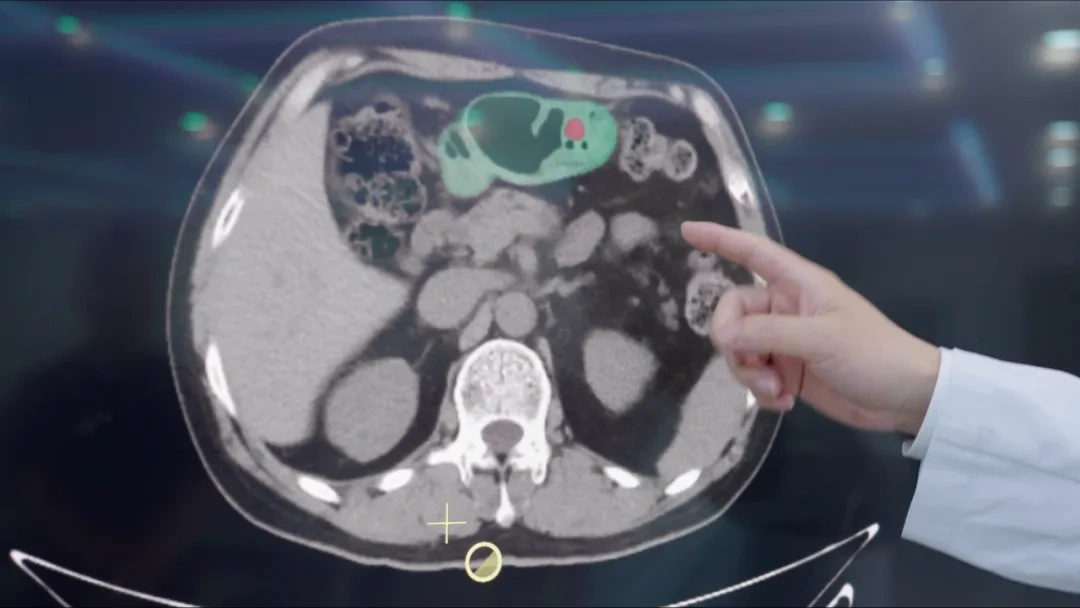
“We reviewed all the CT images of a gastric cancer patient taken before diagnosis and found that the AI model could issue a warning six months before symptoms became apparent,” said Dr. Hu Can from the Department of Gastric Surgery at Zhejiang Cancer Hospital. In April 2024, the patient sought medical attention for symptoms of “food obstruction” and was diagnosed with gastric cancer through gastroscopy, by which point the condition had already worsened. In hindsight, in October 2023, the patient had undergone a non-contrast CT scan to check for pulmonary nodules. When Dr. Hu imported this older scan into the AI model, the gastric region was flagged as “high risk for gastric cancer.”
This case is not an isolated one. Retrospective studies conducted by Dr. Hu’s team on multiple gastric cancer patients have all shown that the AI model can keenly detect subtle changes—such as thickening of the stomach wall—that human readers might easily overlook when identifying similar early-stage lesion features. Dr. Hu noted that because CT resolution is relatively low, it has never previously been used as a routine method for gastric cancer screening. Without AI assistance, even highly experienced radiologists would find it extremely difficult to spot the subtle lesion features related to early-stage gastric cancer in non-targeted areas on a non-contrast CT scan.
What makes a large AI model different? “We fed both non-contrast CT and contrast-enhanced CT data into the AI, and used an image registration algorithm to let the AI ‘piece together’ the scans—perfectly aligning the enhanced and non-contrast CT images of the same patient in three-dimensional space. This way, the AI can mark the exact location of tumors on the otherwise blurry non-contrast CT images,” explained Dr. Xia Yingda, Senior Algorithm Expert at the Medical AI Lab of Alibaba DAMO Academy. “Although the human eye cannot distinguish differences between these CT images, the AI can. After being trained repeatedly on thousands of data sets, the AI becomes adept at recognizing subtle patterns that are imperceptible to humans.”
In fact, this is not DAMO Academy’s first attempt at developing a cancer screening model. In 2023, DAMO Academy, together with multiple medical institutions worldwide, released DAMO PANDA, an AI model for pancreatic cancer screening. The “well-trained” PANDA also focuses on subtle density differences in non-contrast CT scans—those lesion signals less than 0.5 cm in diameter that are easily overlooked in conventional image reading but serve as important clues to early-stage lesions in the eyes of AI.
As of March 2025, Ningbo University Affiliated People’s Hospital in Zhejiang Province had used the model to screen more than 40,000 people. The AI successfully identified two cases of early-stage pancreatic cancer that were missed in routine examinations, one of which had a lesion measuring only 1.5 cm.
With AI, early cancer screening can achieve breakthroughs in both cost and efficiency. Combining non-contrast CT scans with AI analysis can keep the cost of a single examination between 200 and 300 yuan—only about one-third of the price of a traditional contrast-enhanced CT. AI can complete the analysis of a single CT scan in 30 seconds, a task that could take a radiologist four hours.
However, scientists at DAMO Academy note that such single-cancer early screening is only the starting point. “Our next step is ‘one scan, multiple screenings,’” said Xia Yingda, envisioning a future where a single CT scan during a health check could screen for multiple high-incidence cancers—such as pancreatic, gastric, liver, and colorectal cancer—as well as chronic diseases like fatty liver and osteoporosis, all for roughly the cost of a meal.
At present, AI-assisted cancer screening technologies developed in China have already gone global, serving multiple low- and middle-income countries. Statistics show that 70% of cancer deaths occur in such countries. For example, Wuhan Landing Medical’s AI-powered cloud diagnosis platform for cervical cancer screening has been introduced in Brazil, increasing local laboratories’ positive detection rate by more than 40%, allowing more women to benefit from accurate and efficient early screening. Likewise, equipment from Shanghai United Imaging Healthcare is aiding early breast cancer screening in Morocco, helping improve the country’s cancer incidence and survival rates.
Harnessing the power of AI to shift cancer screening from “treating the sick” to “preventing illness” is a hope that is increasingly illuminating our daily lives.
Editor: Zhiyu Wang
Note: This is an edited version of an original article written in Chinese, available at:

Othman Hassan Majid
I like the emphasis on preventative medicine. This an AI super use.