


Flying Cars Are Expensive. Could China Help?
As part of China’s 15th Five-Year Plan for 2026 to 2030, the low-altitude economy has been officially designated a strategic pillar industry. And at the center of that strategy? Flying cars or as they’re formally known, eVTOLs: electric vertical take-off and landing aircraft.
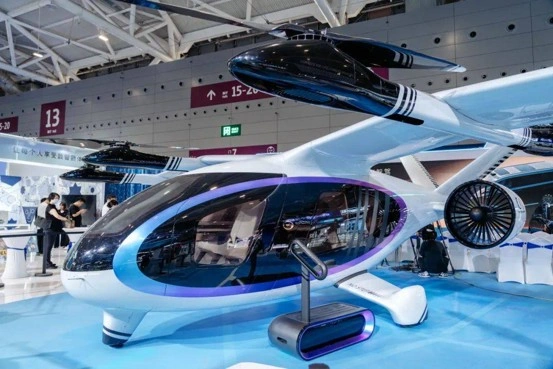
These are no longer concepts on a drawing board. In Guangzhou, a smart manufacturing base combining automotive efficiency with aviation standards has begun operations— with an annual design capacity of 100 units, producing a multi-rotor flying car capable of vertical take-off and landing. In Chengdu, a six-seat pure-electric flying car designed for urban three-dimensional transport is undergoing airworthiness certification. It uses a tilt-rotor design, reaches a maximum speed of 230 kilometers per hour, and has already completed its first phase of production-model test flights.
What’s driving all of this? Several forces converging at once. Policy is the accelerant — “low-altitude economy” is now a national strategy, pushing everything from airspace management reform to infrastructure buildout. Technology has matured — battery energy density, lightweight materials, and autonomous flight control have all made significant advances in recent years. And the cost curve is bending — scaled production is starting to bring unit prices down.
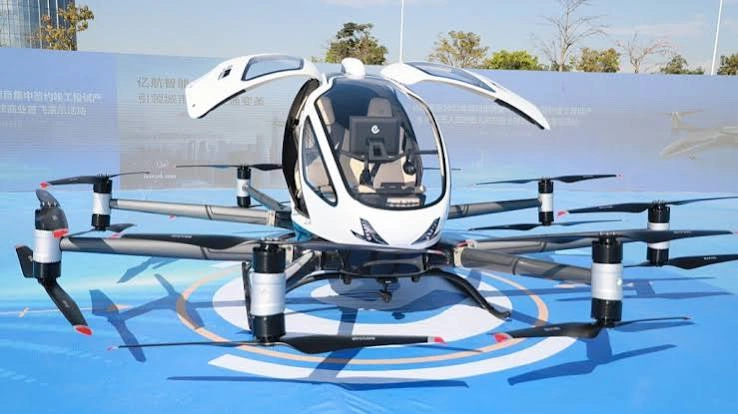
And it’s not just prototypes. The EH216 — China’s first manned autonomous flying car to receive airworthiness certification — is already in commercial trial operation in Hefei, serving aerial sightseeing routes, with its flight base now running multiple flights per day.
How big could this get? A widely cited projection puts the low-altitude economy on a path toward a 10 trillion yuan industry cluster. For comparison: China’s electric vehicle sector — arguably the most successful manufacturing story of the past decade — had a total industry chain output of around 6 trillion yuan in 2025. We may be looking at a track that surpasses even that.
Of course, major hurdles remain. Before eVTOLs become a daily commuting option, manufacturers need to clear three separate airworthiness certifications. And public acceptance is its own challenge — flying over city traffic in a battery-powered aircraft isn’t just a technological leap. It’s a psychological one.
But the fundamental judgment stands: this is not speculative fantasy. This is an early-stage industry reality.