



Artificial intelligence robots are finally getting down to real business——moving from racetracks and boxing rings into operating rooms.
In a paper published in Science Robotics in July, researchers at the Chinese University of Hong Kong (CUHK) reported that AI-powered surgical robots acted as assistants to surgeons during a stomach-removal procedure on a pig — the world’s first multitask surgical automation tests on a live animal.
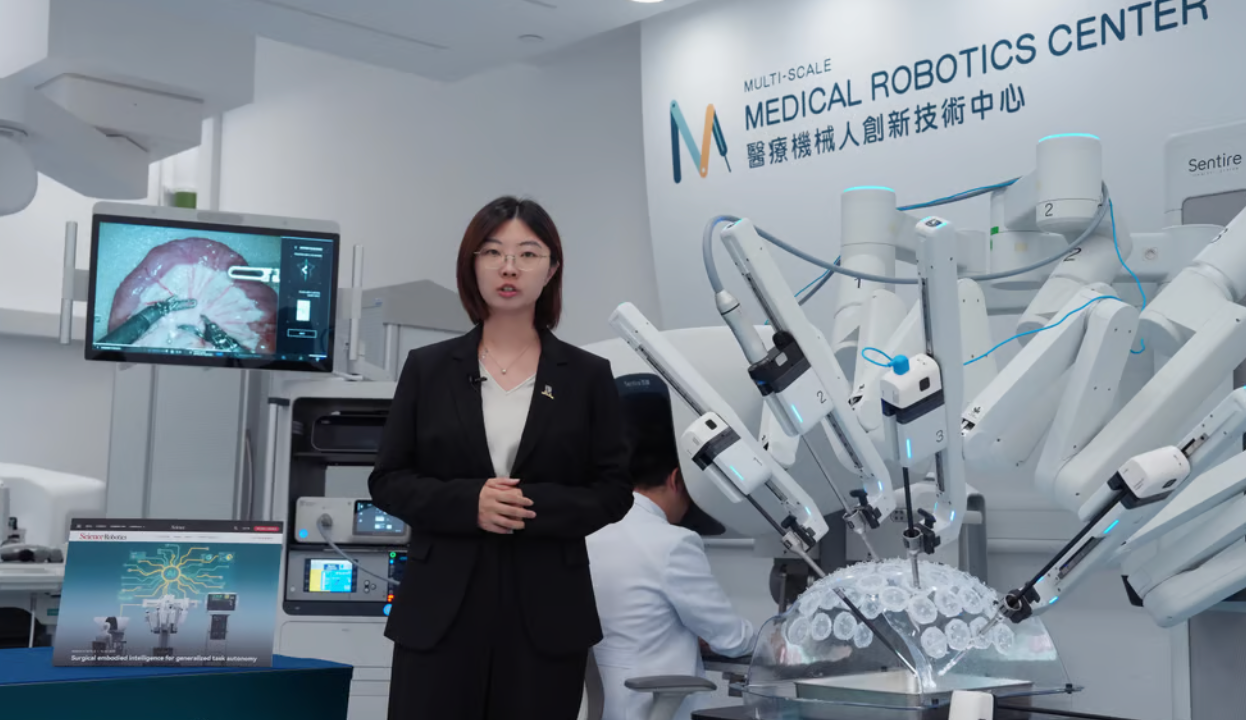 Dou Qi of CUHK’s computer sciences and engineering department led the research paper.
In this operation, the AI system developed by the CUHK team was able to autonomously control a robotic arm to help surgeons with routine auxiliary tasks such as retracting tissue, picking up gauze, and clipping blood vessels.
The AI-driven robotic arm served as the surgeon’s “third hand,” while the surgeon operated the other two robotic arms from a console, watching live endoscopic footage throughout the procedure.
CUHK’s AI system could analyze endoscopic images in real time, interpret the surgical scene, and anticipate the surgeon’s needs. This allowed the surgeon to save time by not having to switch controls to the third arm.
During the stomach-detachment procedure, one of the automated tasks for the AI robot was to pick up gauze placed near the pig’s stomach, succeeding in five out of six attempts.
The most challenging task was vessel clipping, due to the variable appearance of blood vessels and the high precision required. The robot successfully completed four out of six clipping attempts. The research team wrote: “The surgeon first dissected the surrounding tissue and stabilized the pig’s right gastroepiploic artery using two instruments, after which the robotic arm autonomously placed a clip across the vessel under close human monitoring.” They added that respiratory movement caused dynamic changes in the surrounding tissue, complicating localization and planning, and that even slight inaccuracies could result in failure. Thus, AI robots still have much to learn.
The AI system was tested on a surgical platform developed by Cornerstone Robotics, a start-up founded by CUHK professor Samuel Au Kwok-wai. According to the company, the original system without AI integration has already been used in over 300 surgeries and more than 100 clinical training sessions in mainland China.
Study co-author Yip Hon-chi of CUHK, who led the animal experiments, said: “The surgeon is still fully in charge, just like a driver, and can immediately take over if the AI malfunctions.” He added: “The AI robotic arm is like my assistant. Normally, I need to free up my hand to control the ‘extra’ arm during surgery, but the AI system could potentially help me control the arms according to my needs. What interests me most is whether the AI could be further ‘trained’ as more data are input into the system. Future surgeons may have an easier job as AI takes over part of the procedure and greatly assists the operation.”
In the same issue of Science Robotics, another team from Johns Hopkins University in the United States also published results on AI surgical robots: their robot was able to independently perform a phase of gallbladder removal surgery without human assistance. The team said: “The robot had to precisely identify and grasp specific ducts and arteries, strategically place clips, and cut tissue with scissors. After watching videos of surgeons performing the procedure on pig cadavers, the robot achieved 100 per cent accuracy.”
CUHK researcher Dou Qi said she is in contact with the Johns Hopkins team to jointly promote the international development of AI-powered surgical robots. The CUHK team is also pushing for open-sourcing, hoping more scientists will join in and that the embodied AI software infrastructure for surgery will be freely accessible to researchers worldwide.
As the CUHK team wrote in their paper: “The trend of an ageing population further brings growing clinical demand, placing increasing pressure on surgeons who must treat more patients. Next-generation surgical robots are expected to move toward autonomy, improving operational efficiency, consistency, and human productivity.”
Editor: Zhongxiaowen


Raymond Li
Not to be confused with “pig butchering” scamming! 🐖