


China Reclaims the Global Lead in Supercomputing
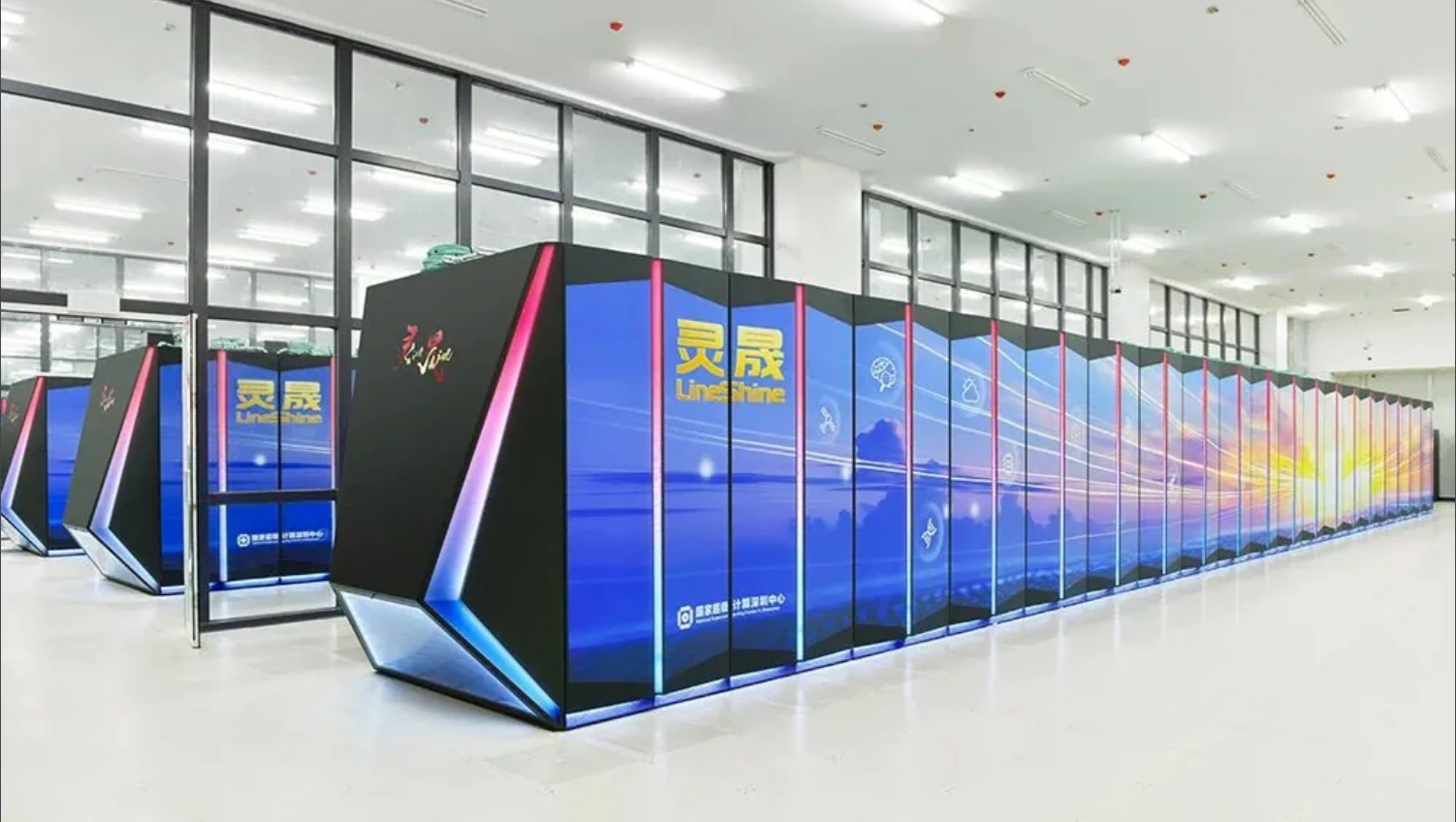
On June 23, the 2026 International Supercomputing Conference held in Hamburg, Germany, unveiled the latest Global Top500 Supercomputer List. Lineshine, a fully domestically developed supercomputer deployed at the National Supercomputing Center in Guangming Science City, Shenzhen, China, claimed the number one global ranking. After a nine-year hiatus, China’s supercomputers have once again secured the world’s top position.
As a major national science and technology infrastructure facility within Guangming Science City, the commissioning and operation of Lineshine delivers robust computing power to support major scientific and technological breakthroughs as well as cutting-edge interdisciplinary research across the Guangdong-Hong Kong-Macao Greater Bay Area.
Lineshine is the world’s first supercomputer system to sustain a performance exceeding 2 EFLOPS (one quintillion floating-point operations per second), with a measured sustained performance of 2.198 EFLOPS. To put this computing capacity into perspective: if 7 billion people each performed one calculation per second nonstop around the clock, it would take nearly a decade to match the computational throughput of Lineshine.
The period spanning from 2015 to the present marks a transformative era for China’s supercomputing industry.
During this timeframe, China’s supercomputing sector completed two pivotal shifts: first, transitioning from reliance on foreign chips to full indigenous controllability; second, shifting its core focus from raw computational speed (HPL benchmark performance) to practical application deployment, highlighted by landmark wins of the Gordon Bell Prize. Following years of low-profile technological advancement, China reclaimed the global supercomputing championship in June 2026.
Prior to 2015, Tianhe-2, China’s former consecutive world-leading supercomputer, ran on Intel Xeon processors. In April 2015, the U.S. government imposed a chip embargo targeting China’s four national supercomputing centers. Rather than stalling progress, this technological sanction accelerated China’s push for full self-reliance in supercomputing hardware.
June 2016 – November 2017: Four Consecutive Terms as Global Top Performer
Located at the National Supercomputing Center in Wuxi, the Sunway TaihuLight achieved a historic milestone as the first Chinese supercomputer equipped with entirely homegrown processors. Powered by the independently developed SW26010 many-core processor, it eliminated all reliance on U.S.-manufactured chips.
•Peak performance: 125 petaFLOPS (12.5 quadrillion floating-point operations per second)
•Sustained performance: 93 petaFLOPS (9.3 quadrillion floating-point operations per second)
In 2016, Chinese research teams received the Gordon Bell Prize—the highest honor in high-performance computing—for two projects: multi-million-core chemical simulation and a global atmospheric dynamics solver. This victory broke a 30-year monopoly on the award by Western research groups.
In 2017, Chinese teams retained the Gordon Bell Prize with their work on nonlinear seismic simulation.
Against a backdrop of escalating geopolitical tensions and technology export controls, China’s supercomputing research entered a phase of restrained, low-key development in the subsequent years.
Although China rolled out successive generations of exascale supercomputers, including follow-up iterations of the next-generation Sunway system and Tianhe-3 prototypes, national authorities and supercomputing operators opted to stop submitting benchmark test results to the international Top500 consortium voluntarily.
2018 – 2025: U.S. Systems Dominate the Top 500 Summit
For nearly eight years, the number-one ranking on the Top 500 list was held by U.S. supercomputing systems, including Frontier at Oak Ridge National Laboratory and El Capitan at Lawrence Livermore National Laboratory.
While absent from the top of the global leaderboard, China’s supercomputing applications expanded dramatically throughout this period, covering weather forecasting, genetic engineering, disaster prevention and mitigation, industrial manufacturing simulation, and large-scale artificial intelligence model training. National supercomputing hubs across Tianjin, Shenzhen, Changsha, Wuxi, Jinan and other cities underwent multiple rounds of hardware upgrades.
June 23, 2026: Lineshine Claims the Global Crown at the 67th Top 500 Release
•System Name: Lineshine
•Deployment Site: National Supercomputing Center, Shenzhen
•Performance Benchmark: Measured HPL computing speed of 2.198 EFLOPS (219.8 quintillion calculations per second), surpassing the previous global leader El Capitan (1.809 EFLOPS) by more than 20%.
Looking back on China’s supercomputing evolution from Tianhe-2 to Sunway TaihuLight, Chinese systems long occupied the world’s top rankings.
Circumstances shifted drastically around 2015 amid external technological restrictions. Undeterred by these challenges, China sustained iterative refinement across scientific research, engineering implementation, industrial deployment and AI computing scenarios. Through sustained long-term investment and persistent technological breakthroughs, the country forged an entirely self-reliant, secure, and sustainably upgradable supercomputing technology roadmap.
Supercomputing constitutes an extraordinarily complex system engineering discipline, where gaps in any single component—from chips, high-speed interconnection networks and storage systems to system software and application ecosystems—degrade overall system performance. Lineshine’s ascent to global supremacy stems not from isolated single-component upgrades, but from systematic cross-layer innovation. Built upon a full stack of domestically developed hardware and software, the platform delivers end-to-end indigenous controllability spanning core chips, high-speed interconnects, system-level software, energy-efficient green operation, and coordinated application support.
Full-stack indigenous development delivers dual core advantages: robust cybersecurity and technological sovereignty, granting China full autonomy over iterative supercomputing upgrades and the authority to define industry technical standards.
One of the most formidable hurdles during Lineshine’s development centered on technology route selection and large-scale system engineering realization. After multiple rounds of technical evaluation and repeated verification, the R&D team pioneered an all-CPU integrated superintelligent fusion architecture—a deliberate strategic choice rather than a makeshift substitute for foreign hardware. Conventional heterogeneous CPU-GPU architectures, while capable of high peak performance, suffer from severe data transfer overhead, cumbersome programming workflows, and prohibitive costs for migrating legacy applications. Lineshine embeds native matrix acceleration units directly within its CPUs to deliver built-in high-throughput computing capabilities. Paired with domestically manufactured high-bandwidth memory, proprietary high-speed interconnection fabrics, and a complete indigenous software stack, the platform achieves deep architectural integration of traditional high-performance computing and artificial intelligence computing.
This differentiated technological pathway not only attains world-record peak performance but also establishes an innovative new paradigm for next-generation superintelligent fusion computing platforms, representing a landmark original innovation from China tailored to the era of scientific artificial intelligence.
Supercomputing forms the foundational bedrock of national scientific and technological innovation, serving as a critical strategic resource empowering fundamental research, engineering breakthroughs, and industrial transformation. After decades of cumulative progress, China’s supercomputing industry has advanced from following international leaders to running parallel, and now to setting the global pace, entering a new phase centered on innovative superintelligent fusion architecture. The nation is steadily translating its computing power advantages into tangible scientific discoveries, engineering leaps, and industrial innovation productivity.
As a fully indigenous integrated computing infrastructure built for scientific research, engineering simulation and artificial intelligence workloads, Lineshine leverages Shenzhen’s complete industrial supply chain and abundant cutting-edge research resources within Guangming Science City to precisely address demand from fundamental research and industrial innovation. Since deployment, the system has supported world-class research outcomes across atmospheric and oceanic modeling, engineering simulation, materials science, pharmaceutical discovery, and large language model inference. Though supercomputers may seem distant from everyday life, their impact permeates all facets of society: delivering more precise weather forecasting, accelerating novel drug development, enabling more reliable engineering design, and powering smarter industrial services, reshaping daily life across food, clothing, housing and transportation.
Lineshine’s global number-one ranking marks a pivotal milestone, yet it also represents a fresh starting point for advancing even higher levels of indigenous innovation. Moving forward, research teams will continue to deepen supercomputing technological innovation and ecosystem cultivation, optimize integrated software suites and service environments for cross-domain superintelligent fusion workloads, refine compatibility frameworks for domestic supercomputing hardware and software, and fully unlock the transformative value of supercomputing for scientific research, industrial upgrading and public welfare.
Editor: Grace